Cardiovascular system L 9 Faisal I Mohammed MD


- Slides: 15
Cardiovascular system- L 9 Faisal I. Mohammed, MD, Ph. D Yanal A. Shafagoj MD, Ph. D University of Jordan 1
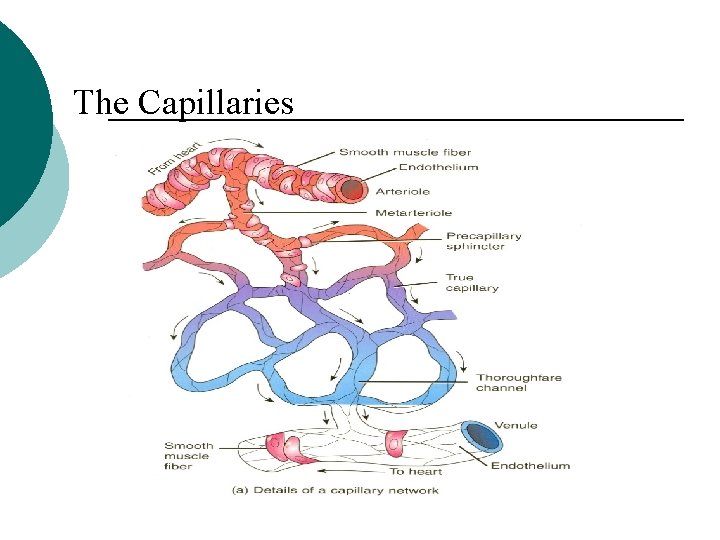
The Capillaries
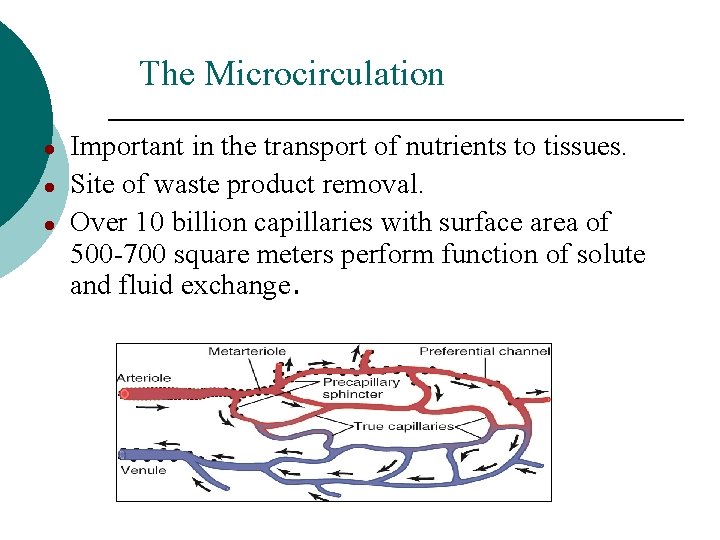
The Microcirculation ● ● ● Important in the transport of nutrients to tissues. Site of waste product removal. Over 10 billion capillaries with surface area of 500 -700 square meters perform function of solute and fluid exchange.
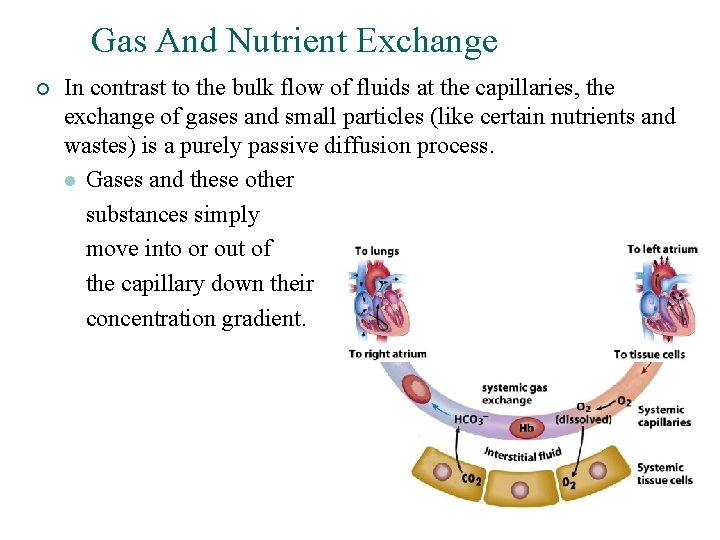
Diffusion l l Most important method Substances move down their concentration gradient ¡ O 2 and nutrients from blood to interstitial fluid to body cells ¡ CO 2 and wastes move from body cells to interstitial fluid to blood
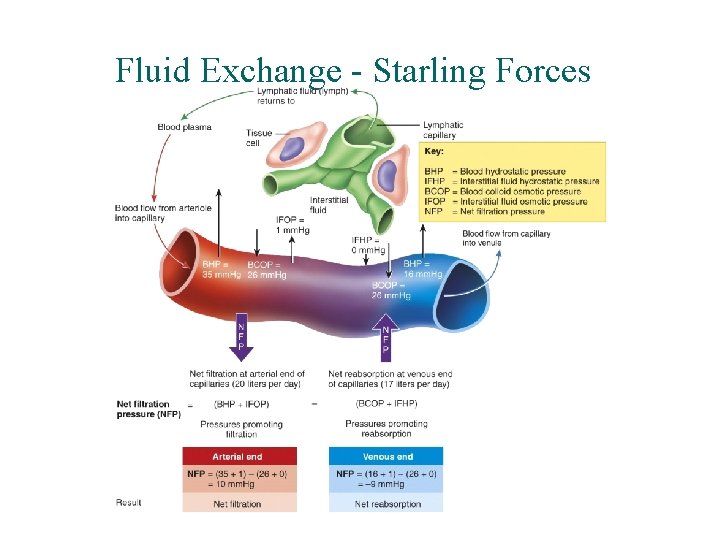
Fluid Exchange - Starling Forces ¡ As blood flows to the tissues of the body, hydrostatic and osmotic forces at the capillaries determine how much fluid leaves the arterial end of the capillary and how much is then reabsorbed at the venous end. These are called Starling Forces. l l Filtration is the movement of fluid through the walls of the capillary into the interstitial fluid. Reabsorption is the movement of fluid from the interstitial fluid back into the capillary.
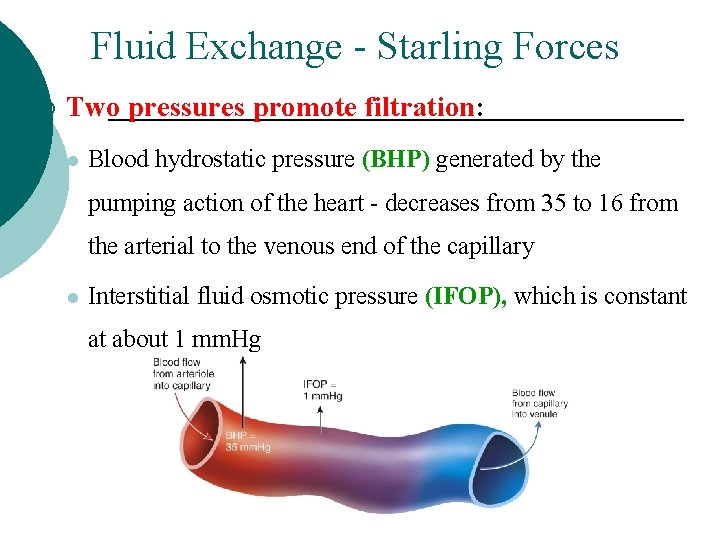
Fluid Exchange - Starling Forces ¡ Two pressures promote filtration: l Blood hydrostatic pressure (BHP) generated by the pumping action of the heart - decreases from 35 to 16 from the arterial to the venous end of the capillary l Interstitial fluid osmotic pressure (IFOP), which is constant at about 1 mm. Hg
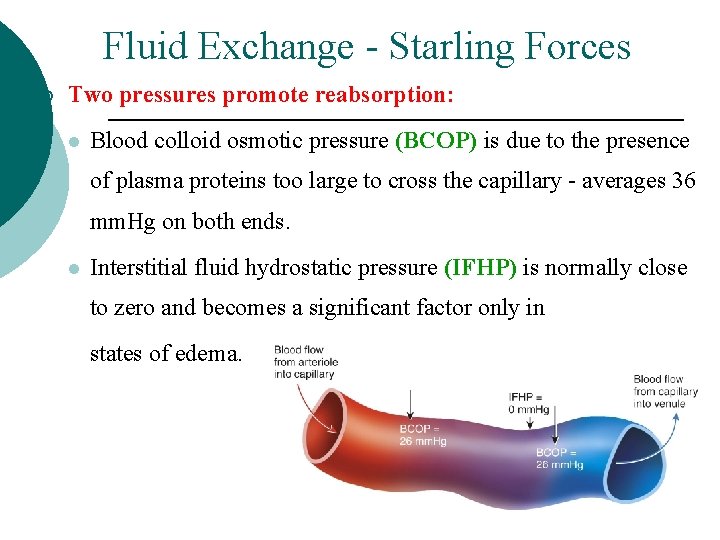
Fluid Exchange - Starling Forces ¡ Two pressures promote reabsorption: l Blood colloid osmotic pressure (BCOP) is due to the presence of plasma proteins too large to cross the capillary - averages 36 mm. Hg on both ends. l Interstitial fluid hydrostatic pressure (IFHP) is normally close to zero and becomes a significant factor only in states of edema.
Fluid Exchange - Starling Forces
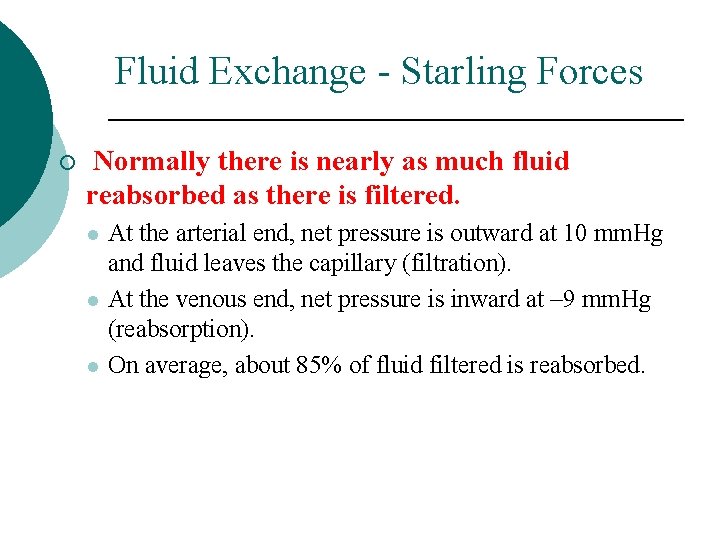
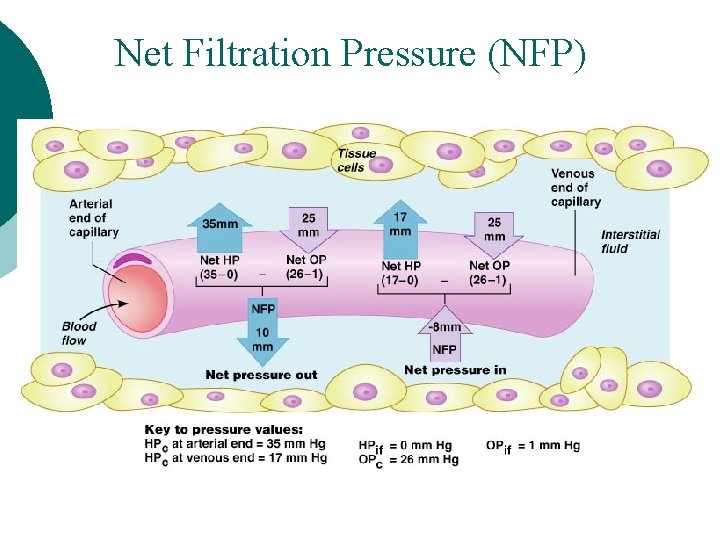
Fluid Exchange - Starling Forces ¡ Normally there is nearly as much fluid reabsorbed as there is filtered. l l l At the arterial end, net pressure is outward at 10 mm. Hg and fluid leaves the capillary (filtration). At the venous end, net pressure is inward at – 9 mm. Hg (reabsorption). On average, about 85% of fluid filtered is reabsorbed.
Fluid Exchange - Starling Forces ¡ Fluid that is not reabsorbed (about 3 L/ day for the entire body) enters the lymphatic vessels to be eventually returned to the blood.
Net Filtration Pressure (NFP)
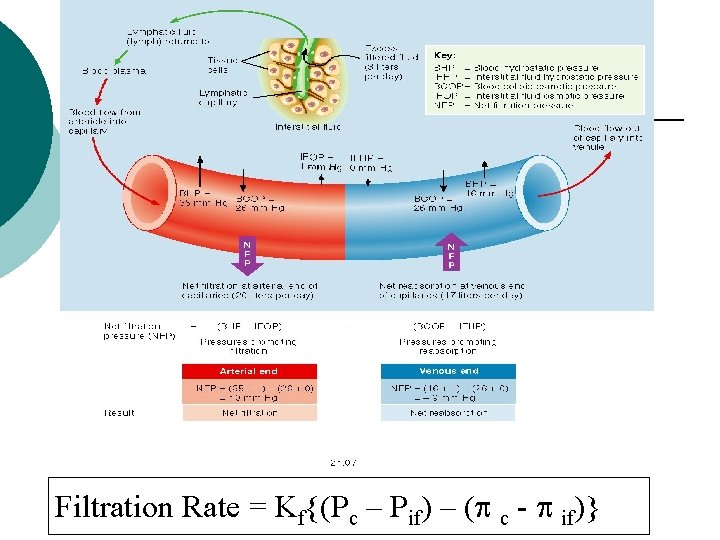
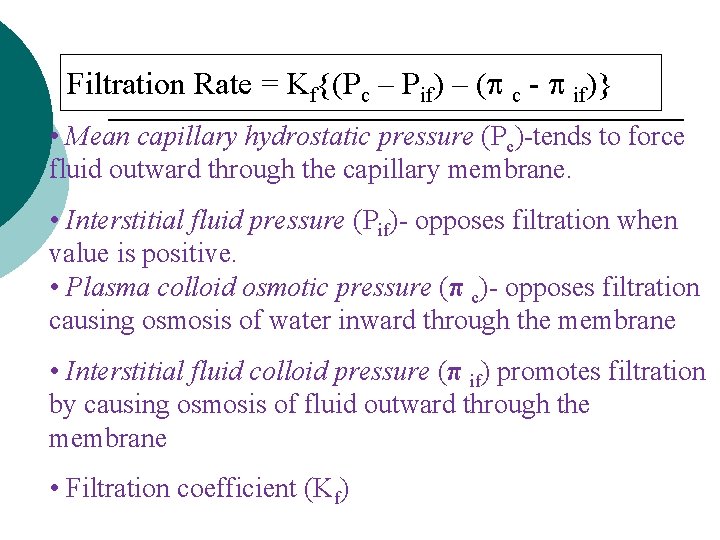
Filtration Rate = Kf{(Pc – Pif) – ( c - if)}
Filtration Rate = Kf{(Pc – Pif) – ( c - if)} • Mean capillary hydrostatic pressure (Pc)-tends to force fluid outward through the capillary membrane. • Interstitial fluid pressure (Pif)- opposes filtration when value is positive. • Plasma colloid osmotic pressure (π c)- opposes filtration causing osmosis of water inward through the membrane • Interstitial fluid colloid pressure (π if) promotes filtration by causing osmosis of fluid outward through the membrane • Filtration coefficient (Kf)
Gas And Nutrient Exchange ¡ In contrast to the bulk flow of fluids at the capillaries, the exchange of gases and small particles (like certain nutrients and wastes) is a purely passive diffusion process. l Gases and these other substances simply move into or out of the capillary down their concentration gradient.
Thank You 15