Autonomic Nervous System Dr Dileep Verma Associate Professor


- Slides: 39
Autonomic Nervous System Dr Dileep Verma Associate Professor Deptt of Physiology KGMU
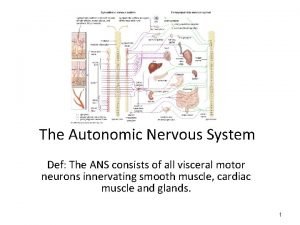
Lecture-5 : Topics Functions of ANS Effect of Sympathetic & Parasympathetic stimulation Overall difference between 2 divisions of ANS Applied -Autonomic failure -Horner’s syndrome
Learning Objectives Effects of sympathetic and parasympathetic neurotransmitters on target organs and tissues. Common functions disorders of autonomic
Sympathetic Effects Fight, Fright or flight response Release of Neurotransmitters (NT)ØNorepinephrine (NT) from postganglionic fibers ØEpinephrine (NT) from adrenal medulla
Sympathetic Effects Mass activation prepares for intense activity ØHeart rate (HR) increases ØBronchioles dilate ØBlood [glucose] increases
Sympathetic Effects GI motility decreases Contraction of sphincters Relaxation of ØDetrusor muscle ØCiliary muscle Mydriasis
Parasympathetic Effects Normally not activated as a whole ØStimulation of separate parasympathetic nerves. Release ACh as NT Relaxing effectsØDecreases HR. ØDilates visceral blood vessels. ØIncreases digestive activity.
Parasympathetic Effects Bronchonstriction GI motility increases Relaxation of sphincters Contraction of ØDetrusor muscle ØCiliary muscle Miosis
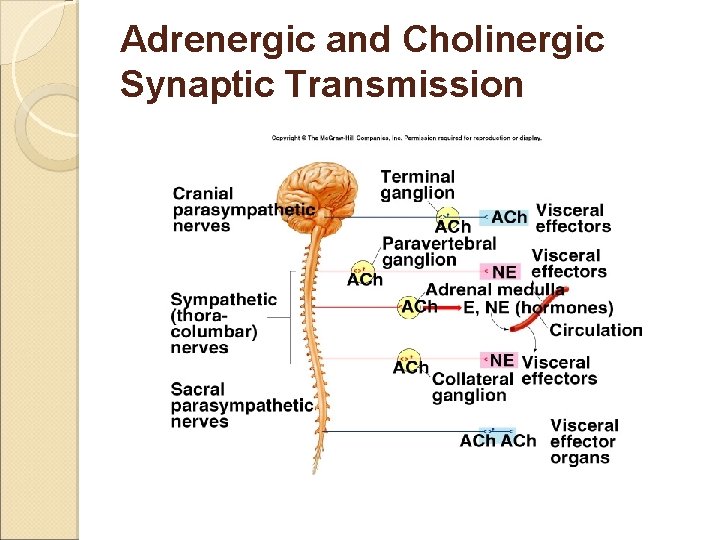
Adrenergic and Cholinergic Synaptic Transmission ACh is NT for all preganglionic ØSympathetic fibers ØParasympathetic fibers Transmission at these synapses is termed cholinergic All preganglionic fibers terminate in autonomic ganglia
Adrenergic and Cholinergic Synaptic Transmission • ACh is NT released by ØMost postganglionic parasympathetic fibers ØSome postganglionic sympathetic fibers • Postganglionic autonomic fibers innervate the target tissue
Adrenergic and Cholinergic Synaptic Transmission
Adrenergic Synaptic Transmission (continued) Transmission at these synapses is called adrenergic: ØNorepinephrine vreleased by most postganglionic sympathetic nerve fibers. ØEpinephrine, vreleased by the adrenal medulla Collectively called Catecholamines
Responses to Adrenergic Stimulation Beta adrenergic receptors: ØProduce their effects by stimulating production of c. AMP ØNE binds to receptor ØG-protein dissociates into va subunit or vbg- complex
Responses to Adrenergic Stimulation • Depending upon tissue, either a subunit or bg-complex produces the effects • Alpha subunitv. Activates adenylate cyclase v Producing c. AMP vc. AMP activates protein kinase v. Opening ion channels
Responses to Adrenergic Stimulation (continued) Alpha 1 adrenergic receptors: ØProduce their effects by the production of Ca 2+ ØEpi binds to receptor ØCa 2+ binds to calmodulin ØCalmodulin activates protein kinase, modifying enzyme action
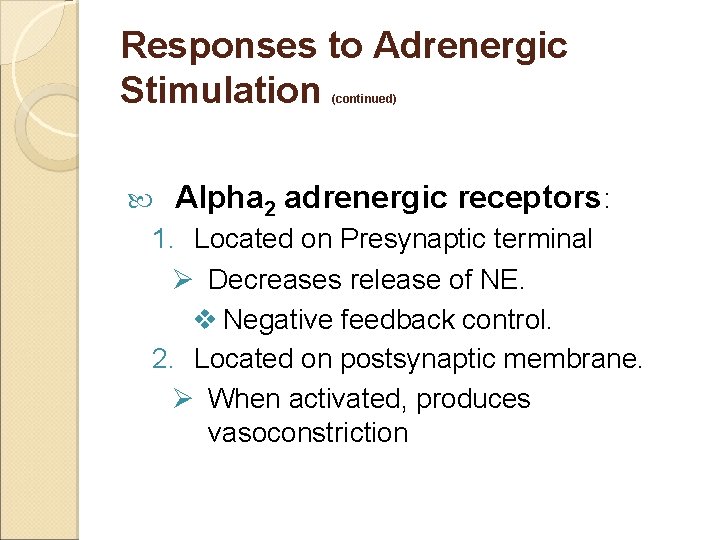
Responses to Adrenergic Stimulation (continued) Alpha 2 adrenergic receptors: 1. Located on Presynaptic terminal Ø Decreases release of NE. v Negative feedback control. 2. Located on postsynaptic membrane. Ø When activated, produces vasoconstriction
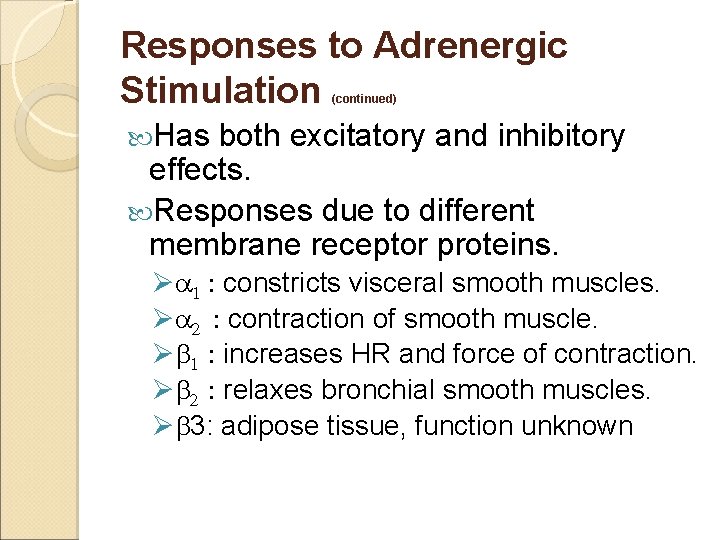
Responses to Adrenergic Stimulation (continued) Has both excitatory and inhibitory effects. Responses due to different membrane receptor proteins. Øa 1 : constricts visceral smooth muscles. Øa 2 : contraction of smooth muscle. Øb 1 : increases HR and force of contraction. Øb 2 : relaxes bronchial smooth muscles. Øb 3: adipose tissue, function unknown
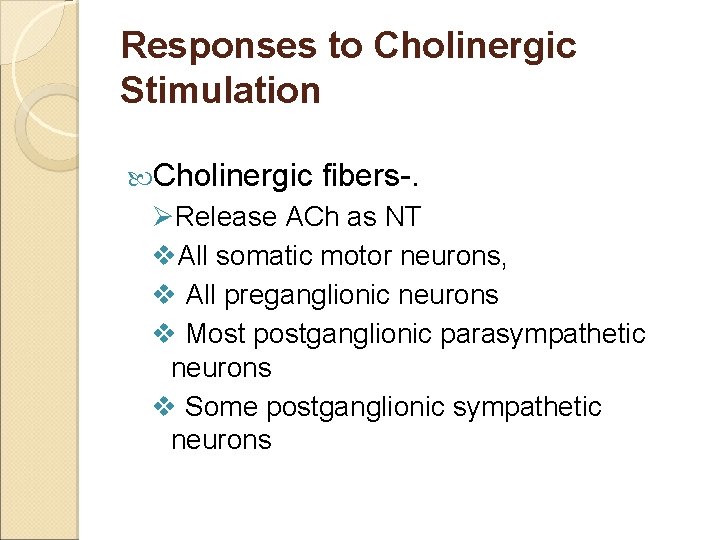
Responses to Cholinergic Stimulation Cholinergic fibers-. ØRelease ACh as NT v. All somatic motor neurons, v All preganglionic neurons v Most postganglionic parasympathetic neurons v Some postganglionic sympathetic neurons
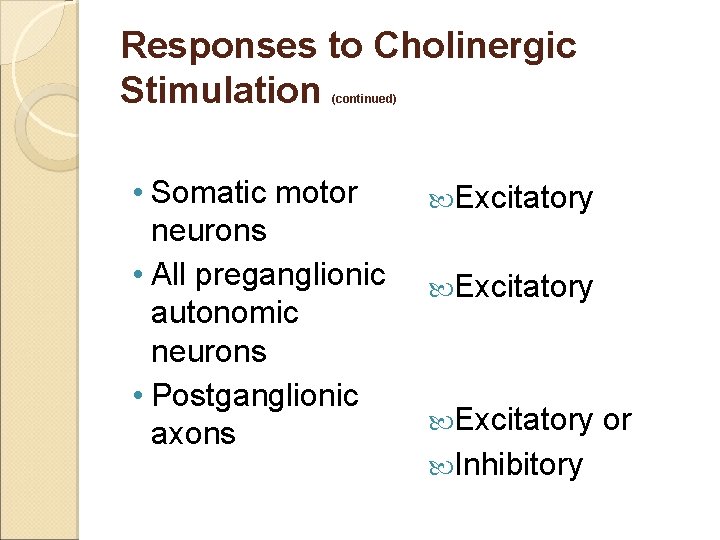
Responses to Cholinergic Stimulation (continued) • Somatic motor neurons • All preganglionic autonomic neurons • Postganglionic axons Excitatory Inhibitory or
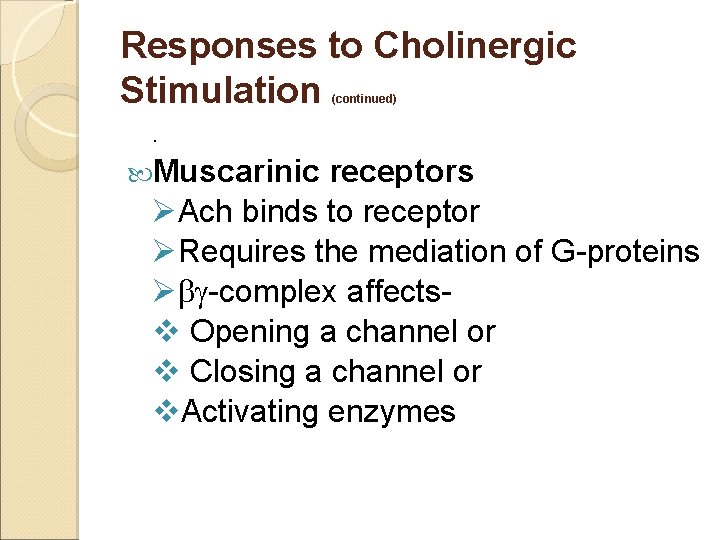
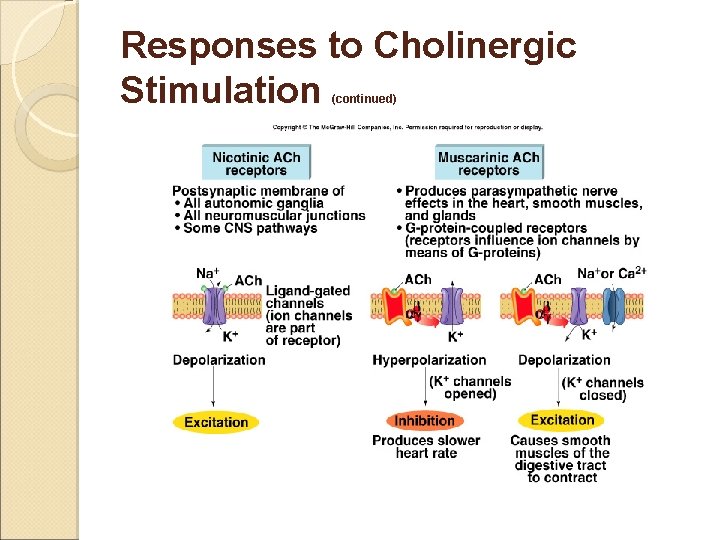
Responses to Cholinergic Stimulation (continued) . Muscarinic receptors ØAch binds to receptor ØRequires the mediation of G-proteins Øbg-complex affectsv Opening a channel or v Closing a channel or v. Activating enzymes
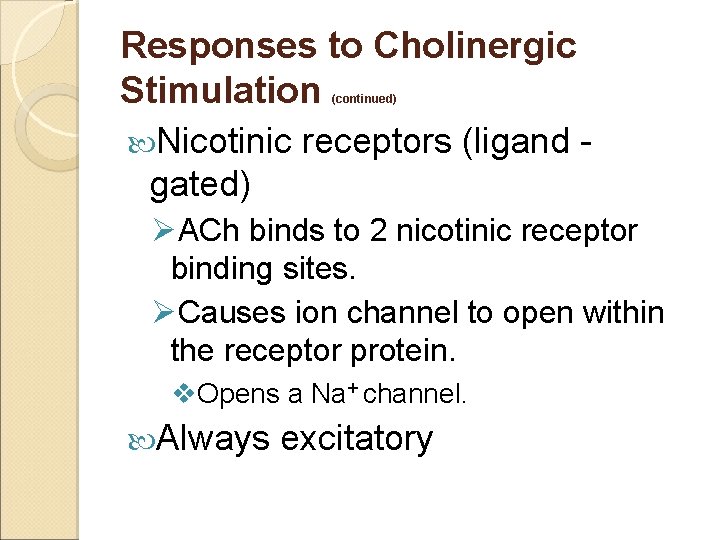
Responses to Cholinergic Stimulation Nicotinic receptors (ligand gated) (continued) ØACh binds to 2 nicotinic receptor binding sites. ØCauses ion channel to open within the receptor protein. v. Opens a Na+ channel. Always excitatory
Responses to Cholinergic Stimulation (continued)
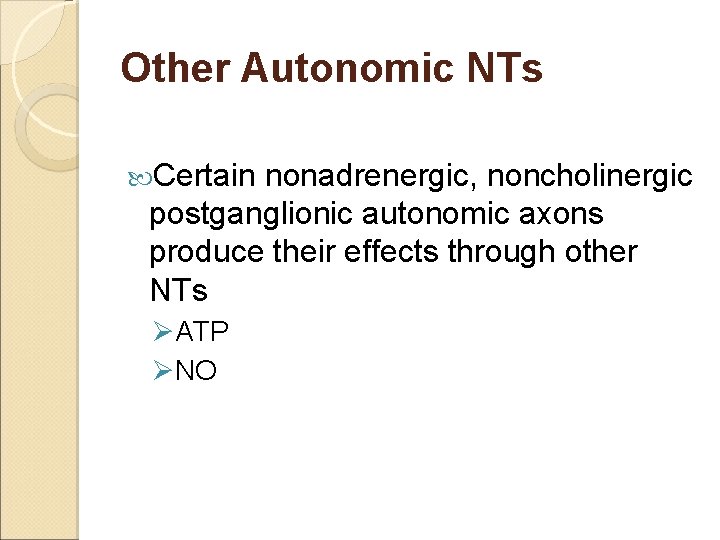
Other Autonomic NTs Certain nonadrenergic, noncholinergic postganglionic autonomic axons produce their effects through other NTs ØATP ØNO
Organs With Dual Innervations Dual innervations Ø Innervations by both v. Sympathetic fibers v. Parasympathetic fibers Most visceral organs receive dual innervations Effects of dual innervations ØAntagonistic ØComplementary ØCooperative
Organs With Dual Innervations Antagonistic : ◦ Sympathetic and parasympathetic fibers innervate the same cells. Actions counteract each other. Heart rate. Complementary: ◦ Sympathetic and parasympathetic stimulation produces similar effects. Salivary gland secretion. Cooperative: ◦ Sympathetic and parasympathetic stimulation produce different effects that work together to produce desired effect. Micturition.
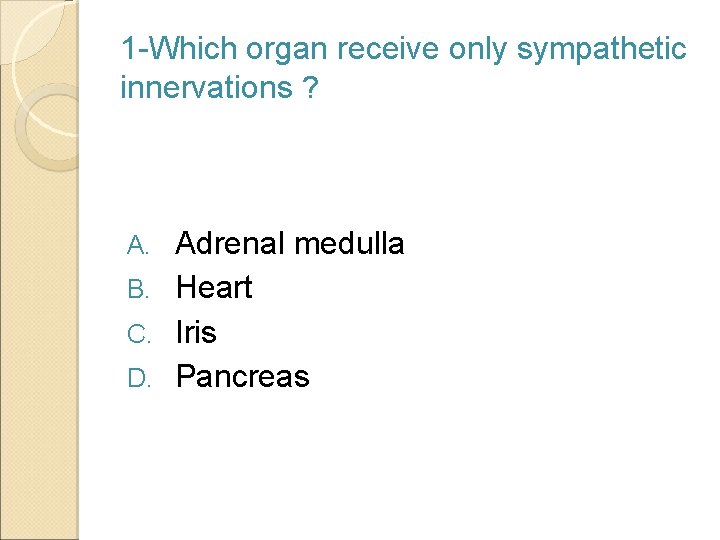
Organs Without Dual Innervations Regulation achieved by increasing or decreasing firing rate. Organ receive only sympathetic innervationsØAdrenal medulla ØArrector pili muscle ØSweat glands ØMost blood vessels. v. Nonshivering thermogenesis.
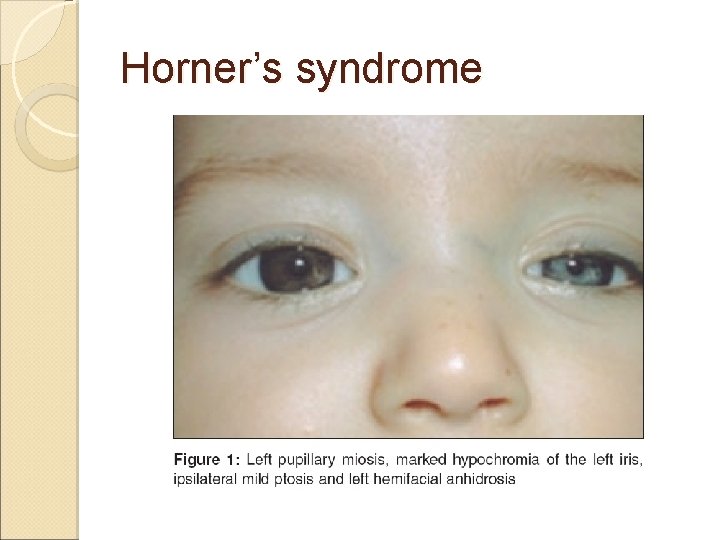
Applied Horner’s syndrome Characterized byØConstriction of the pupil ØEnophthalmos ØDrooping of eye lid ØAnhydrosis on affected side of face Occurs due to- ØDamage of stellate ganglia ØParalysis of Cervical Sympathetic nerve trunk
Horner’s syndrome
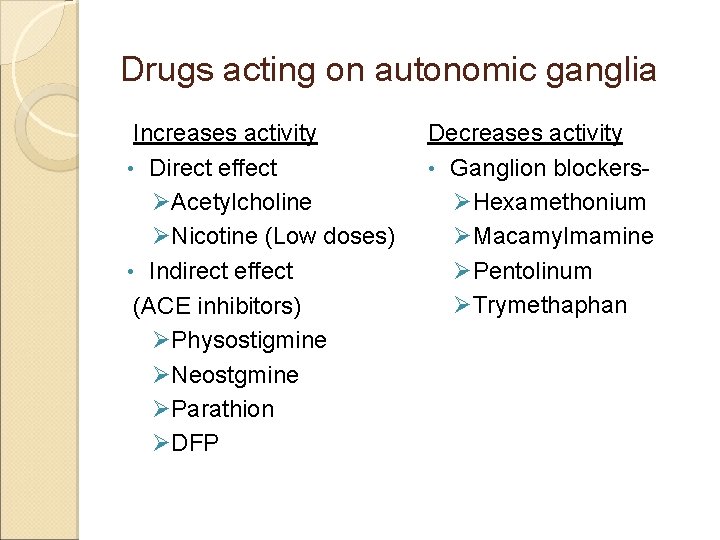
Drugs acting on autonomic ganglia Increases activity • Direct effect ØAcetylcholine ØNicotine (Low doses) • Indirect effect (ACE inhibitors) ØPhysostigmine ØNeostgmine ØParathion ØDFP Decreases activity • Ganglion blockersØHexamethonium ØMacamylmamine ØPentolinum ØTrymethaphan
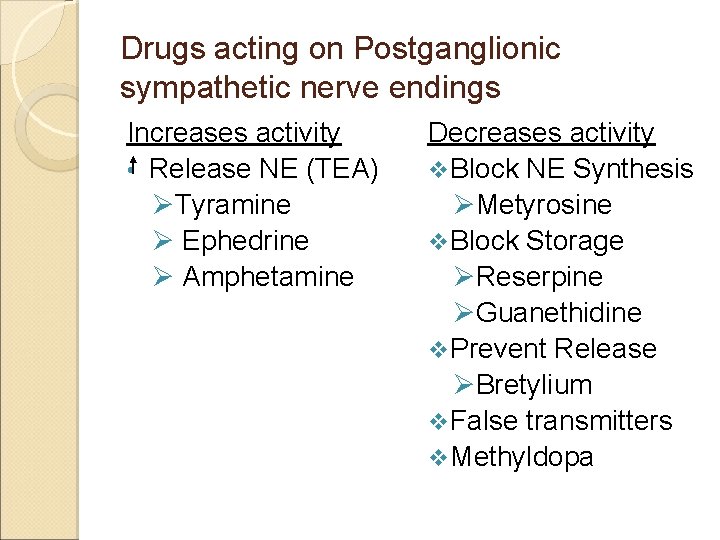
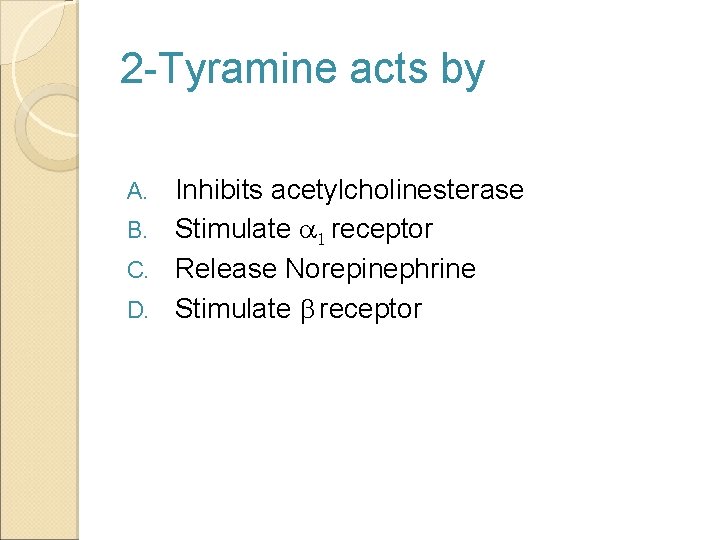
Drugs acting on Postganglionic sympathetic nerve endings Increases activity • Release NE (TEA) ØTyramine Ø Ephedrine Ø Amphetamine Decreases activity v Block NE Synthesis ØMetyrosine v Block Storage ØReserpine ØGuanethidine v Prevent Release ØBretylium v False transmitters v Methyldopa
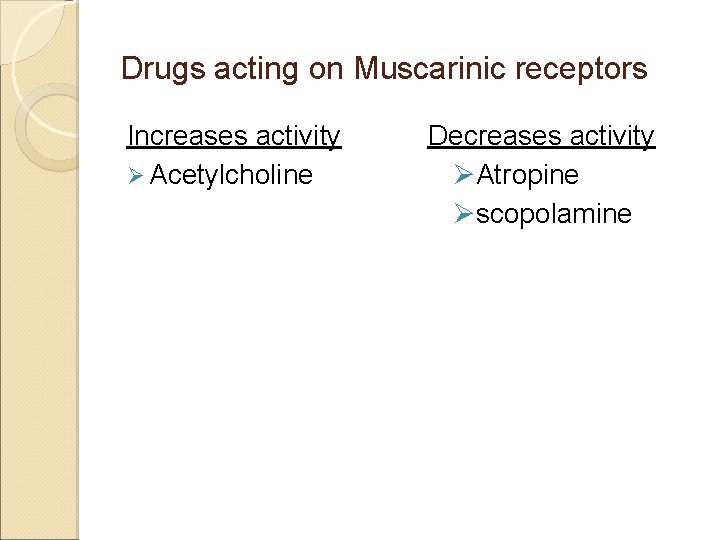
Drugs acting on Muscarinic receptors Increases activity Ø Acetylcholine Decreases activity ØAtropine Øscopolamine
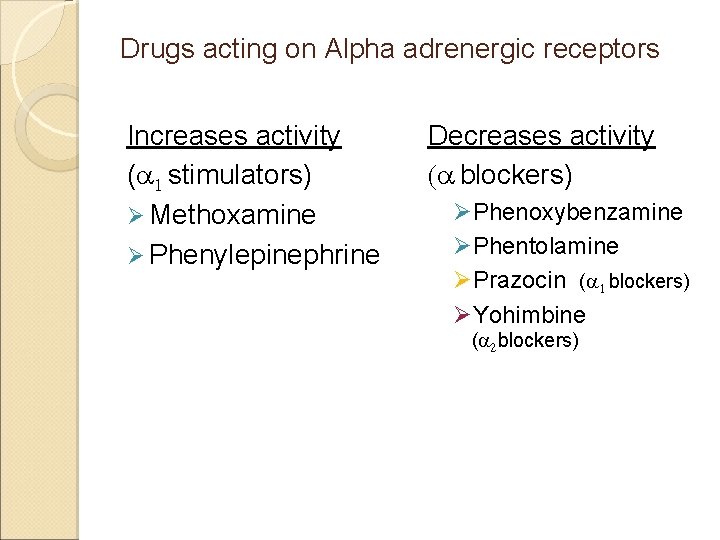
Drugs acting on Alpha adrenergic receptors Increases activity (a 1 stimulators) Ø Methoxamine Ø Phenylepinephrine Decreases activity (a blockers) ØPhenoxybenzamine ØPhentolamine ØPrazocin (a 1 blockers) ØYohimbine (a 2 blockers)
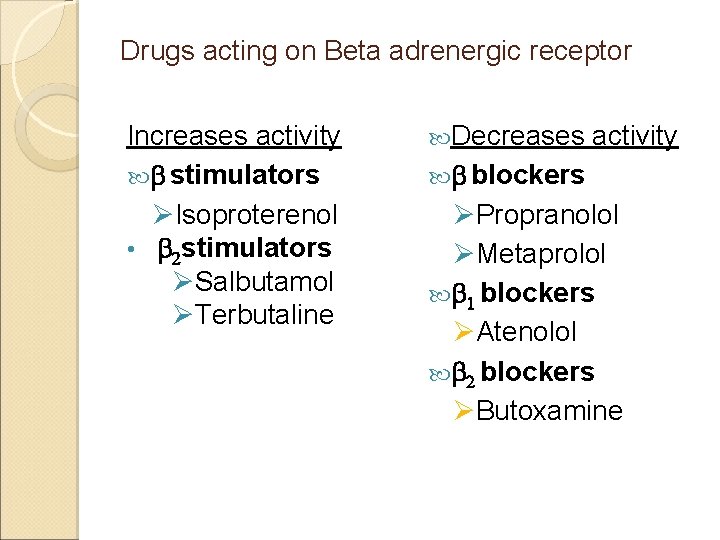
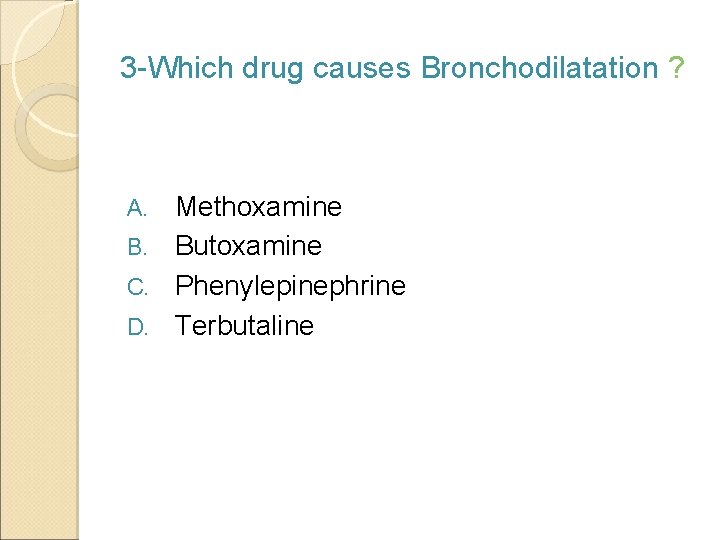
Drugs acting on Beta adrenergic receptor Increases activity b stimulators ØIsoproterenol • b 2 stimulators ØSalbutamol ØTerbutaline Decreases activity b blockers ØPropranolol ØMetaprolol b 1 blockers ØAtenolol b 2 blockers ØButoxamine
1 -Which organ receive only sympathetic innervations ? Adrenal medulla B. Heart C. Iris D. Pancreas A.
2 -Tyramine acts by Inhibits acetylcholinesterase B. Stimulate a 1 receptor C. Release Norepinephrine D. Stimulate b receptor A.
3 -Which drug causes Bronchodilatation ? Methoxamine B. Butoxamine C. Phenylepinephrine D. Terbutaline A.
4 -Pilocarpine causes Pupillary dilatation B. Bronchoconstriction C. Bronchodilatation D. Pupillary constriction A.
5 -Atropine is a Parasympathomimetic drug B. Parasympatholytic drug C. Sympathomimetic drug D. Sympatholytic drug A.