Aurora Tumino T109 1011 K 0 1 10
- Slides: 18
Aurora Tumino
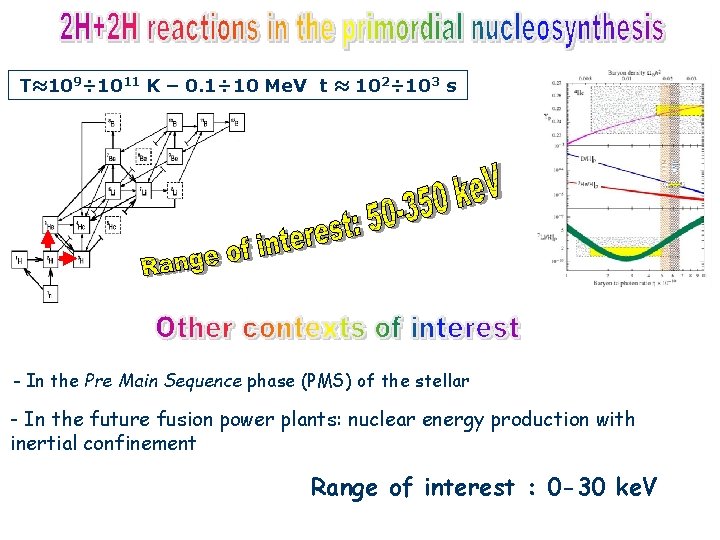
T≈109÷ 1011 K – 0. 1÷ 10 Me. V t ≈ 102÷ 103 s - In the Pre Main Sequence phase (PMS) of the stellar - In the future fusion power plants: nuclear energy production with inertial confinement Range of interest : 0 -30 ke. V
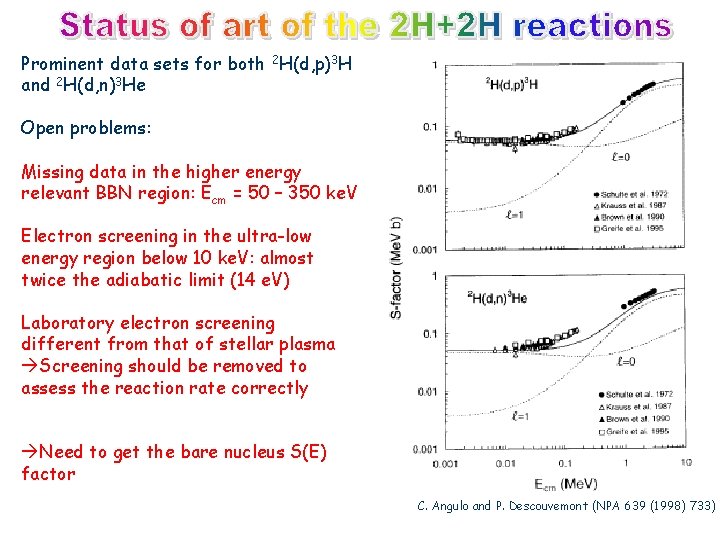
Prominent data sets for both 2 H(d, p)3 H and 2 H(d, n)3 He Open problems: Missing data in the higher energy relevant BBN region: Ecm = 50 – 350 ke. V Electron screening in the ultra-low energy region below 10 ke. V: almost twice the adiabatic limit (14 e. V) Laboratory electron screening different from that of stellar plasma Screening should be removed to assess the reaction rate correctly Need to get the bare nucleus S(E) factor C. Angulo and P. Descouvemont (NPA 639 (1998) 733)
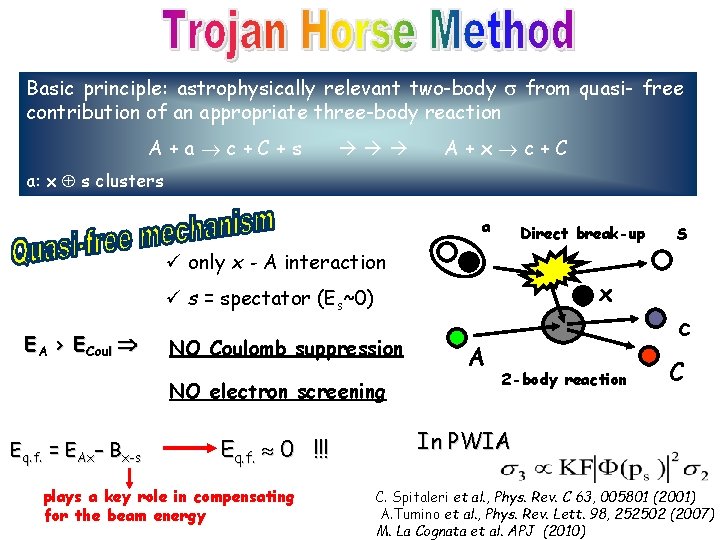
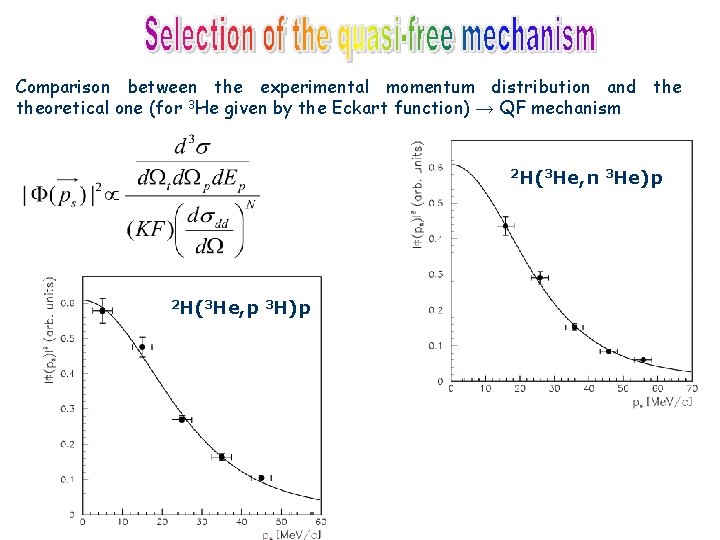
Basic principle: astrophysically relevant two-body from quasi- free contribution of an appropriate three-body reaction A+a c+C+s A+x c+C a: x s clusters a Direct break-up S ü only x - A interaction x ü s = spectator (Es~0) EA > ECoul NO Coulomb suppression NO electron screening Eq. f. = EAx– Bx-s Eq. f. 0 !!! plays a key role in compensating for the beam energy A c 2 -body reaction C In PWIA C. Spitaleri et al. , Phys. Rev. C 63, 005801 (2001) A. Tumino et al. , Phys. Rev. Lett. 98, 252502 (2007) M. La Cognata et al. APJ (2010)
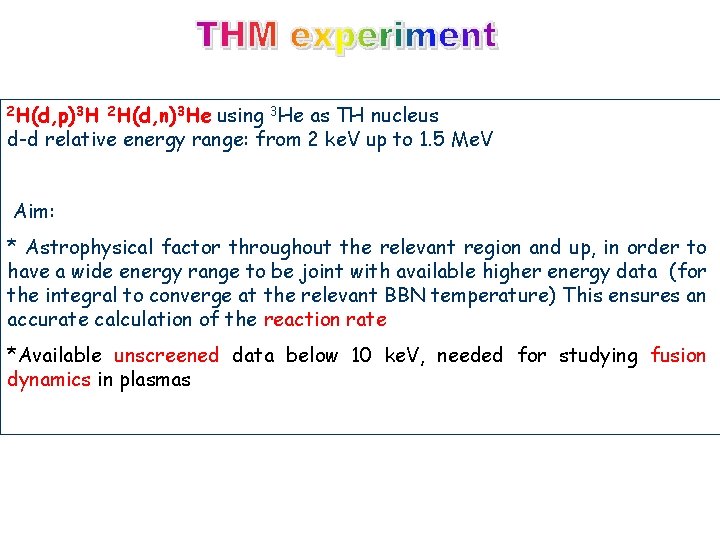
2 H(d, p)3 H 2 H(d, n)3 He using 3 He as TH nucleus d-d relative energy range: from 2 ke. V up to 1. 5 Me. V Aim: * Astrophysical factor throughout the relevant region and up, in order to have a wide energy range to be joint with available higher energy data (for the integral to converge at the relevant BBN temperature) This ensures an accurate calculation of the reaction rate *Available unscreened data below 10 ke. V, needed for studying fusion dynamics in plasmas
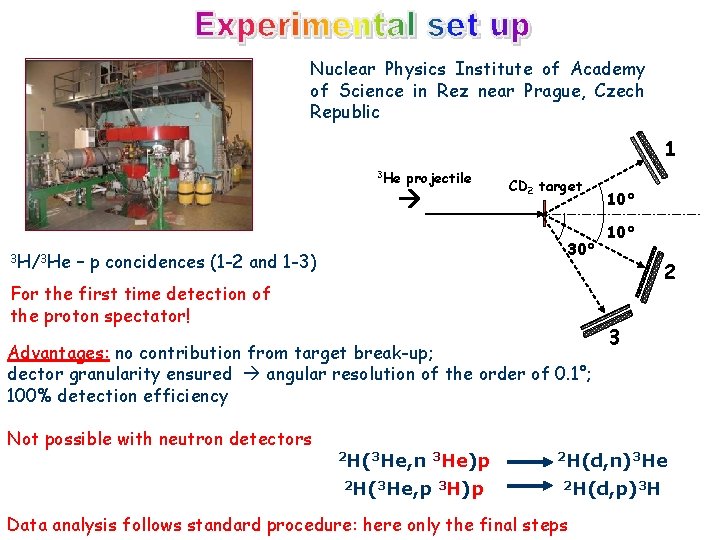
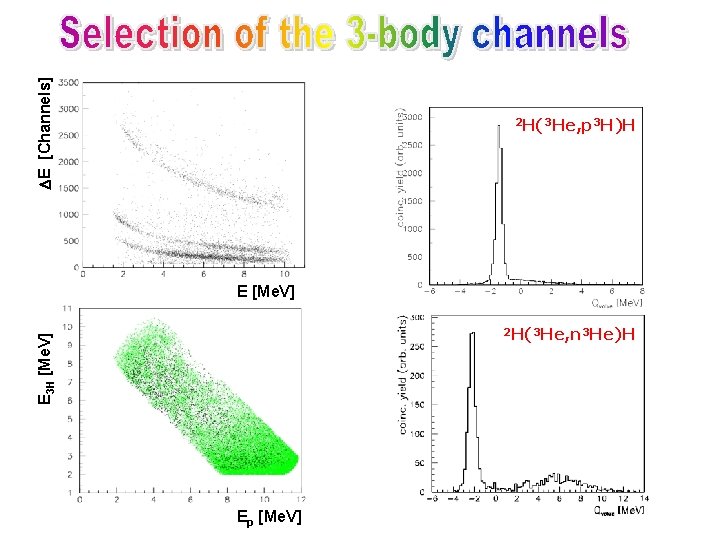
Nuclear Physics Institute of Academy of Science in Rez near Prague, Czech Republic 1 3 He projectile 3 H/3 He CD 2 target 30° – p concidences (1 -2 and 1 -3) For the first time detection of the proton spectator! Advantages: no contribution from target break-up; dector granularity ensured angular resolution of the order of 0. 1°; 100% detection efficiency Not possible with neutron detectors 10° 2 3 2 H(3 He, n 3 He)p 2 H(d, n)3 He 2 H(3 He, p 3 H)p 2 H(d, p)3 H Data analysis follows standard procedure: here only the final steps
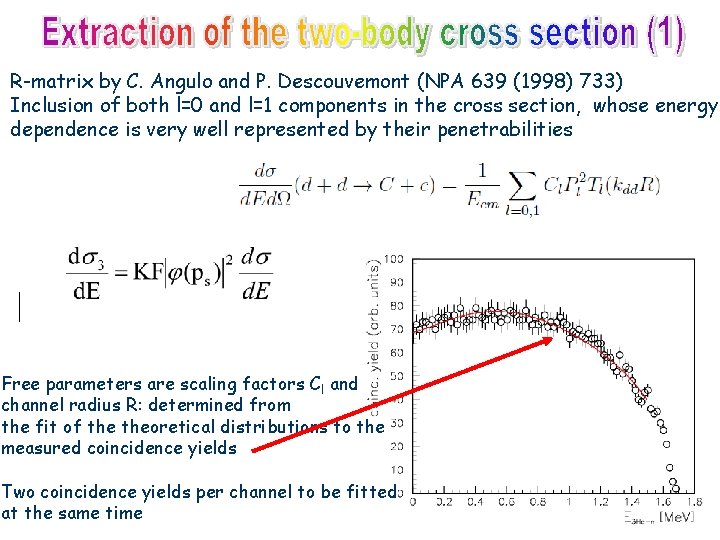
R-matrix by C. Angulo and P. Descouvemont (NPA 639 (1998) 733) Inclusion of both l=0 and l=1 components in the cross section, whose energy dependence is very well represented by their penetrabilities Free parameters are scaling factors Cl and channel radius R: determined from the fit of theoretical distributions to the measured coincidence yields Two coincidence yields per channel to be fitted at the same time
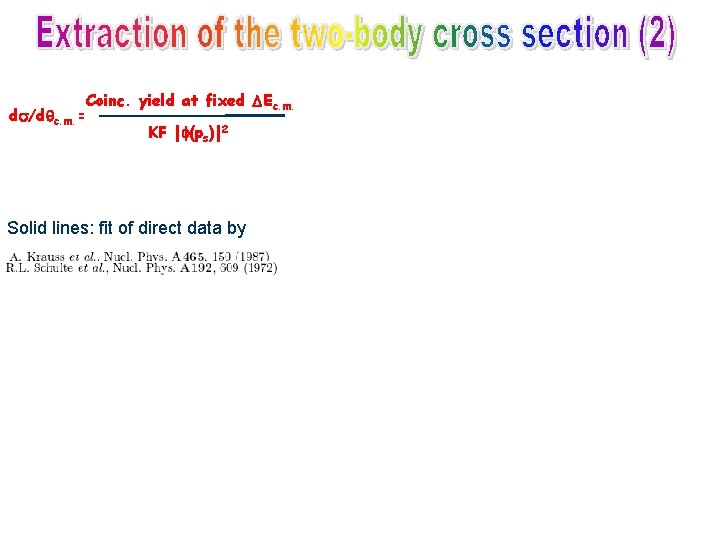
Coinc. yield at fixed Ec. m. d /d c. m. = KF | (ps)|2 Solid lines: fit of direct data by
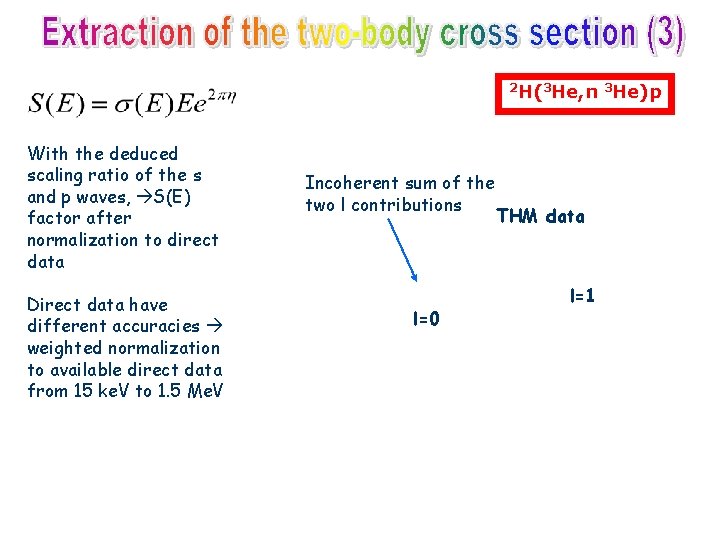
2 H(3 He, n 3 He)p With the deduced scaling ratio of the s and p waves, S(E) factor after normalization to direct data Direct data have different accuracies weighted normalization to available direct data from 15 ke. V to 1. 5 Me. V Incoherent sum of the two l contributions l=0 THM data l=1
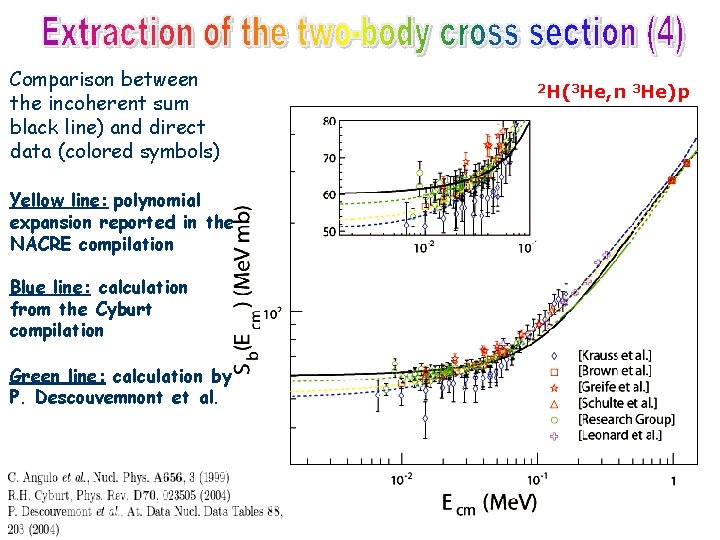
Comparison between the incoherent sum black line) and direct data (colored symbols) Yellow line: polynomial expansion reported in the NACRE compilation Blue line: calculation from the Cyburt compilation Green line: calculation by P. Descouvemnont et al. 2 H(3 He, n 3 He)p
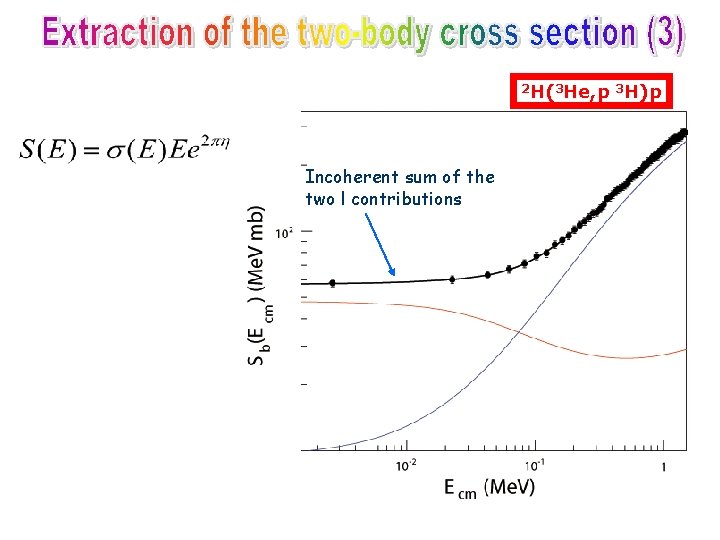
2 H(3 He, p 3 H)p Incoherent sum of the two l contributions
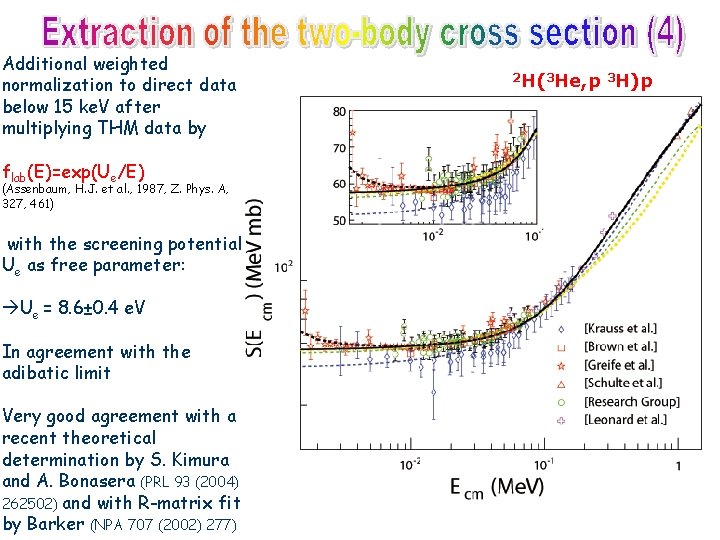
Additional weighted normalization to direct data below 15 ke. V after multiplying THM data by flab(E)=exp(Ue/E) (Assenbaum, H. J. et al. , 1987, Z. Phys. A, 327, 461) with the screening potential Ue as free parameter: Ue = 8. 6± 0. 4 e. V In agreement with the adibatic limit Very good agreement with a recent theoretical determination by S. Kimura and A. Bonasera (PRL 93 (2004) 262502) and with R-matrix fit by Barker (NPA 707 (2002) 277) 2 H(3 He, p 3 H)p
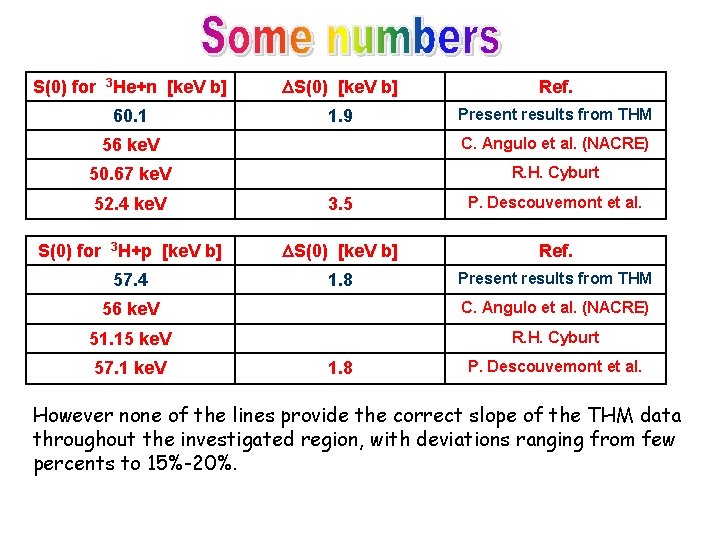
S(0) for 3 He+n [ke. V b] S(0) [ke. V b] Ref. 60. 1 1. 9 Present results from THM 56 ke. V C. Angulo et al. (NACRE) 50. 67 ke. V R. H. Cyburt 52. 4 ke. V 3. 5 P. Descouvemont et al. S(0) for 3 H+p [ke. V b] S(0) [ke. V b] Ref. 57. 4 1. 8 Present results from THM 56 ke. V C. Angulo et al. (NACRE) 51. 15 ke. V R. H. Cyburt 57. 1 ke. V 1. 8 P. Descouvemont et al. However none of the lines provide the correct slope of the THM data throughout the investigated region, with deviations ranging from few percents to 15%-20%.
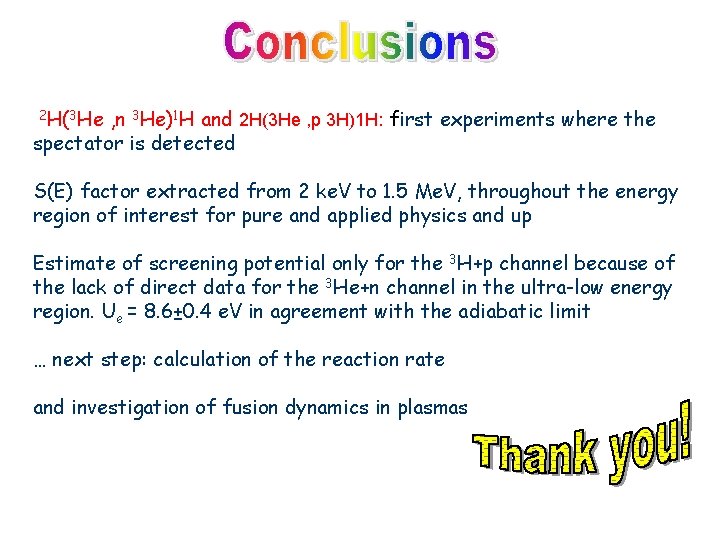
2 H(3 He , n 3 He)1 H and 2 H(3 He , p 3 H)1 H: first experiments where the spectator is detected S(E) factor extracted from 2 ke. V to 1. 5 Me. V, throughout the energy region of interest for pure and applied physics and up Estimate of screening potential only for the 3 H+p channel because of the lack of direct data for the 3 He+n channel in the ultra-low energy region. Ue = 8. 6± 0. 4 e. V in agreement with the adiabatic limit … next step: calculation of the reaction rate and investigation of fusion dynamics in plasmas
C. SPITALERI, S. CHERUBIN, M. GULINO, M. LA COGNATA, M. LAMIA, R. G. PIZZONE, S. M. R. PUGLIA, G. G. RAPISARDA, S. ROMANO, M. L. SERGI, S. TUDISCO, A. TUMINO I N F N, Laboratori Nazionali del Sud, Catania, Italy and Università di Catania, Italy A. MUKHAMEDZHANOV, R. TRIBBLE, L. TRACHE, V. GOLDBERG Ciclotron Institute, Texas A&M University, Usa C. ROLFS Institut für Experimentalphysik III- Ruhr Universität Bochum, Germany S. TYPEL GSI-Germany S. KUBONO, T. MOTOBAYASHI CNS and RIKEN, Tokio, Japan A. COC, F. HAMMACHE CSNSM and IPN, Orsay, France V. BURJAN, V. KROHA, I. MRAZEK Nuclear Physics Institute, Academic of Science, Rez, Czech Rep. Z. ELEKES, Z. FULOP, G. GYURKY, G. KISS, E. SOMORJAI Inst. Of Nuclear Research of. Academic of Science Debrecen, Ungaria G. ROGACHEV, E. JOHNSON FSU, USA N. CARLIN, M. GAMEIRO MUNHOZ, M. GIMENEZ DEL SANTO, R. LIGUORI NETO, M. DE MOURA, F. SOUZA, A. SUAIDE, E. SZANTO, A. SZANTO DE TOLEDO Dipartimento de Fisica Nucleare, Universidade de Sao Paulo, Brasil
Comparison between the experimental momentum distribution and theoretical one (for 3 He given by the Eckart function) → QF mechanism 2 H(3 He, n 3 He)p 2 H(3 He, p 3 H)p
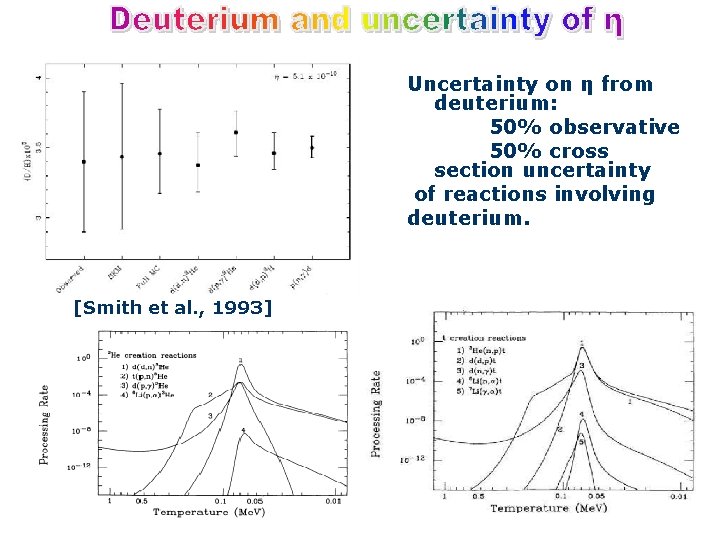
Uncertainty on η from deuterium: 50% observative 50% cross section uncertainty of reactions involving deuterium. [Smith et al. , 1993]
E [Channels] 2 H(3 He, p 3 H)H E [Me. V] E 3 H [Me. V] 2 H(3 He, n 3 He)H Ep [Me. V]