Archdiocese of San Francisco Safe Environment Training Presented


- Slides: 23
Archdiocese of San Francisco Safe Environment Training Presented By: Derek Gaskin – gaskind@sfarch. org Department of Safety & Security – Risk Management & Disaster Emergency Preparedness The Archdiocese of San Francisco Safety Training Program
Purpose of the Annual Safety Training Occupational Safety and Health Act of 1970 “To assure safe and healthful working conditions for working men and women; by authorizing enforcement of the standards developed under the Act; by assisting and encouraging the States in their efforts to assure safe and healthful working conditions; by providing for research, information, education, and training in the field of occupational safety and health. ” The Archdiocese of San Francisco Safety Training Program
Important Topics of Discussion q q q q q Safety Coordinator Defined Safety Coordinator Responsibilities Injury Illness Prevention Program (IIPP) Standard Response Protocol (SRP) – Crisis Response - “Action Plan” Ergonomics – Lifting Techniques Slip Trip & Falls Kitchen Food & Safety Training Module Proper Housekeeping Practices Disaster Emergency Preparedness – RED Binder Personal Protection Equipment The Archdiocese of San Francisco Safety Training Program
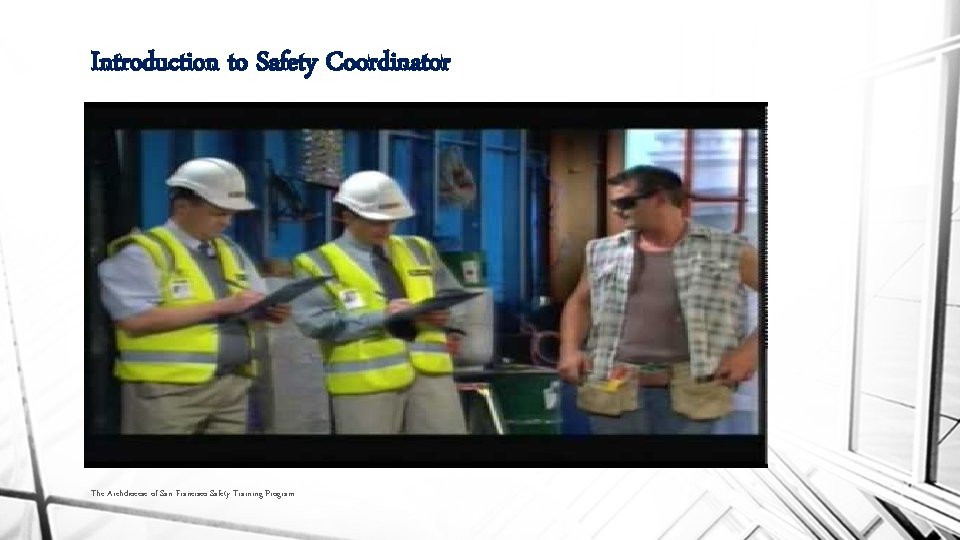
Introduction to Safety Coordinator The Archdiocese of San Francisco Safety Training Program
Safety Coordinator Defined Safety Coordinators work with the Priest, Principal and the site Safety Committee members to help create both, Parish and campus safety policies and/or best practices to help protect Parishioners, students and employees - while doing the very best to help protect property assets. Safety policies cover topics such as risks, hazard reporting processes, safe practices in the workplace, accident investigation procedures and maintaining basic safety rules. The Archdiocese of San Francisco Safety Training Program
Responsibilities The Archdiocese of San Francisco Safety Training Program
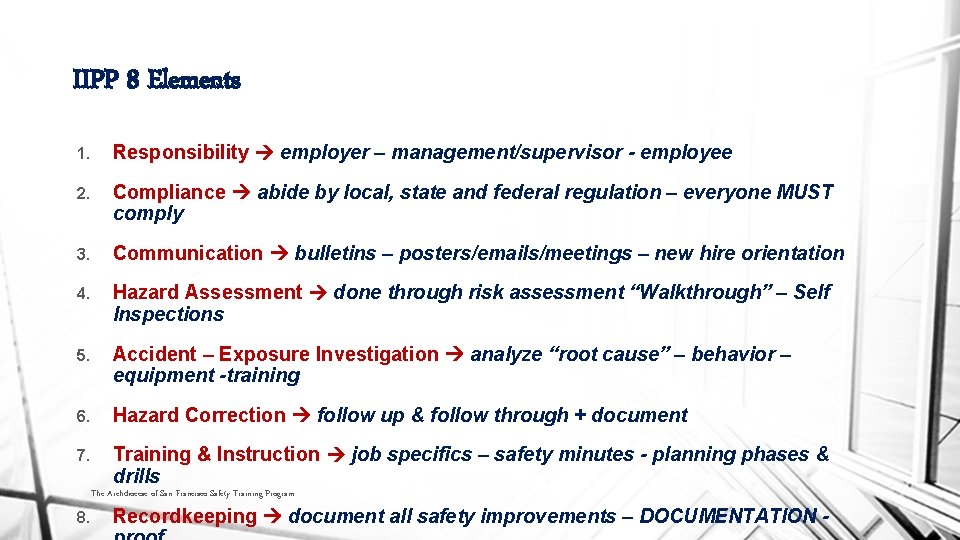
Injury Illness Prevention Program The IIPP is the most important health and safety regulation /program on campus or at the church site - in California. The IIPP law is administered by the California Occupational Safety and Health Administration (Cal. OSHA)… Also supported by OSHA 300 A= record keeping and documentation/reporting. It is to ensure that workers are trained in, and comply with, the best safe work practices. This also includes Parishioners and authorized volunteers. The IIPP are contained in Title 8 of the California Code of Regulations – Section 3203 – and consist of the following eight (8) elements: The Archdiocese of San Francisco Safety Training Program
IIPP 8 Elements 1. Responsibility employer – management/supervisor - employee 2. Compliance abide by local, state and federal regulation – everyone MUST comply 3. Communication bulletins – posters/emails/meetings – new hire orientation 4. Hazard Assessment done through risk assessment “Walkthrough” – Self Inspections 5. Accident – Exposure Investigation analyze “root cause” – behavior – equipment -training 6. Hazard Correction follow up & follow through + document 7. Training & Instruction job specifics – safety minutes - planning phases & drills The Archdiocese of San Francisco Safety Training Program 8. Recordkeeping document all safety improvements – DOCUMENTATION -
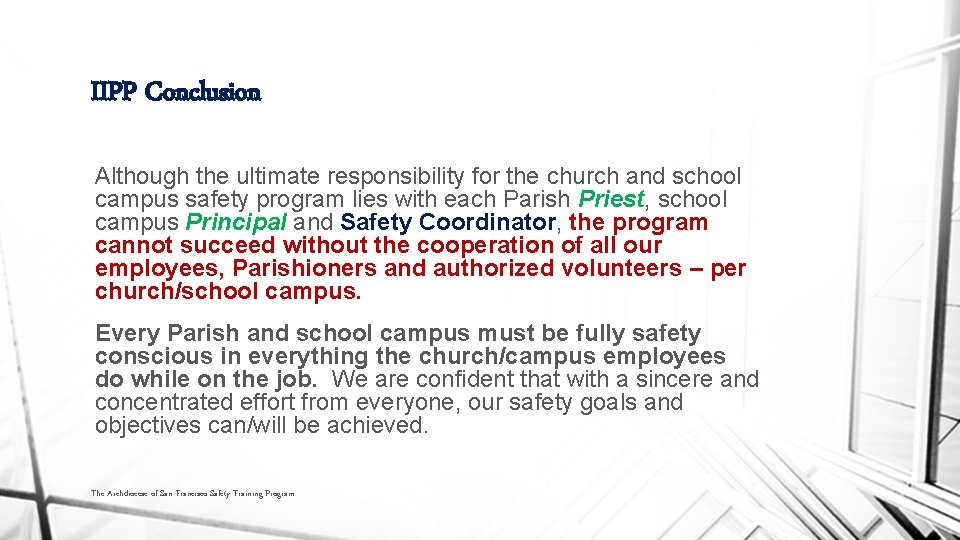
IIPP Conclusion Although the ultimate responsibility for the church and school campus safety program lies with each Parish Priest, school campus Principal and Safety Coordinator, the program cannot succeed without the cooperation of all our employees, Parishioners and authorized volunteers – per church/school campus. Every Parish and school campus must be fully safety conscious in everything the church/campus employees do while on the job. We are confident that with a sincere and concentrated effort from everyone, our safety goals and objectives can/will be achieved. The Archdiocese of San Francisco Safety Training Program
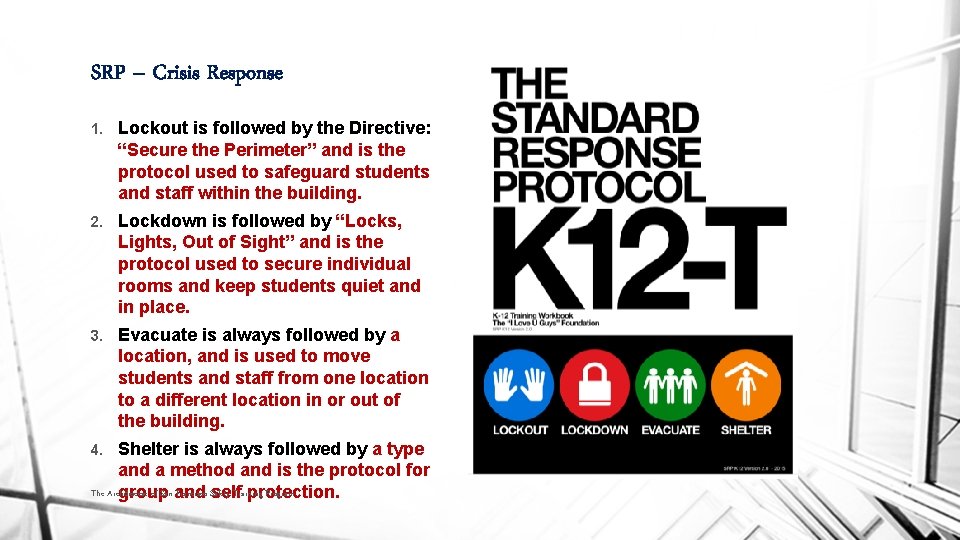
SRP – Crisis Response 1. Lockout is followed by the Directive: “Secure the Perimeter” and is the protocol used to safeguard students and staff within the building. 2. Lockdown is followed by “Locks, Lights, Out of Sight” and is the protocol used to secure individual rooms and keep students quiet and in place. 3. Evacuate is always followed by a location, and is used to move students and staff from one location to a different location in or out of the building. Shelter is always followed by a type and a method and is the protocol for The Archdiocese of San Francisco Safety Training Program group and self protection. 4.
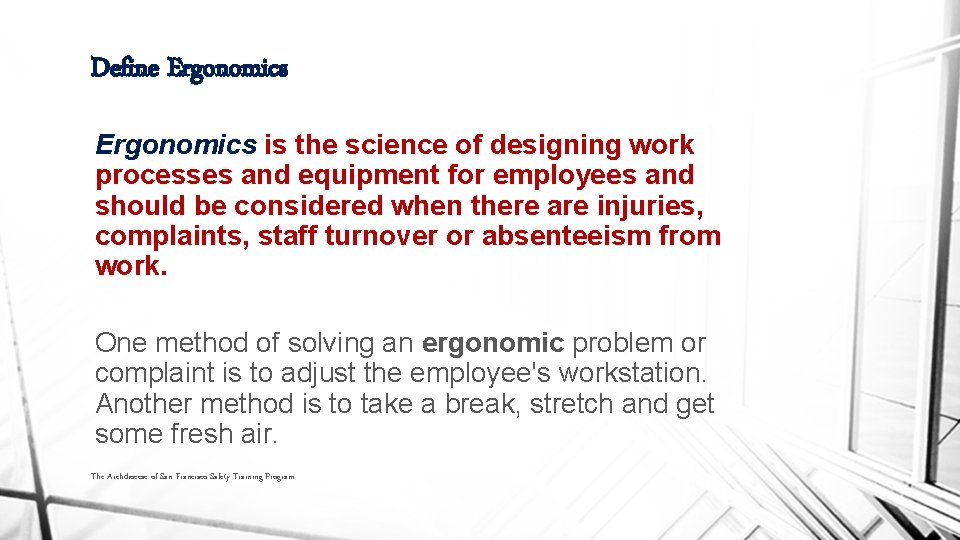
Define Ergonomics is the science of designing work processes and equipment for employees and should be considered when there are injuries, complaints, staff turnover or absenteeism from work. One method of solving an ergonomic problem or complaint is to adjust the employee's workstation. Another method is to take a break, stretch and get some fresh air. The Archdiocese of San Francisco Safety Training Program
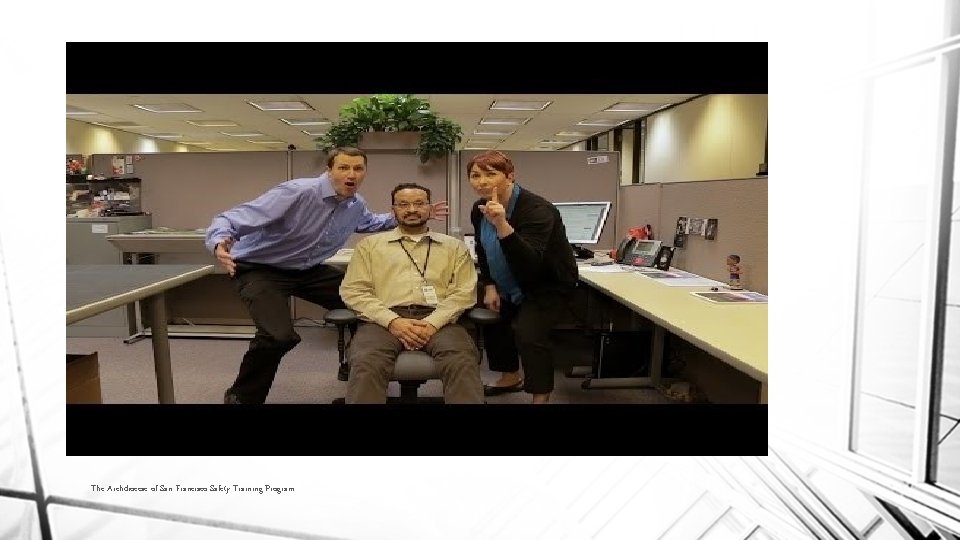
Ergonomics Avoiding Ergonomic Issues o Stretch and walk around regularly; do not remain sedentary. o Do not ignore pain. Inform your supervisor immediately if you experience ergonomic discomfort on the job. o Refrain from carrying items that are too heavy. o Sleep on a quality mattress that supports good posture. o Select tools that are ergonomically designed for comfort. The Archdiocese of San Francisco Safety Training Program Attracting Ergonomic Issues See next video:
The Archdiocese of San Francisco Safety Training Program
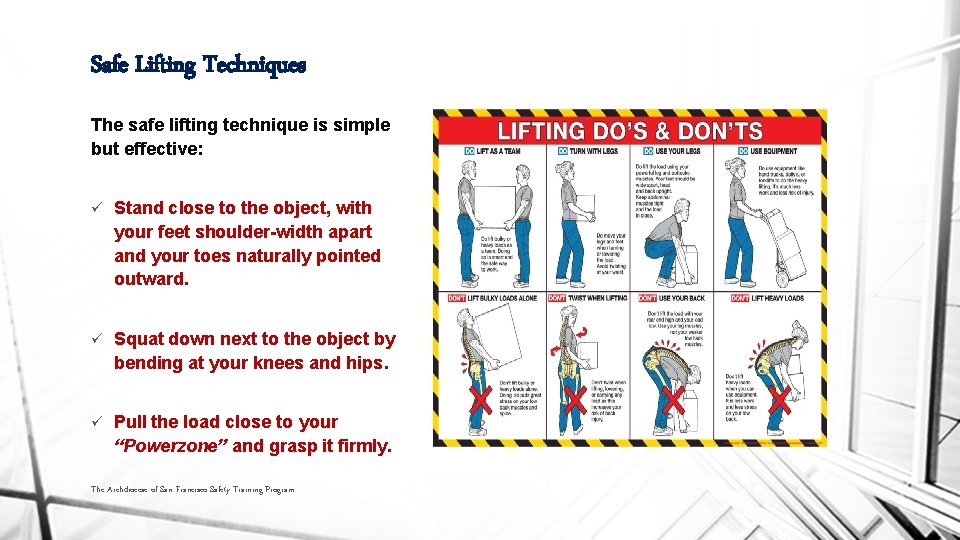
Safe Lifting Techniques The safe lifting technique is simple but effective: ü Stand close to the object, with your feet shoulder-width apart and your toes naturally pointed outward. ü Squat down next to the object by bending at your knees and hips. ü Pull the load close to your “Powerzone” and grasp it firmly. The Archdiocese of San Francisco Safety Training Program
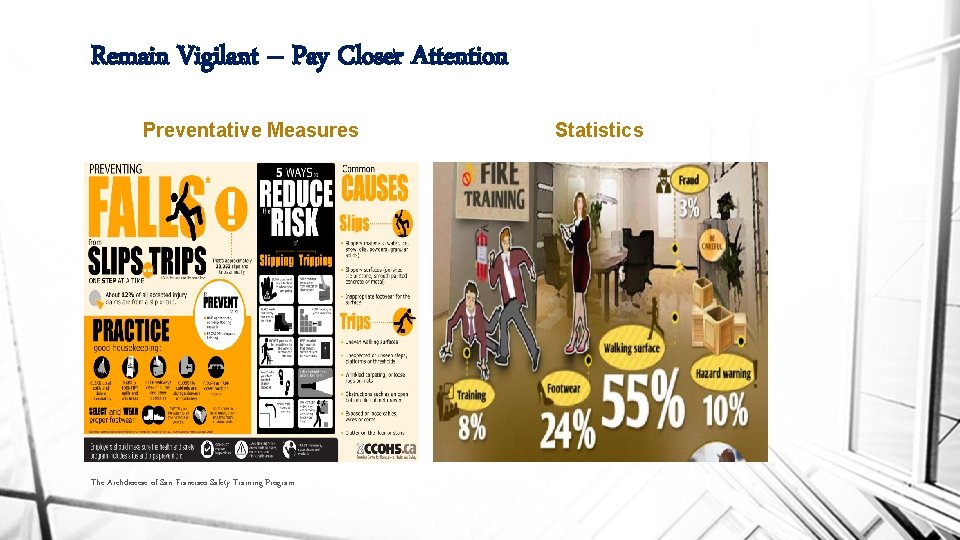
Slip Trips & Falls According to the Bureau of Labor Statistics (BLS), slips, trips and falls accounted for 15. 8% of all fatal occupational injuries in 2013. The most disabling workplace injuries and illnesses in 2010 amounted to $51. 1 billion in direct workers’ compensation costs, according to the 2012 Liberty Mutual Workplace Safety Index (WSI). The actual cost of work-related deaths and injuries is much greater than the cost of workers’ compensation insurance alone. Per the National Safety Council Injury Facts® 2014 Edition, the average cost per death in 2012 was $1, 420, 000 and the average cost per medically consulted injury was $39, 000 per. The Archdiocese of San Francisco Safety Training Program
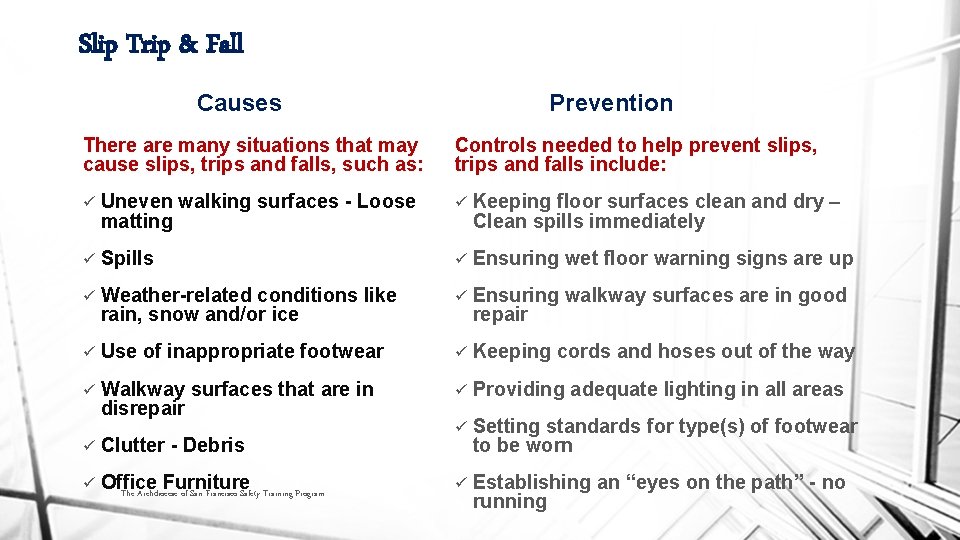
Slip Trip & Fall Prevention Causes There are many situations that may cause slips, trips and falls, such as: Controls needed to help prevent slips, trips and falls include: ü Uneven walking surfaces - Loose matting ü Keeping floor surfaces clean and dry – Clean spills immediately ü Spills ü Ensuring wet floor warning signs are up ü Weather-related conditions like rain, snow and/or ice ü Ensuring walkway surfaces are in good repair ü Use of inappropriate footwear ü Keeping cords and hoses out of the way ü Walkway surfaces that are in disrepair ü Providing adequate lighting in all areas ü Setting standards for type(s) of footwear to be worn ü Establishing an “eyes on the path” - no running ü Clutter - Debris ü Office Furniture The Archdiocese of San Francisco Safety Training Program
Remain Vigilant – Pay Closer Attention Preventative Measures The Archdiocese of San Francisco Safety Training Program Statistics
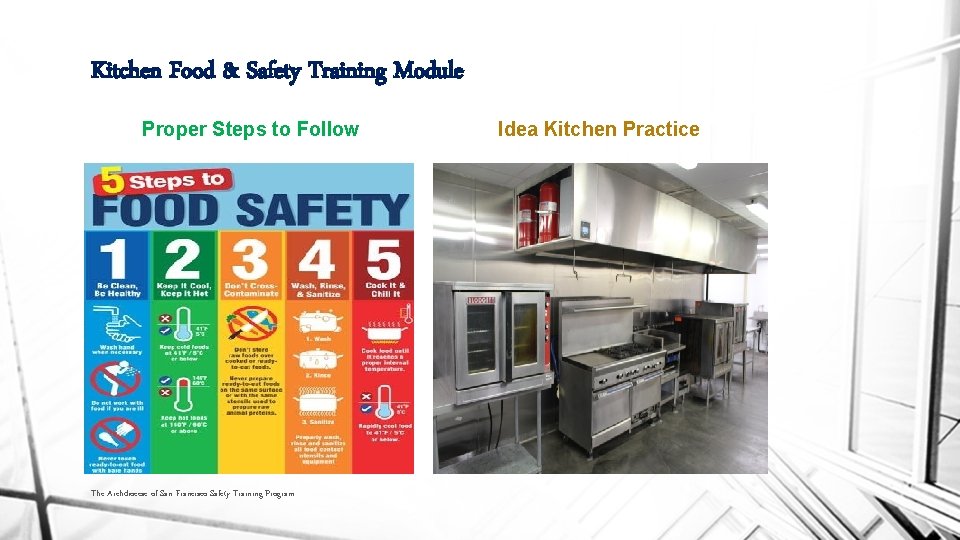
Kitchen Food & Safety Training Module Proper Steps to Follow The Archdiocese of San Francisco Safety Training Program Idea Kitchen Practice
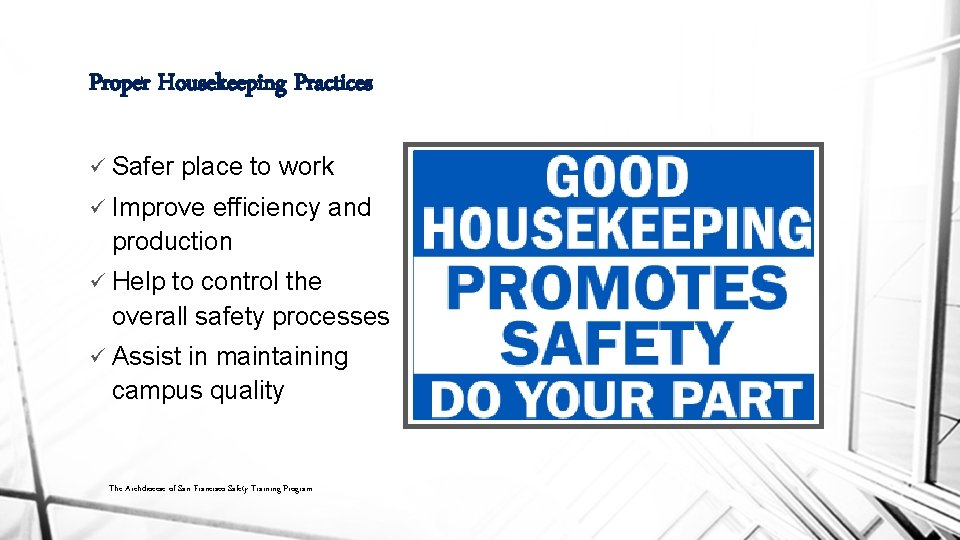
Proper Housekeeping Practices ü Safer place to work ü Improve efficiency and production ü Help to control the overall safety processes ü Assist in maintaining campus quality The Archdiocese of San Francisco Safety Training Program
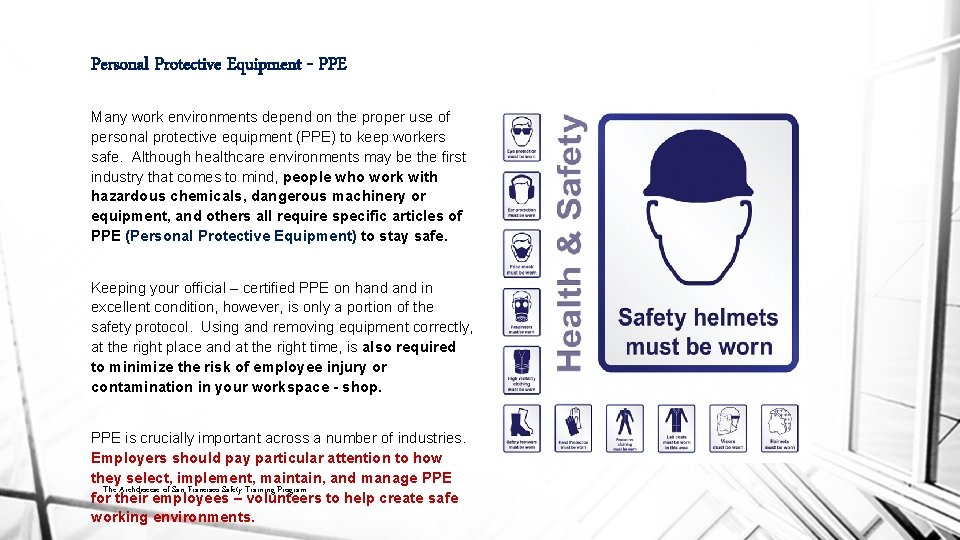
Personal Protective Equipment - PPE Many work environments depend on the proper use of personal protective equipment (PPE) to keep workers safe. Although healthcare environments may be the first industry that comes to mind, people who work with hazardous chemicals, dangerous machinery or equipment, and others all require specific articles of PPE (Personal Protective Equipment) to stay safe. Keeping your official – certified PPE on hand in excellent condition, however, is only a portion of the safety protocol. Using and removing equipment correctly, at the right place and at the right time, is also required to minimize the risk of employee injury or contamination in your workspace - shop. PPE is crucially important across a number of industries. Employers should pay particular attention to how they select, implement, maintain, and manage PPE The Archdiocese of San Francisco Safety Training Program for their employees – volunteers to help create safe working environments.
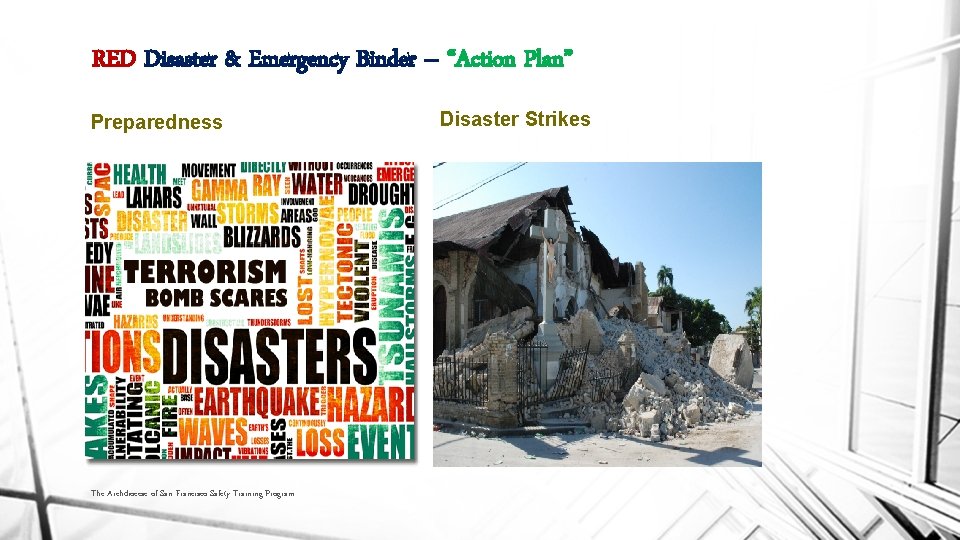
RED Disaster & Emergency Binder – “Action Plan” Preparedness The Archdiocese of San Francisco Safety Training Program Disaster Strikes
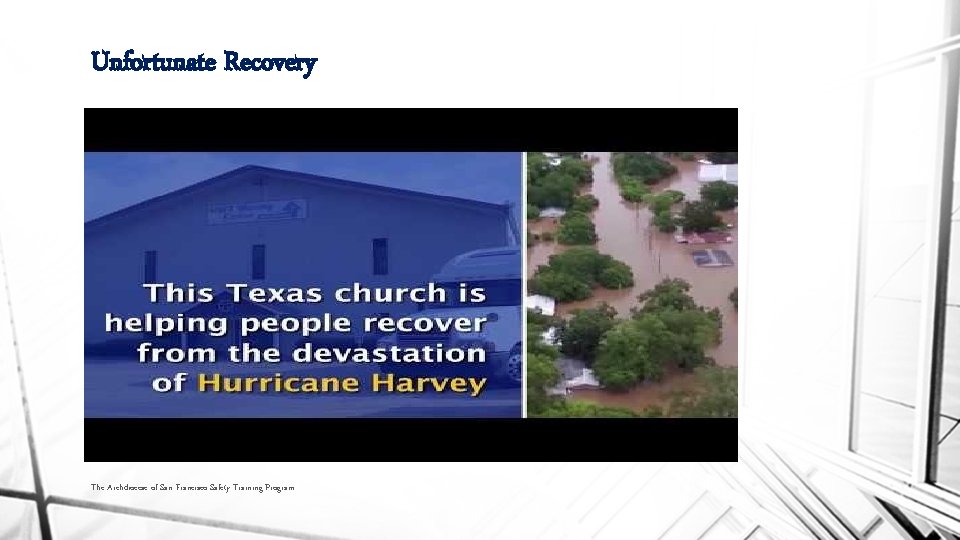
Unfortunate Recovery The Archdiocese of San Francisco Safety Training Program
Questions & Answers The Archdiocese of San Francisco Safety Training Program