Animation from https room 114 wikispaces comfileviewDNARep Anima

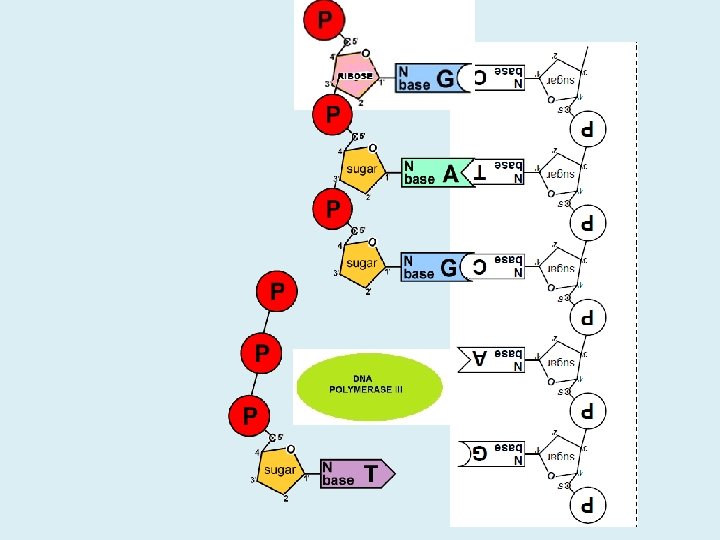
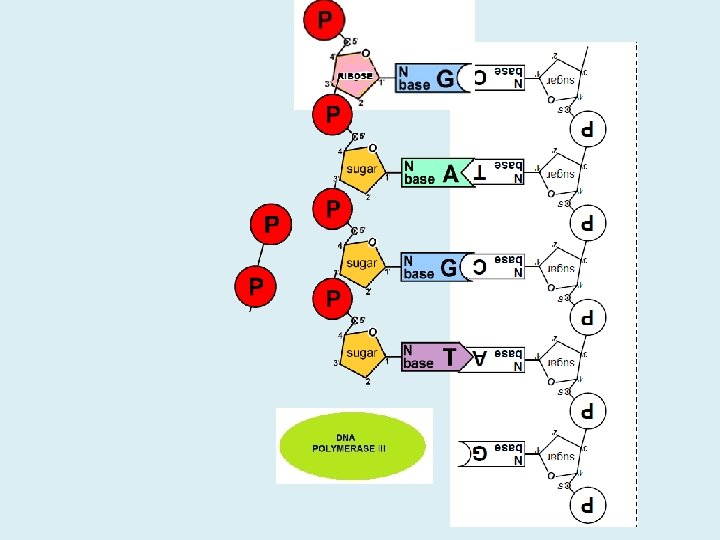
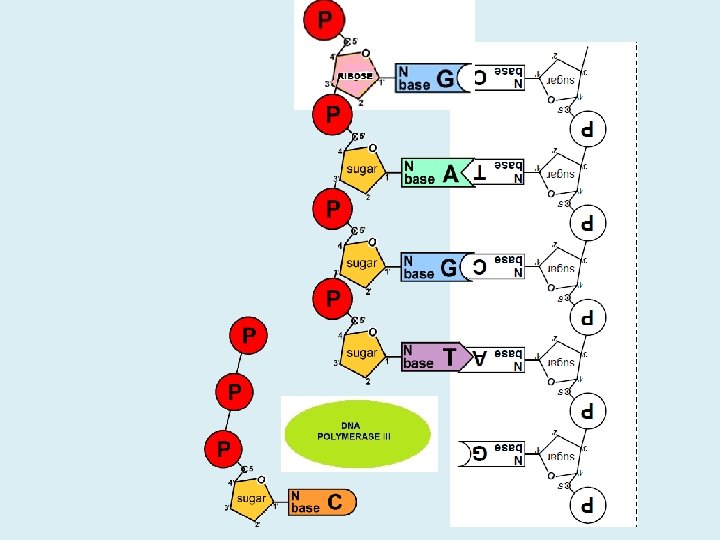
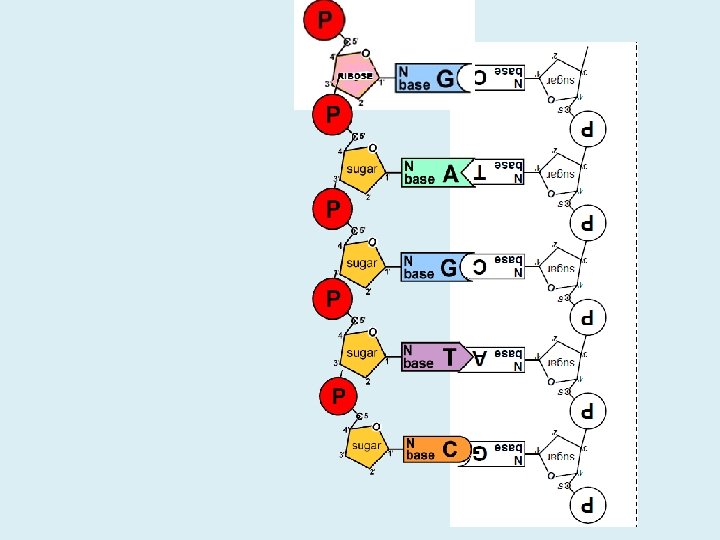

- Slides: 59
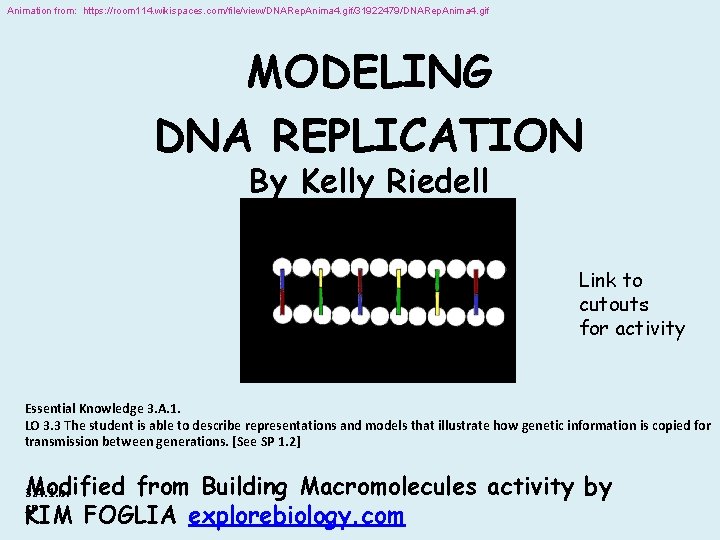
Animation from: https: //room 114. wikispaces. com/file/view/DNARep. Anima 4. gif/31922479/DNARep. Anima 4. gif MODELING DNA REPLICATION By Kelly Riedell Link to cutouts for activity Essential Knowledge 3. A. 1. LO 3. 3 The student is able to describe representations and models that illustrate how genetic information is copied for transmission between generations. [See SP 1. 2] Modified from Building Macromolecules activity by 3. A. 1. b. SP KIM FOGLIA explorebiology. com
Essential knowledge 3. A. 1: DNA, and in some cases RNA, is the primary source of 5. DNA replication ensures continuity of hereditary information. a. Genetic information is transmitted from one generation to the next through DNA or RNA 5. DNA replication ensures continuity of hereditary information. ii. Replication requires DNA polymerase plus many other essential cellular enzymes, occurs bidirectionally, and differs in the production of the leading and lagging strands. X The names of the steps and particular enzymes involved beyond DNA polymerase, ligase, RNA polymerase, helicase, and topoisomerase, are outside the scope of the course for the purposes of the AP Exam. b. DNA and RNA molecules have structural similarities and differences that define function [See also 4. A. 1] 1. Both have three components-sugar, phosphate and a nitrogenous base- which form nucleotide units that are connected by covalent bonds to form a linear molecule with 3’ and 5’ ends, with the nitrogenous bases perpendicular to the sugar-phosphate backbone. 2. The basic structural differences include: i. DNA contains deoxyribose (RNA contains ribose) ii. RNA contains uracil in lieu of thymine in DNA iii. DNA is usually double stranded, RNA is usually single stranded iv. The two DNA strands in double-stranded DNA are antiparallel in directionality. 3. Both DNA and RNA exhibit specific nucleotide base pairing that is conserved through evolution: adenine pairs with thymine or uracil (A-T or A-U) and cytosine pairs with guanine (C-G). i. Purines (G AND A) have a double ring structure ii. Pyrimidines (C, T, and U) have a single ring structure.
Essential knowledge 4. A. 1: The subcomponents of biological molecules and their sequence determine the properties of that molecule. a. Structure and function of polymers are derived from the way their monomers are assembled. 1. in nucleic acids, biological information is encoded in sequences of nucleotide monomers. Each nucleotide has structural components: a five carbon sugar (deoxyribose or ribose), a phosphate and a nitrogen base (adenine, thymine, guanine, cytosine, or uracil). DNA and RANA differ in function and differ slightly in structure, and these structural differences account for the differing functions [See also 1. D. 1, 2. A. 3, 3. A. 1] b. Directionality influences structure and function of the polymer. 1. Nucleic acids have ends, defined by the 3’ and 5’carbons of the sugar in the nucleotide, that determine the direction in which complementary nucleotides are added during DNA synthesis and the direction in which transcription occurs (from 5’ to 3’). [See also 3. A. 1] LO 4. 1 The student is able to explain the connection between the sequence and the subcomponents of a biological polymer and its properties [See SP 7. 1] LO 4. 2 The student is able to refine representation and models to explain how the subcomponents of a biological polymer and their sequence determine the properties of that polymer [See SP 1. 3] SP 1. The student can use representation and models to communicate scientific phenomena and solve scientific problems. SP 7. The student is able to connect and relate knowledge across various scales, concepts and representations in and across domains.
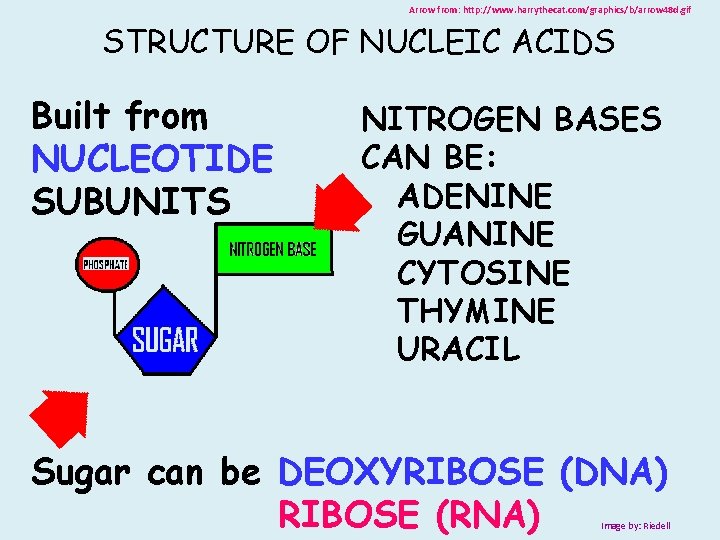
Arrow from: http: //www. harrythecat. com/graphics/b/arrow 48 d. gif STRUCTURE OF NUCLEIC ACIDS Built from NUCLEOTIDE SUBUNITS NITROGEN BASES CAN BE: ADENINE GUANINE CYTOSINE THYMINE URACIL Sugar can be DEOXYRIBOSE (DNA) RIBOSE (RNA) Image by: Riedell
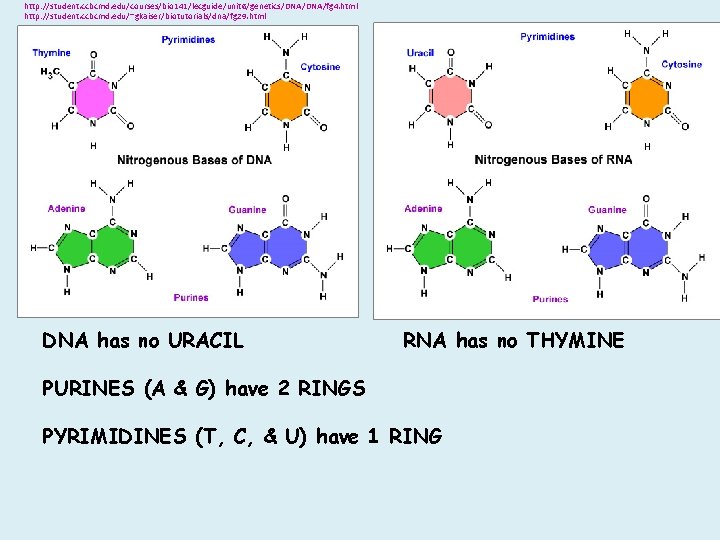
http: //student. ccbcmd. edu/courses/bio 141/lecguide/unit 6/genetics/DNA/fg 4. html http: //student. ccbcmd. edu/~gkaiser/biotutorials/dna/fg 29. html DNA has no URACIL RNA has no THYMINE PURINES (A & G) have 2 RINGS PYRIMIDINES (T, C, & U) have 1 RING
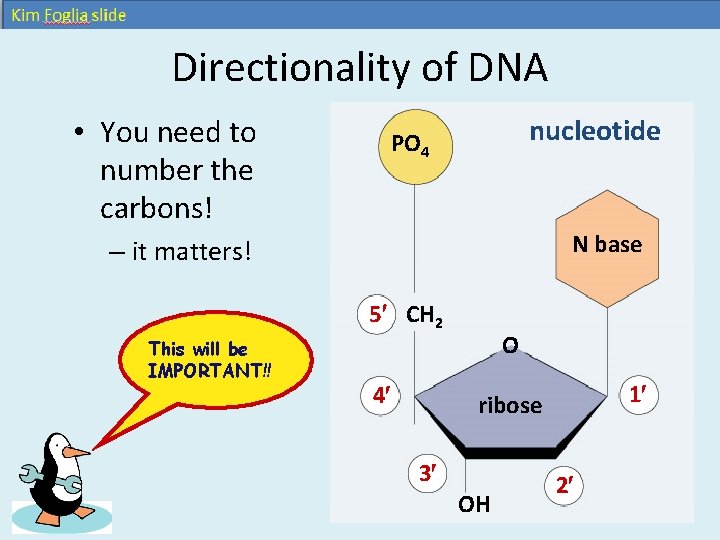
Directionality of DNA • You need to number the carbons! nucleotide PO 4 N base – it matters! 5 CH 2 This will be IMPORTANT!! 4 O 1 ribose 3 OH 2
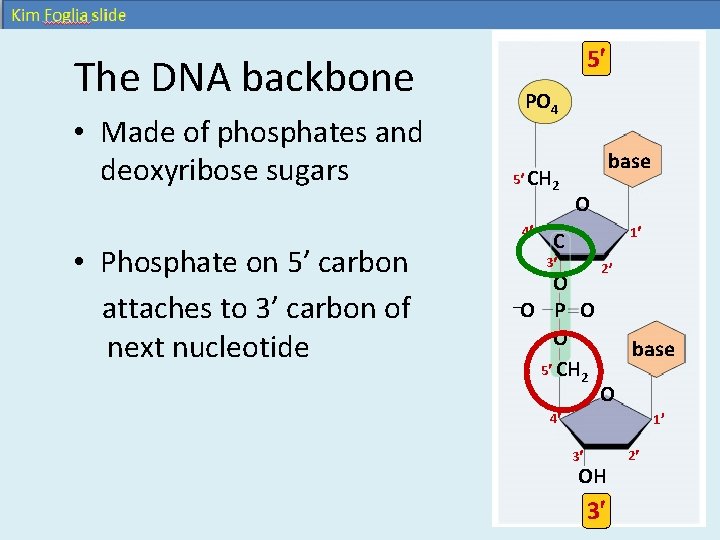
The DNA backbone • Made of phosphates and deoxyribose sugars 5 PO 4 5 CH 2 4 • Phosphate on 5’ carbon attaches to 3’ carbon of next nucleotide base O 1 C 3 O –O P O O 5 CH 2 2 base O 4 1 3 OH 3 2
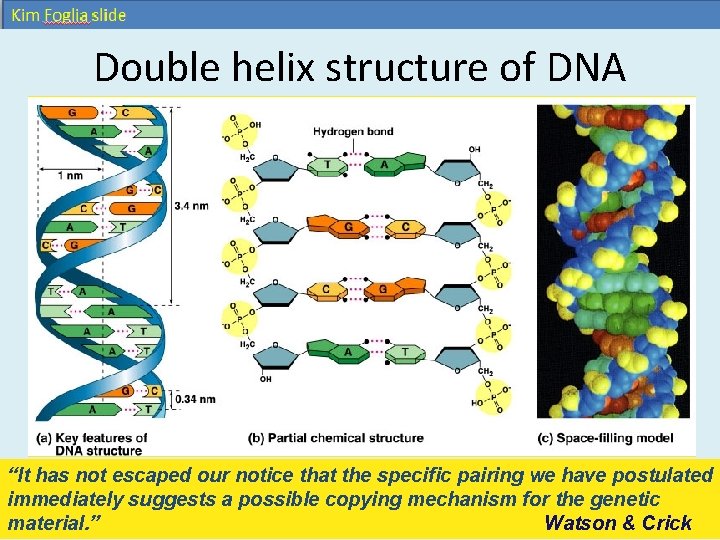
Double helix structure of DNA “It has not escaped our notice that the specific pairing we have postulated immediately suggests a possible copying mechanism for the genetic material. ” Watson & Crick
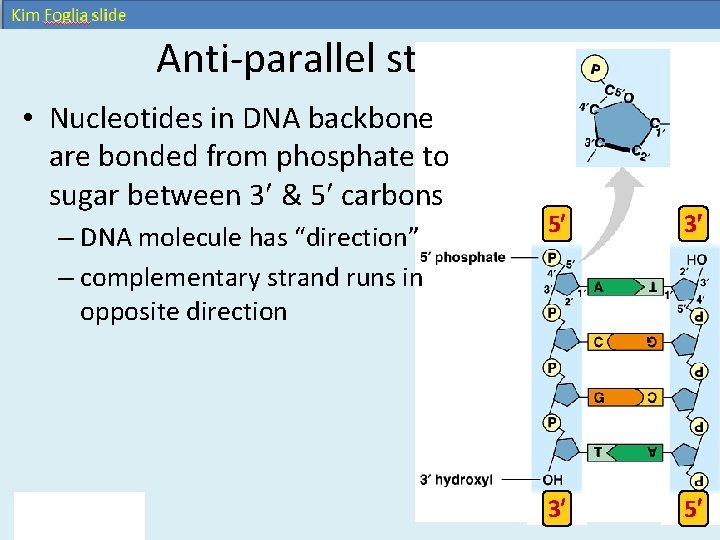
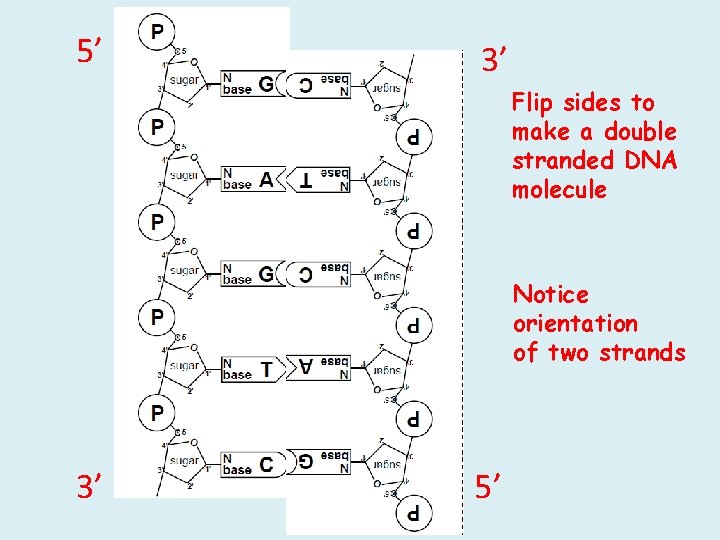
Anti-parallel strands • Nucleotides in DNA backbone are bonded from phosphate to sugar between 3 & 5 carbons – DNA molecule has “direction” – complementary strand runs in opposite direction 5 3 3 5
Bonding in DNA 5 hydrogen bonds 3 covalent phosphodiester bonds 3 …. strong or weak bonds? How do the bonds fit the mechanism for copying DNA? 5
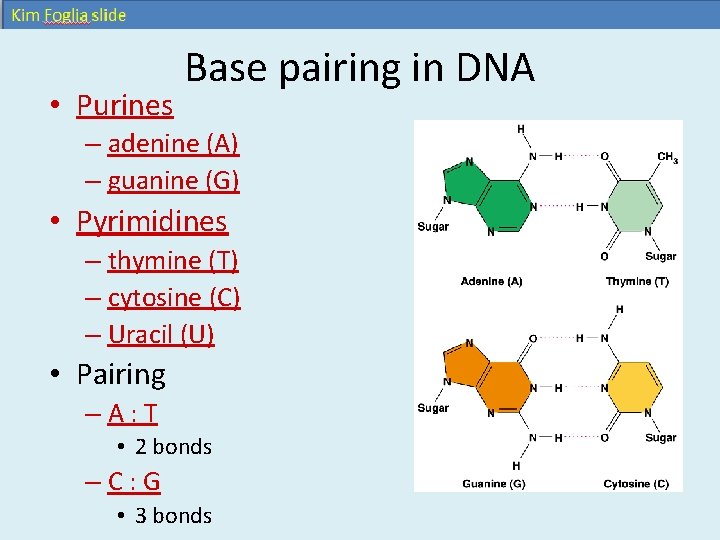
• Purines Base pairing in DNA – adenine (A) – guanine (G) • Pyrimidines – thymine (T) – cytosine (C) – Uracil (U) • Pairing –A: T • 2 bonds –C: G • 3 bonds
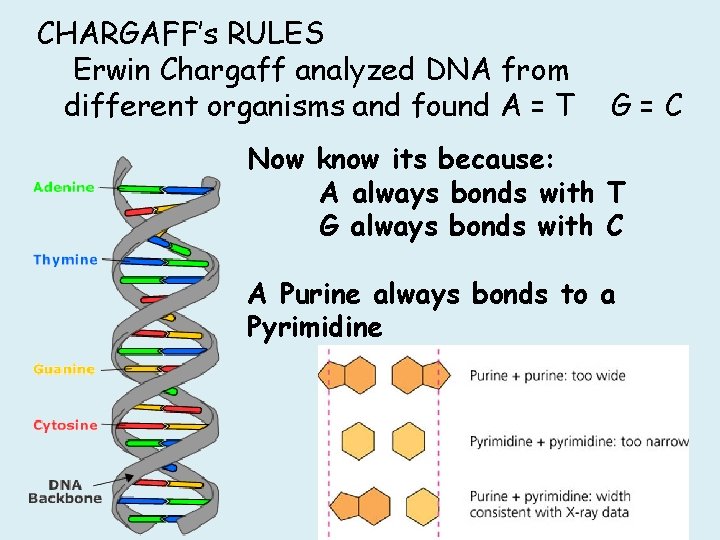
CHARGAFF’s RULES Erwin Chargaff analyzed DNA from different organisms and found A = T G=C Now know its because: A always bonds with T G always bonds with C A Purine always bonds to a Pyrimidine
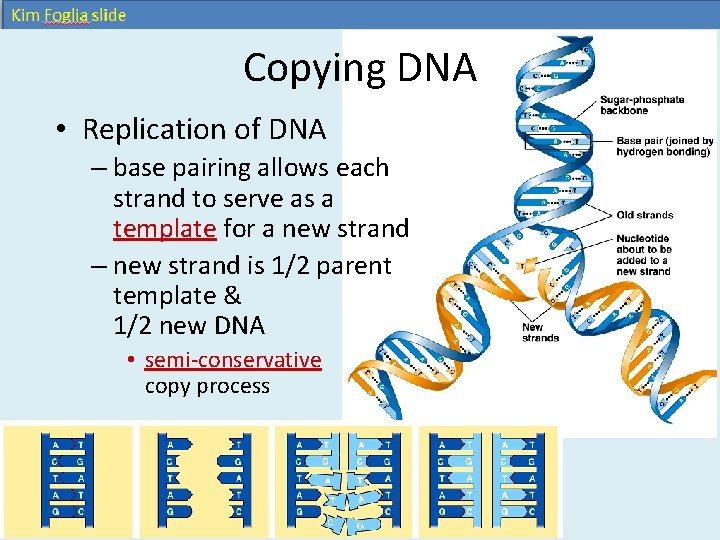
Copying DNA • Replication of DNA – base pairing allows each strand to serve as a template for a new strand – new strand is 1/2 parent template & 1/2 new DNA • semi-conservative copy process
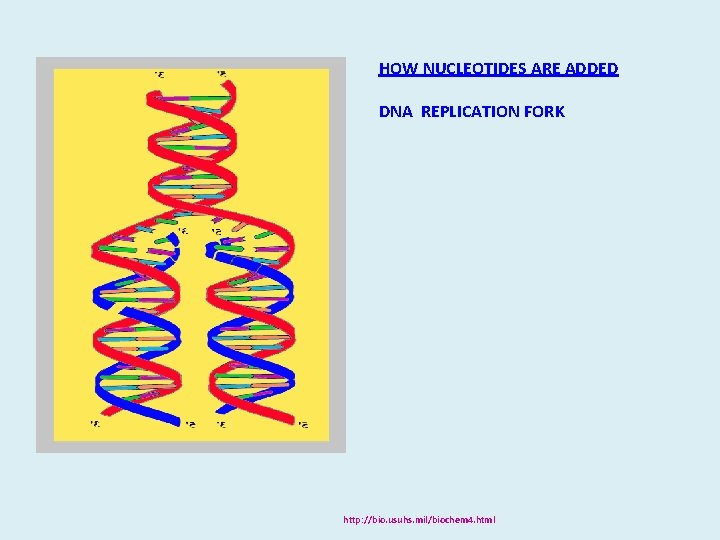
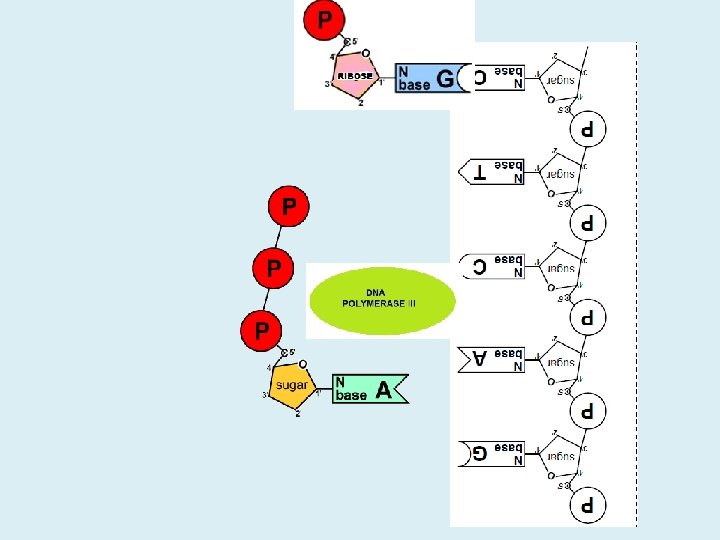
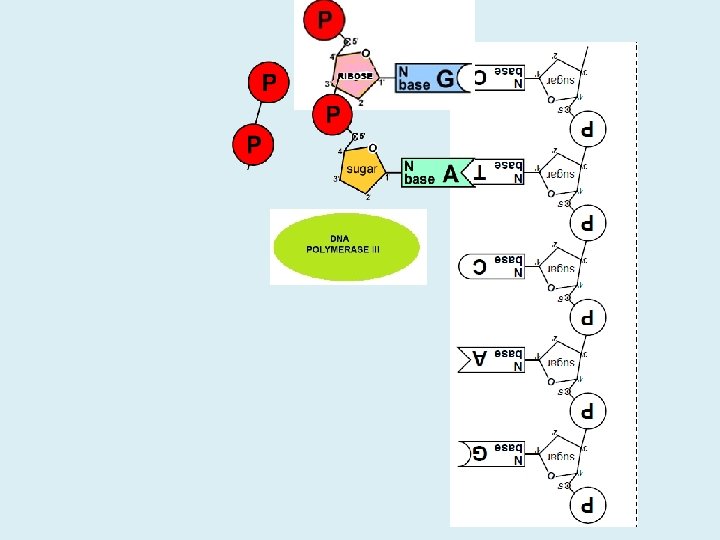
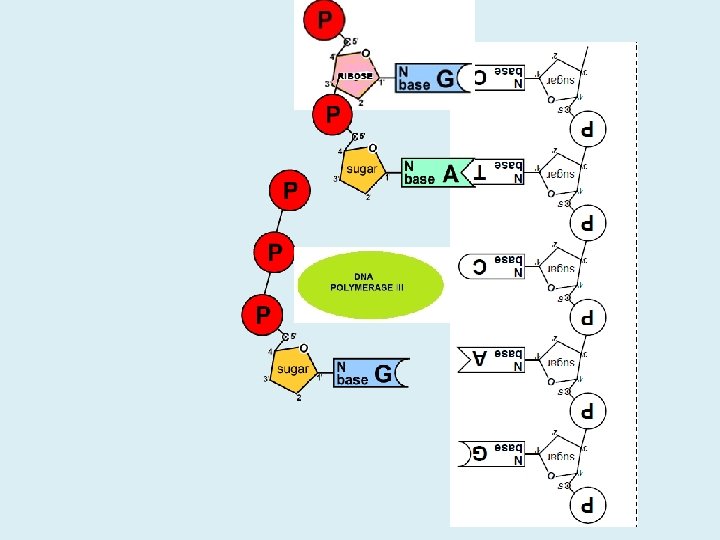
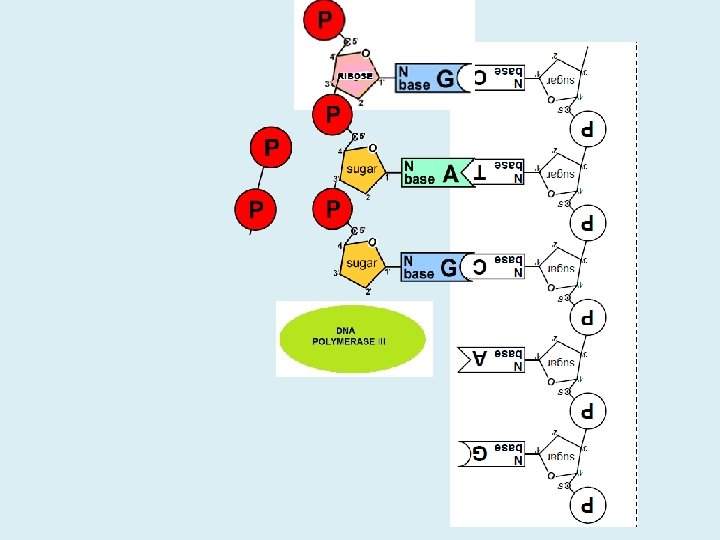
HOW NUCLEOTIDES ARE ADDED DNA REPLICATION FORK http: //bio. usuhs. mil/biochem 4. html
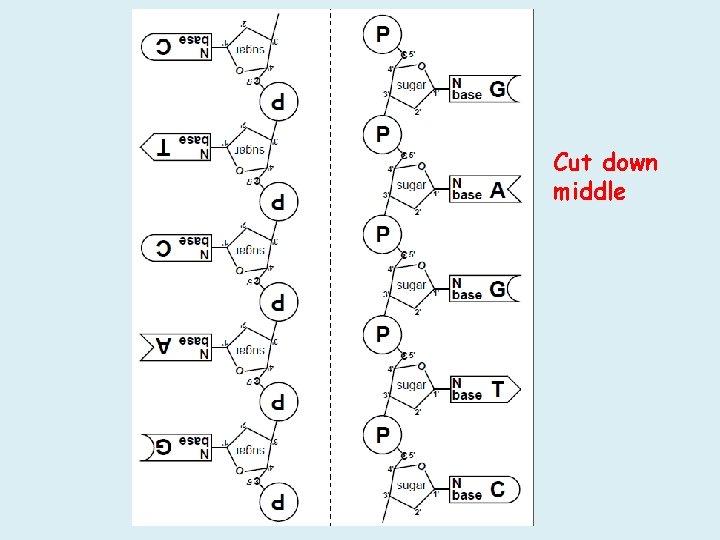
Cut down middle
5’ 3’ Flip sides to make a double stranded DNA molecule Notice orientation of two strands 3’ 5’
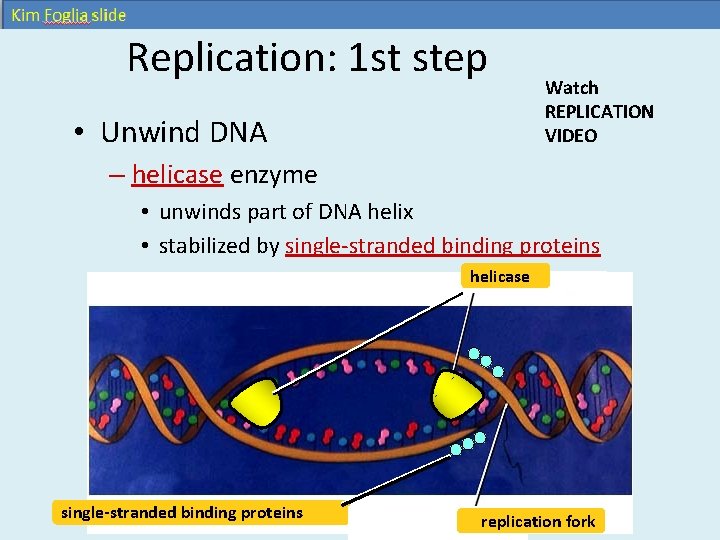
Replication: 1 st step • Unwind DNA Watch REPLICATION VIDEO – helicase enzyme • unwinds part of DNA helix • stabilized by single-stranded binding proteins helicase single-stranded binding proteins replication fork
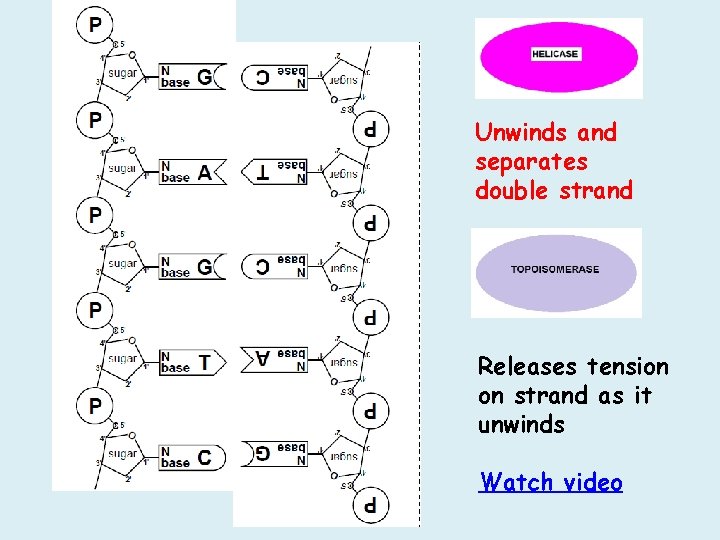
Unwinds and separates double strand Releases tension on strand as it unwinds Watch video
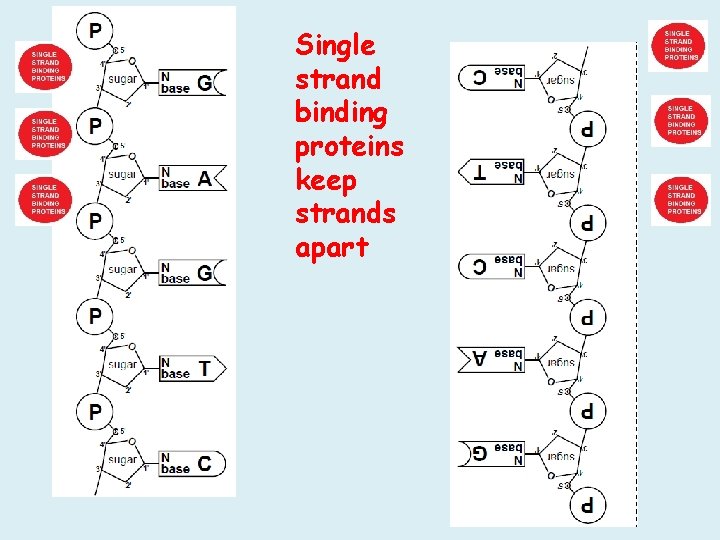
Single strand binding proteins keep strands apart
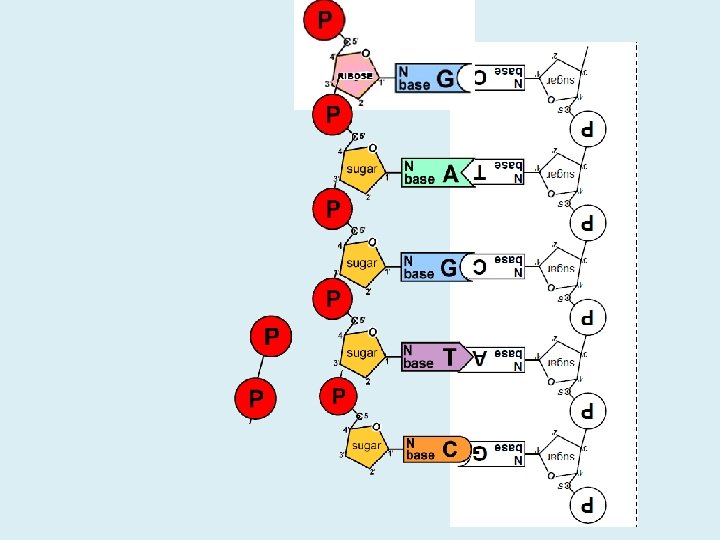
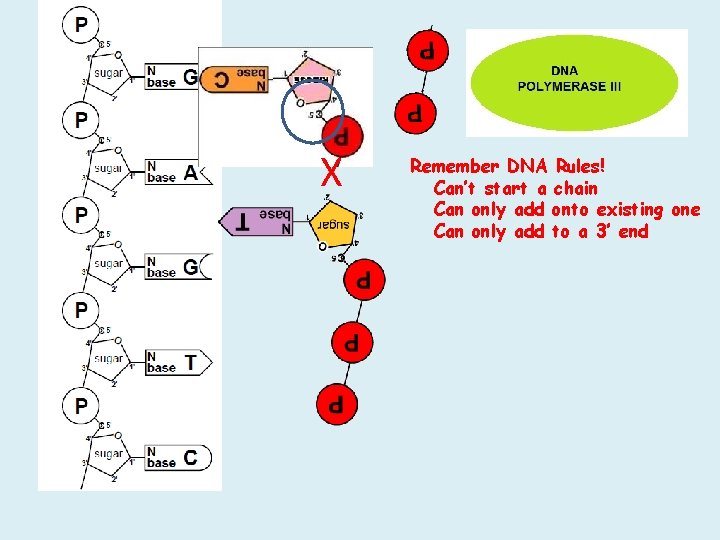
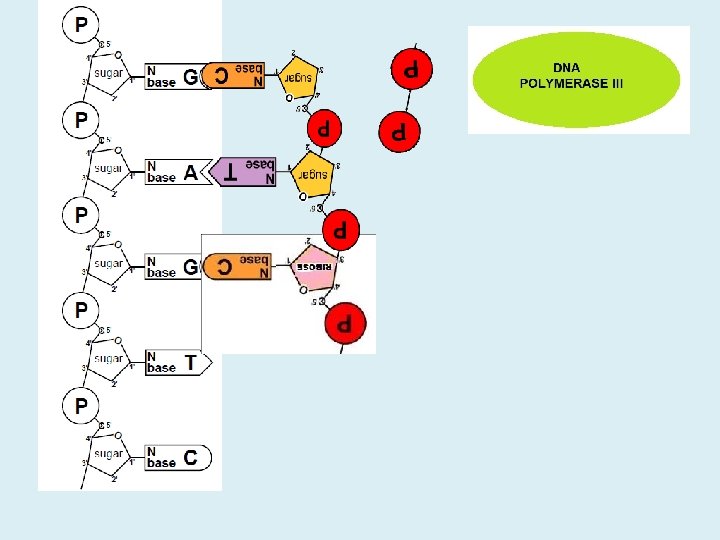
DNA Polymerase RULES • Can’t start a chain • Can only add onto existing one • Can only add to an available 3’ end http: //s 0. pic 4 you. ru/allimage/3634/618671. png
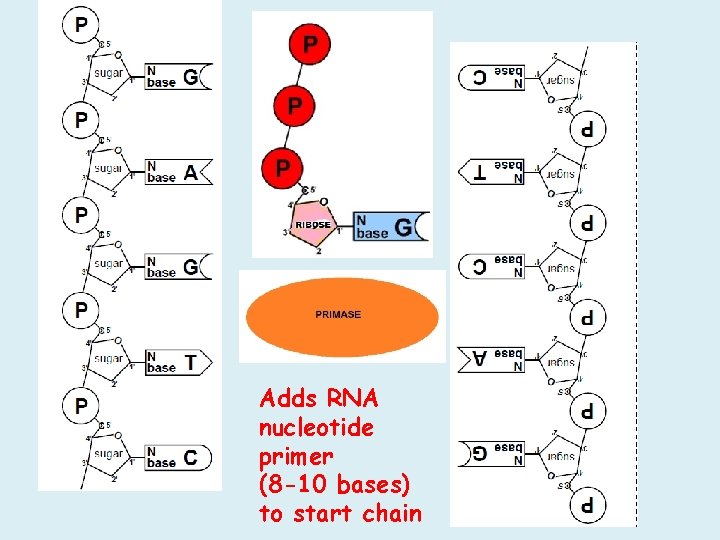
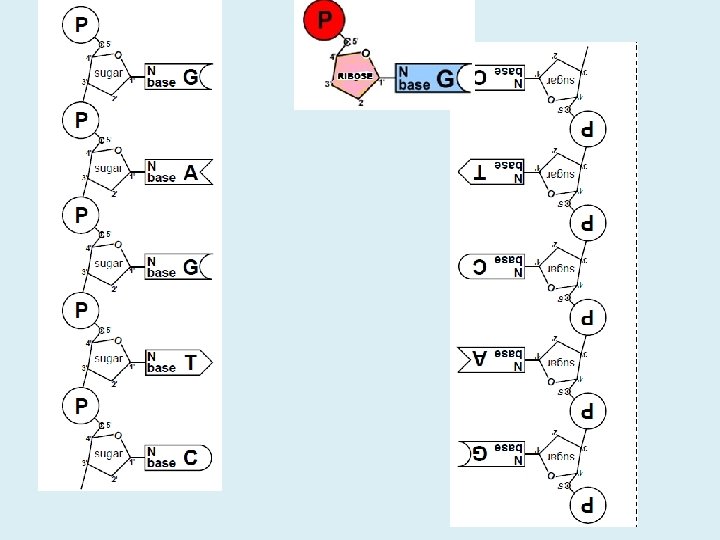
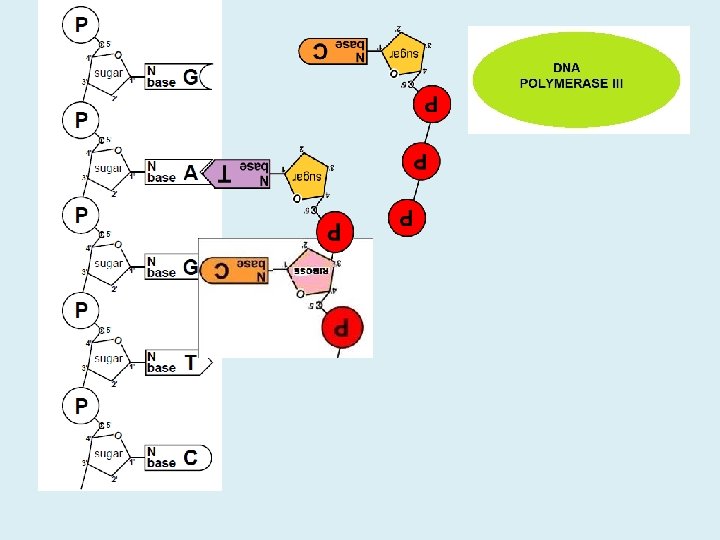
Adds RNA nucleotide primer (8 -10 bases) to start chain
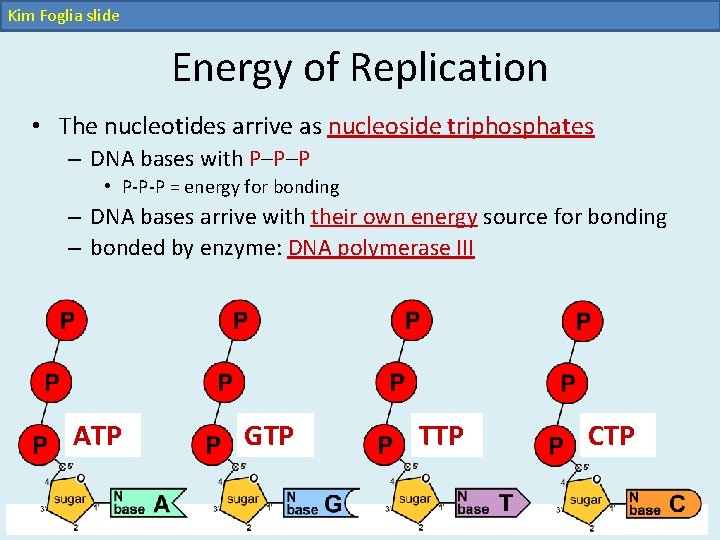
Kim Foglia slide Energy of Replication • The nucleotides arrive as nucleoside triphosphates – DNA bases with P–P–P • P-P-P = energy for bonding – DNA bases arrive with their own energy source for bonding – bonded by enzyme: DNA polymerase III ATP GTP TTP CTP
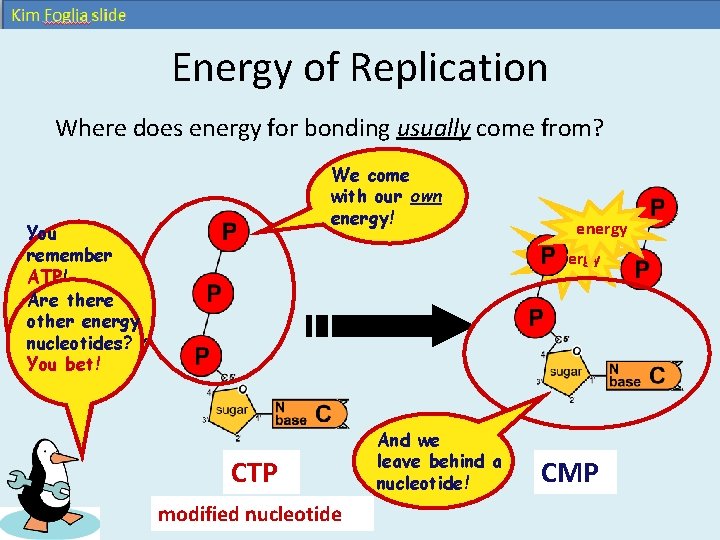
Energy of Replication Where does energy for bonding usually come from? We come with our own energy! You remember ATP! Are there other ways energy to get energy nucleotides? out it? You of bet! energy ATP CTP TTP GTP modified nucleotide And we leave behind a nucleotide! CMP TMP GMP ADP
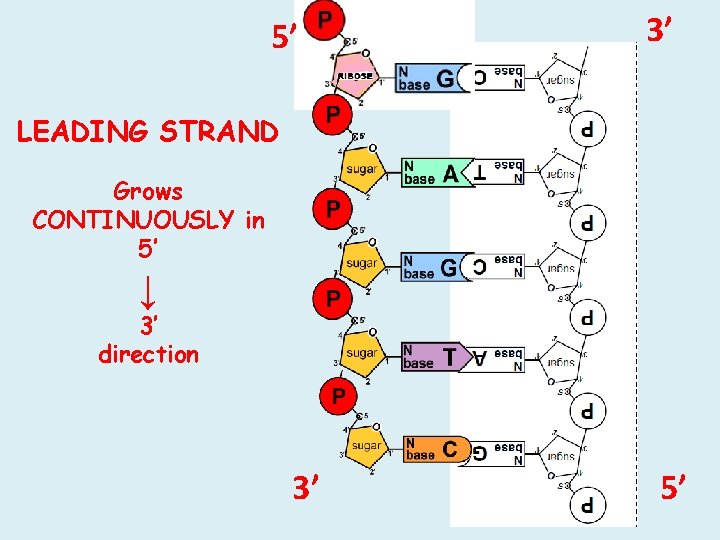
5’ 3’ LEADING STRAND Grows CONTINUOUSLY in 5’ ↓ 3’ direction 3’ 5’
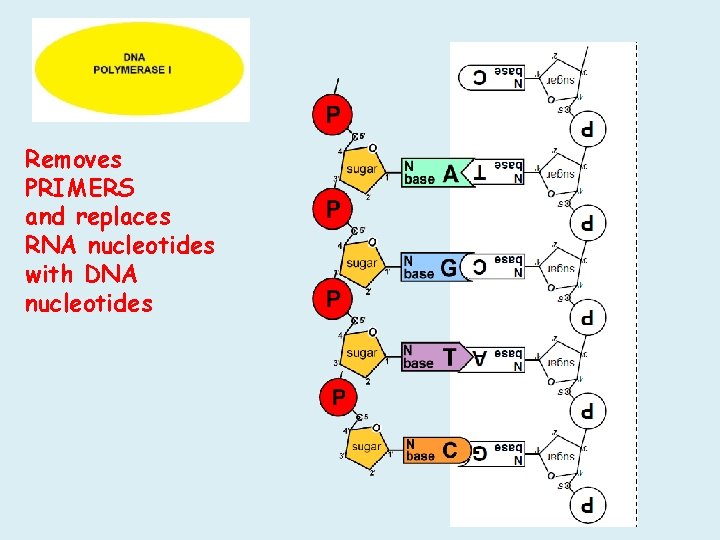
Removes PRIMERS and replaces RNA nucleotides with DNA nucleotides
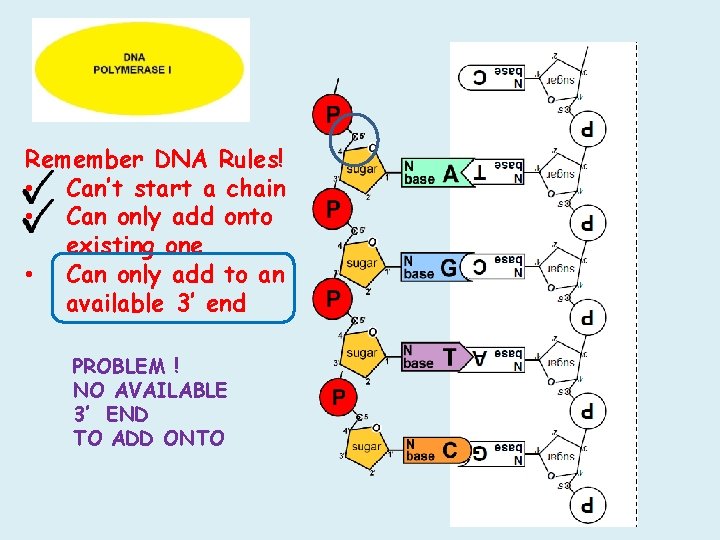
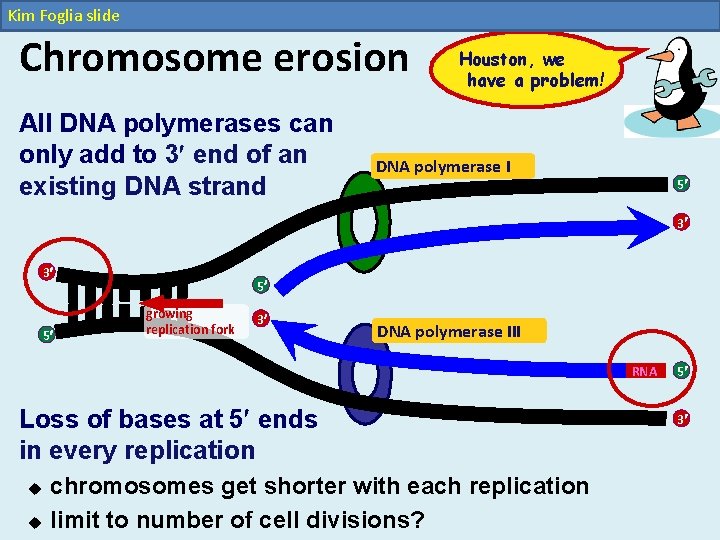
Remember DNA Rules! • Can’t start a chain • Can only add onto existing one • Can only add to an available 3’ end PROBLEM ! NO AVAILABLE 3’ END TO ADD ONTO
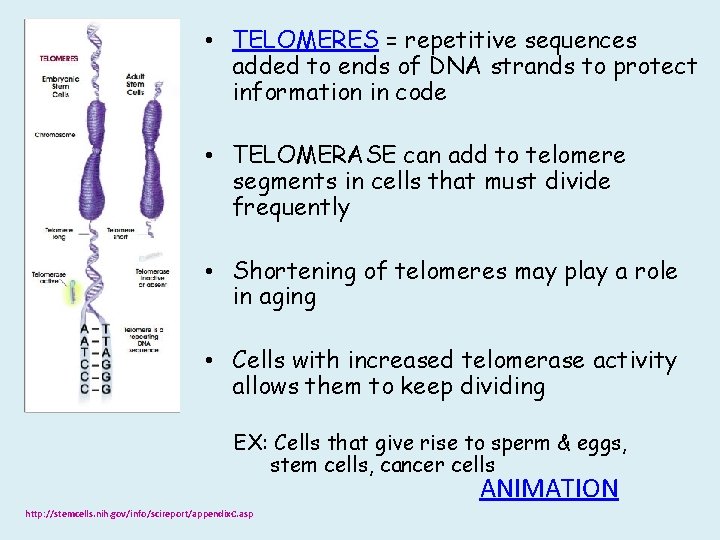
• TELOMERES = repetitive sequences added to ends of DNA strands to protect information in code • TELOMERASE can add to telomere segments in cells that must divide frequently • Shortening of telomeres may play a role in aging • Cells with increased telomerase activity allows them to keep dividing EX: Cells that give rise to sperm & eggs, stem cells, cancer cells ANIMATION http: //stemcells. nih. gov/info/scireport/appendix. C. asp
X Remember DNA Rules! Can’t start a chain Can only add onto existing one Can only add to a 3’ end
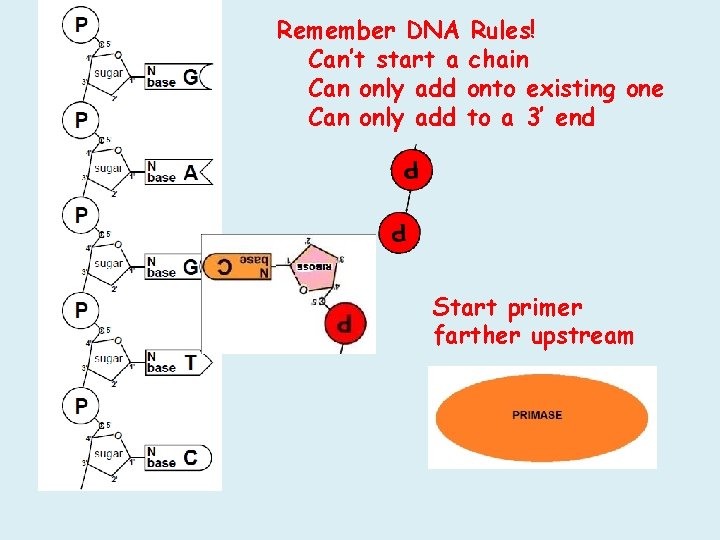
Remember DNA Rules! Can’t start a chain Can only add onto existing one Can only add to a 3’ end Start primer farther upstream
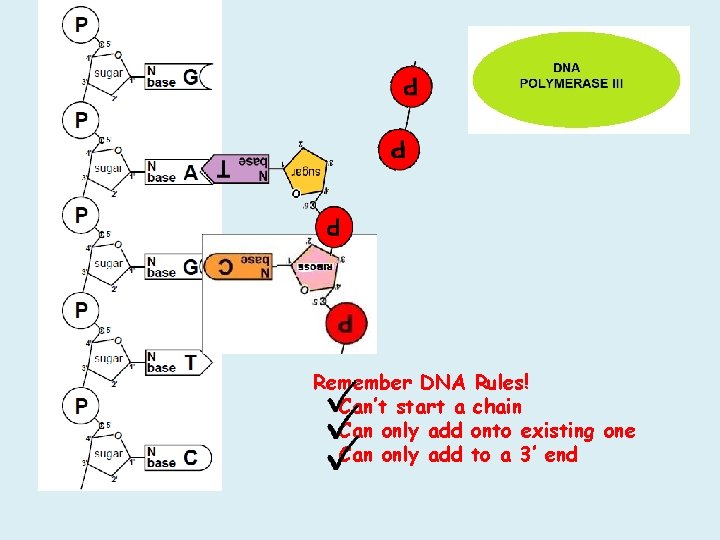
Remember DNA Rules! Can’t start a chain Can only add onto existing one Can only add to a 3’ end
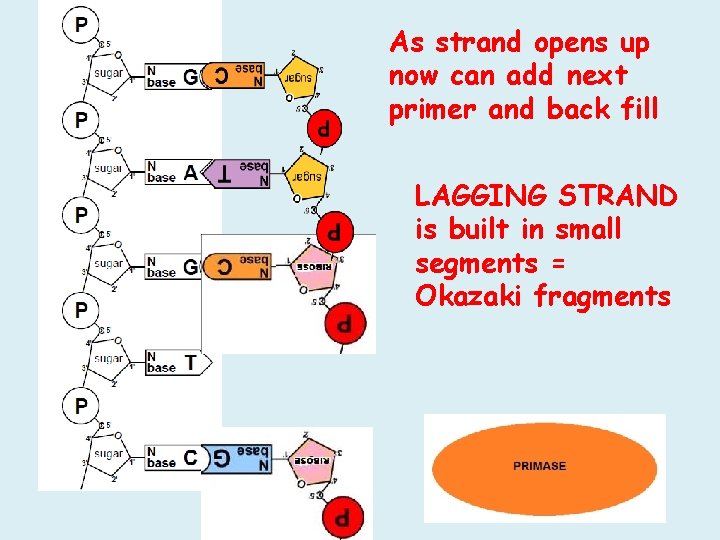
As strand opens up now can add next primer and back fill LAGGING STRAND is built in small segments = Okazaki fragments
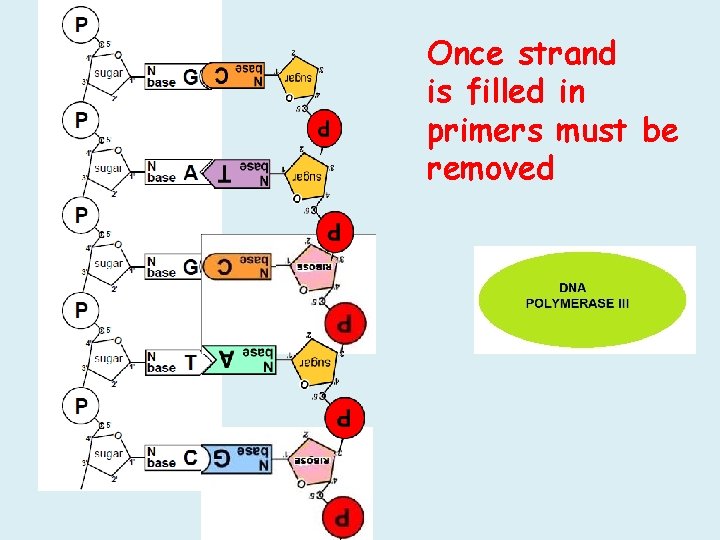
Once strand is filled in primers must be removed
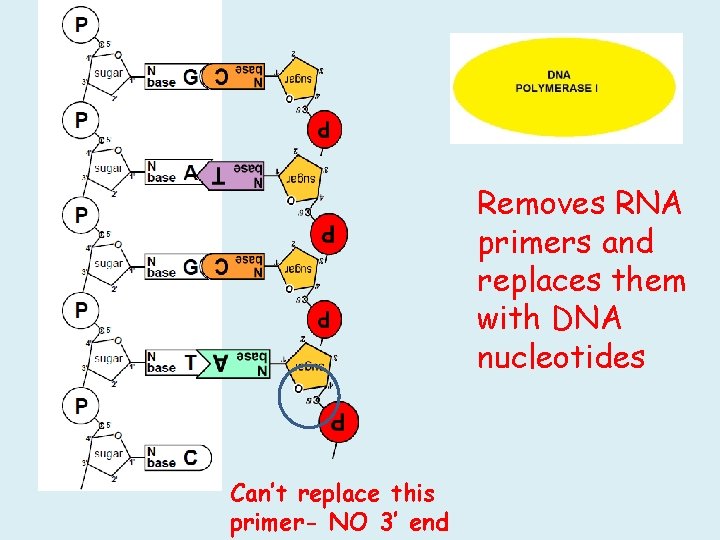
Removes RNA primers and replaces them with DNA nucleotides Can’t replace this primer- NO 3’ end
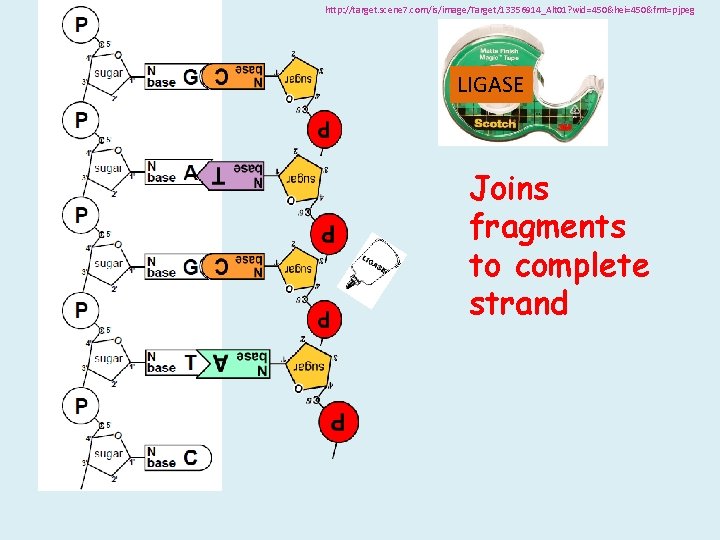
http: //target. scene 7. com/is/image/Target/13356914_Alt 01? wid=450&hei=450&fmt=pjpeg LIGASE Joins fragments to complete strand
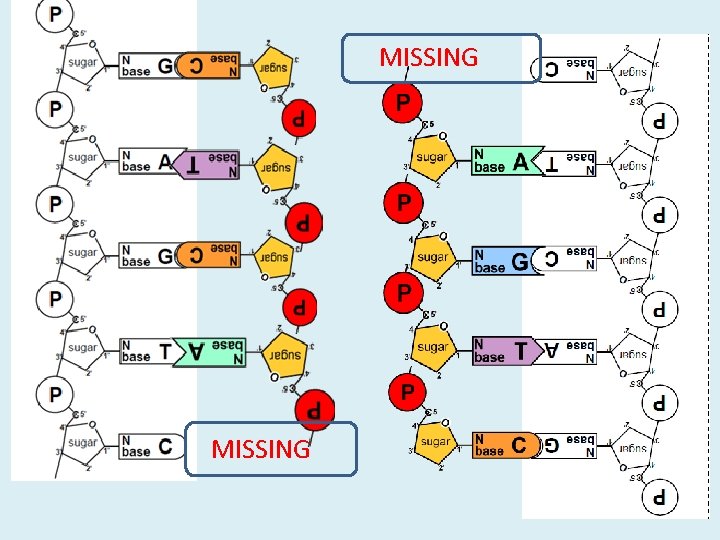
MISSING
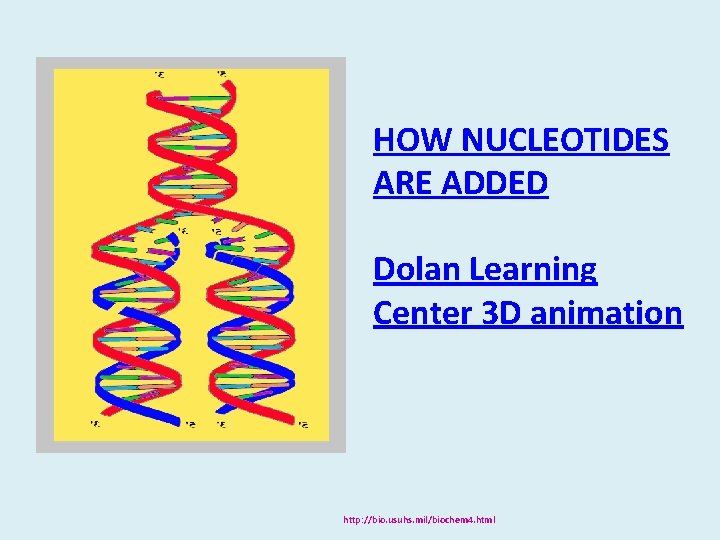
HOW NUCLEOTIDES ARE ADDED Dolan Learning Center 3 D animation http: //bio. usuhs. mil/biochem 4. html
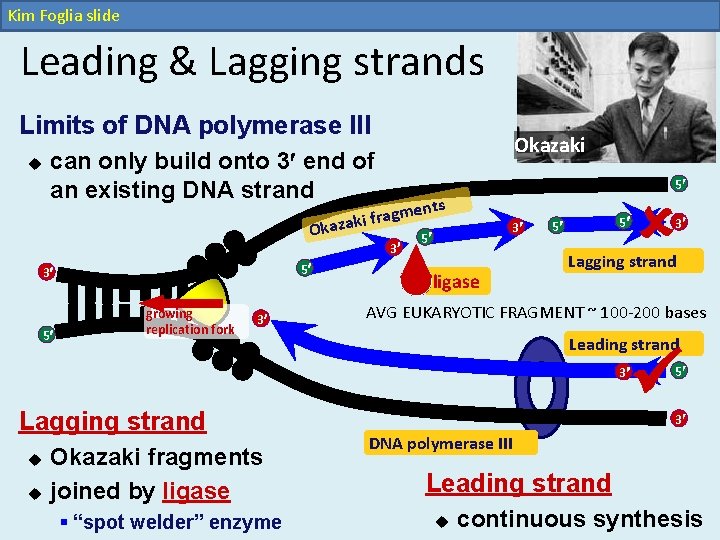
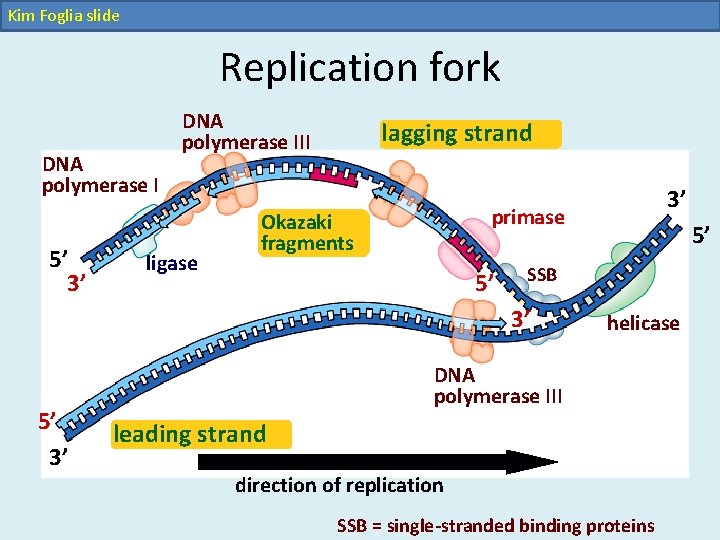
Kim Foglia slide Leading & Lagging strands Limits of DNA polymerase III u Okazaki can only build onto 3 end of an existing DNA strand 5 ent m g a r f i Okazak 3 5 growing replication fork 3 s 3 5 ligase 5 5 Lagging strand AVG EUKARYOTIC FRAGMENT ~ 100 -200 bases Leading strand 3 Lagging strand u u Okazaki fragments joined by ligase § “spot welder” enzyme 3 5 3 DNA polymerase III Leading strand u continuous synthesis
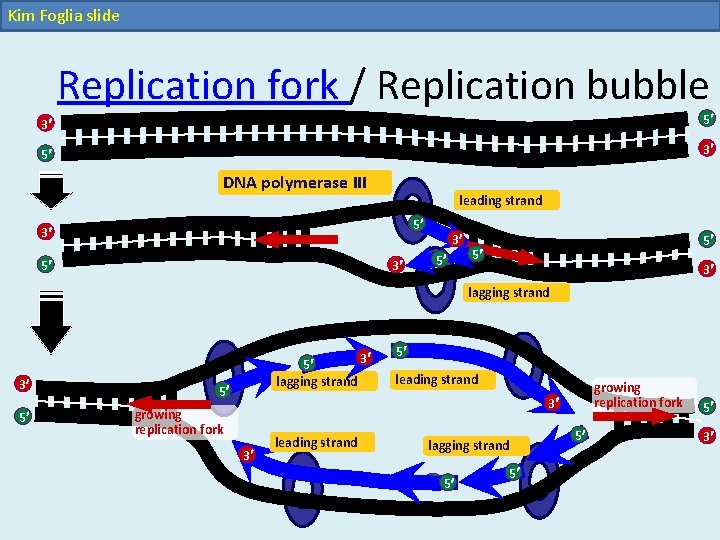
Kim Foglia slide Replication fork / Replication bubble 3 5 5 3 DNA polymerase III leading strand 5 3 3 5 5 5 3 lagging strand 3 5 lagging strand 5 5 leading strand growing replication fork 3 leading strand lagging strand 5 5 5 3
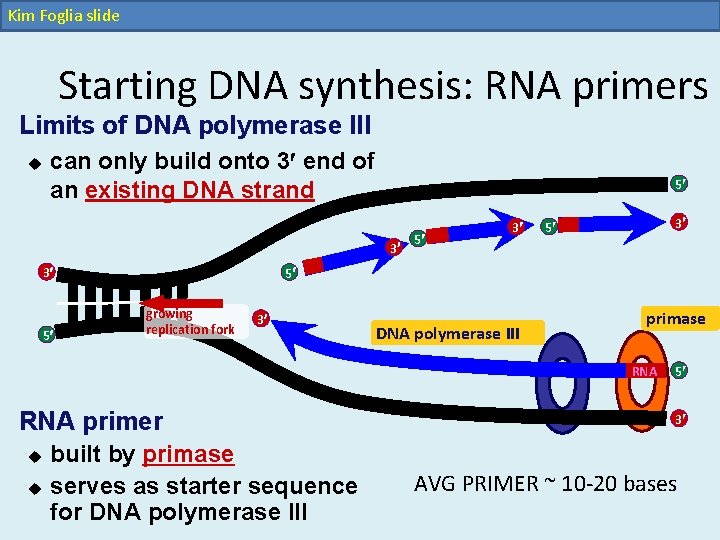
Kim Foglia slide Starting DNA synthesis: RNA primers Limits of DNA polymerase III u can only build onto 3 end of an existing DNA strand 5 3 3 5 5 3 3 5 5 growing replication fork 3 DNA polymerase III primase RNA primer u u built by primase serves as starter sequence for DNA polymerase III 5 3 AVG PRIMER ~ 10 -20 bases
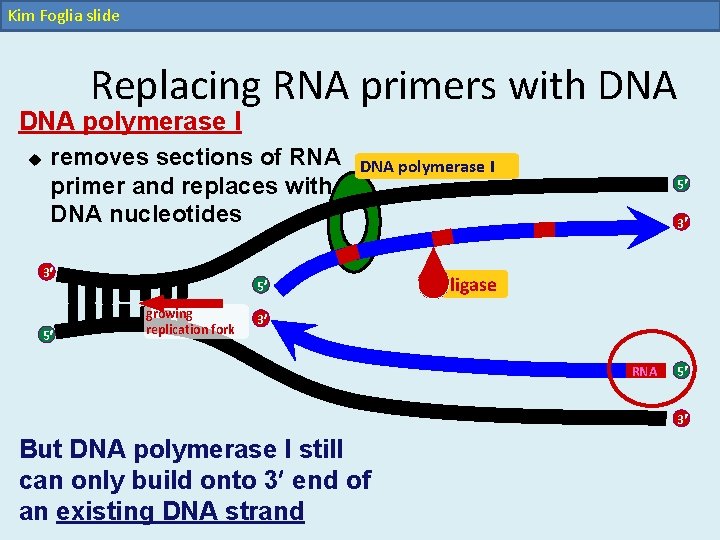
Kim Foglia slide Replacing RNA primers with DNA polymerase I u removes sections of RNA primer and replaces with DNA nucleotides 3 5 DNA polymerase I 5 growing replication fork 5 3 ligase 3 RNA 5 3 But DNA polymerase I still can only build onto 3 end of an existing DNA strand
Kim Foglia slide Chromosome erosion All DNA polymerases can only add to 3 end of an existing DNA strand Houston, we have a problem! DNA polymerase I 5 3 3 5 5 growing replication fork 3 DNA polymerase III RNA Loss of bases at 5 ends in every replication u u chromosomes get shorter with each replication limit to number of cell divisions? 5 3
Kim Foglia slide Replication fork DNA polymerase I 5’ 3’ DNA polymerase III ligase lagging strand primase Okazaki fragments 5’ 5’ SSB 3’ 5’ 3’ 3’ helicase DNA polymerase III leading strand direction of replication SSB = single-stranded binding proteins
Kim Foglia slide DNA polymerases • DNA polymerase III – 1000 bases/second! – main DNA builder Thomas Kornberg • DNA polymerase I – 20 bases/second – editing, repair & primer removal DNA polymerase III enzyme Arthur Kornberg 1959
Kim Foglia slide Fast & accurate! • It takes E. coli <1 hour to copy 5 million base pairs in its single chromosome – divide to form 2 identical daughter cells • Human cell copies its 6 billion bases & divide into daughter cells in only few hours – remarkably accurate – only ~1 error per 100 million bases – ~30 errors per cell cycle
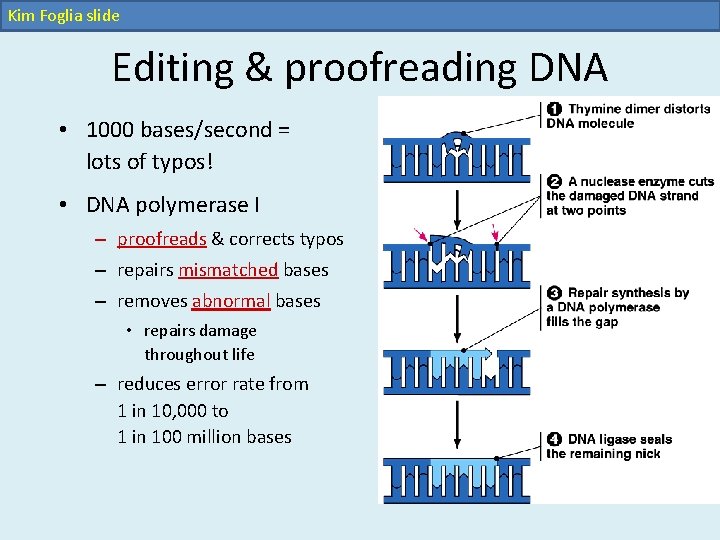
Kim Foglia slide Editing & proofreading DNA • 1000 bases/second = lots of typos! • DNA polymerase I – proofreads & corrects typos – repairs mismatched bases – removes abnormal bases • repairs damage throughout life – reduces error rate from 1 in 10, 000 to 1 in 100 million bases
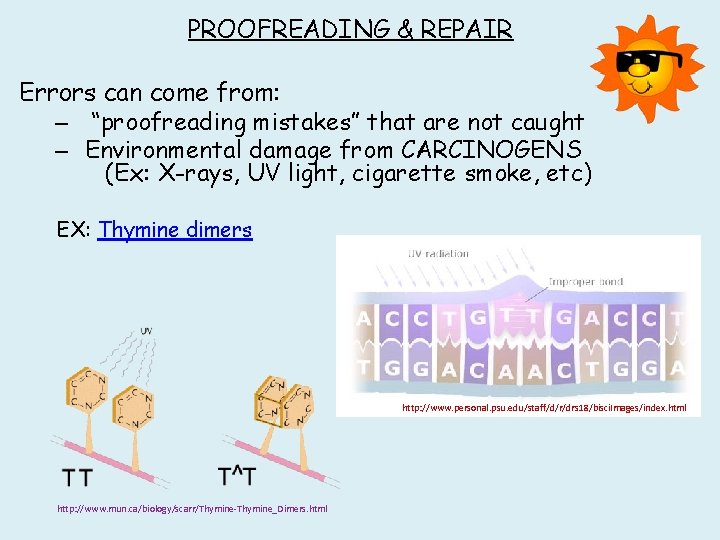
PROOFREADING & REPAIR Errors can come from: – “proofreading mistakes” that are not caught – Environmental damage from CARCINOGENS (Ex: X-rays, UV light, cigarette smoke, etc) EX: Thymine dimers http: //www. personal. psu. edu/staff/d/r/drs 18/bisci. Images/index. html http: //www. mun. ca/biology/scarr/Thymine-Thymine_Dimers. html
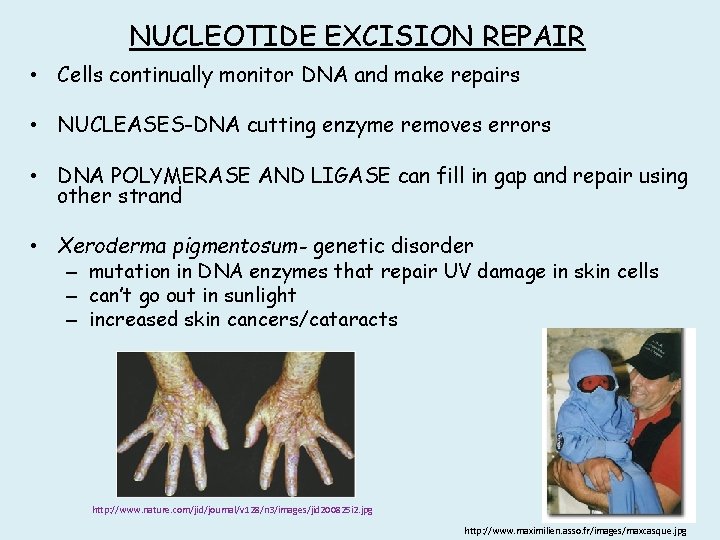
NUCLEOTIDE EXCISION REPAIR • Cells continually monitor DNA and make repairs • NUCLEASES-DNA cutting enzyme removes errors • DNA POLYMERASE AND LIGASE can fill in gap and repair using other strand • Xeroderma pigmentosum- genetic disorder – mutation in DNA enzymes that repair UV damage in skin cells – can’t go out in sunlight – increased skin cancers/cataracts http: //www. nature. com/jid/journal/v 128/n 3/images/jid 200825 i 2. jpg http: //www. maximilien. asso. fr/images/maxcasque. jpg