An Introduction to Hidden Markov Models Zane Goodwin

- Slides: 14
An Introduction to Hidden Markov Models Zane Goodwin 3/20/13 3/20/2013 Zane Goodwin Slide 1 of 12
What is a Hidden Markov Model? • A Hidden Markov Model (HMM) is a type of unsupervised machine learning algorithm. • With respect to genome annotation, HMMs label individual nucleotides with a nucleotide type. Possible nucleotide types include: • Introns • Exons • Splice Sites (3’ and 5’) • HMMs are used in speech recognition, facial recognition and many other applications. 3/20/2013 Zane Goodwin Slide 2 of 12
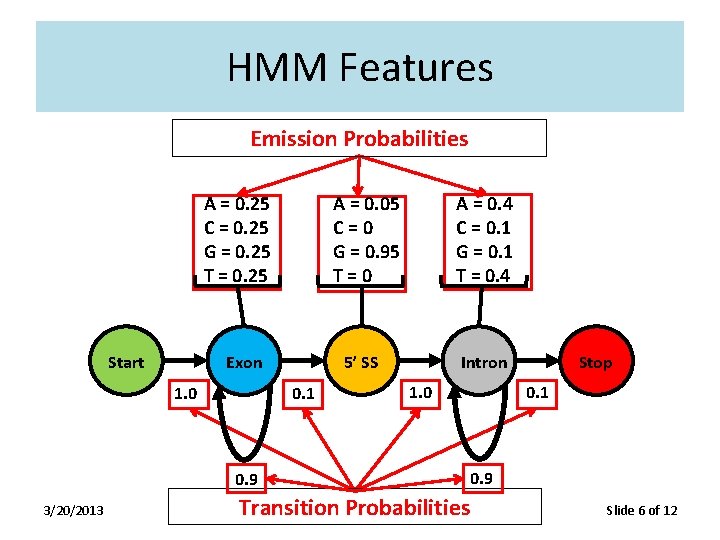
HMM Probabilities • The probability of switching from one nucleotide type to another (ex. Exon Intron) is called a transition probability. • The probability of observing a nucleotide (A, T, C, G) that is of a certain nucleotide type (exon, intron, splice site) is called an emission probability. • Think of an emission probability as the probability of: – Observing an adenine in an exon – Observing an adenine in a splice site 3/20/2013 Zane Goodwin Slide 3 of 12
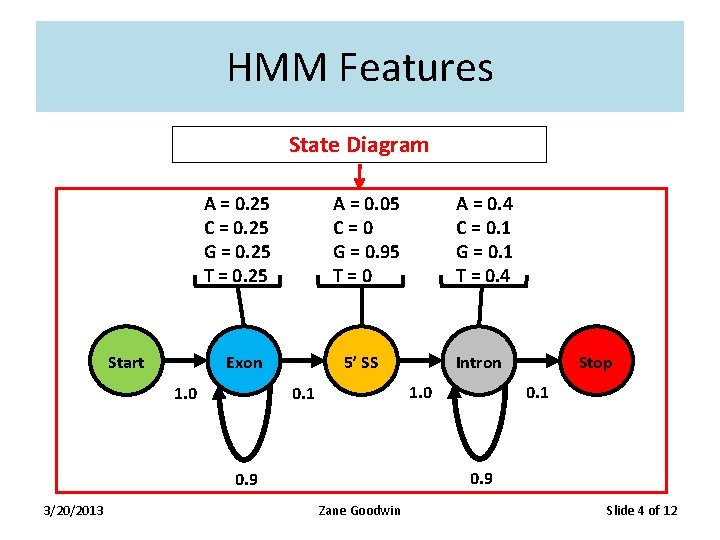
HMM Features State Diagram A = 0. 25 C = 0. 25 G = 0. 25 T = 0. 25 Start A = 0. 05 C=0 G = 0. 95 T=0 Exon 1. 0 5’ SS Intron 1. 0 0. 1 Stop 0. 1 0. 9 3/20/2013 A = 0. 4 C = 0. 1 G = 0. 1 T = 0. 4 Zane Goodwin Slide 4 of 12
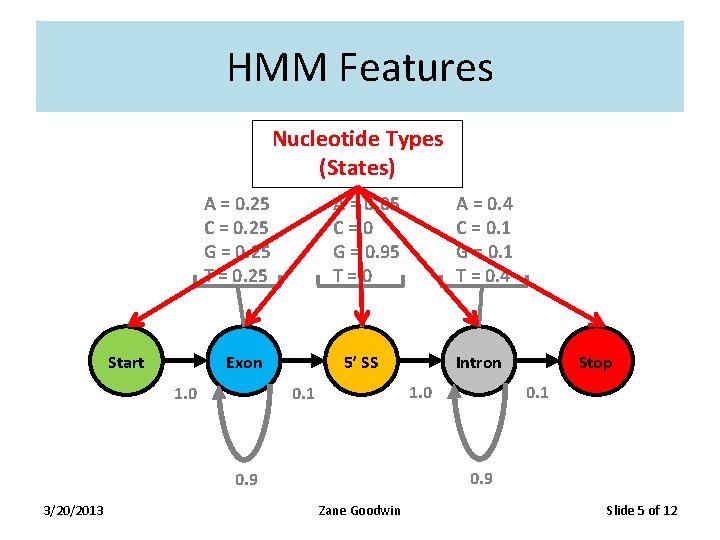
HMM Features Nucleotide Types (States) A = 0. 05 C=0 G = 0. 95 T=0 A = 0. 25 C = 0. 25 G = 0. 25 T = 0. 25 Start Exon 1. 0 5’ SS Intron 1. 0 0. 1 Stop 0. 1 0. 9 3/20/2013 A = 0. 4 C = 0. 1 G = 0. 1 T = 0. 4 Zane Goodwin Slide 5 of 12
HMM Features Emission Probabilities A = 0. 25 C = 0. 25 G = 0. 25 T = 0. 25 Start A = 0. 05 C=0 G = 0. 95 T=0 Exon 1. 0 A = 0. 4 C = 0. 1 G = 0. 1 T = 0. 4 5’ SS 0. 1 Intron 1. 0 0. 9 3/20/2013 Transition Zane. Probabilities Goodwin Stop 0. 1 0. 9 Slide 6 of 12
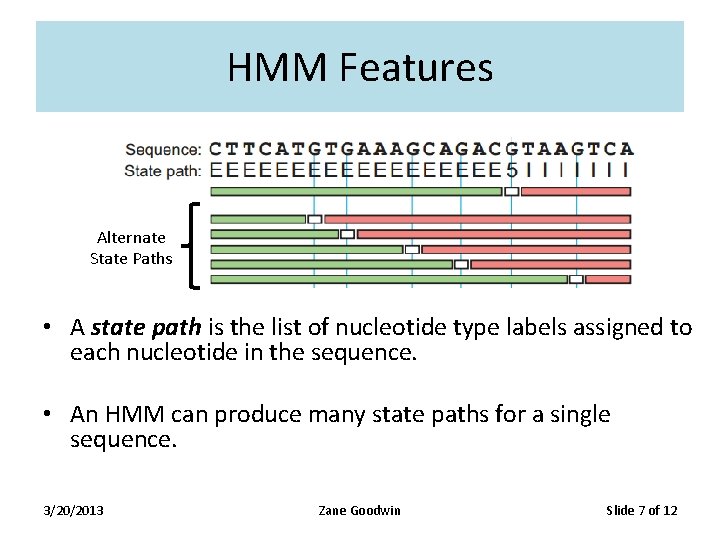
HMM Features Alternate State Paths • A state path is the list of nucleotide type labels assigned to each nucleotide in the sequence. • An HMM can produce many state paths for a single sequence. 3/20/2013 Zane Goodwin Slide 7 of 12
Determining the Correct State Path • A HMM will produce many state paths for one sequence, but how do we measure which state path is likely to be correct? • One way is to calculate the probability of each state path. • State path probabilities are calculated by multiplying all transition and emission probabilities in the state path. • The state path with the highest probability is most likely the correct state path. 3/20/2013 Zane Goodwin Slide 8 of 12
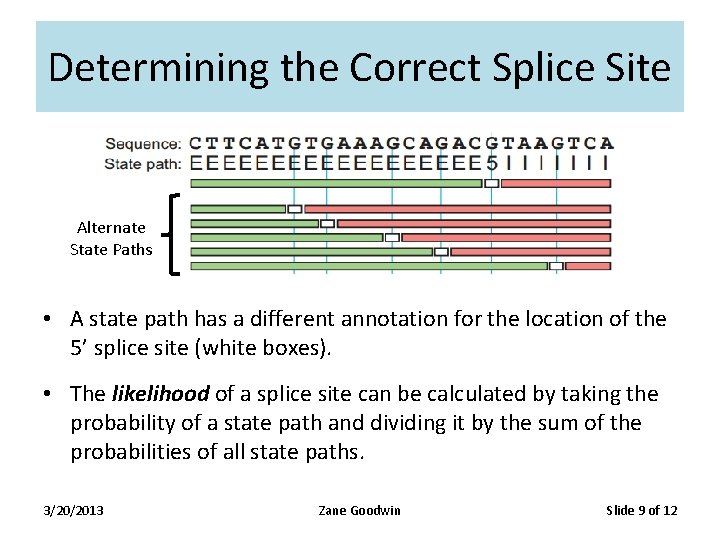
Determining the Correct Splice Site Alternate State Paths • A state path has a different annotation for the location of the 5’ splice site (white boxes). • The likelihood of a splice site can be calculated by taking the probability of a state path and dividing it by the sum of the probabilities of all state paths. 3/20/2013 Zane Goodwin Slide 9 of 12
HMMs and Gene Prediction • Hidden Markov Models are the core of a number of gene prediction algorithms. • GENSCAN • Augustus • Gene. Id • Genemark • GRAIL • Twinscan 3/20/2013 Zane Goodwin Slide 10 of 12
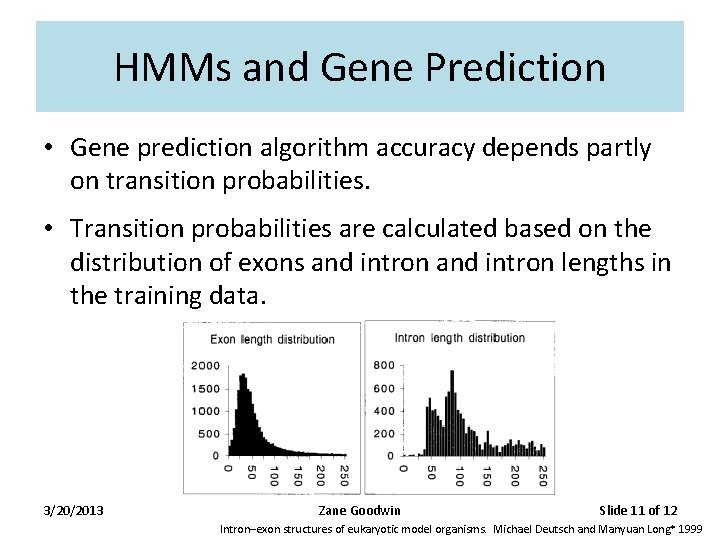
HMMs and Gene Prediction • Gene prediction algorithm accuracy depends partly on transition probabilities. • Transition probabilities are calculated based on the distribution of exons and intron lengths in the training data. 3/20/2013 Zane Goodwin Slide 11 of 12 Intron–exon structures of eukaryotic model organisms. Michael Deutsch and Manyuan Long* 1999
Conclusions • Hidden Markov Models have proven to be useful for finding genes in unlabeled genomic sequence. • Hidden Markov Models are machine learning algorithms that have nucleotide types, transition probabilities and emission probabilities. • Hidden Markov Models label a series of observations with a state path, and they can create multiple state paths. • It is mathematically possible to determine state paths that are likely to be correct. 3/20/2013 Zane Goodwin Slide 12 of 12
Challenges • How do transition probabilities affect the length of predicted ORFs? • How do emission probabilities for specific states affect the accuracy of splice site predictions? • Do gene predictions give the final word on correct splice sites? What other pieces of information would be useful for annotating genes? 3/20/2013 Zane Goodwin Slide 13 of 12
Questions? 3/20/2013 Zane Goodwin Slide 14 of 12