Amines Dr Shatha I Alaqeel 108 Chem Learning

- Slides: 20
Amines Dr. Shatha I Alaqeel 108 Chem
Learning Objectives Chapter ten discusses the amines and by the end of this chapter the students will: o Know the structure and classification of amines o Know the naming rules for amines. o Know the physical properties of amines o Know the effect of lone pair of electrons of N atom on basic properties of amines o Know the different methods used in synthesis of amines o Know the reactions of amines; in addition to behaving as bases amines can be nucleophiles. 108 Chem
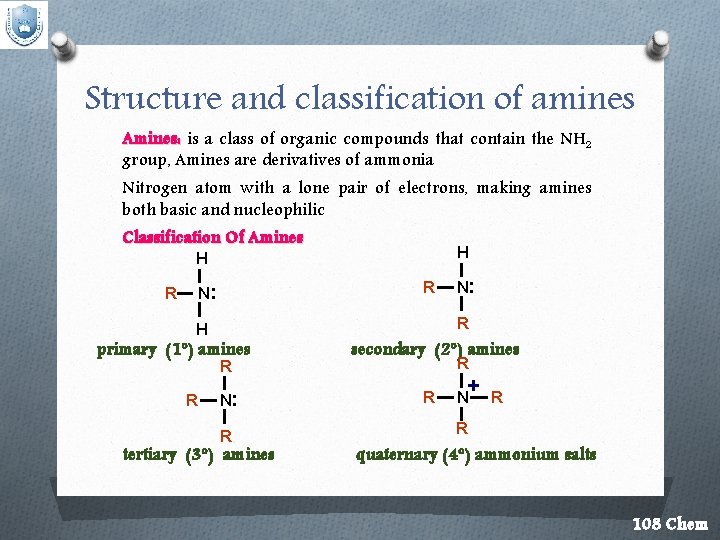
Structure and classification of amines Amines: is a class of organic compounds that contain the NH 2 group, Amines are derivatives of ammonia Nitrogen atom with a lone pair of electrons, making amines both basic and nucleophilic Classification Of Amines H H R N: R R H primary (1°) amines R R N: R tertiary (3°) amines secondary (2°) amines R R + N R R quaternary (4°) ammonium salts 108 Chem
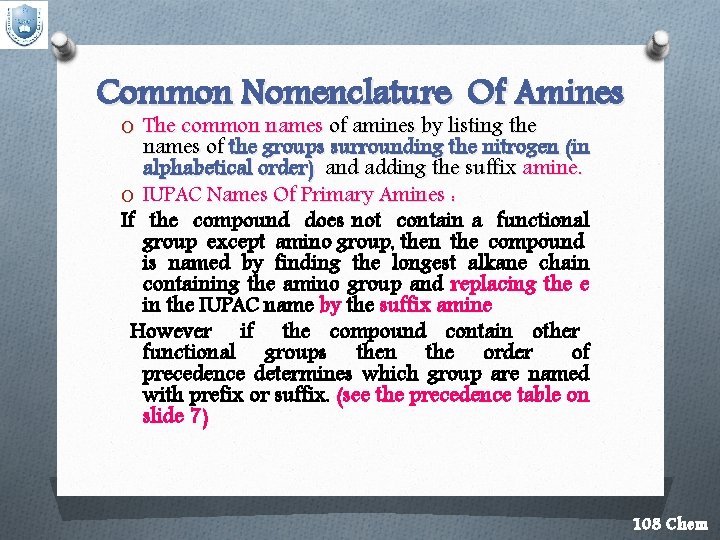
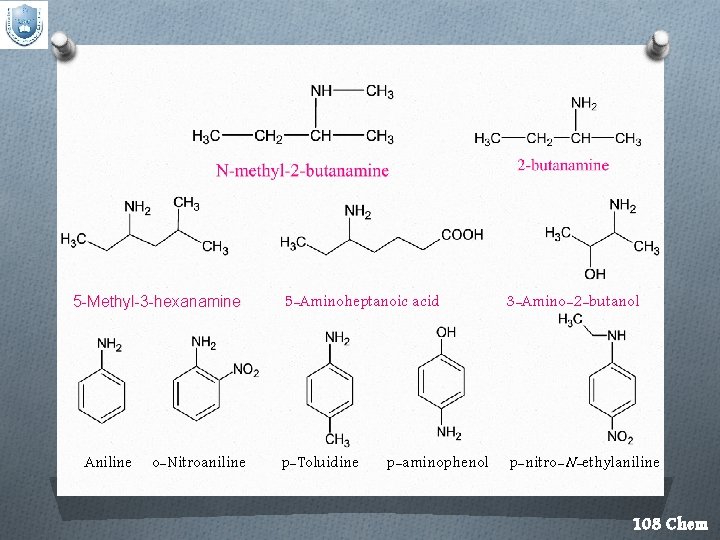
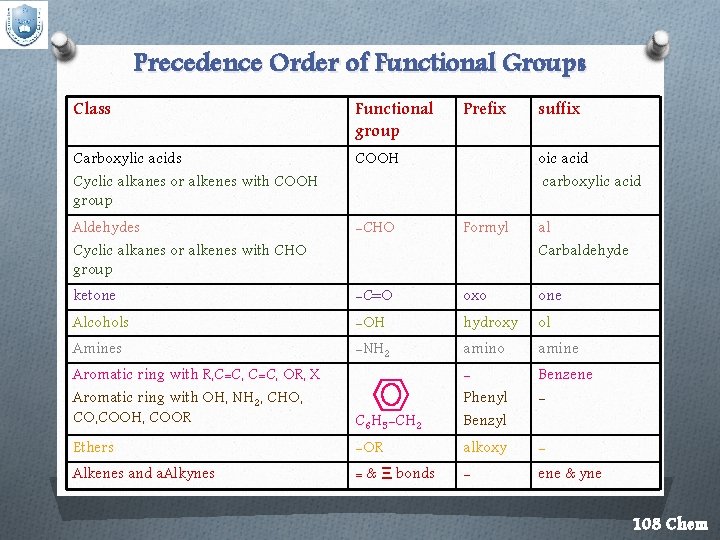
Common Nomenclature Of Amines O The common names of amines by listing the names of the groups surrounding the nitrogen (in alphabetical order) and adding the suffix amine. O IUPAC Names Of Primary Amines : If the compound does not contain a functional group except amino group, then the compound is named by finding the longest alkane chain containing the amino group and replacing the e in the IUPAC name by the suffix amine However if the compound contain other functional groups then the order of precedence determines which group are named with prefix or suffix. (see the precedence table on slide 7) 108 Chem
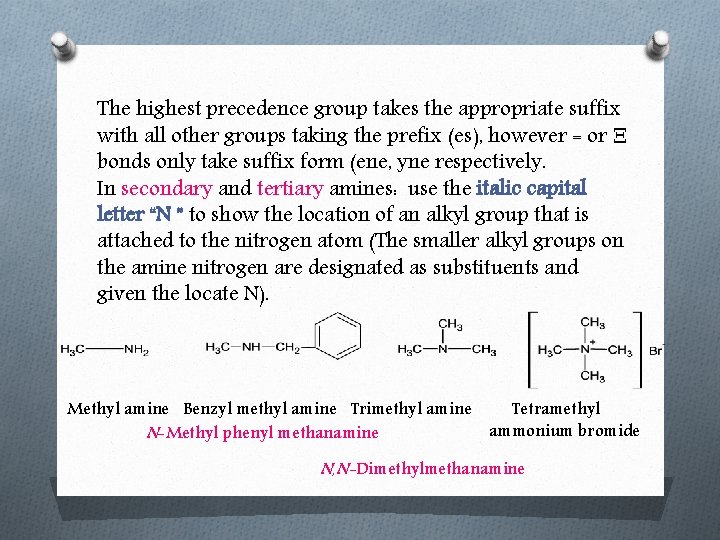
The highest precedence group takes the appropriate suffix with all other groups taking the prefix (es), however = or Ξ bonds only take suffix form (ene, yne respectively. In secondary and tertiary amines: use the italic capital letter “N ” to show the location of an alkyl group that is attached to the nitrogen atom (The smaller alkyl groups on the amine nitrogen are designated as substituents and given the locate N). Methyl amine Benzyl methyl amine Trimethyl amine Tetramethyl ammonium bromide N-Methyl phenyl methanamine N, N-Dimethylmethanamine
5 -Methyl-3 -hexanamine Aniline o-Nitroaniline 5 -Aminoheptanoic acid 3 -Amino-2 -butanol p-Toluidine p-nitro-N-ethylaniline p-aminophenol 108 Chem
Precedence Order of Functional Groups Class Functional group Prefix suffix Carboxylic acids Cyclic alkanes or alkenes with COOH group COOH Aldehydes Cyclic alkanes or alkenes with CHO group -CHO Formyl al Carbaldehyde ketone -C=O oxo one Alcohols -OH hydroxy ol Amines -NH 2 amino amine Aromatic ring with R, C=C, OR, X Aromatic ring with OH, NH 2, CHO, COOH, COOR C 6 H 5 -CH 2 Phenyl Benzene - Ethers -OR alkoxy - Alkenes and a. Alkynes = & Ξ bonds - ene & yne oic acid carboxylic acid 108 Chem
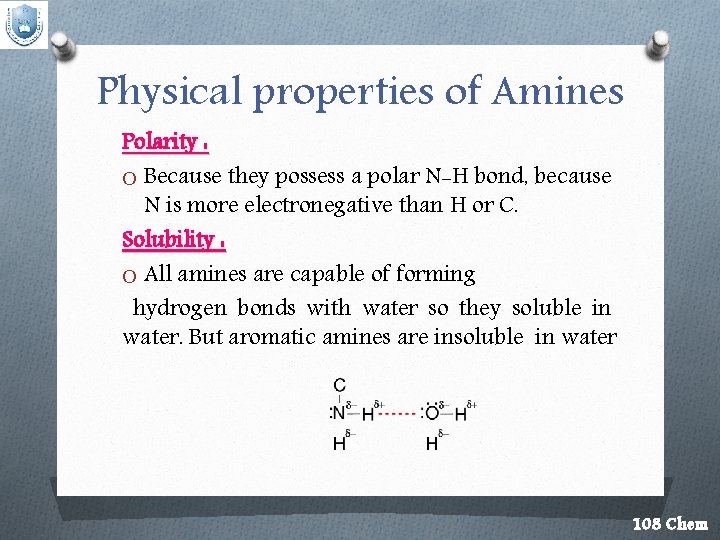
Physical properties of Amines Polarity : O Because they possess a polar N-H bond, because N is more electronegative than H or C. Solubility : O All amines are capable of forming hydrogen bonds with water so they soluble in water. But aromatic amines are insoluble in water 108 Chem
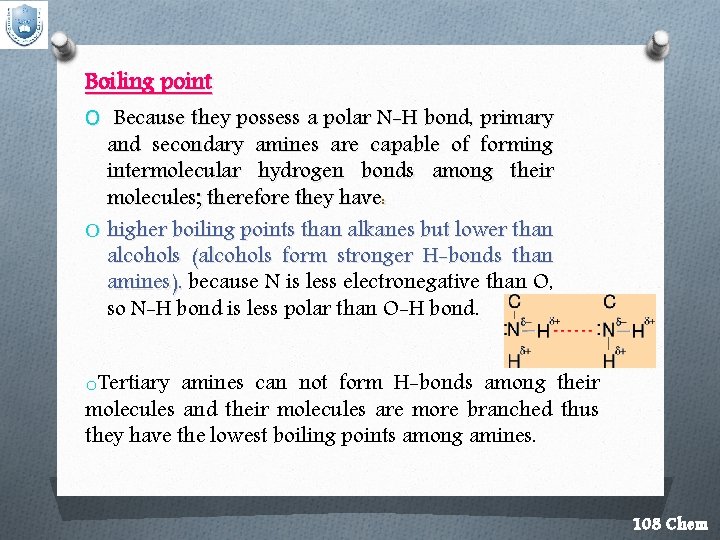
Boiling point O Because they possess a polar N-H bond, primary and secondary amines are capable of forming intermolecular hydrogen bonds among their molecules; therefore they have: O higher boiling points than alkanes but lower than alcohols (alcohols form stronger H-bonds than amines). because N is less electronegative than O, so N-H bond is less polar than O-H bond. o. Tertiary amines can not form H-bonds among their molecules and their molecules are more branched thus they have the lowest boiling points among amines. 108 Chem
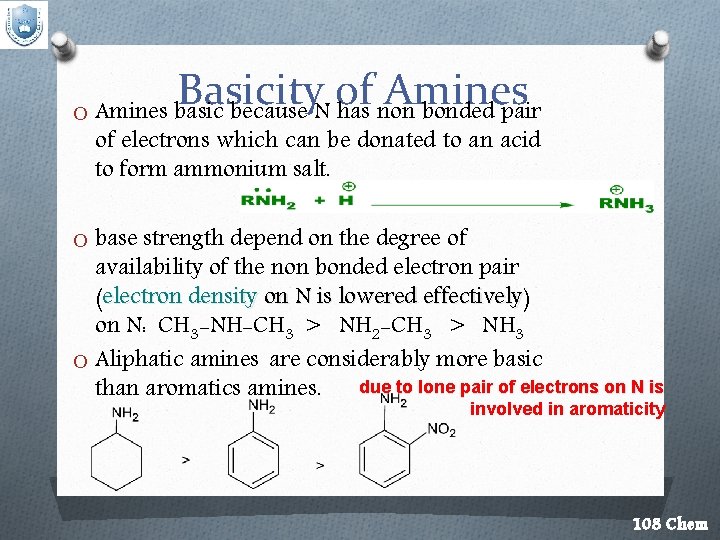
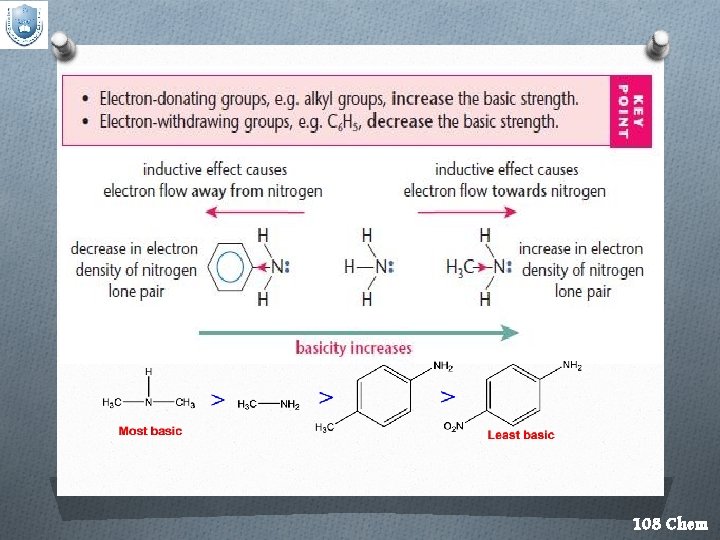
Basicity of Amines O Amines basic because N has non bonded pair of electrons which can be donated to an acid to form ammonium salt. O base strength depend on the degree of availability of the non bonded electron pair (electron density on N is lowered effectively) effectively on N: CH 3 -NH-CH 3 > NH 2 -CH 3 > NH 3 O Aliphatic amines are considerably more basic due to lone pair of electrons on N is than aromatics amines. involved in aromaticity 108 Chem
108 Chem
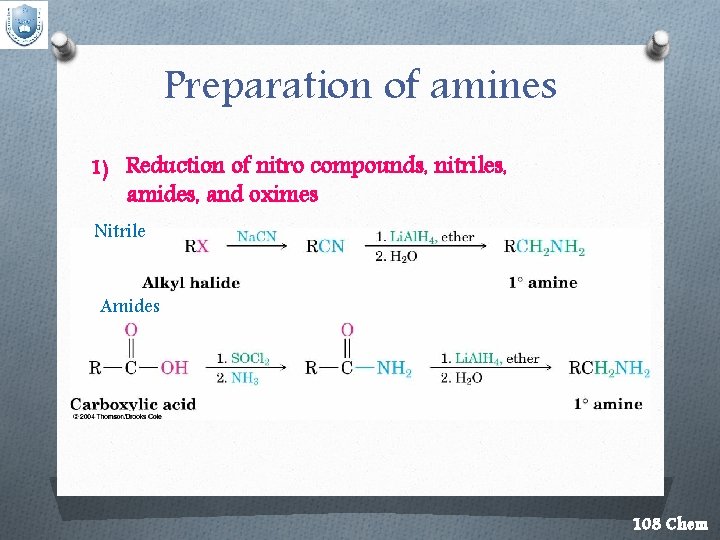
Preparation of amines 1) Reduction of nitro compounds, nitriles, amides, and oximes Nitrile Amides 108 Chem
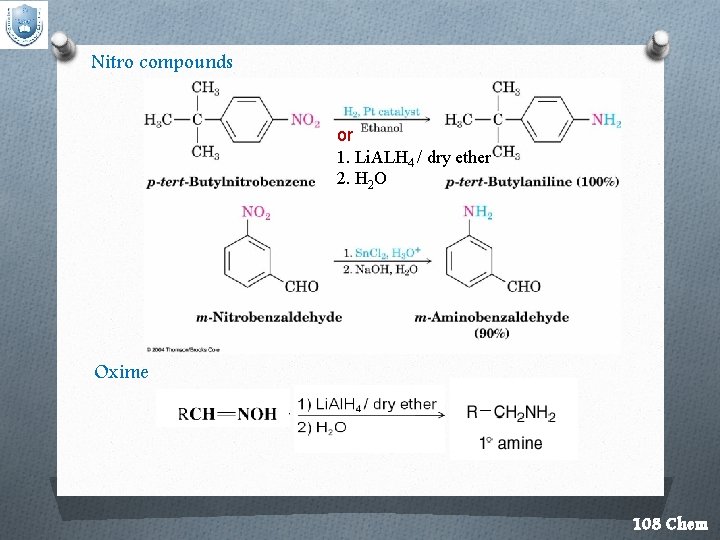
Nitro compounds or 1. Li. ALH 4 / dry ether 2. H 2 O Oxime 108 Chem
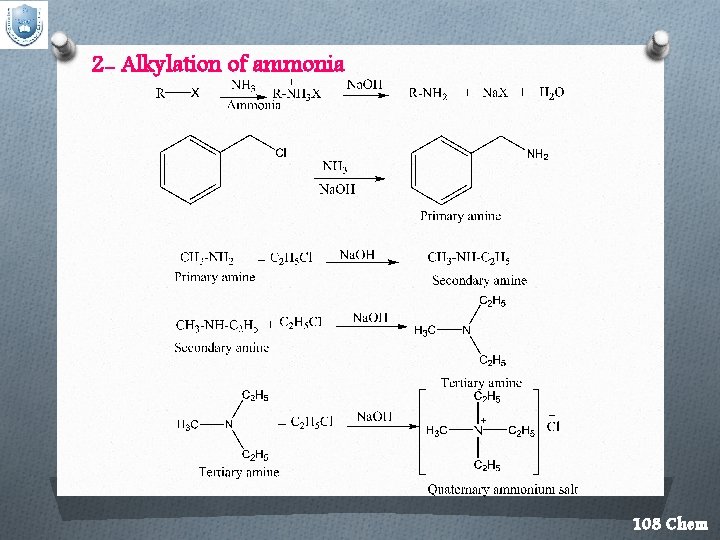
2 - Alkylation of ammonia 108 Chem
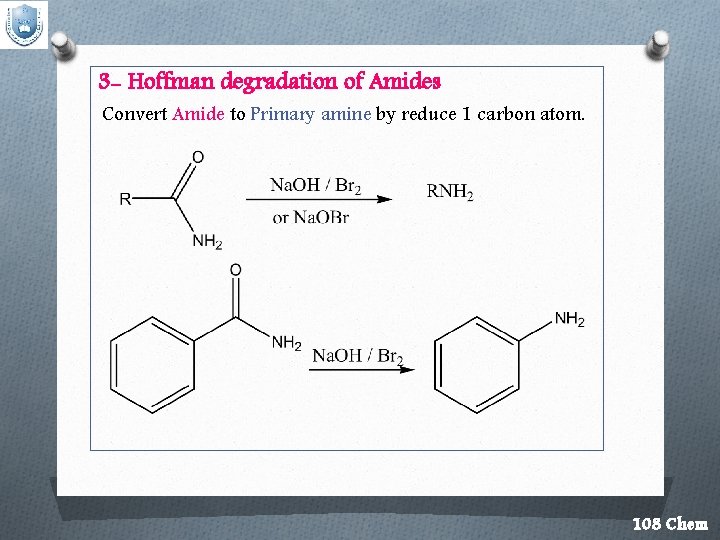
3 - Hoffman degradation of Amides Convert Amide to Primary amine by reduce 1 carbon atom. 108 Chem
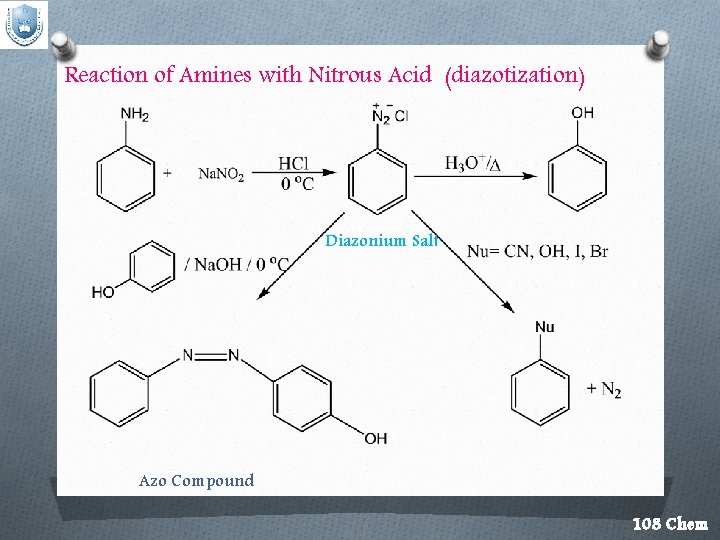
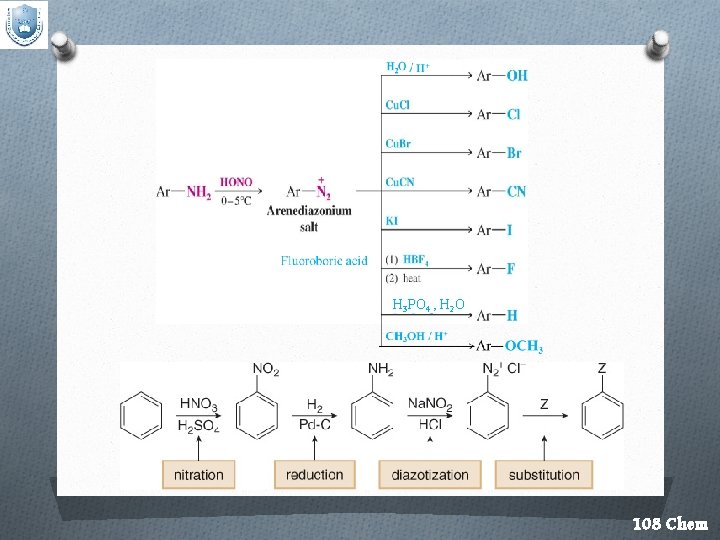
Reaction of Amines with Nitrous Acid (diazotization) Diazonium Salt Azo Compound 108 Chem
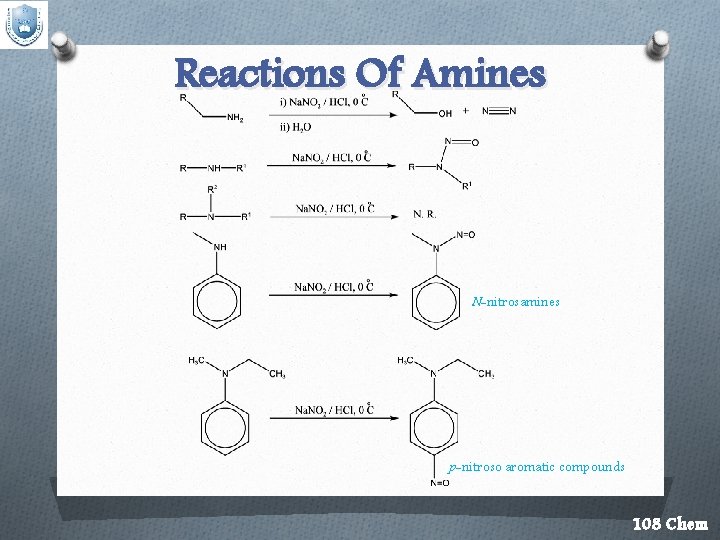
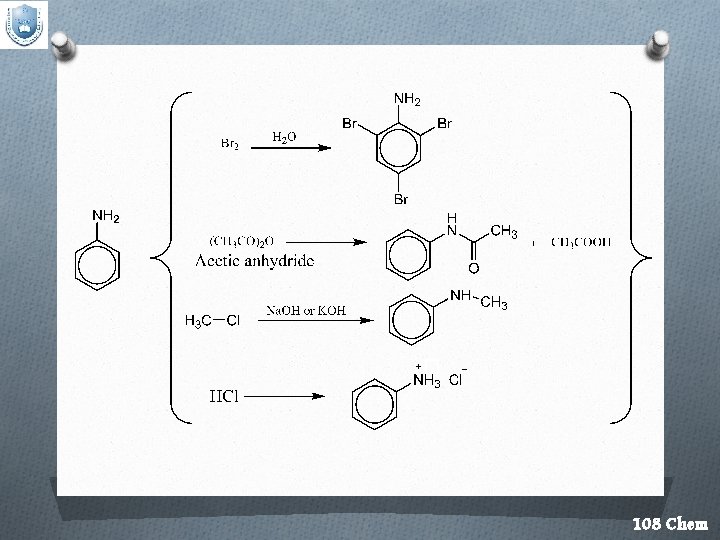
Reactions Of Amines N-nitrosamines p-nitroso aromatic compounds 108 Chem
H 3 PO 4 , H 2 O 108 Chem
3 108 Chem
Thank you for attentions Questions 108 Chem