Advanced Human Trafficking in the State of Texas





- Slides: 34
Advanced Human Trafficking in the State of Texas TCOLE Course #: 3271 Hosted By UNIT FIVE Bexar County Constable’s Office PCT#4 Constable Robert M. Blount
UNIT FIVE 2
LEARNING OBJECTIVES Learning Objective 5. 0: The participant will be able to explain indicators of Human Trafficking. Learning Objective 5. 1: The participant will be able to identify and explain 3 -visual indicators of a Human Trafficking Victim. Learning Objective 5. 2: The participant will be able to explain why Human Trafficking victims may be reluctant to provide information about their traffickers. 3 3
LEARNING OBJECTIVES Learning Objective 5. 3: The participant will be able to explain characteristics of domestic victims that may effect their cooperation in human trafficking investigations. Learning Objective 5. 4: The participant will be able to explain characteristics of international victims that may affect their cooperation in human trafficking investigations. 4
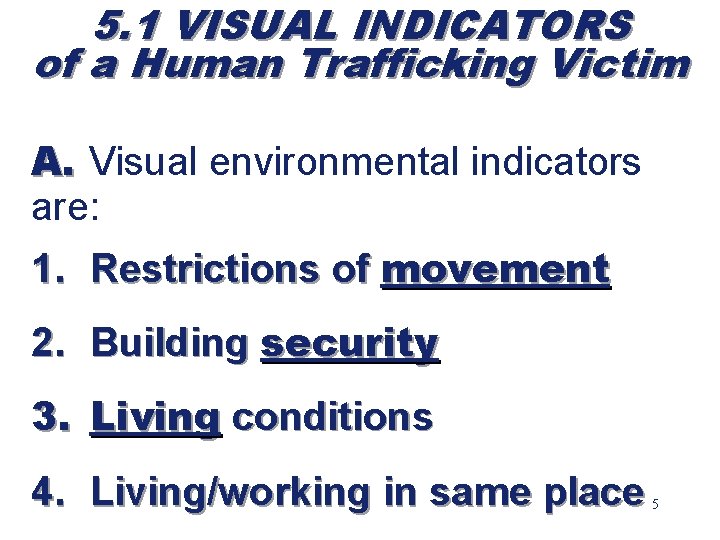
5. 1 VISUAL INDICATORS of a Human Trafficking Victim A. Visual environmental indicators are: 1. Restrictions of movement 2. Building security 3. Living conditions 4. Living/working in same place 5
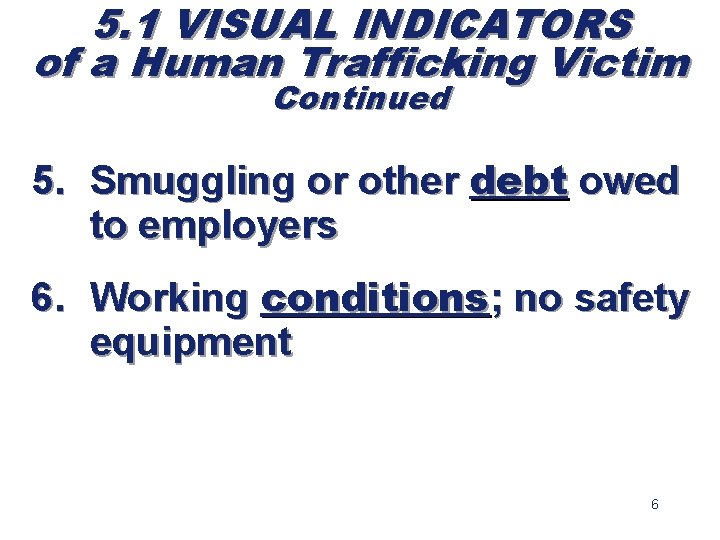
5. 1 VISUAL INDICATORS of a Human Trafficking Victim Continued 5. Smuggling or other debt owed to employers 6. Working conditions; no safety equipment 6
7
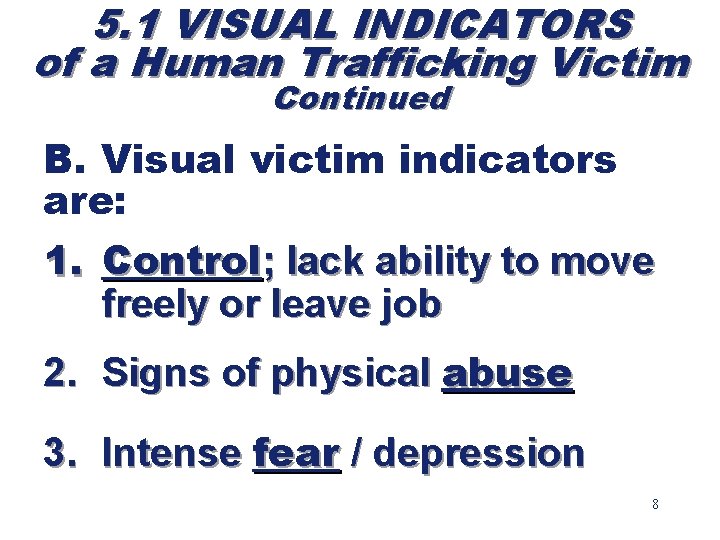
5. 1 VISUAL INDICATORS of a Human Trafficking Victim Continued B. Visual victim indicators are: 1. Control; lack ability to move freely or leave job 2. Signs of physical abuse 3. Intense fear / depression 8
9
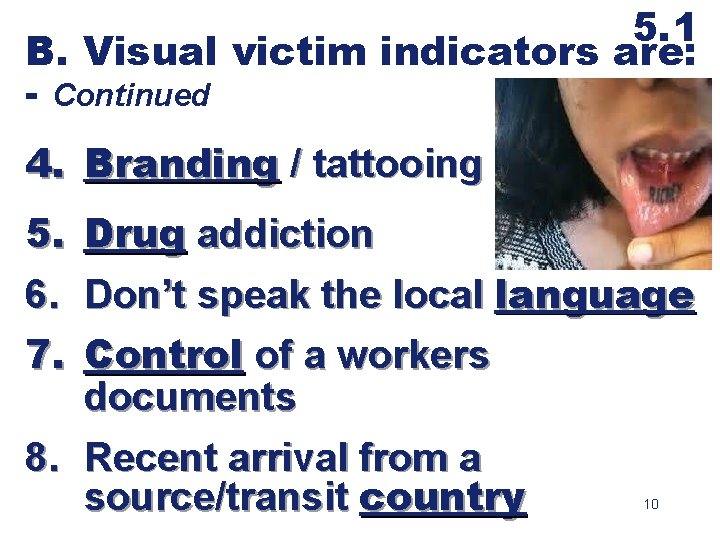
5. 1 B. Visual victim indicators are: - Continued 4. Branding / tattooing 5. 6. 7. Drug addiction Don’t speak the local language Control of a workers documents 8. Recent arrival from a source/transit country 10
11
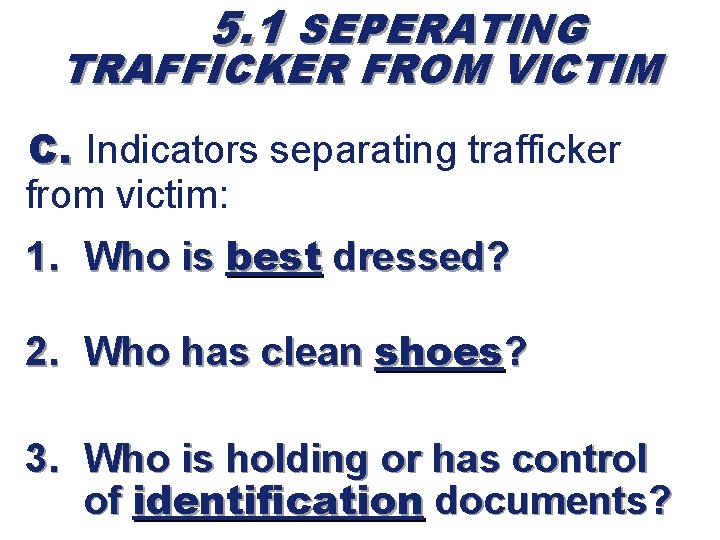
5. 1 SEPERATING TRAFFICKER FROM VICTIM C. Indicators separating trafficker from victim: 1. Who is best dressed? 2. Who has clean shoes? 3. Who is holding or has control of identification documents?
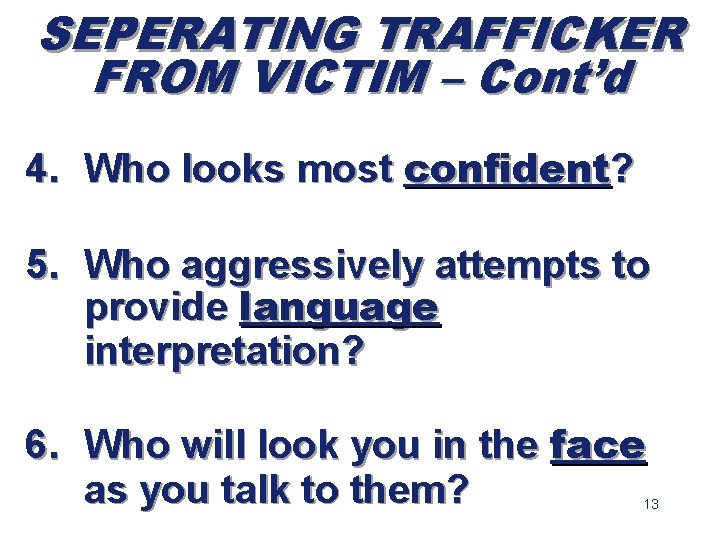
SEPERATING TRAFFICKER FROM VICTIM – Cont’d 4. Who looks most confident? 5. Who aggressively attempts to provide language interpretation? 6. Who will look you in the face as you talk to them? 13
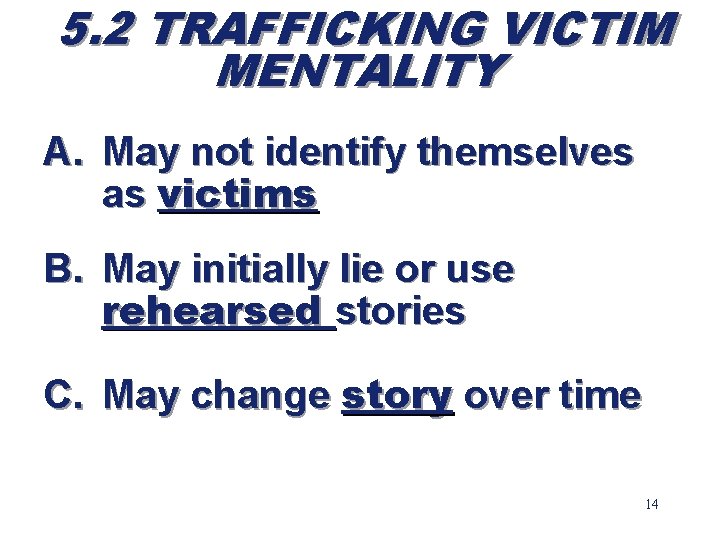
5. 2 TRAFFICKING VICTIM MENTALITY A. May not identify themselves as victims B. May initially lie or use rehearsed stories C. May change story over time 14
5. 2 TRAFFICKING VICTIM MENTALITY – Cont’d D. May be behaviorally dependent on trafficker E. May not want family to know of his/her circumstances F. May exhibit “Stockholm Syndrome” and show empathy for traffickers 15
5. 2 TRAFFICKING VICTIM MENTALITY G. May not speak English H. May have cultural or religious background that deter them from telling full story I. May be reluctant to speak to someone wearing a gun, badge, or uniform 16
17
5. 2 TRAFFICKING VICTIM MENTALITY – Cont’d J. May be culturally conditioned to fear government employees K. May be fearful for their families' safety in home country 18
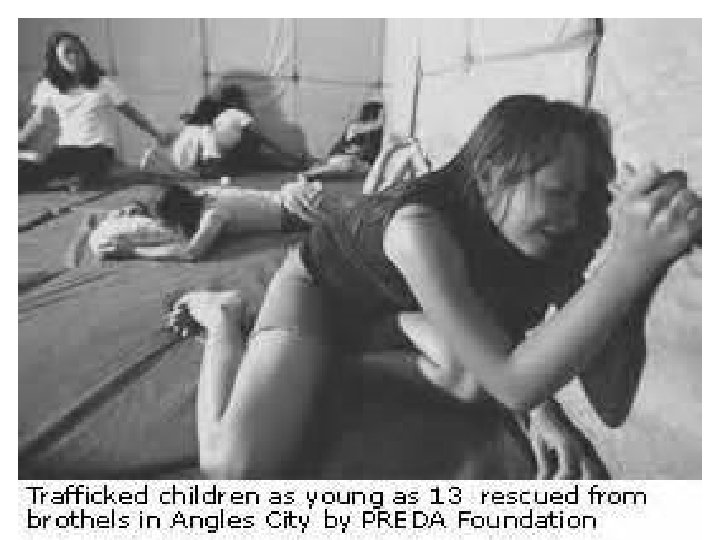
5. 3 Characteristics of domestic victims during investigation Understanding Domestic Victims A. lie about their age and use false identification B. not fit stereotype of a victim (juvenile delinquent, child prostitute, at-risk youth, or runaway)
20
5. 3 Understanding Domestic Victims – Continued: C. think of trafficker as boyfriend” and be reluctant to provide information D. be involved in juvenile gang activity E. have been trafficked by a family member 21
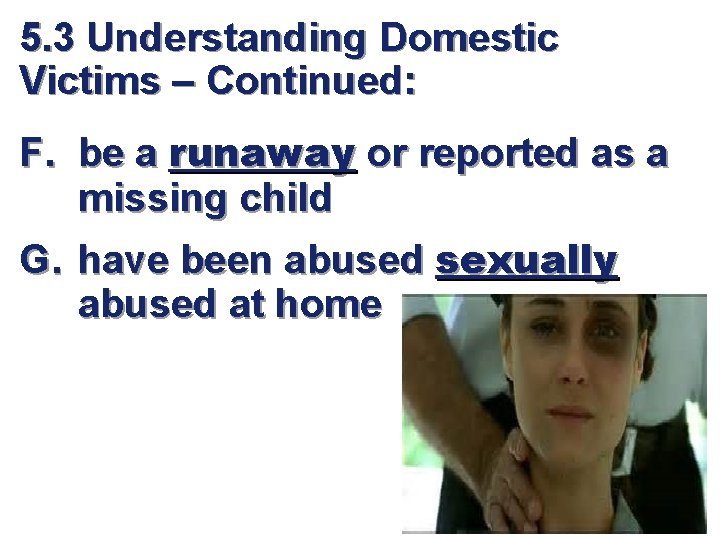
5. 3 Understanding Domestic Victims – Continued: F. be a runaway or reported as a missing child G. have been abused sexually abused at home 22
5. 4 Characteristics of foreign victims during investigation Mindset of trafficking victim: A. Their current situation may still be better than where they came from B. May be unaware of their rights or have been misled C. Often blame themselves for their situations 23
5. 4 Characteristics of foreign victims during investigation Continued Mindset of trafficking victim: D. Have a loyalty to the trafficker E. Distrust outsiders, especially law enforcement and fear deportation or arrest 24
5. 4 Characteristics of foreign victims during investigation Continued Mindset of trafficking victim: F. Do not speak English and lack cultural knowledge G. Fearful for safety of families left behind 25
WHO ARE THE VICTIMS? 4 Men, Women, and Children 4 Domestic – U. S. Citizens and Residents within the United States 4 International – Foreign Nationals Across International Borders 4 Desperate, vulnerable, and impoverished Persons 26
Questions? 27
DEFINE & PROCESS Define: Explain the background and negative impact of racial profiling in law enforcement profession Process: 28
DEFINE & PROCESS Define: Explain the background and negative impact of racial profiling in law enforcement profession Process: 29
DEFINE & PROCESS Define: Explain the background and negative impact of racial profiling in law enforcement profession Process: 30
DEFINE & PROCESS Define: Explain the background and negative impact of racial profiling in law enforcement profession Process: 31
SOURCES All Course Sources and/or Resources are listed in your Participant Handout ADVANCED HUMAN TRAFFICKING TCOLE Course # 3271
FOR YOUR ATTENTION
TAKE A 15 -MINUTE BREAK