Adlerian Psychotherapy Prioritizing social interest History of Adlerian

- Slides: 21
Adlerian Psychotherapy Prioritizing social interest
History of Adlerian Theory n Inspired by Freudian psychoanalysis, but did not buy into determinism or the primacy of sexual trauma n Some overlap with other neo-Freudians (e. g. , Horney) n Anticipated elements of humanistic, cognitive, and systemic approaches n Sought to overcome the superiority of therapist n Championed in U. S. by Rudolf Dreikurs n Dissemination throughout U. S. elementary schools during the guidance movement by Don Dinkmeyer
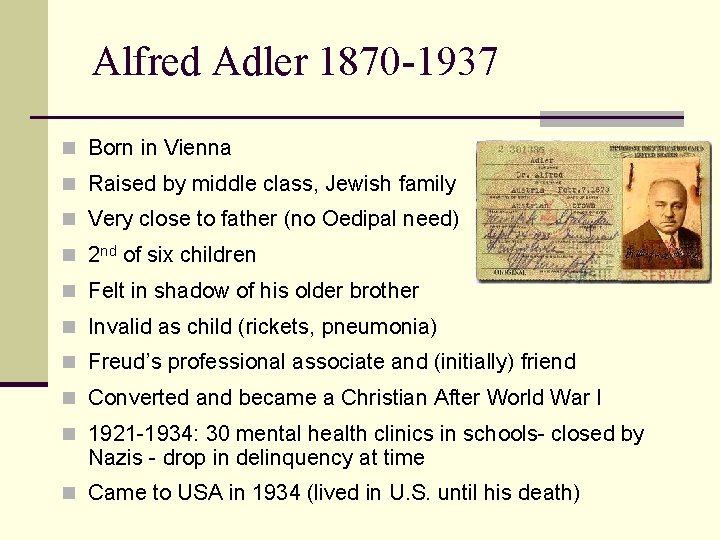
Alfred Adler 1870 -1937 n Born in Vienna n Raised by middle class, Jewish family n Very close to father (no Oedipal need) n 2 nd of six children n Felt in shadow of his older brother n Invalid as child (rickets, pneumonia) n Freud’s professional associate and (initially) friend n Converted and became a Christian After World War I n 1921 -1934: 30 mental health clinics in schools- closed by Nazis - drop in delinquency at time n Came to USA in 1934 (lived in U. S. until his death)
Adler’s Individual Psychology n A phenomenological approach n Social interest is stressed n Birth order and sibling relationships are emphasized n Therapy as teaching, informing and encouraging n Basic mistakes in the client’s private logic n The therapeutic relationship as a collaborative partnership
The Phenomenological Approach n Adlerians attempt to view the world from the client’s subjective frame of reference n n Reality is less important than how the individual perceives and believes life to be It is not the childhood experiences that are crucial ~ It is our present interpretation of these events n Unconscious instincts and our past do not determine our behavior n n It is not genes It is not environment It is not genes and environment It is how we choose to respond to our genes and environment
Social Interest Gemeinshaftsgefuhl – the state of social connectedness and interest in the well-being of others that characterizes psychological health. n Adler’s most significant and distinctive concept n Refers to an individual’s attitude toward and awareness of being a part of the human community n Mental health is measured by the degree to which we successfully share with others and are concerned with their welfare n Happiness and success are largely related to social connectedness
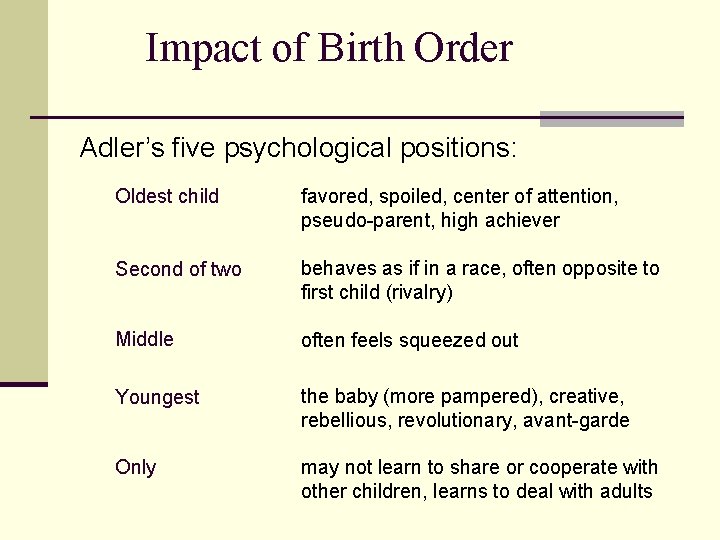
Impact of Birth Order Adler’s five psychological positions: Oldest child favored, spoiled, center of attention, pseudo-parent, high achiever Second of two behaves as if in a race, often opposite to first child (rivalry) Middle often feels squeezed out Youngest the baby (more pampered), creative, rebellious, revolutionary, avant-garde Only may not learn to share or cooperate with other children, learns to deal with adults
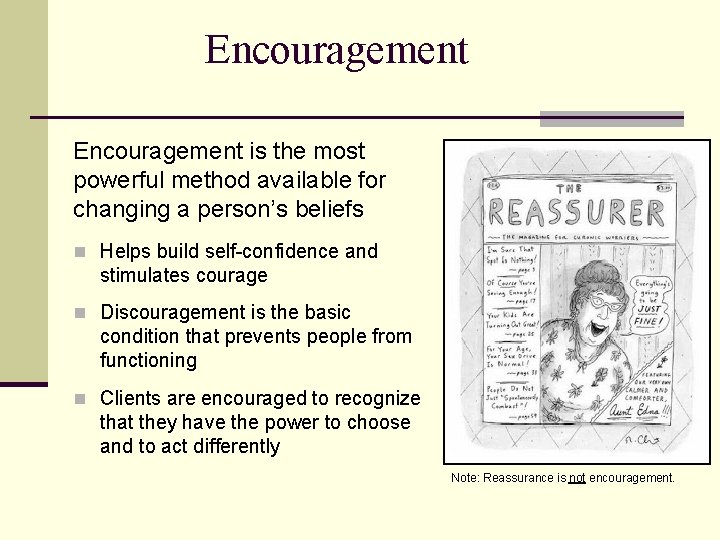
Encouragement is the most powerful method available for changing a person’s beliefs n Helps build self-confidence and stimulates courage n Discouragement is the basic condition that prevents people from functioning n Clients are encouraged to recognize that they have the power to choose and to act differently Note: Reassurance is not encouragement.
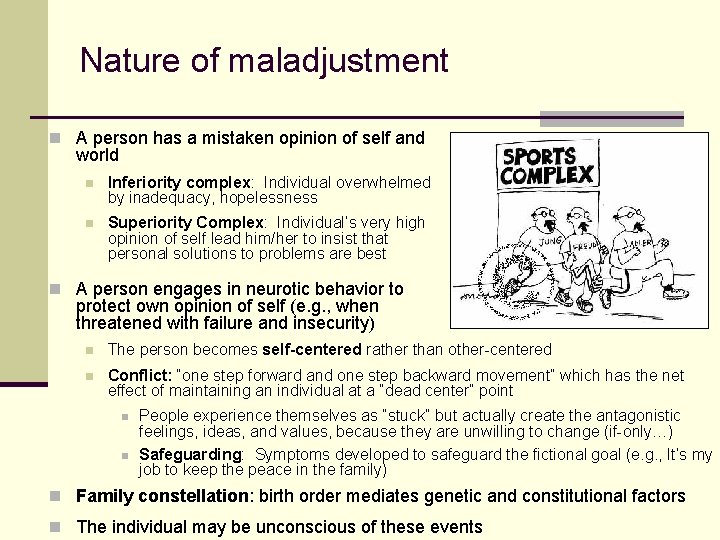
Nature of maladjustment n A person has a mistaken opinion of self and world n Inferiority complex: Individual overwhelmed by inadequacy, hopelessness n Superiority Complex: Individual’s very high opinion of self lead him/her to insist that personal solutions to problems are best n A person engages in neurotic behavior to protect own opinion of self (e. g. , when threatened with failure and insecurity) n The person becomes self-centered rather than other-centered n Conflict: “one step forward and one step backward movement” which has the net effect of maintaining an individual at a “dead center” point n n People experience themselves as “stuck” but actually create the antagonistic feelings, ideas, and values, because they are unwilling to change (if-only…) Safeguarding: Symptoms developed to safeguard the fictional goal (e. g. , It’s my job to keep the peace in the family) n Family constellation: birth order mediates genetic and constitutional factors n The individual may be unconscious of these events
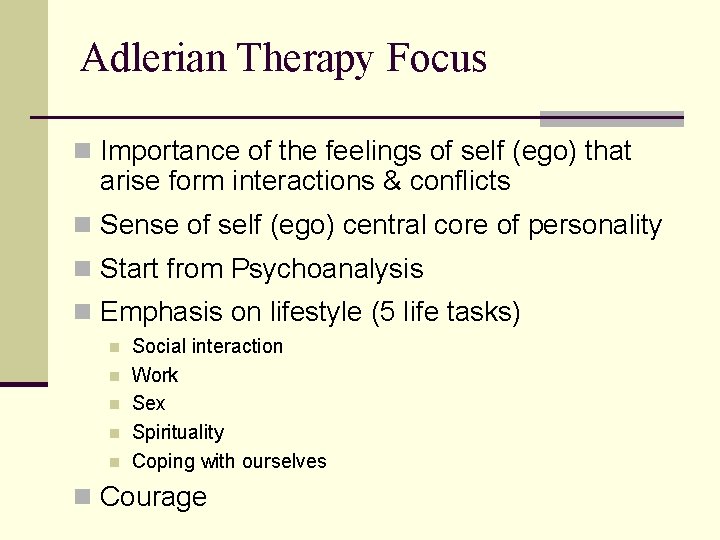
Adlerian Therapy Focus n Importance of the feelings of self (ego) that arise form interactions & conflicts n Sense of self (ego) central core of personality n Start from Psychoanalysis n Emphasis on lifestyle (5 life tasks) n n n Social interaction Work Sex Spirituality Coping with ourselves n Courage
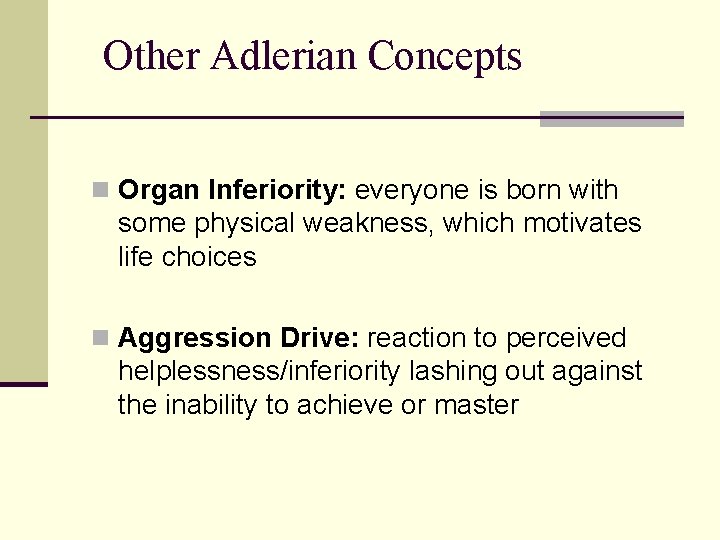
Other Adlerian Concepts n Organ Inferiority: everyone is born with some physical weakness, which motivates life choices n Aggression Drive: reaction to perceived helplessness/inferiority lashing out against the inability to achieve or master
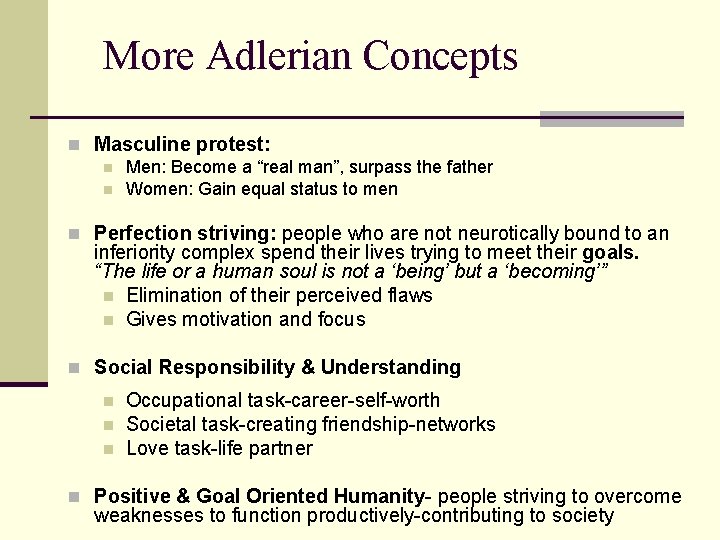
More Adlerian Concepts n Masculine protest: n Men: Become a “real man”, surpass the father n Women: Gain equal status to men n Perfection striving: people who are not neurotically bound to an inferiority complex spend their lives trying to meet their goals. “The life or a human soul is not a ‘being’ but a ‘becoming’” n Elimination of their perceived flaws n Gives motivation and focus n Social Responsibility & Understanding n n n Occupational task-career-self-worth Societal task-creating friendship-networks Love task-life partner n Positive & Goal Oriented Humanity- people striving to overcome weaknesses to function productively-contributing to society
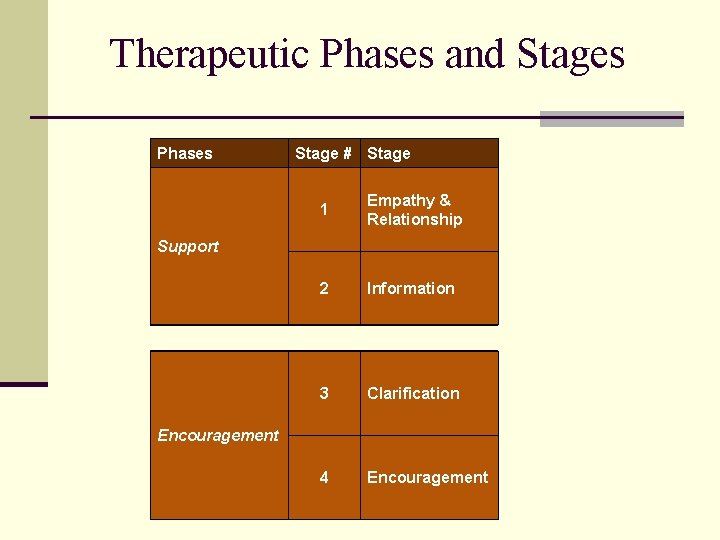
Therapeutic Phases and Stages Phases Stage # Stage 1 Empathy & Relationship 2 Information 3 Clarification 4 Encouragement Support Encouragement
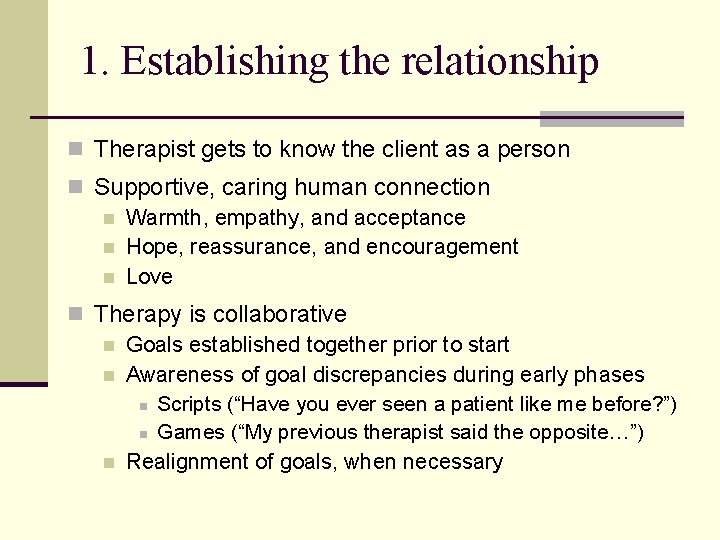
1. Establishing the relationship n Therapist gets to know the client as a person n Supportive, caring human connection n Warmth, empathy, and acceptance n Hope, reassurance, and encouragement n Love n Therapy is collaborative n Goals established together prior to start n Awareness of goal discrepancies during early phases n Scripts (“Have you ever seen a patient like me before? ”) n Games (“My previous therapist said the opposite…”) n Realignment of goals, when necessary
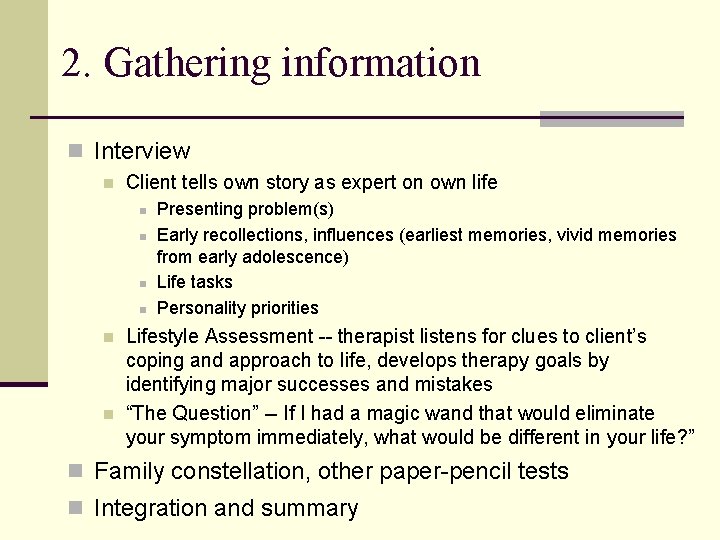
2. Gathering information n Interview n Client tells own story as expert on own life n n n Presenting problem(s) Early recollections, influences (earliest memories, vivid memories from early adolescence) Life tasks Personality priorities Lifestyle Assessment -- therapist listens for clues to client’s coping and approach to life, develops therapy goals by identifying major successes and mistakes “The Question” -- If I had a magic wand that would eliminate your symptom immediately, what would be different in your life? ” n Family constellation, other paper-pencil tests n Integration and summary
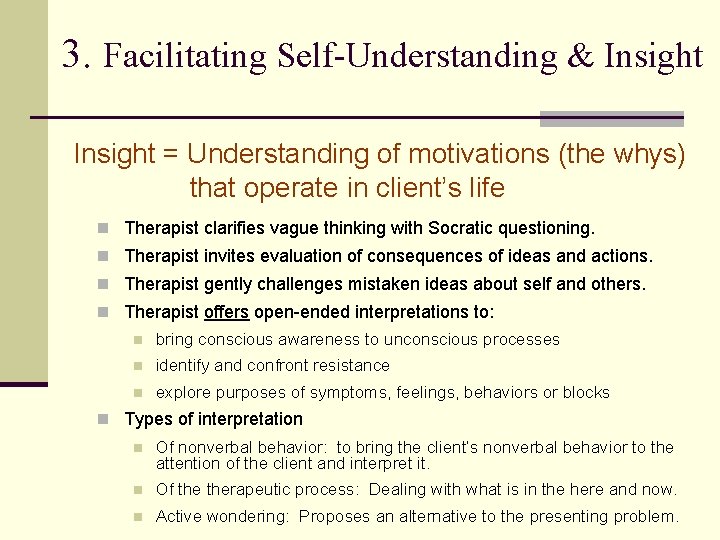
3. Facilitating Self-Understanding & Insight = Understanding of motivations (the whys) that operate in client’s life n Therapist clarifies vague thinking with Socratic questioning. n Therapist invites evaluation of consequences of ideas and actions. n Therapist gently challenges mistaken ideas about self and others. n Therapist offers open-ended interpretations to: n bring conscious awareness to unconscious processes n identify and confront resistance n explore purposes of symptoms, feelings, behaviors or blocks n Types of interpretation n Of nonverbal behavior: to bring the client’s nonverbal behavior to the attention of the client and interpret it. n Of therapeutic process: Dealing with what is in the here and now. n Active wondering: Proposes an alternative to the presenting problem.
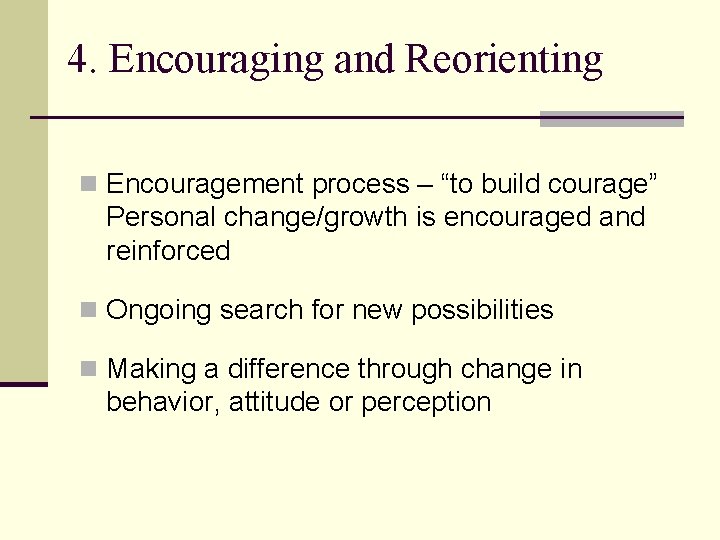
4. Encouraging and Reorienting n Encouragement process – “to build courage” Personal change/growth is encouraged and reinforced n Ongoing search for new possibilities n Making a difference through change in behavior, attitude or perception
Advantages of Adlerian Theory n Applicable to diverse populations and presenting issues n Does not consider people to be predisposed to anything n Phenomenological n Context-focused n Empowering
Disadvantages of Adlerian Theory n Difficult to learn (e. g. , making dream interpretations) n Works best with highly verbal and intelligent clients. (potentially leaves out many people who do not fit this category) n Might be too lengthy for managed care n Adlerians do not like to make diagnoses n Not compatible with managed care n Difficult to systematically measure efficacy n Challenging to develop problem-specific treatments
Adlerian Approaches today n Education n Parent Education n Marriage Counseling n Family Counseling n Group Work
Adlerian Therapy Demonstration Session transcript n Can you diagnose Gina using the DSM? n What were her strengths? n What did she need to work on? n What did Carlson do to build the relationship? n How was the intervention individualized? n Was therapy helpful to Gina? n If not, why do you think it wasn’t? n If it was helpful, what about it made it helpful? n Would you want to work with an Adlerian if you were seeking therapy/counseling?