A Simple Method for Commonsense Reasoning Trieu H

- Slides: 17
A Simple Method for Commonsense Reasoning Trieu H Trinh and Quoc V Le Arxiv, 2018 Nidhi Sridhar (nidhi 16@seas. upenn. edu) 18 March, 2019
Problem • Problem: Supervised learning needs lots of training data but this is scarce 2
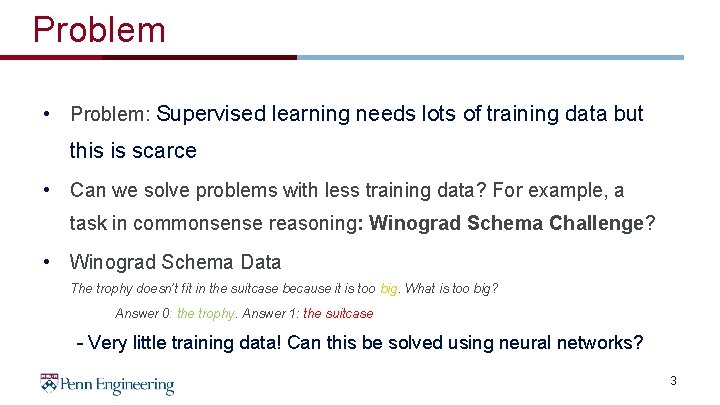
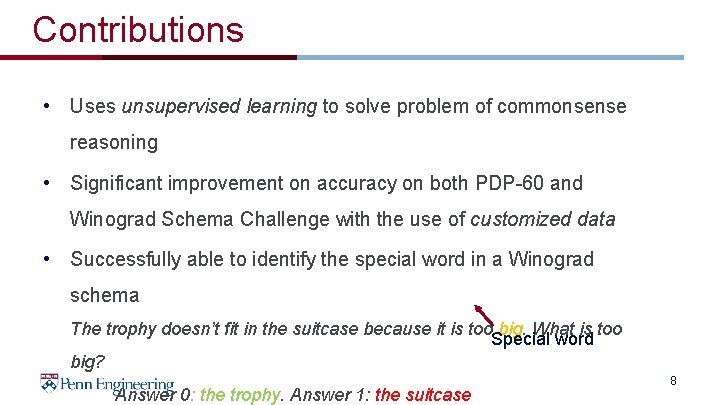
Problem • Problem: Supervised learning needs lots of training data but this is scarce • Can we solve problems with less training data? For example, a task in commonsense reasoning: Winograd Schema Challenge? • Winograd Schema Data The trophy doesn’t fit in the suitcase because it is too big. What is too big? Answer 0: the trophy. Answer 1: the suitcase - Very little training data! Can this be solved using neural networks? 3
Motivation • Can language models(LM) capture commonsense knowledge like word vectors captured analogies or contextually similar words? • Would a simple unsupervised learning method to train a LM on massive amounts of unlabeled data work? • Solve both the MCQ style Pronoun Disambiguation problem and the Winograd Schema Challenge(Less training data) 4
Contents: • • • Previous Approaches Method Experimental Setting Results Analysis Conclusion, Shortcomings and Future Work 5
Previous approaches • Winograd Schema Challenge Attempts: - Supervised Learning through annotated knowledge bases and handcrafted features - Semantic Parsing through rule based reasoning or using Google Search API results • All these attempts are expensive in terms of annotation or manual laying down of rules 6
Previous approaches • Winograd Schema Challenge Attempts: - Supervised Learning through annotated knowledge bases and handcrafted features - Semantic Parsing through rule based reasoning or using Google Search API results • All these attempts are expensive in terms of annotation or manual laying down of rules • Current So. TA: Uses a skip-gram model to learn word representations - 3 knowledge bases to get Knowledge Enhanced Embeddings (KEE) - Semantic Similarity Scorer+ Deep Neural Network Classifier - Supervised + Unsupervised Learning with 3 knowledge bases 7
Contributions • Uses unsupervised learning to solve problem of commonsense reasoning • Significant improvement on accuracy on both PDP-60 and Winograd Schema Challenge with the use of customized data • Successfully able to identify the special word in a Winograd schema The trophy doesn’t fit in the suitcase because it is too big. What is too Special word big? Answer 0: the trophy. Answer 1: the suitcase 8
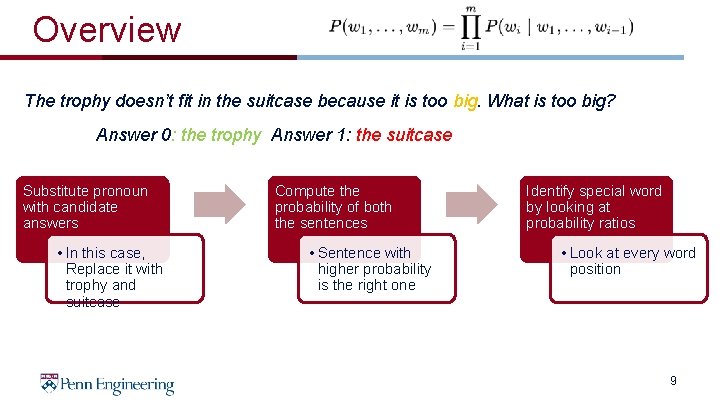
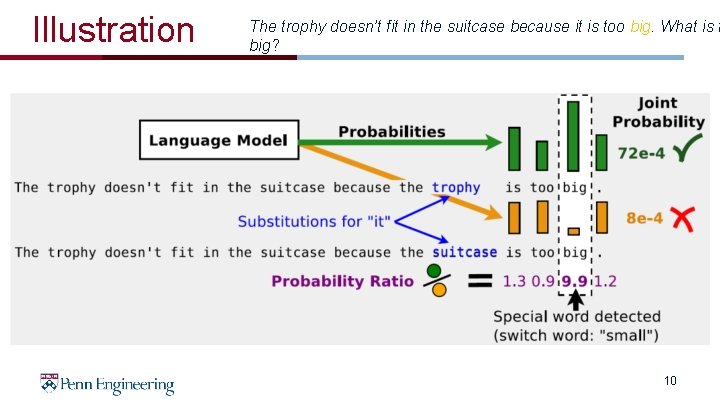
Overview The trophy doesn’t fit in the suitcase because it is too big. What is too big? Answer 0: the trophy Answer 1: the suitcase Substitute pronoun with candidate answers • In this case, Replace it with trophy and suitcase Compute the probability of both the sentences • Sentence with higher probability is the right one Identify special word by looking at probability ratios • Look at every word position 9
Illustration The trophy doesn’t fit in the suitcase because it is too big. What is t big? 10
Method The trophy doesn’t fit in the suitcase because it is too big. What is t big? • 11
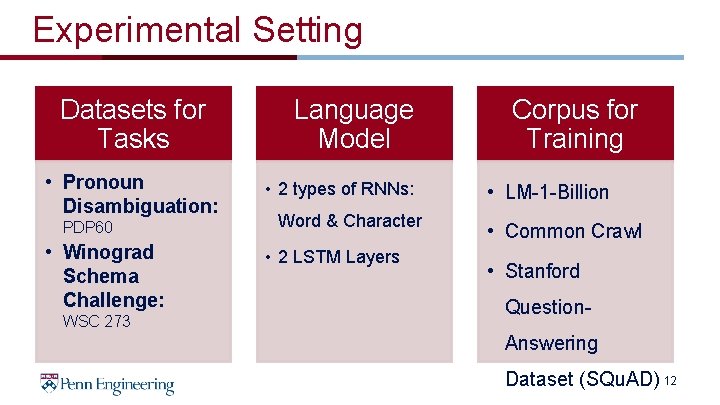
Experimental Setting Datasets for Tasks • Pronoun Disambiguation: PDP 60 • Winograd Schema Challenge: WSC 273 Language Model • 2 types of RNNs: Word & Character • 2 LSTM Layers Corpus for Training • LM-1 -Billion • Common Crawl • Stanford Question. Answering Dataset (SQu. AD) 12
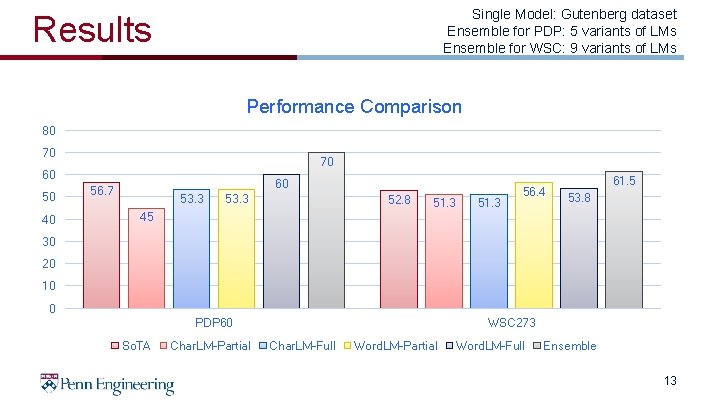
Single Model: Gutenberg dataset Ensemble for PDP: 5 variants of LMs Ensemble for WSC: 9 variants of LMs Results Performance Comparison 80 70 70 60 50 40 60 56. 7 53. 3 52. 8 51. 3 56. 4 61. 5 53. 8 45 30 20 10 0 PDP 60 So. TA Char. LM-Partial WSC 273 Char. LM-Full Word. LM-Partial Word. LM-Full Ensemble 13
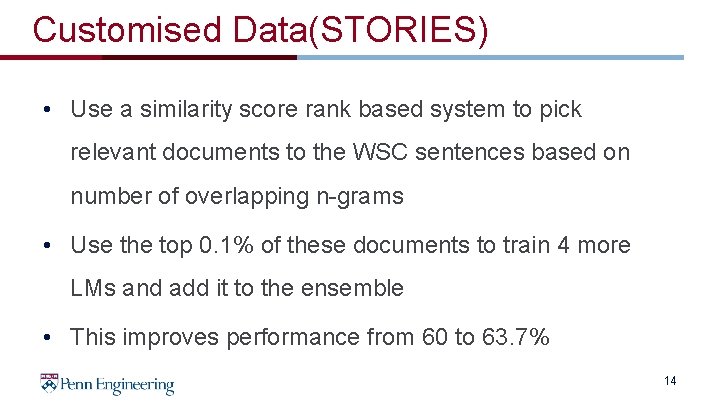
Customised Data(STORIES) • Use a similarity score rank based system to pick relevant documents to the WSC sentences based on number of overlapping n-grams • Use the top 0. 1% of these documents to train 4 more LMs and add it to the ensemble • This improves performance from 60 to 63. 7% 14
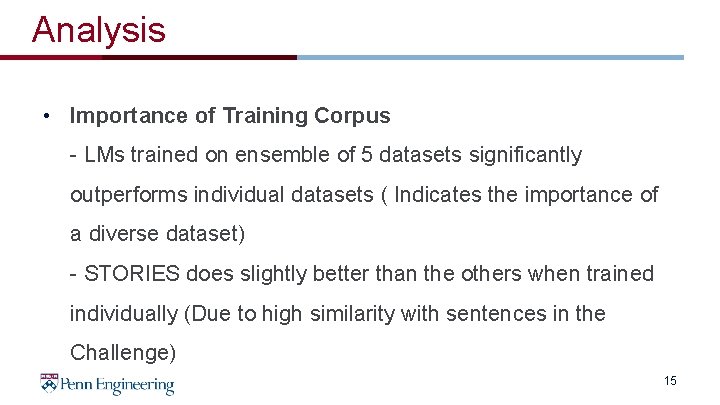
Analysis • Importance of Training Corpus - LMs trained on ensemble of 5 datasets significantly outperforms individual datasets ( Indicates the importance of a diverse dataset) - STORIES does slightly better than the others when trained individually (Due to high similarity with sentences in the Challenge) 15
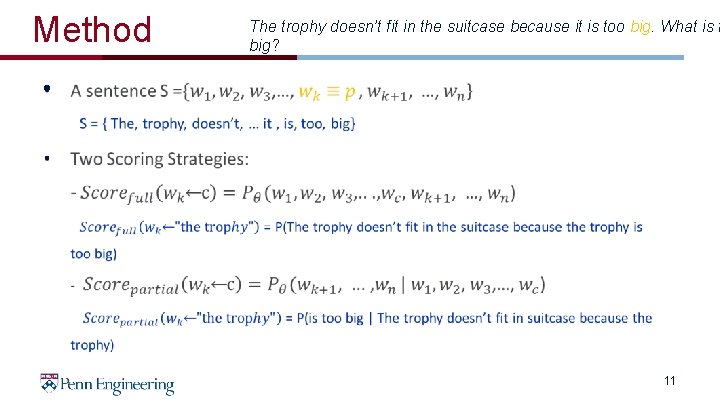
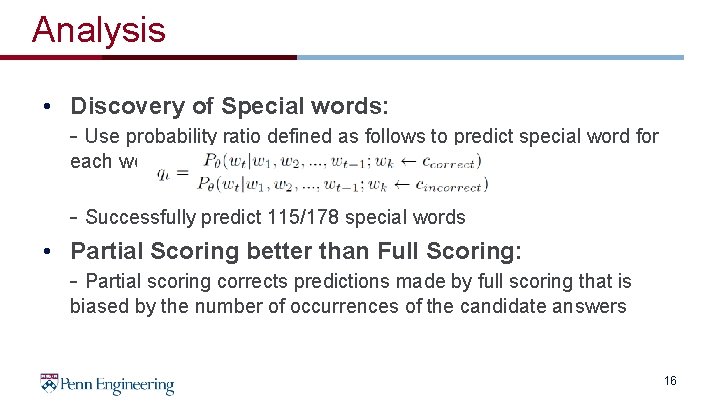
Analysis • Discovery of Special words: - Use probability ratio defined as follows to predict special word for each word t: - Successfully predict 115/178 special words • Partial Scoring better than Full Scoring: - Partial scoring corrects predictions made by full scoring that is biased by the number of occurrences of the candidate answers 16
Conclusions, Shortcomings and Future Work • Learnings: - Simplicity is key, the power of Language Models - The idea to create a dataset like STORIES is interesting • Shortcomings: - Commonsense reasoning is loosely defined Is any problem with less training data a commonsense problem? - Qualitative analysis on failure cases is missing and understanding if complex language models is the right way to go • Future Work: - Identify problems that this simple method can be extended to solve and analyze their performance 17