A Rumor of Empathy The Secret Underground Story

- Slides: 36
A Rumor of Empathy: The Secret, Underground Story of Empathy © Lou Agosta and the Chicago Empathy Project
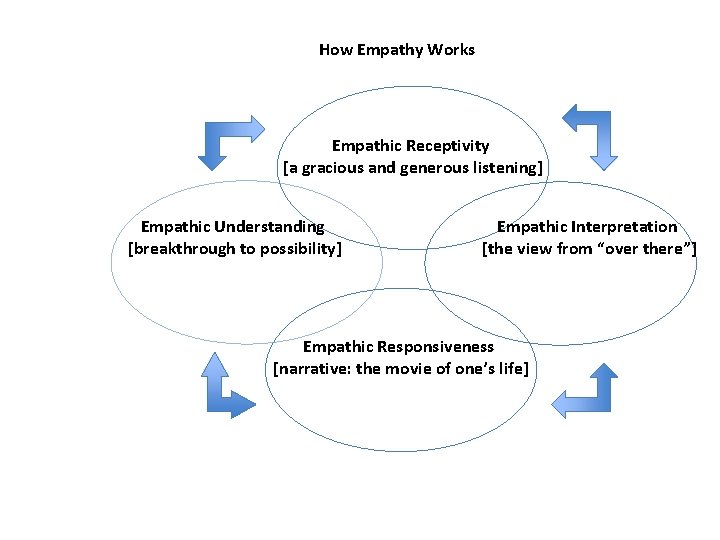
How Empathy Works Empathic Receptivity [a gracious and generous listening] Empathic Understanding [breakthrough to possibility] Empathic Interpretation [the view from “over there”] Empathic Responsiveness [narrative: the movie of one’s life]
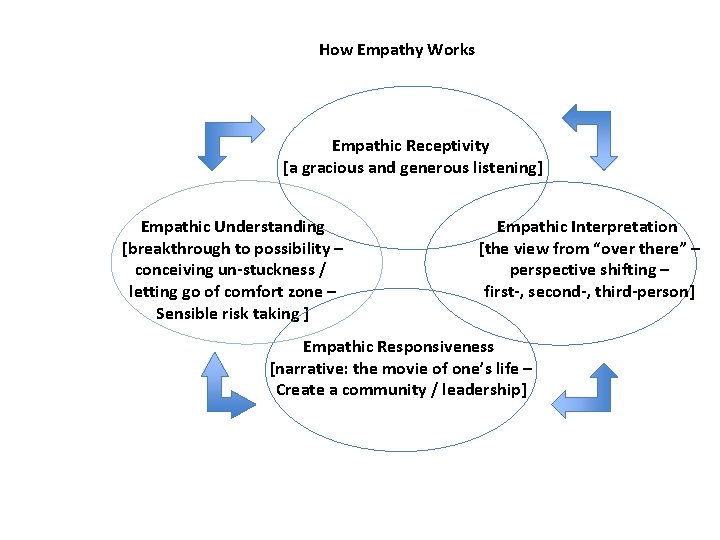
How Empathy Works Empathic Receptivity [a gracious and generous listening] Empathic Understanding [breakthrough to possibility – conceiving un-stuckness / letting go of comfort zone – Sensible risk taking ] Empathic Interpretation [the view from “over there” – perspective shifting – first-, second-, third-person] Empathic Responsiveness [narrative: the movie of one’s life – Create a community / leadership]
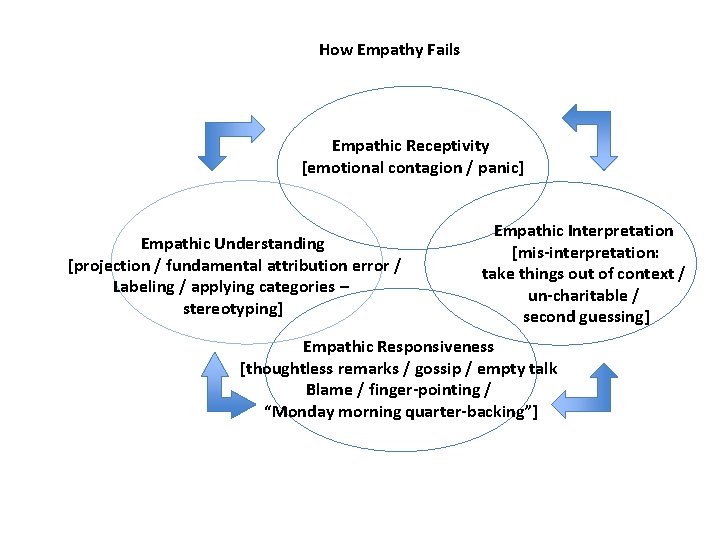
How Empathy Fails Empathic Receptivity [emotional contagion / panic] Empathic Understanding [projection / fundamental attribution error / Labeling / applying categories – stereotyping] Empathic Interpretation [mis-interpretation: take things out of context / un-charitable / second guessing] Empathic Responsiveness [thoughtless remarks / gossip / empty talk Blame / finger-pointing / “Monday morning quarter-backing”]
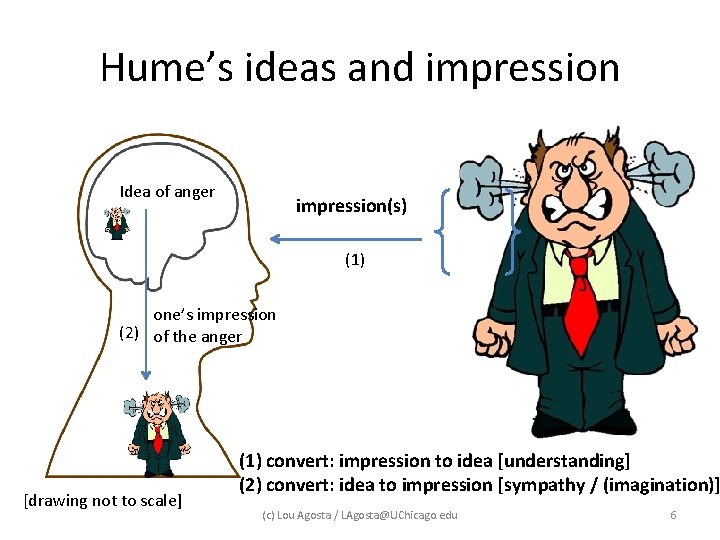
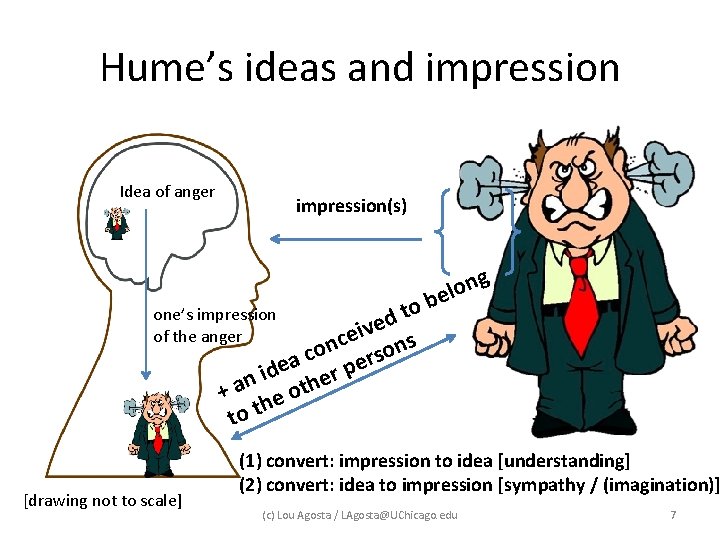
David Hume (1711 – 1776) • ‘Tis indeed evident, that when we sympathize with the passions and sentiments of others, these movements appear at first in our mind as mere ideas, and are conceiv’d to belong to another person, as we conceive any other matter of fact. ‘Tis also evident, that the ideas of the affections of others are converted into the very impressions they represent, and that the passions arise in conformity to the images we form of them (1739: 319 -20). (c) Lou Agosta / LAgosta@UChicago. edu 5
Hume’s ideas and impression Idea of anger impression(s) (1) one’s impression (2) of the anger [drawing not to scale] (1) convert: impression to idea [understanding] (2) convert: idea to impression [sympathy / (imagination)] (c) Lou Agosta / LAgosta@UChicago. edu 6
Hume’s ideas and impression Idea of anger impression(s) to d e iv s e c n n o o c s r ea r pe d i e n h a t + eo h t to one’s impression of the anger [drawing not to scale] ng o l be (1) convert: impression to idea [understanding] (2) convert: idea to impression [sympathy / (imagination)] (c) Lou Agosta / LAgosta@UChicago. edu 7
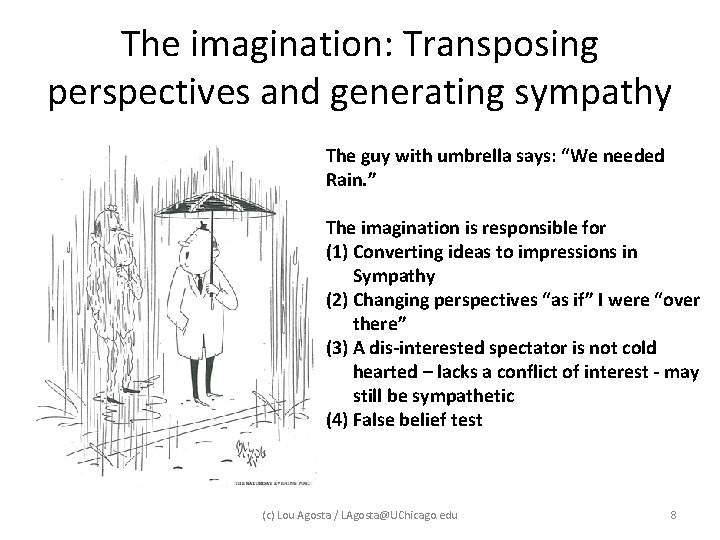
The imagination: Transposing perspectives and generating sympathy The guy with umbrella says: “We needed Rain. ” The imagination is responsible for (1) Converting ideas to impressions in Sympathy (2) Changing perspectives “as if” I were “over there” (3) A dis-interested spectator is not cold hearted – lacks a conflict of interest - may still be sympathetic (4) False belief test (c) Lou Agosta / LAgosta@UChicago. edu 8
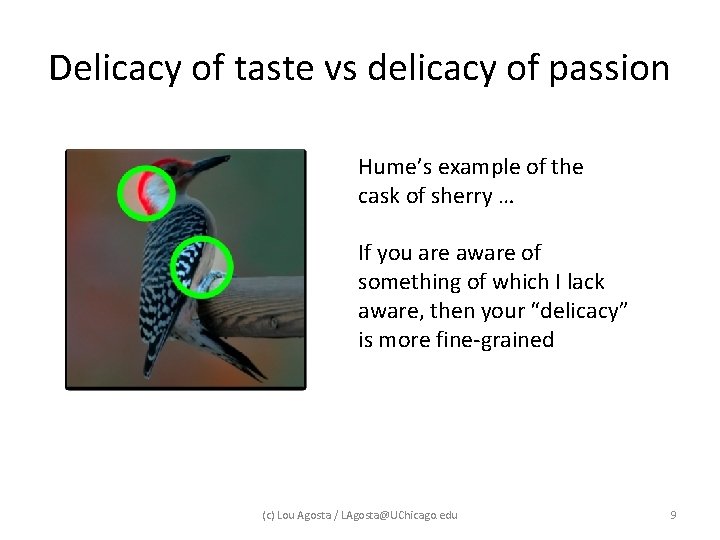
Delicacy of taste vs delicacy of passion Hume’s example of the cask of sherry … If you are aware of something of which I lack aware, then your “delicacy” is more fine-grained (c) Lou Agosta / LAgosta@UChicago. edu 9
David Hume • Every movement of theatre, by a skillful poet, is communicated, as it were by magic, to the spectators; who weep, tremble, resent, rejoice, and are inflamed with all the variety of passions, which actuate the several personages of the drama (1751: 49). (c) Lou Agosta / LAgosta@UChicago. edu 10
David Hume • A cheerful countenance infuses a sensible complacency and serenity into my mind; as an angry or sorrowful one throws a sudden damp upon me. Hatred, resentment, esteem, love, courage, mirth and melancholy; all these passions I feel more from communication than from my own natural temper and disposition (T 2. 1. 11. 2; 1739: 316 -17). (c) Lou Agosta / LAgosta@UChicago. edu 11
David Hume • So close and intimate is the correspondence of human souls that no sooner any person approaches me, than he diffuses on me all his opinions, and draws along my judgment in a greater or less degree. And tho’, on many occasions, my sympathy with him goes not so far as entirely to change my sentiments and way of thinking; yet it seldom is so weak as not to disturb the easy course of my thought. . . (T 3. 3. 2. 2; 1739: 592). (c) Lou Agosta / LAgosta@UChicago. edu 12
David Hume • ‘Tis remarkable, that nothing touches a man of humanity more than any instance of extraordinary delicacy in love or friendship. . . The passions are so contagious, that they pass with the greatest facility from one person to another, and produce correspondent movements in all human breast. • Where friendship appears in very signal instances, my hart catches the same passion, and is warmed by those warm sentiments, that display themselves me (T 3. 3. 3. 5; 1739: 604 -5). (c) Lou Agosta / LAgosta@UChicago. edu 13
Summary (Hume) • • • Emotional contagion / suggestion Conversion of idea to impression + The Other Delicacy of taste impression Benevolence / compassion (c) Lou Agosta / LAgosta@UChicago. edu 14
A Rumor of Empathy in Kant • Like taste, empathy is disinterested • Like taste, empathy requires the universal communicability of feelings • Like taste, empathy leverages the form of purposiveness • Like taste, empathy relates necessarily to the other (c) Lou Agosta / LAgosta@UChicago. edu 15
A rumor of empathy in Kant • The “communicability of feelings” (1790/93 a: 174; § 40 (AA 294)) sounds like step one of the multi-dimensional approach to empathy. • Kant’s “communicability of feeling” is the clue to the reconstruction of the deep history of empathy in Kant. (c) Lou Agosta / LAgosta@UChicago. edu 16
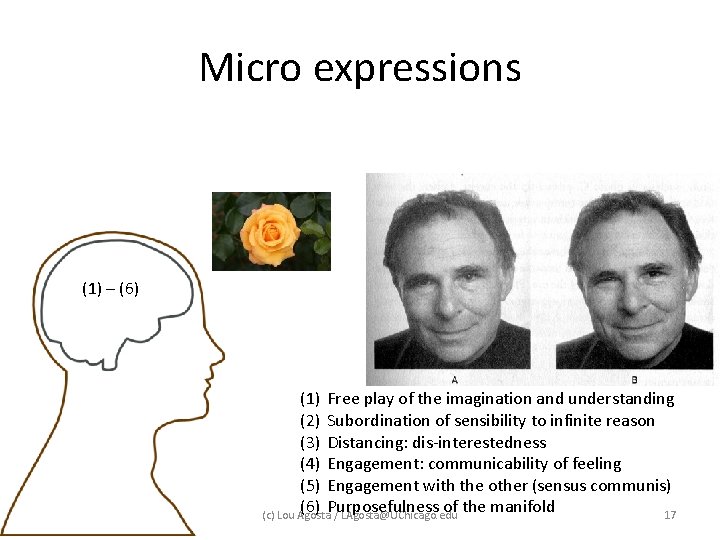
Micro expressions (1) – (6) (1) Free play of the imagination and understanding (2) Subordination of sensibility to infinite reason (3) Distancing: dis-interestedness (4) Engagement: communicability of feeling (5) Engagement with the other (sensus communis) (6) Purposefulness of the manifold (c) Lou Agosta / LAgosta@UChicago. edu 17
Immanuel Kant (1790/93) • We call buildings or trees majestic and magnificent, or fields smiling and joyful; even colors are called innocent, modest or tender, because they arouse sensation that contain something analogical to the consciousness of a mental state produced by moral judgments. Taste as it were makes possible the transition from sensible charm to the habitual moral interest without too violent a leap […] (1790/93 a: 228; § 59 (AA 354)). (c) Lou Agosta / LAgosta@UChicago. edu 18
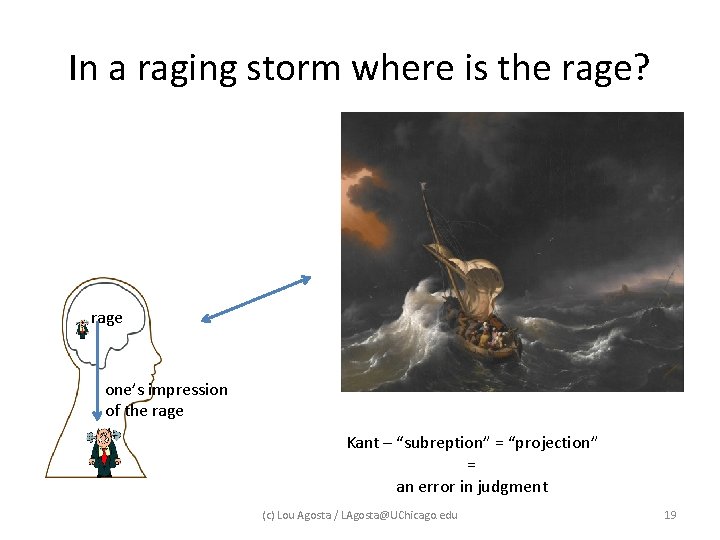
In a raging storm where is the rage? rage one’s impression of the rage Kant – “subreption” = “projection” = an error in judgment (c) Lou Agosta / LAgosta@UChicago. edu 19
Immanuel Kant (1790/1793) • . . . [T]he imagination in its freedom arouses the understanding, and the latter, without concepts, sets the imagination into a regular play [and] the representation is communicated, not as a thought, but as the inner feeling of a purposive state of mind. • Taste is thus the faculty for judging a priori the communicability of the feelings [die Mitteilbarkeit der Gefühle] that are combined with a given representation (without the mediation of a concept) (1790/93 a: § 40; 175 -176; (AA: 296)). (c) Lou Agosta / LAgosta@UChicago. edu 20
Immanuel Kant (1790/93) • This is the moment for top down, cognitive empathic interpretation. Kant explicitly notes this kind of common sense enables us – – “to put ourselves in thought in the place of every other” (1790/93 b: § 40; 136; (AA 293) (“…an der Stelle jedes anderen denken…”)). – This enables one to link back to empathic interpretation and the logical function invoked in substituting a third-person for a first-person perspective. (c) Lou Agosta / LAgosta@UChicago. edu 21
Theodor Lipps (1851 – 1914) • You know how the movie/play Amadeus showed that Antonio Salieri was famous in his day and is now unknown in comparison with Mozart? • Lipps was the Salieri of “empathy, ” dominating the term up until 1914 and beyond whereas today he is unknown (c) Lou Agosta / LAgosta@UChicago. edu 22
Theodor Lipps • Only in so far as this empathy exists are forms beautiful. Their beauty is this ideal freedom with which I express life [Sichausleben] in them. Conversely, form is ugly when I am unable to do this, when I feel unfree inwardly, inhibited, subjected to constraint with regard to form, or in regard to its contemplation (1903: 247). (c) Lou Agosta / LAgosta@UChicago. edu 23
Theodor Lipps • In full, positive empathy only one individual ego exists for me; namely this empathized or objectified own ego, which is projected into an external object (1909: 194). (c) Lou Agosta / LAgosta@UChicago. edu 24
Theodor Lipps • In inner imitation there is no separation between the acrobat up above and me below. On the contrary, I identify myself with him. I feel myself in him and in his place. . (c) Lou Agosta / LAgosta@UChicago. edu 25
Theodor Lipps • In such inner imitation I discharge—not the motions which the acrobat discharges—rather I discharge immediately, or inwardly, or in thought, the motions of the acrobat. I discharge the motions in so far as this discharge of motion is not an external but an inner act in the acrobat himself (1903: 121122). (c) Lou Agosta / LAgosta@UChicago. edu 26
Theodor Lipps • In inner imitation there is no separation between the acrobat up above and me below. On the contrary, I identify myself with him. I feel myself in him and in his place. . • In empathy, therefore, I am not the real ego [ich] but am inwardly liberated from the latter, i. e. , I am liberated from everything which I am apart from the contemplation of form. I am only this ideal, this contemplating ego (1903: 247). (c) Lou Agosta / LAgosta@UChicago. edu 27
Theodor Lipps • The “other” is one’s own personality, a modified own ego, which is represented and modified according to the external appearance and the perceptible expressions of life. The man besides me, of which I am conscious, is a duplicate and at the same time a modification of my self. (1903: 106). (c) Lou Agosta / LAgosta@UChicago. edu 28
Theodor Lipps • The first material and occasion for the construction of the foreign personality is offered by his expression of life, the audible and visible, the sounds and physiognomy or gesture, in short, the expressive movements (1903: 106). (c) Lou Agosta / LAgosta@UChicago. edu 29
The Tangle • Lipps owns the term “empathy” • No one can use the word without appearing to be a student of empathy – but … • Freud is his own man • The phenomenologists – Max Scheler, Edith Stein, Edmund Husserl, Martin Heidegger – argue against Lipps’ theory of “projective empathy” (c) Lou Agosta / LAgosta@UChicago. edu 30
Max Scheler (1874 – 1928) • It is perfectly meaningful to say: “I can feel for you vicariously, but I have no pity [“Mitleid”] for you. ” Such “vicarious feeling” remains within the cognitive sphere, and is not a morally relevant act. The historian of motives, the novelist, the exponent of the dramatic arts, must all possess in high degree the gift of vicarious feeling. But there is not the slightest need for them to share the feelings of their subjects and personages (1912/22: 9). (c) Lou Agosta / LAgosta@UChicago. edu 31
Max Scheler • . . . Neither “projective empathy” nor “imitation” is necessary in order to explain the primary components of shared feeling, namely, understanding and vicarious feeling and [vicarious] life [Nachfühlen und Nachleben] 1912/22). • “Imitation” is “Nachahmung” (“ahmen” means “to measure, ” usually an amount of liquid), while once again “shared feeling” translates “Mitgefühl. ” (c) Lou Agosta / LAgosta@UChicago. edu 32
Sigmund Freud • Freud’s letter to Wilhelm Fliess (August 31, 1898): • In Lipps I have rediscovered my own principles quite clearly stated – perhaps rather more so than suited me. “The reader often finds more than he seeks. ” Lipps regards consciousness as only a sense organ, the contents of the mind as ideation, and all mental processes as unconscious (Freud 1887/1902: 262 -263). (c) Lou Agosta / LAgosta@UChicago. edu 33
Edmund Husserl (1859 - 1938) • Every ego is a “monad. ” But the monads have windows. They do not have windows or doors through which other subjects can literally [reel] get in—the windows are instances of empathy—but rather through which others can get through and be experienced in a way similar to one’s own past remembrances (Husserl XIV: 260). . (c) Lou Agosta / LAgosta@UChicago. edu 34
Edmund Husserl • A monad thus has windows in order to receive foreign impressions [fremde Einwirkungen]. The windows are empathy (Husserl XIV: 295). . (c) Lou Agosta / LAgosta@UChicago. edu 35
Edmund Husserl • In one monad, other individual monads are “directly” mirrored through empathy…. Thus the other ego and its psyche announces itself in me, and I announce myself in it: We are related to one another consciously and know about one another: and, thereby, every one of us has experience of the other body [fremdleib] and apperceives this according to its own body analogically as body (XIV: 300). (c) Lou Agosta / LAgosta@UChicago. edu 36