
Rumor Routing in Sensor Networks David Braginsky and
Rumor Routing in Sensor Networks David Braginsky and Deborah Estrin LECS – UCLA Modified and Presented by Sugata Hazarika
Operating Environment u Large network of dense wireless nodes u Geographically cohesive events in the environment u No global coordinate system u A need to deliver packets to events (query/configure/command)
Data Routing u Data is more important in a power starved data centric network u So focuses on data routing instead of naming based schemes u Previous techniques – query flooding, event flooding u Pub/Sub ? …
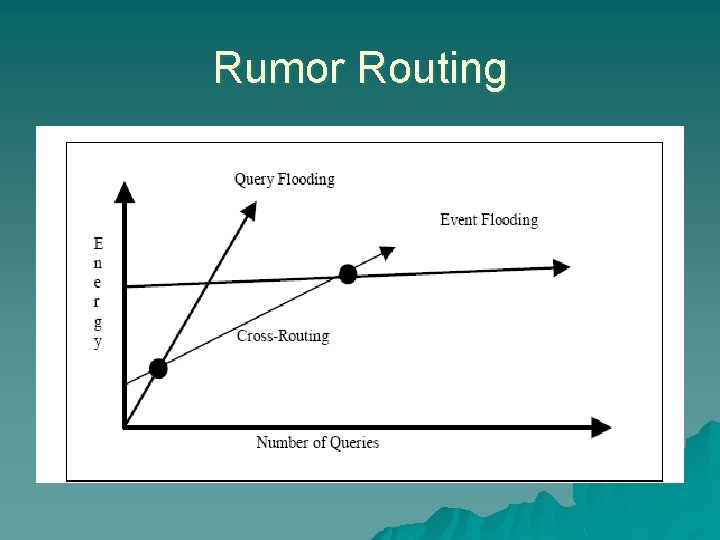
Alternative Methods u Query flooding – – – u Event Flooding – – u Expensive for hig query/event ratio Allows for optimal reverse path setup Gossiping scheme can be use to reduce overhead Expensive for low query/event ratio GRAB provides an effective method for gradient setup Note : – Both of them provide shortest delay paths
Rumor Routing Designed for query/event ratios between query and event flooding u Motivation u – Sometimes a non-optimal route is satisfactory u Advantages – Tunable best effort delivery – Tunable for a range of query/event ratios u Disadvantages – Optimal parameters depend heavily on topology (but can be adaptively tuned) – Does not guarantee delivery
Rumor Routing
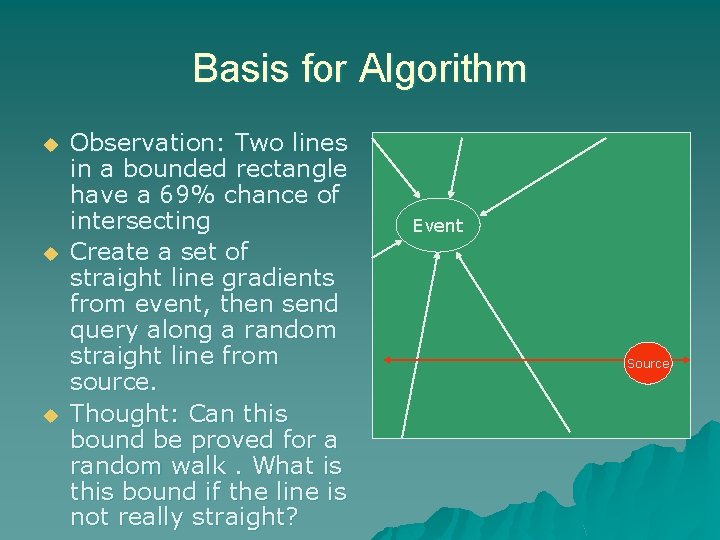
Basis for Algorithm u u u Observation: Two lines in a bounded rectangle have a 69% chance of intersecting Create a set of straight line gradients from event, then send query along a random straight line from source. Thought: Can this bound be proved for a random walk. What is this bound if the line is not really straight? Event Source
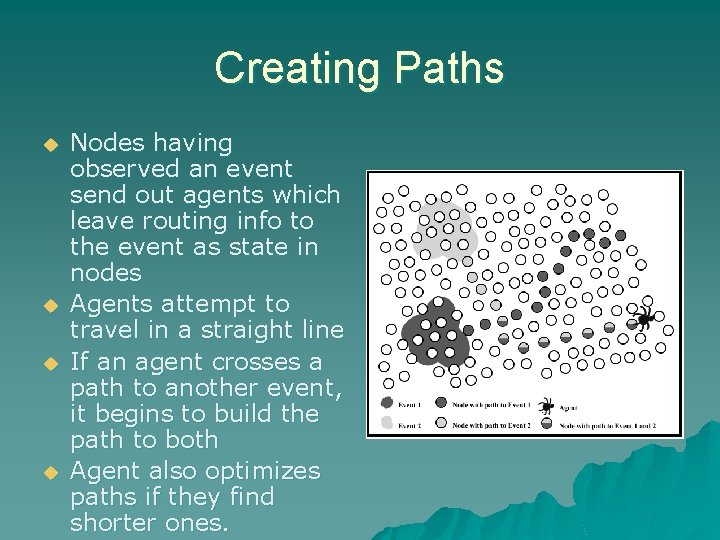
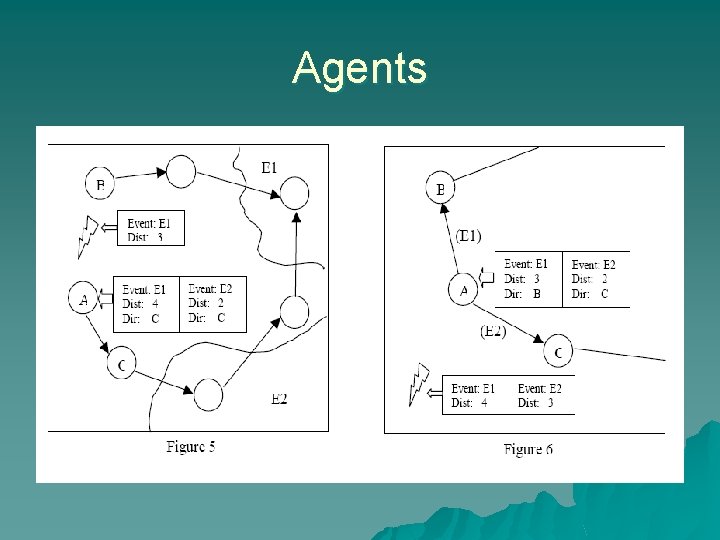
Creating Paths u u Nodes having observed an event send out agents which leave routing info to the event as state in nodes Agents attempt to travel in a straight line If an agent crosses a path to another event, it begins to build the path to both Agent also optimizes paths if they find shorter ones.
Algorithm Basics u All nodes maintain a neighbor list. u Nodes also maintain a event table – When it observes an event, the event is added with distance 0. u Agents – Packets that carry local event info across the network. – Aggregate events as they go.
Agents
Agent Path u Agent tries to travel in a “somewhat” straight path. – Maintains a list of recently seen nodes. – When it arrives at a node adds the node’s neighbors to the list. – For the next tries to find a node not in the recently seen list. – Avoids loops – -important to find a path regardless of “quality”
Following Paths u. A query originates from source, and is forwarded along until it reaches it’s TTL u Forwarding Rules: – If a node has seen the query before, it is sent to a random neighbor – If a node has a route to the event, forward to neighbor along the route – Otherwise, forward to random neighbor using straightening algorithm
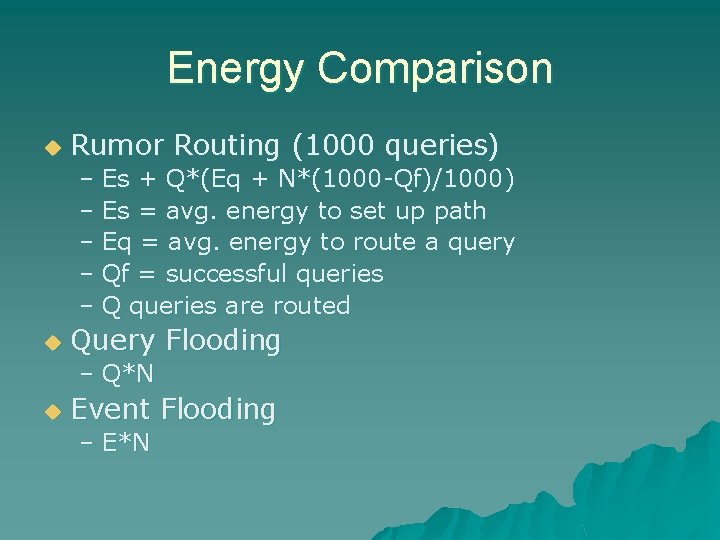
Energy Comparison u Rumor Routing (1000 queries) – Es + Q*(Eq + N*(1000 -Qf)/1000) – Es = avg. energy to set up path – Eq = avg. energy to route a query – Qf = successful queries – Q queries are routed u Query Flooding – Q*N u Event Flooding – E*N
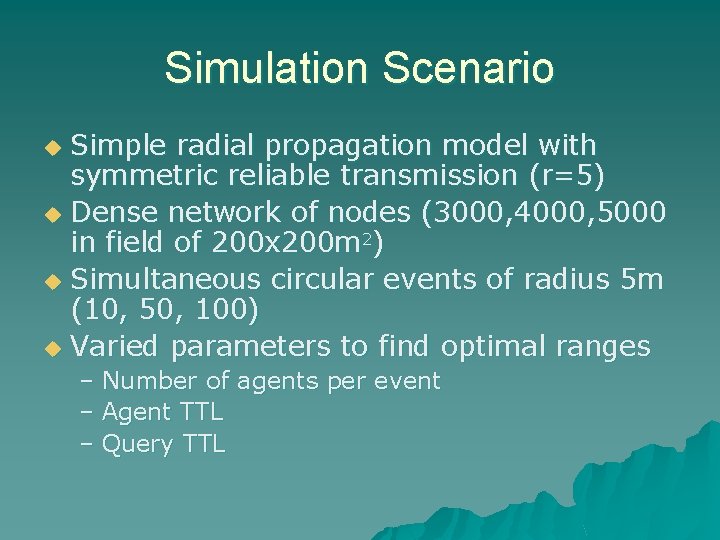
Simulation Scenario Simple radial propagation model with symmetric reliable transmission (r=5) u Dense network of nodes (3000, 4000, 5000 in field of 200 x 200 m 2) u Simultaneous circular events of radius 5 m (10, 50, 100) u Varied parameters to find optimal ranges u – Number of agents per event – Agent TTL – Query TTL
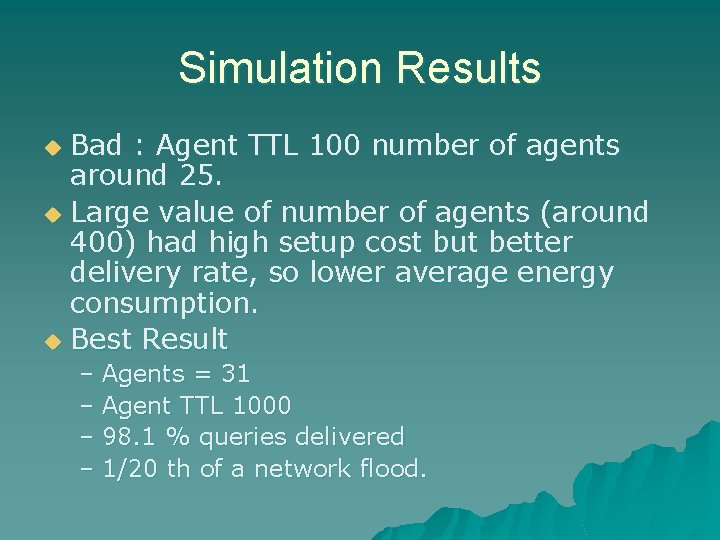
Simulation Results Bad : Agent TTL 100 number of agents around 25. u Large value of number of agents (around 400) had high setup cost but better delivery rate, so lower average energy consumption. u Best Result u – Agents = 31 – Agent TTL 1000 – 98. 1 % queries delivered – 1/20 th of a network flood.
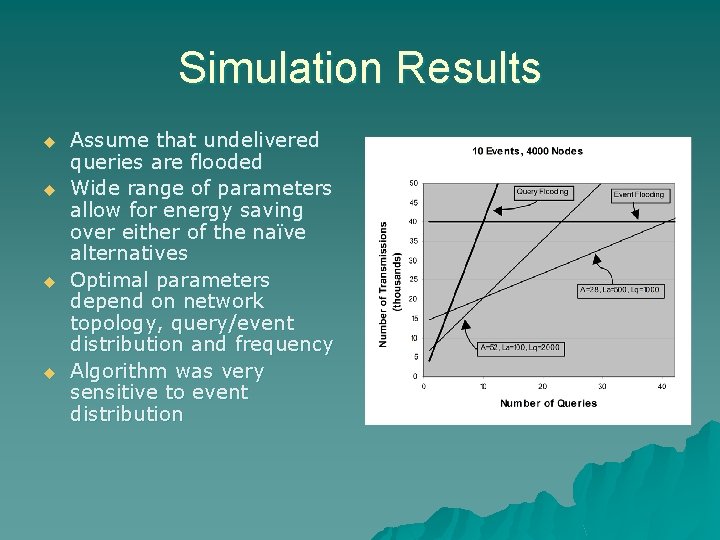
Simulation Results u u Assume that undelivered queries are flooded Wide range of parameters allow for energy saving over either of the naïve alternatives Optimal parameters depend on network topology, query/event distribution and frequency Algorithm was very sensitive to event distribution
Fault Tolerance u After agents propagated paths to events, some nodes were disabled. u Delivery probability degraded linearly up to 20% node failure, then dropped sharply u Both random and clustered failure were simulated with similar results
Some Thoughts The effect of event distribution on the results is not clear. u The straightening algorithm used is essentially only a random walk … can something better be done. u The tuning of parameters for different network sizes and different node densities is not clear. u There are no clear guidelines for parameter tuning, only simulation results in a particular environment. u
Can we analyze u u u The inherent concept looks powerful. Even though not presented in this way … this algorithm is just an example of gossip routing. There are two types of gossip, gossip of events and gossip of queries. With the same gossip probability = 1/number of neighbors. (change this, would that help) It maybe possible to find the probability of intersection of these two. That might lead to a set of techniques for parameter estimation, or an optimal setting.
Other similar algos. u u Content based pub/sub. – Both the subscription and notification meet inside the network. – Can we borrow some ideas from wired networks DHT – DHTs can also be used to locate events. – Underlying routing is the problem. DHT over DSR or AODV may not be suitable.
Future Work u Network dynamics u Realistic environment u Non-localized Events u Asynchronous Events u Self-tuning algorithm dynamics
- Slides: 21