A RTP crystal electrooptic modulator for next generation




- Slides: 11
A RTP crystal electro-optic modulator for next generation gravitational wave detector Wan Wu, Volker Quetschke, Ira Thorpe, Guido Mueller, David Reitze, and David Tanner LIGO-G 070243 -00 -Z Physics Department University of Florida Gainesville, FL Supported by NSF grant PHY-0555453, PHY-0354999 & NASA//OSS grant BEFS 04 -0019
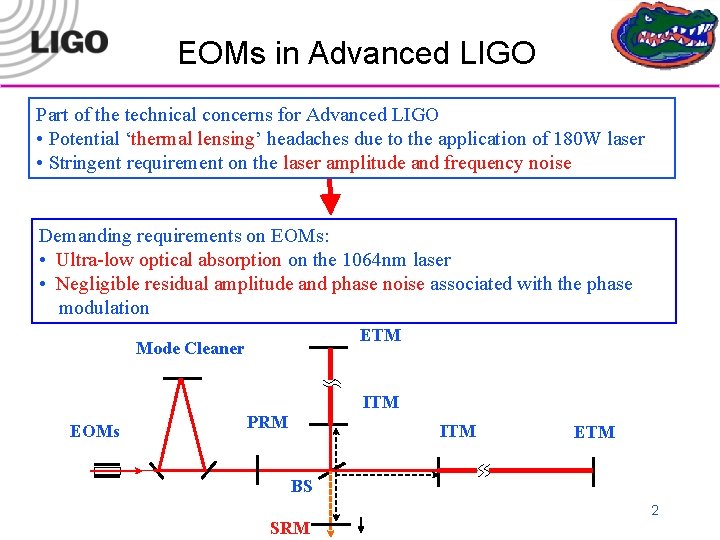
EOMs in Advanced LIGO Part of the technical concerns for Advanced LIGO • Potential ‘thermal lensing’ headaches due to the application of 180 W laser • Stringent requirement on the laser amplitude and frequency noise Demanding requirements on EOMs: • Ultra-low optical absorption on the 1064 nm laser • Negligible residual amplitude and phase noise associated with the phase modulation ETM Mode Cleaner ITM EOMs PRM ITM ETM BS SRM 2
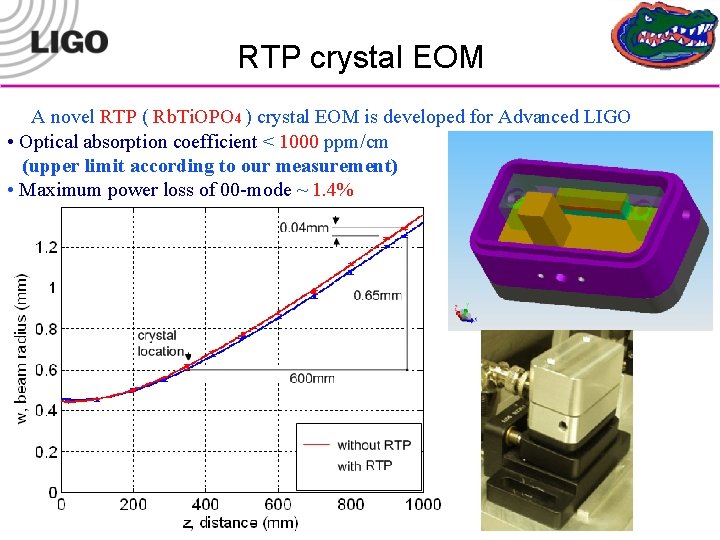
RTP crystal EOM A novel RTP ( Rb. Ti. OPO 4 ) crystal EOM is developed for Advanced LIGO • Optical absorption coefficient < 1000 ppm/cm (upper limit according to our measurement) • Maximum power loss of 00 -mode ~ 1. 4%
RFAM creates unwanted offsets in the length sensing and control signals Measured RFAM produced by RTP EOMs under high power laser heating DIW / IDC ~ 10 e-5
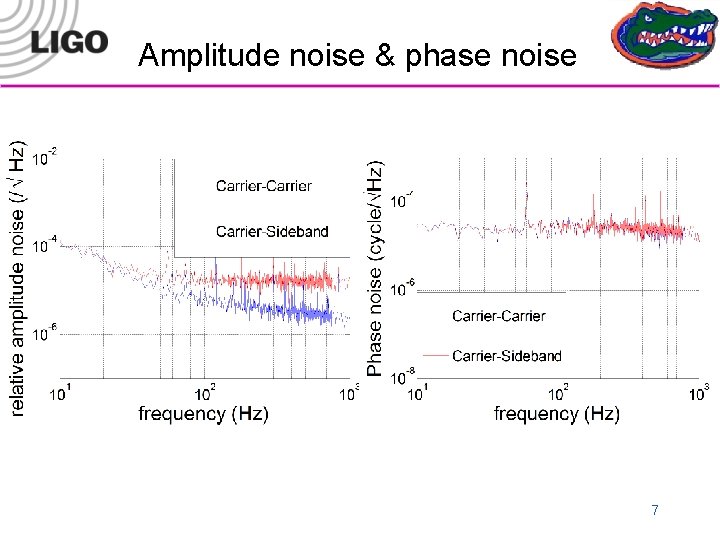
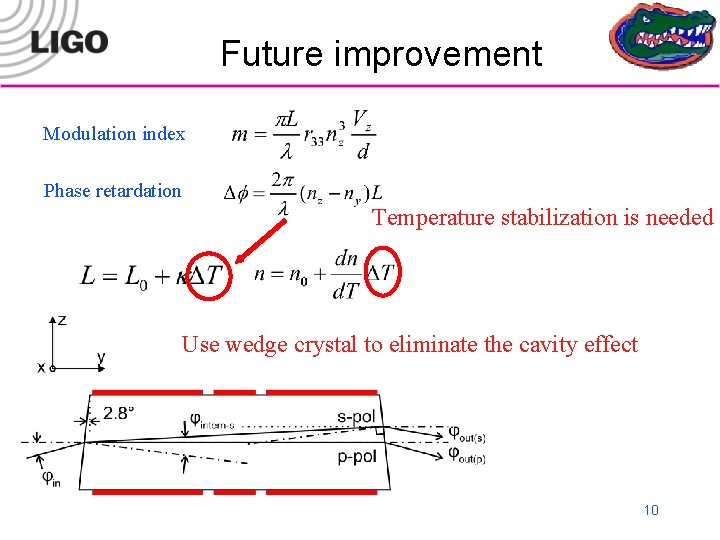
Noise associated with EOM • EOM imposes the additional noise on the transmitted light - Creates intensity noise of both the carrier and the sidebands - Introduces sidebands phase noise ( The phase fluctuation between the carrier and the sidebands causes laser frequency noise via the feed back loop ) • Noise generation mechanism - Variation of the modulation index - Variation of the phase retardation Carrier - Fabry-Perot cavity effect Sidebands 5
Measurement of the intrinsic EOM noise f 1 Nd: YAG EOM Phase meter Nd: YAG PLL f 2 • Phase lock two lasers with a frequency offset • Measure the beat signals – Carrier-Carrier (C-C), Carrier-Sidebands (C-S) 6
Amplitude noise & phase noise 7
Noise in the beat notes • Noise in two beat signals (C-C, C-S) in common mode - Beam jitter between two laser beams - Laser intensity noise • Noise in two beat signals in differential mode (amplitude & phase noise) - produced by the EOM Common-mode noise rejection analysis Amplitude Phase 8
Data analysis
Future improvement Modulation index Phase retardation Temperature stabilization is needed Use wedge crystal to eliminate the cavity effect 10
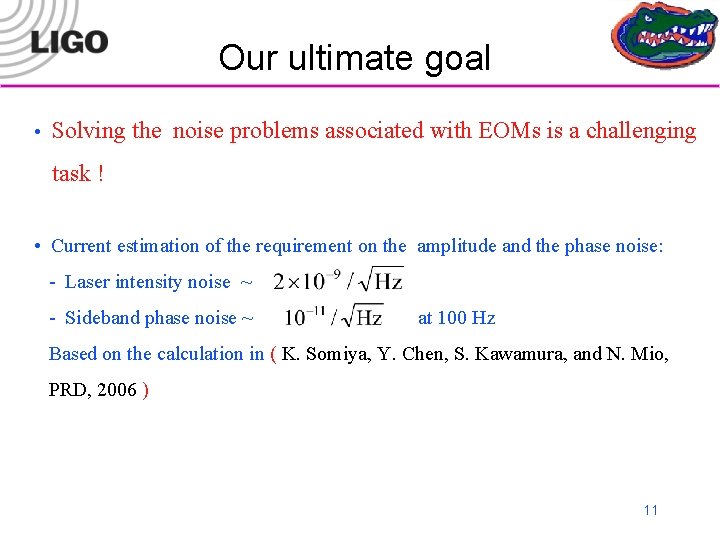
Our ultimate goal • Solving the noise problems associated with EOMs is a challenging task ! • Current estimation of the requirement on the amplitude and the phase noise: - Laser intensity noise ~ - Sideband phase noise ~ at 100 Hz Based on the calculation in ( K. Somiya, Y. Chen, S. Kawamura, and N. Mio, PRD, 2006 ) 11