A 2 Physical Education Sport Psychology PERSONALITY AND


- Slides: 36
A 2 Physical Education Sport Psychology PERSONALITY AND AROUSAL Revision week 1
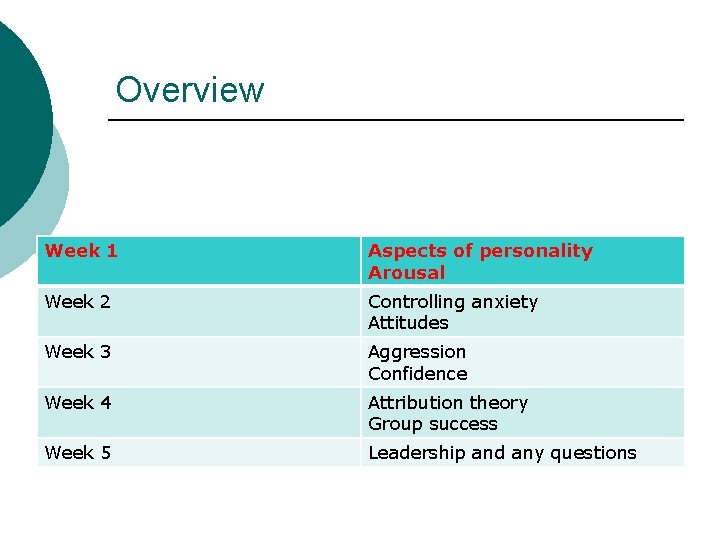
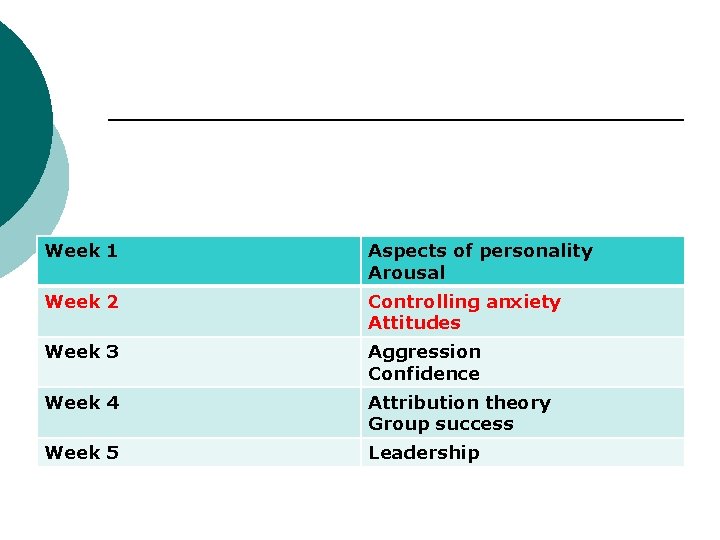
Overview Week 1 Aspects of personality Arousal Week 2 Controlling anxiety Attitudes Week 3 Aggression Confidence Week 4 Attribution theory Group success Week 5 Leadership and any questions
Aspects of personality – traffic light sheet What do I know? What do I need to know? Anything new that I’ve learnt
Review your summary sheet
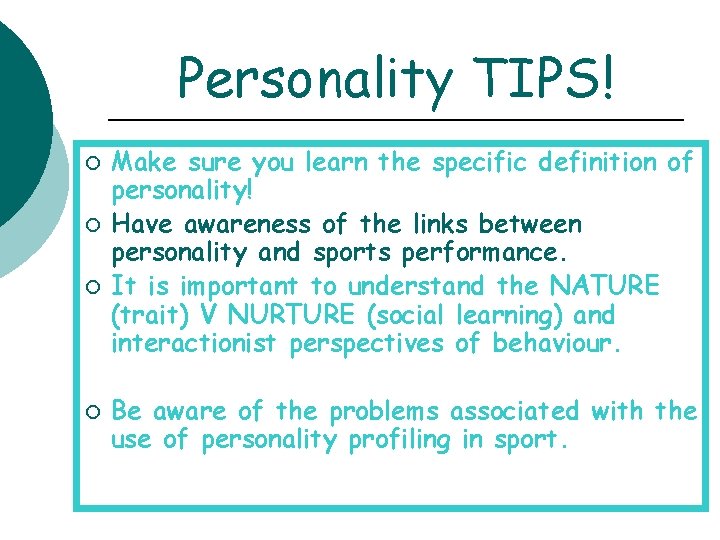
Personality TIPS! ¡ ¡ Make sure you learn the specific definition of personality! Have awareness of the links between personality and sports performance. It is important to understand the NATURE (trait) V NURTURE (social learning) and interactionist perspectives of behaviour. Be aware of the problems associated with the use of personality profiling in sport.
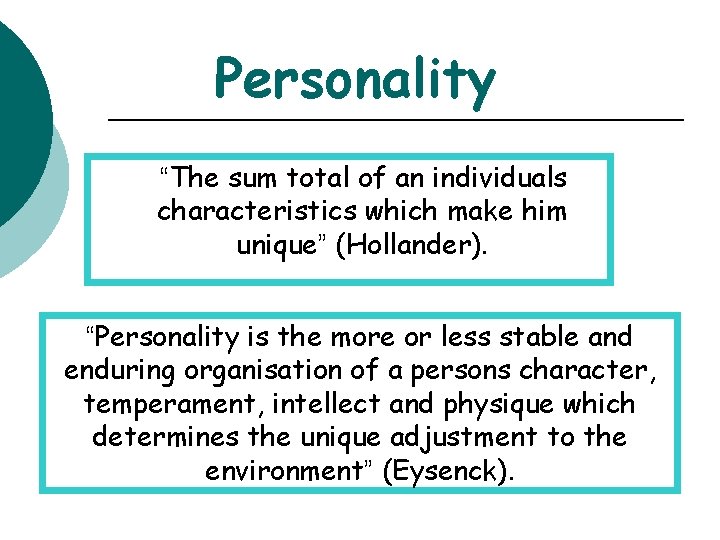
Personality “The sum total of an individuals characteristics which make him unique” (Hollander). “Personality is the more or less stable and enduring organisation of a persons character, temperament, intellect and physique which determines the unique adjustment to the environment” (Eysenck).
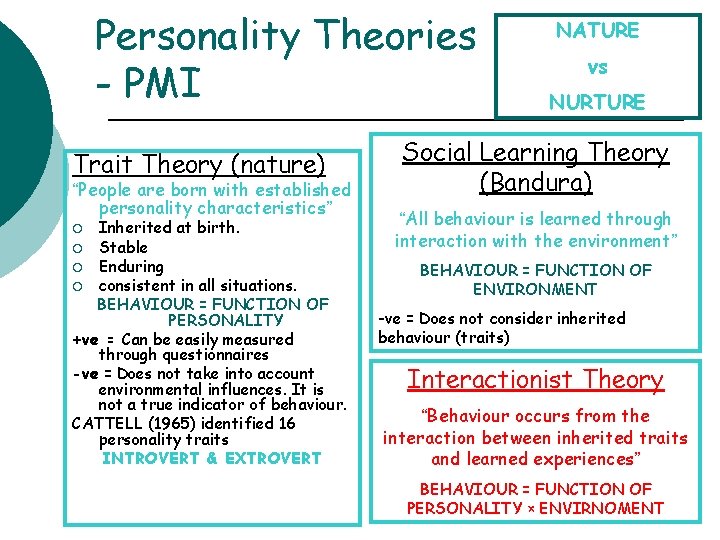
Personality Theories - PMI Trait Theory (nature) “People are born with established personality characteristics” Inherited at birth. ¡ Stable ¡ Enduring ¡ consistent in all situations. BEHAVIOUR = FUNCTION OF PERSONALITY +ve = Can be easily measured through questionnaires -ve = Does not take into account environmental influences. It is not a true indicator of behaviour. CATTELL (1965) identified 16 personality traits INTROVERT & EXTROVERT ¡ NATURE vs NURTURE Social Learning Theory (Bandura) “All behaviour is learned through interaction with the environment” BEHAVIOUR = FUNCTION OF ENVIRONMENT -ve = Does not consider inherited behaviour (traits) Interactionist Theory “Behaviour occurs from the interaction between inherited traits and learned experiences” BEHAVIOUR = FUNCTION OF PERSONALITY × ENVIRNOMENT
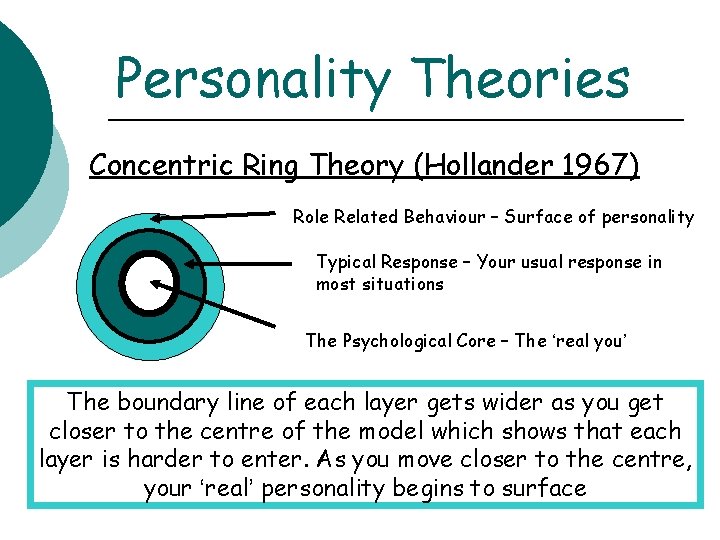
Personality Theories Concentric Ring Theory (Hollander 1967) Role Related Behaviour – Surface of personality Typical Response – Your usual response in most situations The Psychological Core – The ‘real you’ The boundary line of each layer gets wider as you get closer to the centre of the model which shows that each layer is harder to enter. As you move closer to the centre, your ‘real’ personality begins to surface
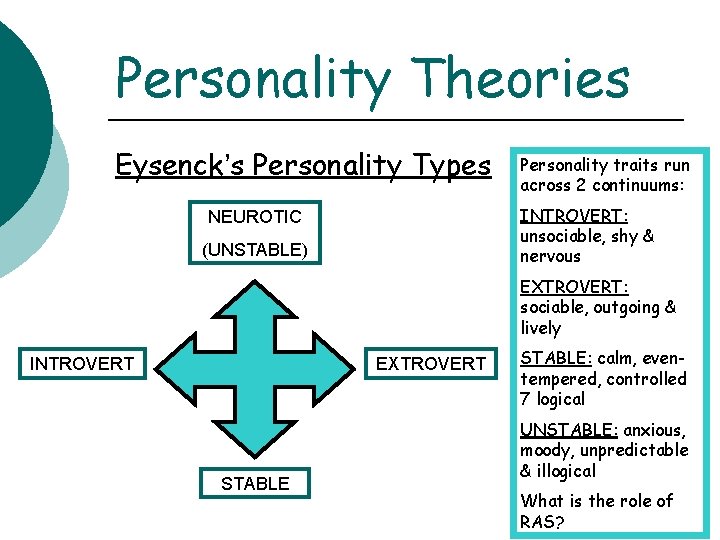
Personality Theories Eysenck’s Personality Types Personality traits run across 2 continuums: INTROVERT: unsociable, shy & nervous NEUROTIC (UNSTABLE) EXTROVERT: sociable, outgoing & lively INTROVERT EXTROVERT STABLE: calm, eventempered, controlled 7 logical UNSTABLE: anxious, moody, unpredictable & illogical What is the role of RAS?
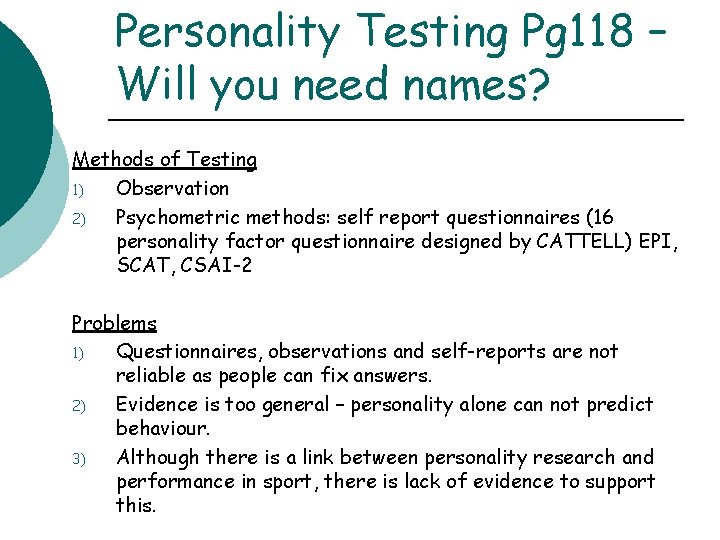
Personality Testing Pg 118 – Will you need names? Methods of Testing 1) Observation 2) Psychometric methods: self report questionnaires (16 personality factor questionnaire designed by CATTELL) EPI, SCAT, CSAI-2 Problems 1) Questionnaires, observations and self-reports are not reliable as people can fix answers. 2) Evidence is too general – personality alone can not predict behaviour. 3) Although there is a link between personality research and performance in sport, there is lack of evidence to support this.
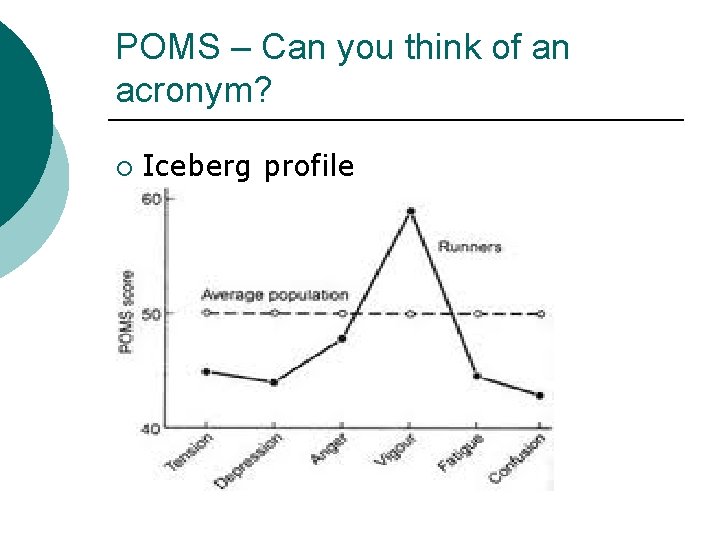
POMS – Can you think of an acronym? ¡ Iceberg profile
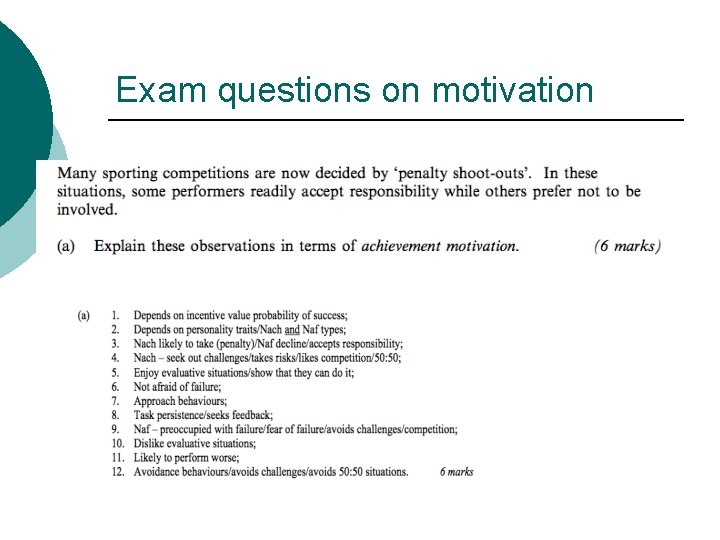
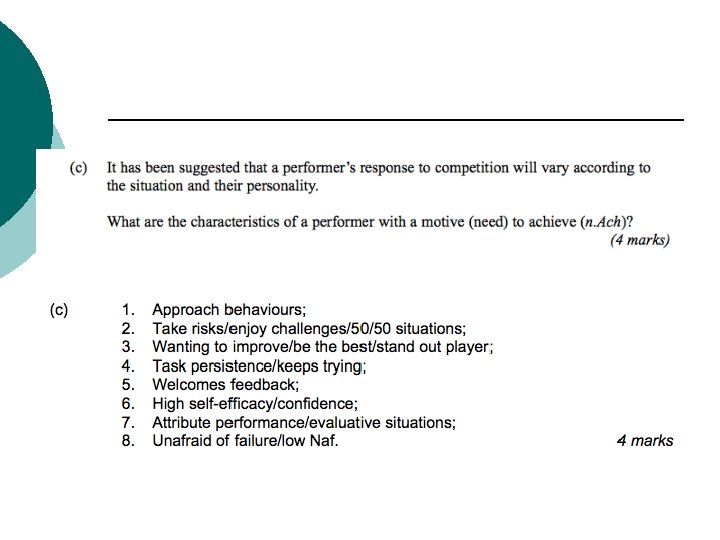
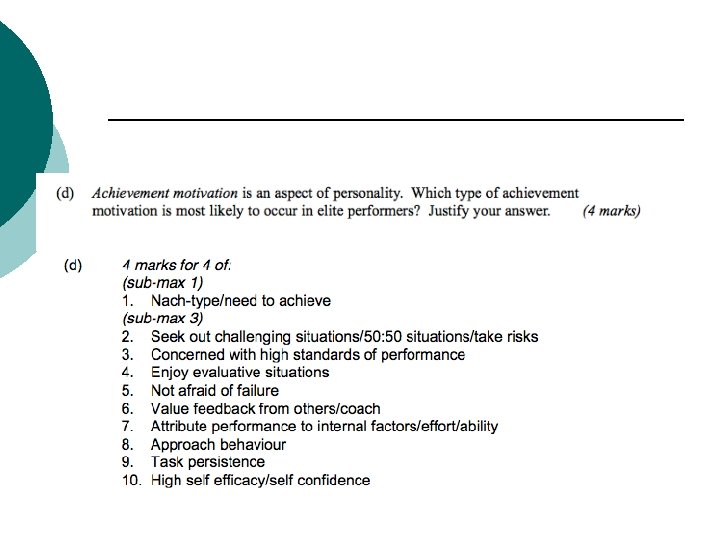
Exam questions on motivation
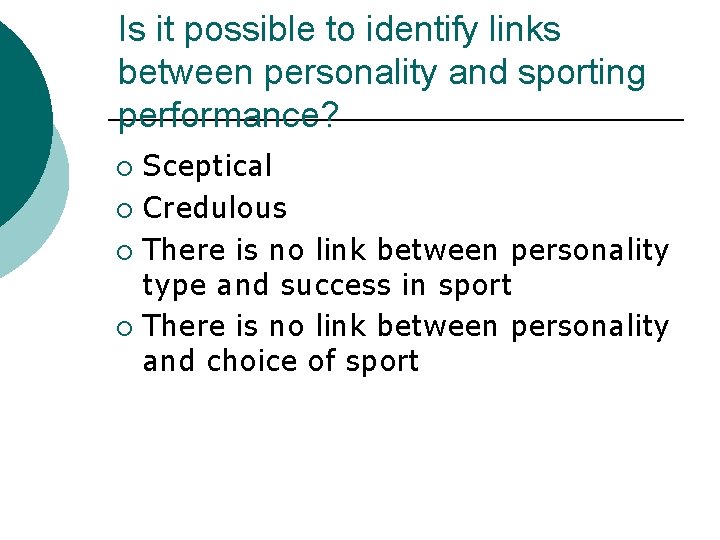
Is it possible to identify links between personality and sporting performance? Sceptical ¡ Credulous ¡ There is no link between personality type and success in sport ¡ There is no link between personality and choice of sport ¡
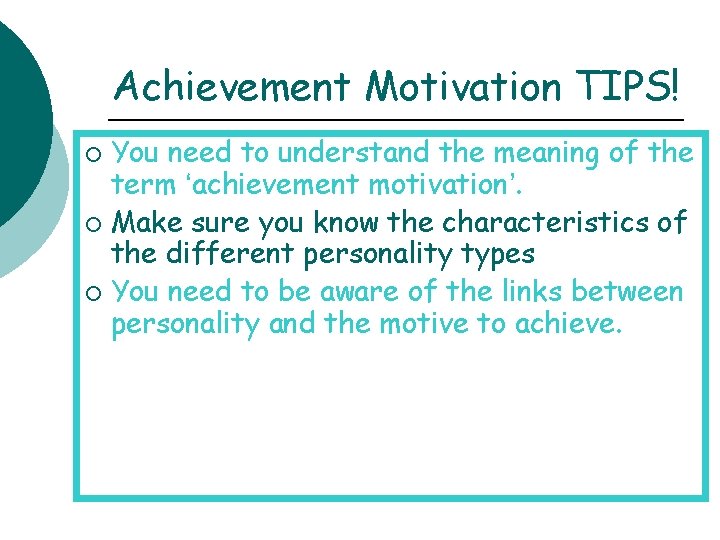
Achievement Motivation TIPS! You need to understand the meaning of the term ‘achievement motivation’. ¡ Make sure you know the characteristics of the different personality types ¡ You need to be aware of the links between personality and the motive to achieve. ¡
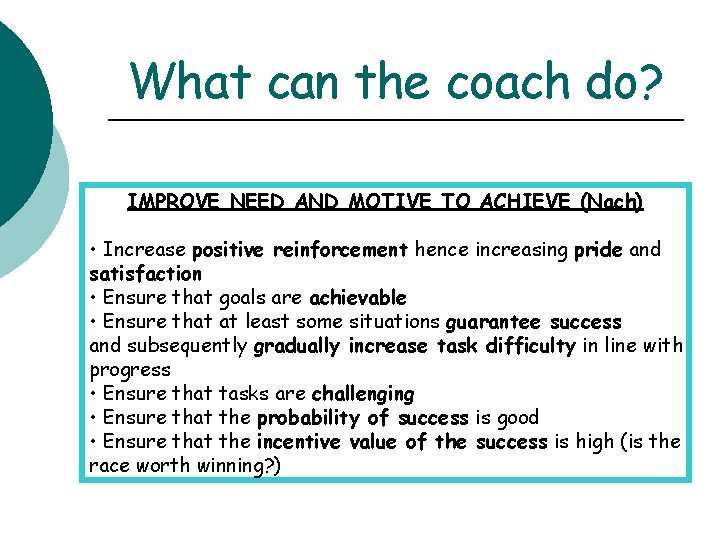
What can the coach do? IMPROVE NEED AND MOTIVE TO ACHIEVE (Nach) • Increase positive reinforcement hence increasing pride and satisfaction • Ensure that goals are achievable • Ensure that at least some situations guarantee success and subsequently gradually increase task difficulty in line with progress • Ensure that tasks are challenging • Ensure that the probability of success is good • Ensure that the incentive value of the success is high (is the race worth winning? )
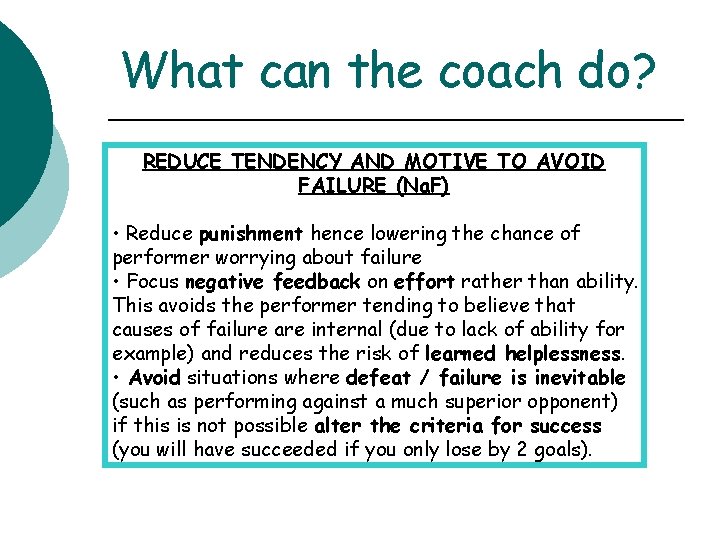
What can the coach do? REDUCE TENDENCY AND MOTIVE TO AVOID FAILURE (Na. F) • Reduce punishment hence lowering the chance of performer worrying about failure • Focus negative feedback on effort rather than ability. This avoids the performer tending to believe that causes of failure are internal (due to lack of ability for example) and reduces the risk of learned helplessness. • Avoid situations where defeat / failure is inevitable (such as performing against a much superior opponent) if this is not possible alter the criteria for success (you will have succeeded if you only lose by 2 goals).
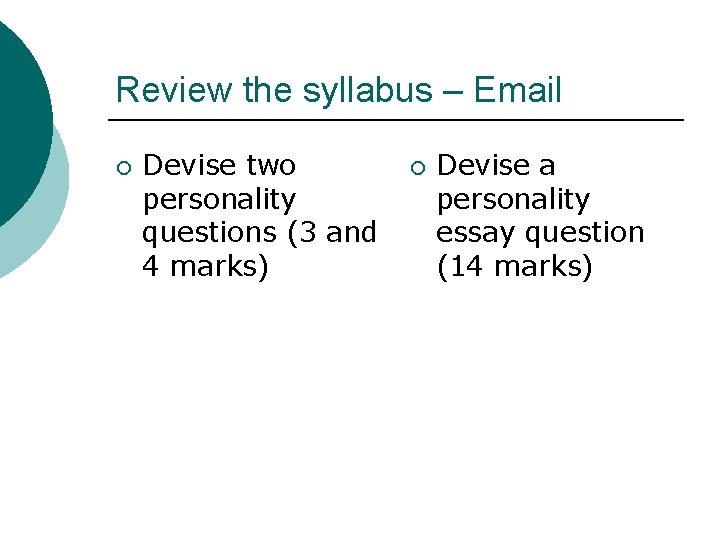
Review the syllabus – Email ¡ Devise two personality questions (3 and 4 marks) ¡ Devise a personality essay question (14 marks)
Aspects of personality – traffic light sheet Anything new that I’ve learnt
Anything to add to the summary sheet? ¡ ¡ Any further questions? Homework – Exam questions and devised questions due in on Friday
A 2 Physical Education Sport Psychology Arousal Revision
Review your summary sheet
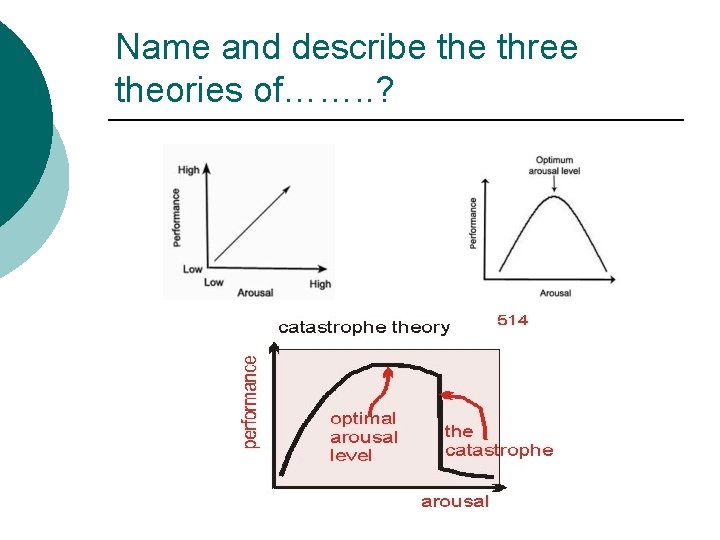
Name and describe three theories of……. . ?
Key terms ¡ Arousal ¡ Somatic ¡ Reticular activating system (RAS) ¡ P = f (H X D)
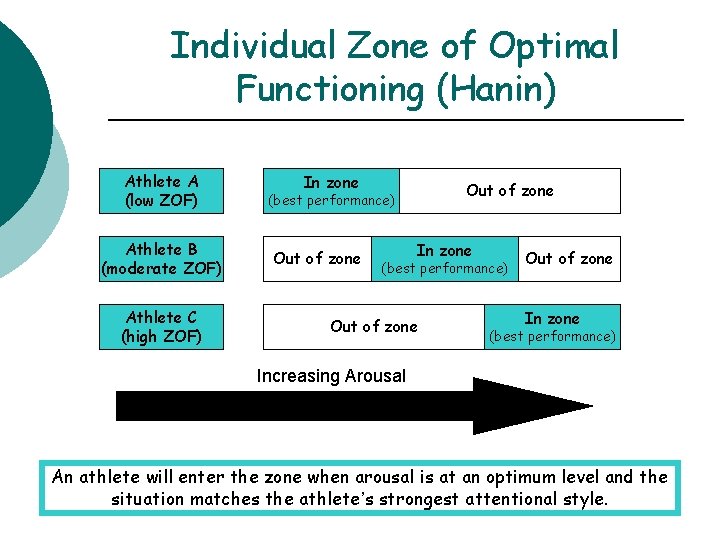
Individual Zone of Optimal Functioning (Hanin) Athlete A (low ZOF) Athlete B (moderate ZOF) Athlete C (high ZOF) In zone Out of zone (best performance) Out of zone In zone (best performance) Increasing Arousal An athlete will enter the zone when arousal is at an optimum level and the situation matches the athlete’s strongest attentional style.
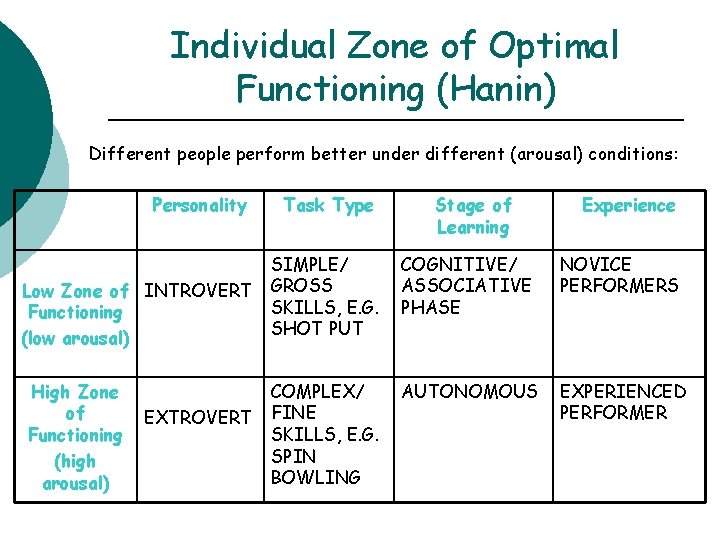
Individual Zone of Optimal Functioning (Hanin) Different people perform better under different (arousal) conditions: Personality Task Type Low Zone of INTROVERT Functioning (low arousal) SIMPLE/ GROSS SKILLS, E. G. SHOT PUT COGNITIVE/ ASSOCIATIVE PHASE NOVICE PERFORMERS COMPLEX/ FINE SKILLS, E. G. SPIN BOWLING AUTONOMOUS EXPERIENCED PERFORMER High Zone of Functioning (high arousal) EXTROVERT Stage of Learning Experience
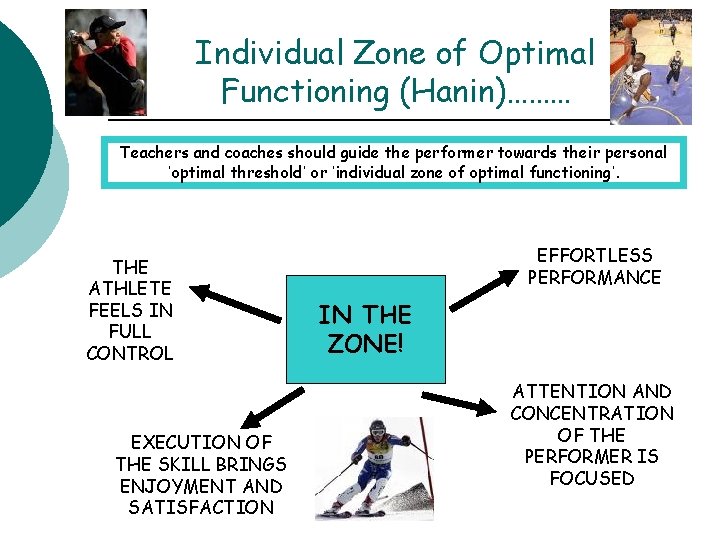
Individual Zone of Optimal Functioning (Hanin)……… Teachers and coaches should guide the performer towards their personal ‘optimal threshold’ or ‘individual zone of optimal functioning’. THE ATHLETE FEELS IN FULL CONTROL EXECUTION OF THE SKILL BRINGS ENJOYMENT AND SATISFACTION EFFORTLESS PERFORMANCE IN THE ZONE! ATTENTION AND CONCENTRATION OF THE PERFORMER IS FOCUSED
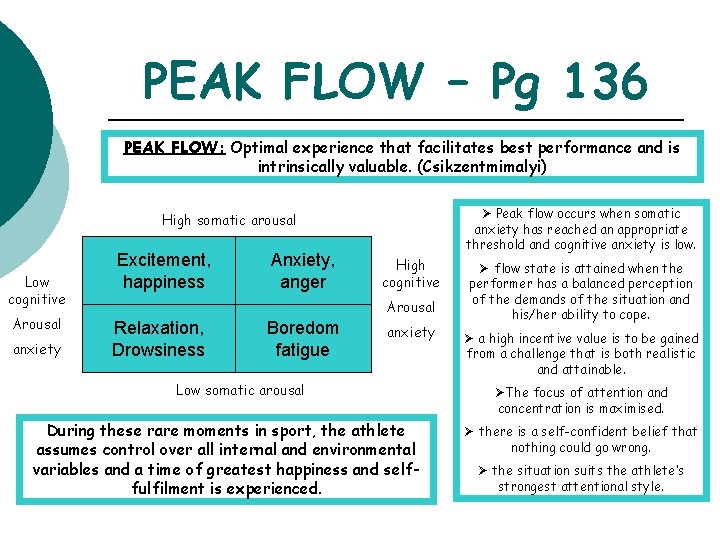
PEAK FLOW – Pg 136 PEAK FLOW: Optimal experience that facilitates best performance and is intrinsically valuable. (Csikzentmimalyi) Ø Peak flow occurs when somatic anxiety has reached an appropriate threshold and cognitive anxiety is low. High somatic arousal Low cognitive Arousal anxiety Excitement, happiness Anxiety, anger High cognitive Arousal Relaxation, Drowsiness Boredom fatigue anxiety Low somatic arousal During these rare moments in sport, the athlete assumes control over all internal and environmental variables and a time of greatest happiness and selffulfilment is experienced. Ø flow state is attained when the performer has a balanced perception of the demands of the situation and his/her ability to cope. Ø a high incentive value is to be gained from a challenge that is both realistic and attainable. ØThe focus of attention and concentration is maximised. Ø there is a self-confident belief that nothing could go wrong. Ø the situation suits the athlete’s strongest attentional style.
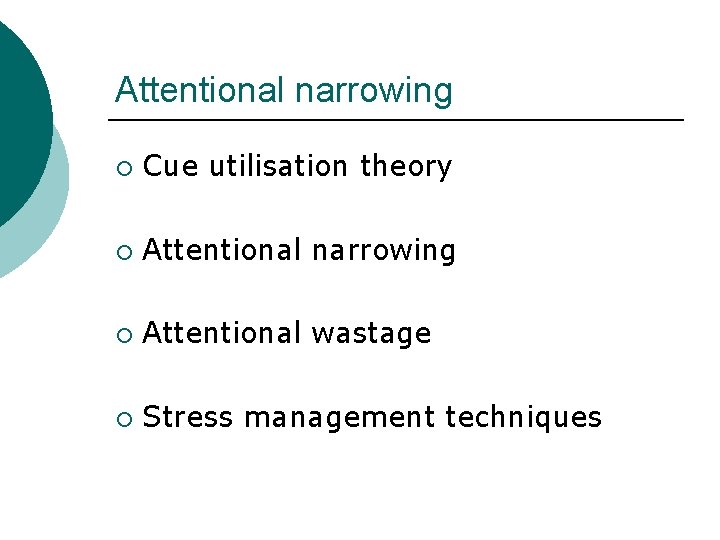
Attentional narrowing ¡ Cue utilisation theory ¡ Attentional narrowing ¡ Attentional wastage ¡ Stress management techniques
Review the syllabus – traffic light sheet ¡ Devise two arousal questions (3 and 4 marks) ¡ Devise an arousal essay question (14 marks)
Examination questions
Aspects of personality – traffic light sheet What do I know? What do I need to know? Anything new that I’ve learnt
Anything to add to the summary sheet? ¡ ¡ Any further questions? Homework – Exam questions and devised questions due in on Friday
Week 1 Aspects of personality Arousal Week 2 Controlling anxiety Attitudes Week 3 Aggression Confidence Week 4 Attribution theory Group success Week 5 Leadership
Home learning review