THEORIES OF PERSONALITY We will discuss Meaning of


- Slides: 21
THEORIES OF PERSONALITY
We will discuss… • Meaning of Type approach a) Type approach by Hippocrates b) Type approach by Charak Samhita c) Type approach by Sheldon d) Type approach by Carl Jung • Meaning of Trait approach a) Trait approach by Gordan Allport b) Trait approach by Raymond Cattell c) Trait approach by H. J. Eysenck
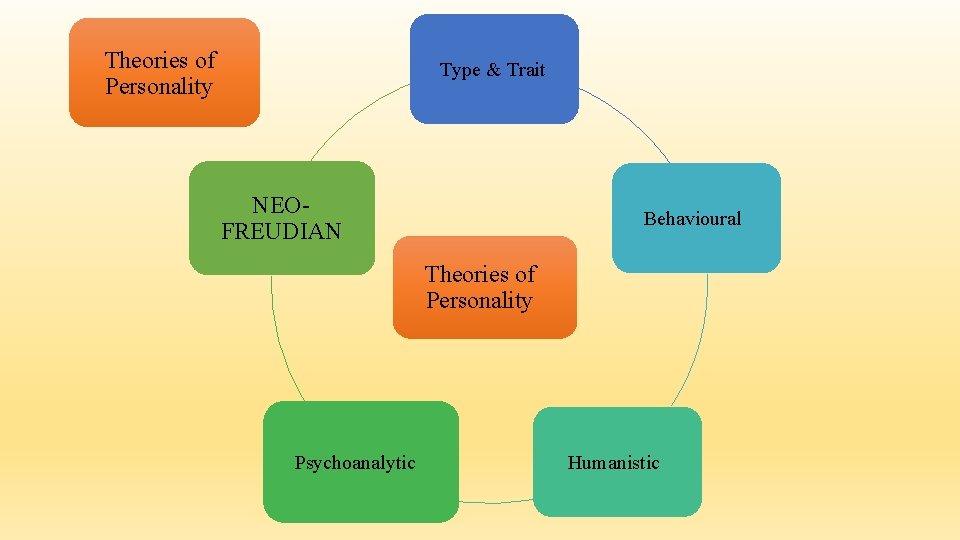
Theories of Personality Type & Trait NEOFREUDIAN Behavioural Theories of Personality Psychoanalytic Humanistic
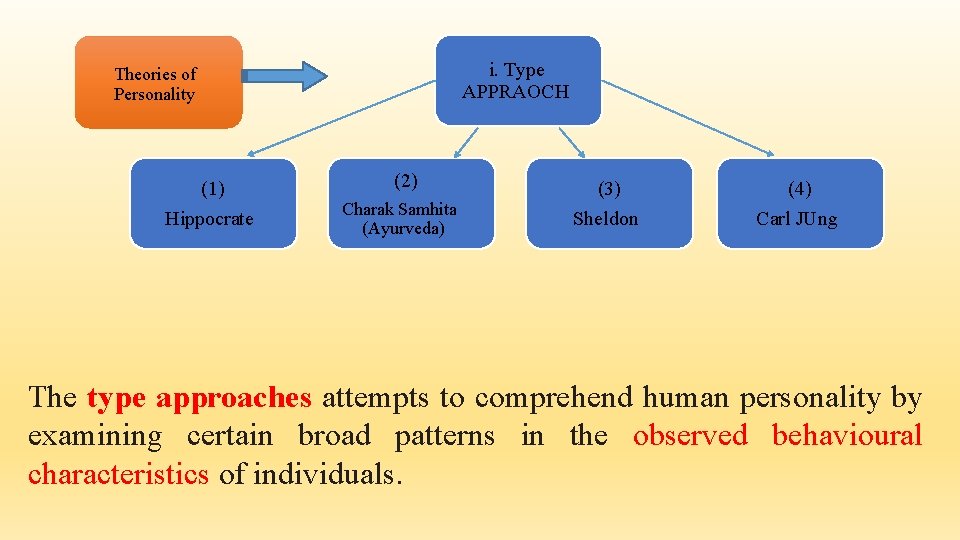
i. Type APPRAOCH Theories of Personality (1) Hippocrate (2) Charak Samhita (Ayurveda) (3) Sheldon (4) Carl JUng The type approaches attempts to comprehend human personality by examining certain broad patterns in the observed behavioural characteristics of individuals.
I. HIPPOCRATES Type Approach According to Hippocrates- • human body consists of four types of humours or fluids – Blood, Yellow bile, Phlegm and black bile. • The predominance of one of these four types of fluids which are all present in one’s body gives him unique temperamental characteristics leading to a particular type of personality. • Types of Personality: • Sanguine • Choleric • Phlegmatic • Melancholic
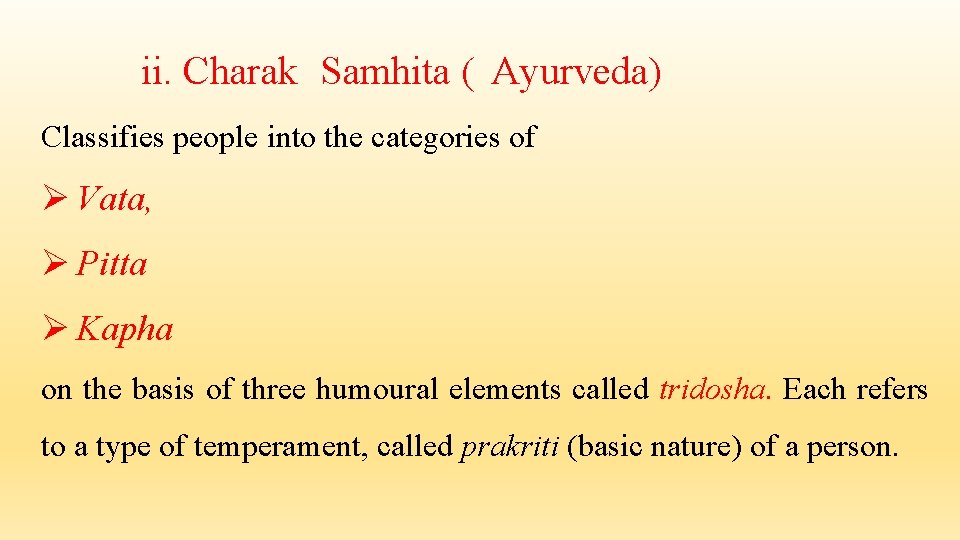
ii. Charak Samhita ( Ayurveda) Classifies people into the categories of Ø Vata, Ø Pitta Ø Kapha on the basis of three humoural elements called tridosha. Each refers to a type of temperament, called prakriti (basic nature) of a person.
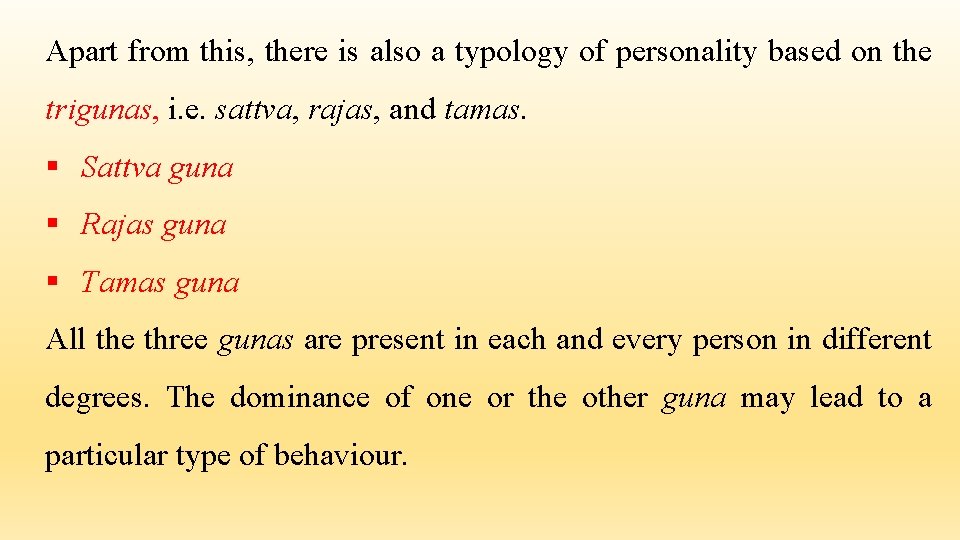
Apart from this, there is also a typology of personality based on the trigunas, i. e. sattva, rajas, and tamas. § Sattva guna § Rajas guna § Tamas guna All the three gunas are present in each and every person in different degrees. The dominance of one or the other guna may lead to a particular type of behaviour.
Reflection Spot… What are you ? Sattvic, Rajasic, or Tamasic
III. Sheldon’s Body types Sheldon classified human beings into discrete types according to their physical structures (body types) and attached certain temperamental characteristics. § Endomorphs § Mesomorphs § Ectomorphs These body typologies are simple, and have limited use in predicting behaviour of individuals. They are more like stereotypes which people hold.
Reflection Spot… Identify Endomorphs, Mesomorphs, Ectomorphs in your friend circle.
IV. Carl Jung’s typology Jung has proposed another important typology by grouping people into introverts and extraverts. This is widely recognised. Ø INTROVERTS Ø EXTRAVERTS
Reflection Spot… Are you an Ambivert?
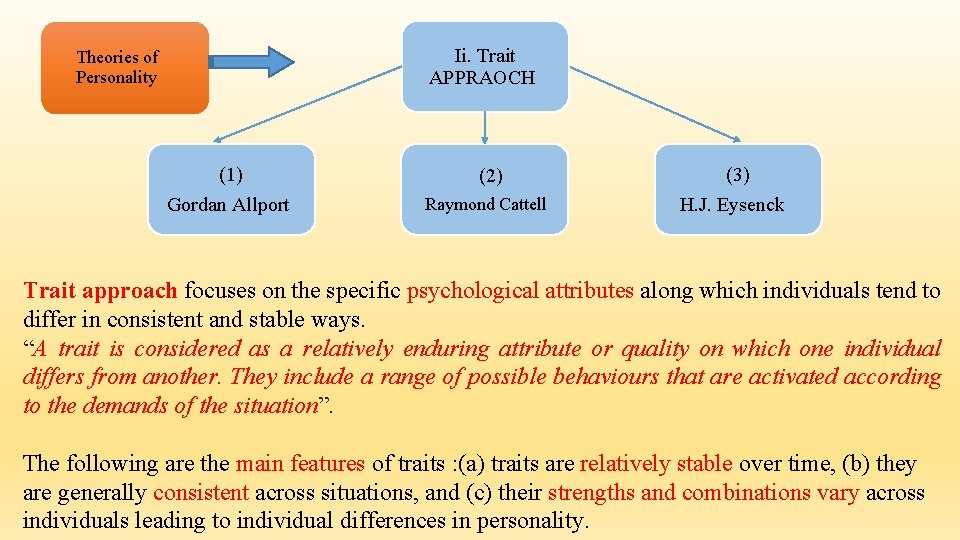
Ii. Trait APPRAOCH Theories of Personality (1) Gordan Allport (2) Raymond Cattell (3) H. J. Eysenck Trait approach focuses on the specific psychological attributes along which individuals tend to differ in consistent and stable ways. “A trait is considered as a relatively enduring attribute or quality on which one individual differs from another. They include a range of possible behaviours that are activated according to the demands of the situation”. The following are the main features of traits : (a) traits are relatively stable over time, (b) they are generally consistent across situations, and (c) their strengths and combinations vary across individuals leading to individual differences in personality.
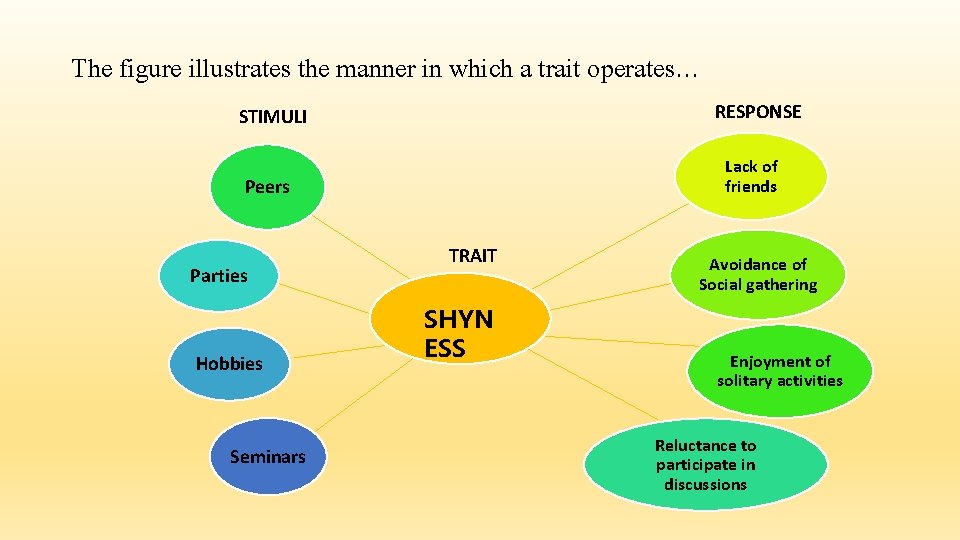
The figure illustrates the manner in which a trait operates… RESPONSE STIMULI Lack of friends Peers Parties Hobbies Seminars TRAIT SHYN ESS Avoidance of Social gathering Enjoyment of solitary activities Reluctance to participate in discussions
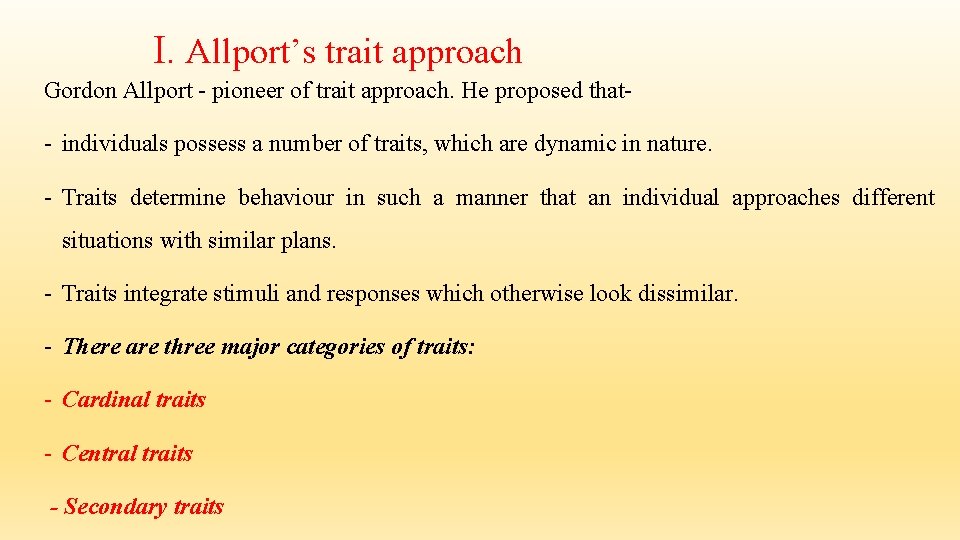
I. Allport’s trait approach Gordon Allport - pioneer of trait approach. He proposed that- - individuals possess a number of traits, which are dynamic in nature. - Traits determine behaviour in such a manner that an individual approaches different situations with similar plans. - Traits integrate stimuli and responses which otherwise look dissimilar. - There are three major categories of traits: - Cardinal traits - Central traits - Secondary traits
REFLECTION SPOT… What is your Cardinal Trait?
II. Raymond Cattell’s Factor theory Ø Given by Raymond Cattell Ø According to him there is a common structure on which people differ from each other. Ø He applied a statistical technique, called factor analysis, to discover the common structures. Ø He found 16 basic personality factors including emotional stability, outgoingness, assertiveness, self assurance self discipline etc. Ø He distinguished between Source traits and surface traits. Ø Sixteen Personality Factor Questionnaire (16 PF), for the assessment of personality.
REFLECTION SPOT… Identify your surface traits?
III. H. J. Eysenck’s Dimensions of personality H. J. Eysenck proposed that personality could be reduced into two broad dimensions. These are biologically and genetically based. Each dimension subsumes a number of specific traits. These dimensions are: (1) Neuroticism vs. emotional stability (2) Extraversion vs. introversion (3) In a later work a third dimension, called Psychoticism vs. Sociability, Eysenck Personality Questionnaire is the test which is used for studying these dimensions of personality.
REFLECTION SPOT… Are you at times Neurotic?
THANK YOU…