
Unit 5 Personality and Individuality Ch 13 Psychological

- Slides: 41
Unit 5: Personality and Individuality Ch 13: Psychological Testing Ch 14: Theories of Personality
Ch 13 – Psychological Testing • Characteristics • One of the ______ of testing is that we of psychological tend to forget that tests are merely testing tools for measuring + predicting ___________. • We start to think of test results as an _____ (ex. IQ tests). • The fairness + usefulness of a test depends on 3 things: 1. ______ 2. ____ 3. ________
• Reliability • The ability of a test to give the same _______ under similar ______ – it’s _______. • There are 3 ways of determining a test’s reliability: 1. If a person ________ or a similar test w/in a short time after the 1 st testing, they should receive approximately the _______. 2. The test should yield the same results when scored at different _______ by different _______. 3. If the test is randomly split in ½, you should receive roughly the ____ on each ½.
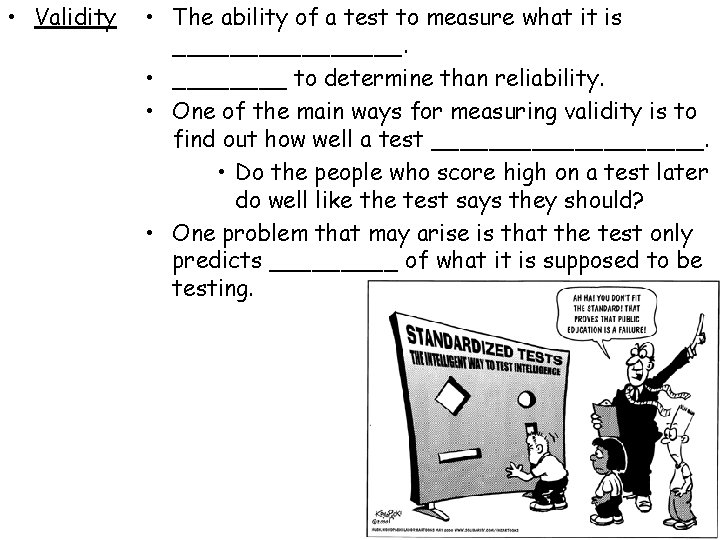
• Validity • The ability of a test to measure what it is ________. • ____ to determine than reliability. • One of the main ways for measuring validity is to find out how well a test __________. • Do the people who score high on a test later do well like the test says they should? • One problem that may arise is that the test only predicts _____ of what it is supposed to be testing.
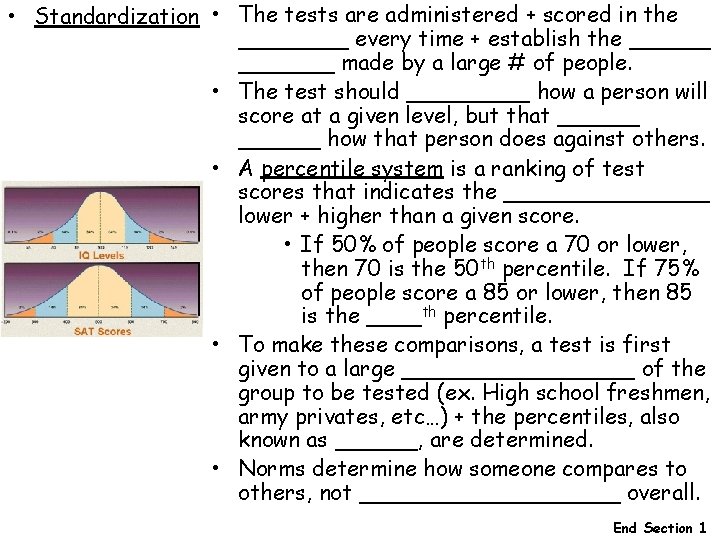
• Standardization • The tests are administered + scored in the ____ every time + establish the _______ made by a large # of people. • The test should _____ how a person will score at a given level, but that ______ how that person does against others. • A percentile system is a ranking of test scores that indicates the ________ lower + higher than a given score. • If 50% of people score a 70 or lower, then 70 is the 50 th percentile. If 75% of people score a 85 or lower, then 85 is the ____th percentile. • To make these comparisons, a test is first given to a large _________ of the group to be tested (ex. High school freshmen, army privates, etc…) + the percentiles, also known as ______, are determined. • Norms determine how someone compares to others, not __________ overall. End Section 1
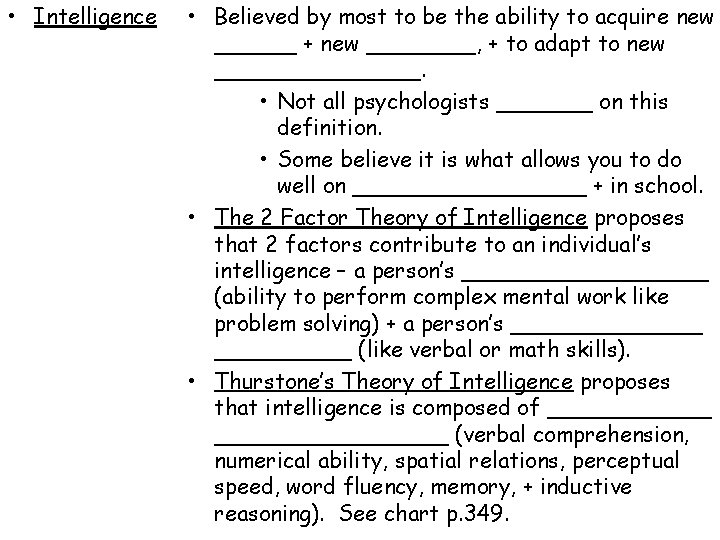
• Intelligence • Believed by most to be the ability to acquire new ______ + new ____, + to adapt to new ________. • Not all psychologists _______ on this definition. • Some believe it is what allows you to do well on _________ + in school. • The 2 Factor Theory of Intelligence proposes that 2 factors contribute to an individual’s intelligence – a person’s _________ (ability to perform complex mental work like problem solving) + a person’s _______ (like verbal or math skills). • Thurstone’s Theory of Intelligence proposes that intelligence is composed of _________________ (verbal comprehension, numerical ability, spatial relations, perceptual speed, word fluency, memory, + inductive reasoning). See chart p. 349.
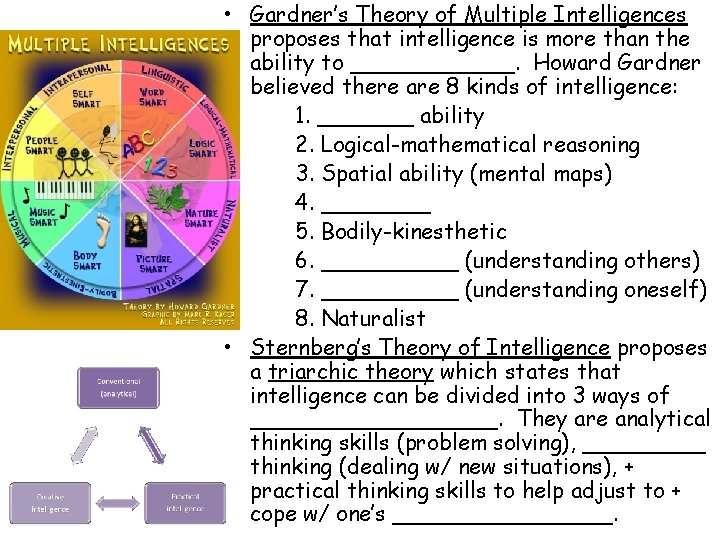
• Gardner’s Theory of Multiple Intelligences proposes that intelligence is more than the ability to ______. Howard Gardner believed there are 8 kinds of intelligence: 1. _______ ability 2. Logical-mathematical reasoning 3. Spatial ability (mental maps) 4. ____ 5. Bodily-kinesthetic 6. _____ (understanding others) 7. _____ (understanding oneself) 8. Naturalist • Sternberg’s Theory of Intelligence proposes a triarchic theory which states that intelligence can be divided into 3 ways of _________. They are analytical thinking skills (problem solving), _____ thinking (dealing w/ new situations), + practical thinking skills to help adjust to + cope w/ one’s ________.
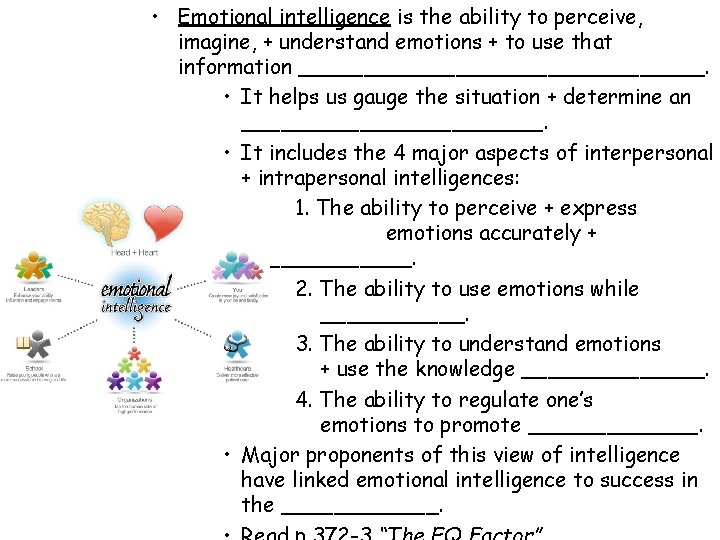
• Emotional intelligence is the ability to perceive, imagine, + understand emotions + to use that information ________________. • It helps us gauge the situation + determine an ____________. • It includes the 4 major aspects of interpersonal + intrapersonal intelligences: 1. The ability to perceive + express emotions accurately + _______. 2. The ability to use emotions while ______. 3. The ability to understand emotions + use the knowledge _______. 4. The ability to regulate one’s emotions to promote _______. • Major proponents of this view of intelligence have linked emotional intelligence to success in the ______.
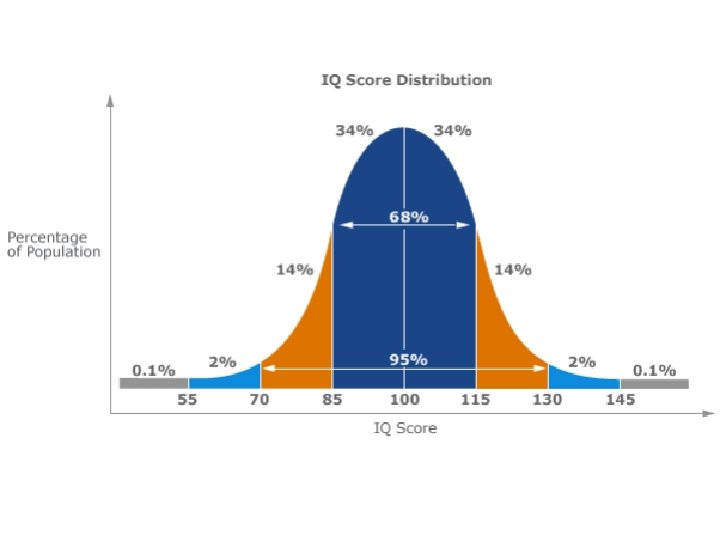
• Intelligence tests • Alfred Binet was a French psychologist who was asked by authorities to design an intelligence test pick out “_______” to be placed in separate classes. • This led to the development of the Stanford. Binet Intelligence Scale which groups items by _______. A person’s IQ (intelligence quotient) is his/her standardized measure of intelligence based on a scale in which _____ is average. • About 95% of people score b/w ______. • People who score _______ are usually classified as handicapped. • • Mildly handicapped, but educable (55 -69) Moderately handicapped, but trainable (40 -54) Severely handicapped (25 -39) Profoundly handicapped (below 25) • IQ scores are most useful when related to ________ – they are very accurate at predicting how well people will do in school. • Critics argue that IQ testing doesn’t ________ intelligence though.
• Controversy over IQ testing • Is IQ based on ____________? • Researchers have found a high degree of heritability (the degree to which a characteristic is related to _____________) in intelligence. • Although debated, many believe heredity accounts for ____% of a person’s IQ. • The richness of the home environment, the quality of food, + the # of _____ all affect a person’s IQ. • How does _______ affect IQ scores? • A major criticism of IQ tests is that they are culturally biased (an aspect of a test in which the wording used in questions may be more familiar to people of one _______ than to another group). End Section 2
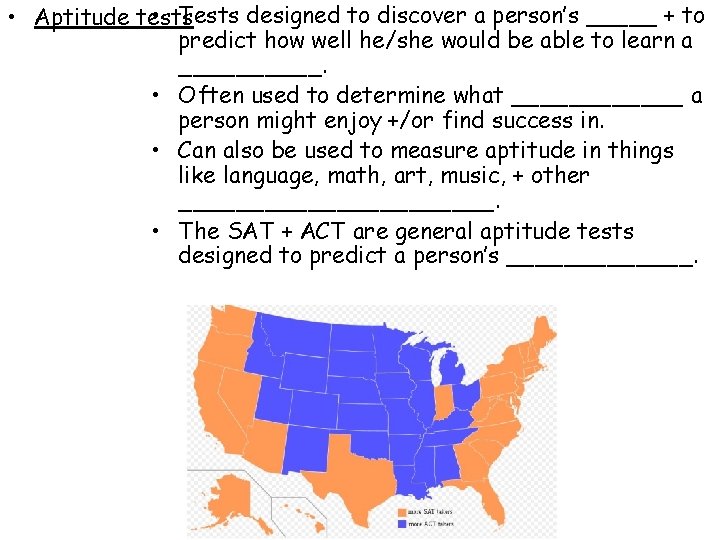
• Tests designed to discover a person’s _____ + to • Aptitude tests predict how well he/she would be able to learn a _____. • Often used to determine what ______ a person might enjoy +/or find success in. • Can also be used to measure aptitude in things like language, math, art, music, + other ___________. • The SAT + ACT are general aptitude tests designed to predict a person’s _______.
• Achievement • Tests designed to measure how much a tests person has learned in a _______ or area. • Instructors + students can assess a student’s ______. • They are validated in terms of their _____ validity. • Many confuse aptitude + achievement tests. The distinction is in whether the test is used to predict _____ (APTITUDE) or to assess what a person ______ (ACHIEVEMENT).
• Interest inventories • Test that measures a person’s _____ + attitudes in a wide variety of activities to identify areas of likely _____. • There are no ________ answers. • These tests are often used to determine what career students might find most _______. • The more a person’s interest patterns correspond to those of people in a particular occupation, the more likely that person is to _________ in that profession. • It’s important to note that ______ as well as interests should be taken into account when __________. End Section 3
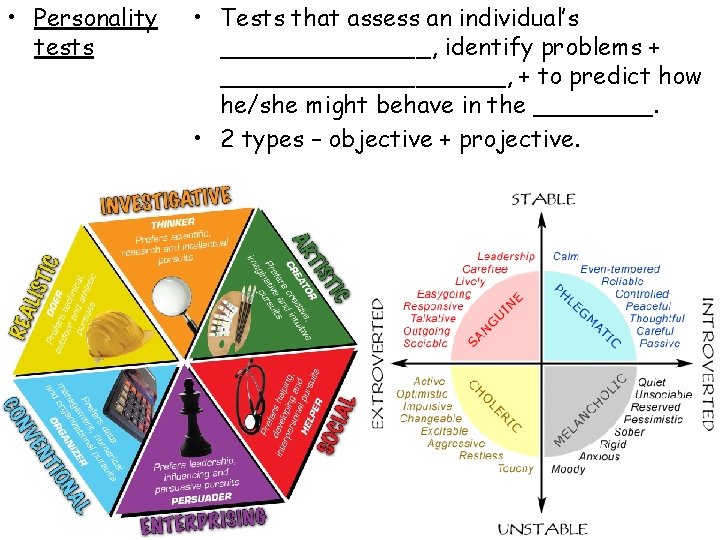
• Personality tests • Tests that assess an individual’s _______, identify problems + __________, + to predict how he/she might behave in the ____. • 2 types – objective + projective.
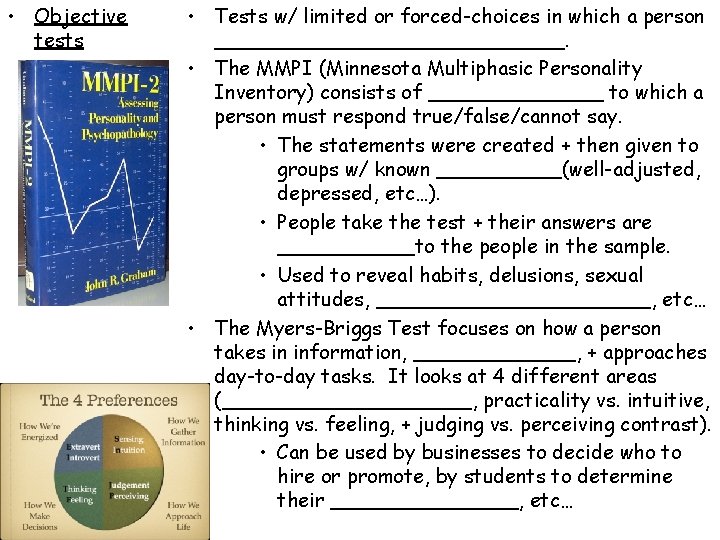
• Objective tests • Tests w/ limited or forced-choices in which a person ______________. • The MMPI (Minnesota Multiphasic Personality Inventory) consists of _______ to which a person must respond true/false/cannot say. • The statements were created + then given to groups w/ known _____(well-adjusted, depressed, etc…). • People take the test + their answers are ______to the people in the sample. • Used to reveal habits, delusions, sexual attitudes, ___________, etc… • The Myers-Briggs Test focuses on how a person takes in information, _______, + approaches day-to-day tasks. It looks at 4 different areas (__________, practicality vs. intuitive, thinking vs. feeling, + judging vs. perceiving contrast). • Can be used by businesses to decide who to hire or promote, by students to determine their ________, etc…
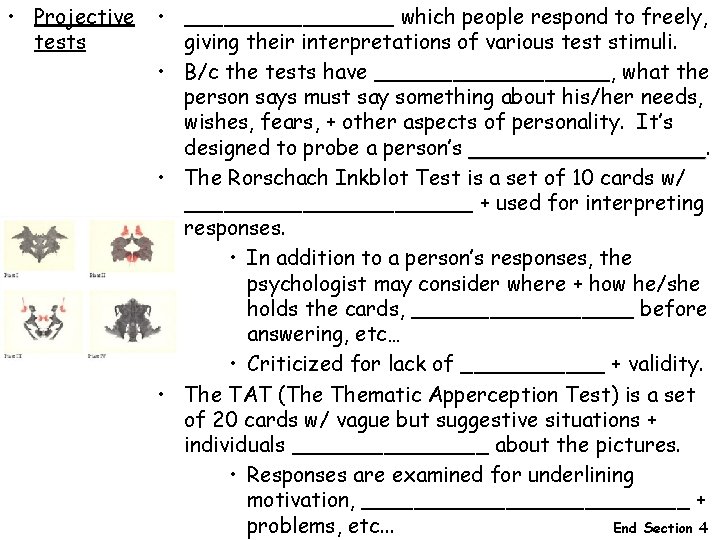
• Projective tests • ________ which people respond to freely, giving their interpretations of various test stimuli. • B/c the tests have _________, what the person says must say something about his/her needs, wishes, fears, + other aspects of personality. It’s designed to probe a person’s _________ • The Rorschach Inkblot Test is a set of 10 cards w/ ___________ + used for interpreting responses. • In addition to a person’s responses, the psychologist may consider where + how he/she holds the cards, _________ before answering, etc… • Criticized for lack of ______ + validity. • The TAT (The Thematic Apperception Test) is a set of 20 cards w/ vague but suggestive situations + individuals ________ about the pictures. • Responses are examined for underlining motivation, _____________ + problems, etc. . . End Section 4
Ch 14 – Theories of Personality • The ______, enduring, + unique ________ of a person. • What is the purpose of personality theories? • Provide a way of _____ the many characteristics about you + others. • Explain _____ among individuals. • Explore how people conduct their lives. • Determine how life can be _____. • Formal personality theories try to make ideas about why people act in certain ways ______ by stating them precisely + testing them scientifically.
• Major schools • There are many __________. of personality • Psychoanalytic theories emphasize theory importance of __________. • Behaviorist theories emphasize the way rewards + punishments _______. • Social learning theories emphasize the impact of ___________ on personality. • Cognitive theorists emphasize how our _____, perceptions, + feelings shape our personalities. • Humanistic theorists stress one’s potential for _____. • Trait theorists emphasize the importance of understanding basic ________________ like friendliness + aggression. End Section 1
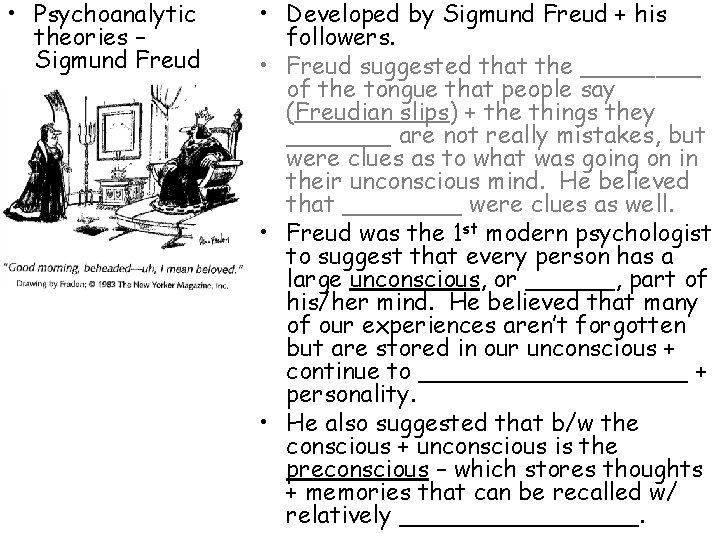
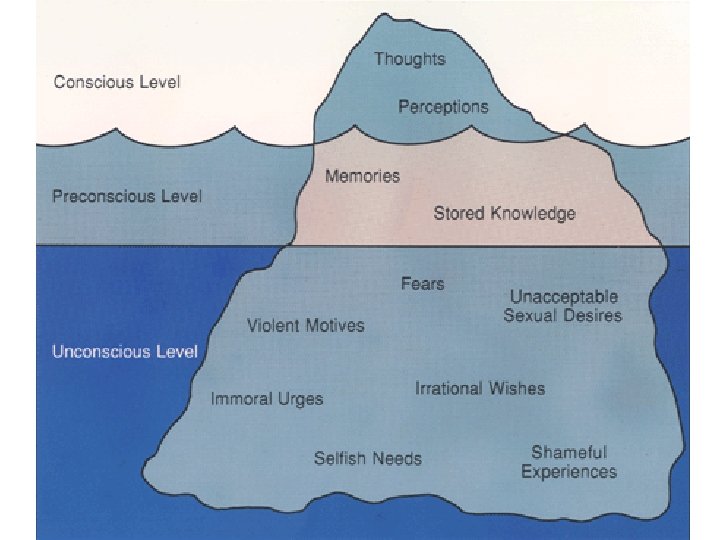
• Psychoanalytic theories – Sigmund Freud • Developed by Sigmund Freud + his followers. • Freud suggested that the ____ of the tongue that people say (Freudian slips) + the things they _______ are not really mistakes, but were clues as to what was going on in their unconscious mind. He believed that ____ were clues as well. • Freud was the 1 st modern psychologist to suggest that every person has a large unconscious, or ______, part of his/her mind. He believed that many of our experiences aren’t forgotten but are stored in our unconscious + continue to _________ + personality. • He also suggested that b/w the conscious + unconscious is the preconscious – which stores thoughts + memories that can be recalled w/ relatively ________.
• Freud believed the energy in personality comes from 2 ________ – life + death. • The death instinct shows up as characteristics like destructiveness + ______. • The life instinct shows up as characteristics like erotic + _________ urges. • Freud thought the ___ instinct is more important.
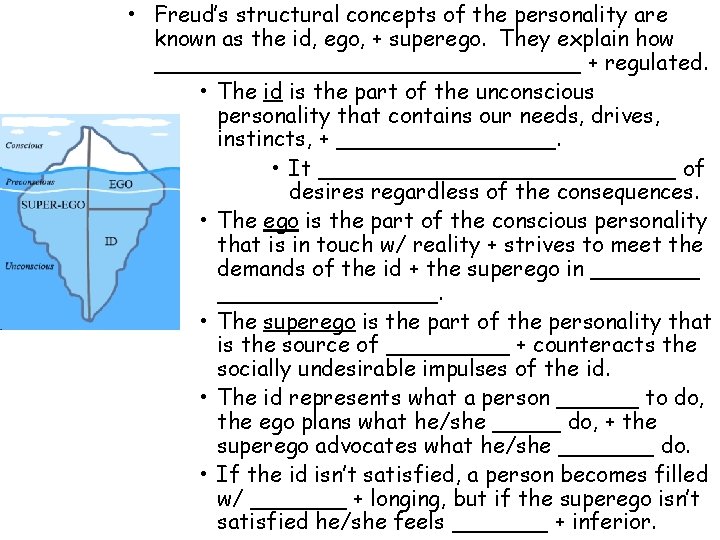
• Freud’s structural concepts of the personality are known as the id, ego, + superego. They explain how ________________ + regulated. • The id is the part of the unconscious personality that contains our needs, drives, instincts, + ________. • It _____________ of desires regardless of the consequences. • The ego is the part of the conscious personality that is in touch w/ reality + strives to meet the demands of the id + the superego in ____________. • The superego is the part of the personality that is the source of _____ + counteracts the socially undesirable impulses of the id. • The id represents what a person ______ to do, the ego plans what he/she _____ do, + the superego advocates what he/she _______ do. • If the id isn’t satisfied, a person becomes filled w/ _______ + longing, but if the superego isn’t satisfied he/she feels _______ + inferior.
• Defense mechanisms Examples p. 381 -383 • Certain specific means by which the ego ____________ against unpleasant impulses or circumstances. People trick themselves into believing nothing is wrong + _______. • They can relieve _____ + give people time to work out problems, but if done too frequently, a person won’t be able to face + solve his/her problems _______. • Rationalization involves making up a logical or rational reason as opposed to the _____ for a behavior. • Repression is pushing __________ + memories out of awareness w/o realizing it. • Denial is ___________ reality. • Projection is believing that your own unacceptable urges are coming from _______. • Reaction formation is replacing an unacceptable feeling w/ the _____ one – putting on a front. • Regression is going back to an earlier + _____ pattern of behavior. • Displacement is taking out impulses on a _____________ target. • Sublimation is redirecting a forbidden desire into a _________ desire.
• Freud’s contribution to understanding humans • He recognized that tremendous forces exist in human personality + are extremely __________. • Made it easier to understand why humans have so much ____. • It’s the savage individual coming to terms w/ _________. • The id is the ____ part + the superego is representative of ______. In a healthy person, the __ (the “I”) is strong enough to handle the struggle. • He was the 1 st psychologist to claim that infancy + childhood are critical times forming a person’s ________. • Believed a person’s personality largely developed in the 1 st ___yrs of life.
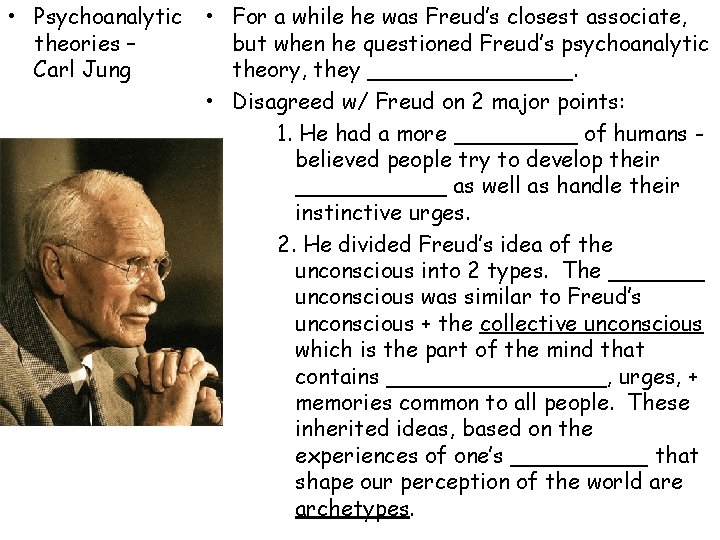
• Psychoanalytic theories – Carl Jung • For a while he was Freud’s closest associate, but when he questioned Freud’s psychoanalytic theory, they ________. • Disagreed w/ Freud on 2 major points: 1. He had a more _____ of humans believed people try to develop their ______ as well as handle their instinctive urges. 2. He divided Freud’s idea of the unconscious into 2 types. The _______ unconscious was similar to Freud’s unconscious + the collective unconscious which is the part of the mind that contains ________, urges, + memories common to all people. These inherited ideas, based on the experiences of one’s _____ that shape our perception of the world are archetypes.
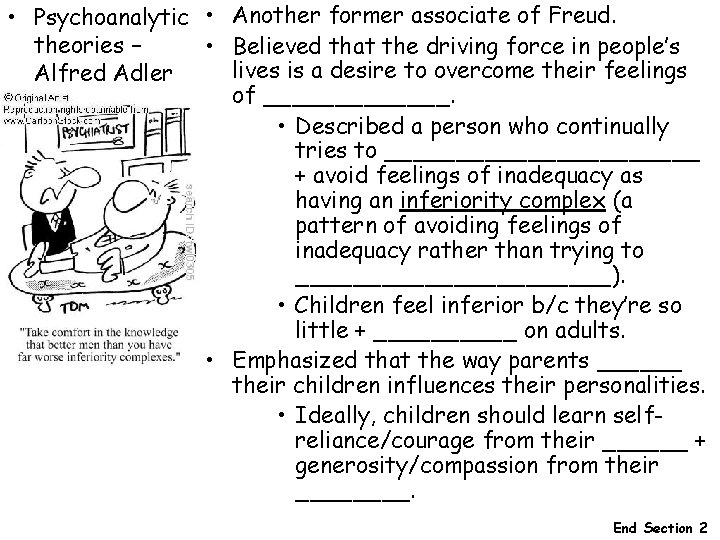
• Psychoanalytic • Another former associate of Freud. theories – • Believed that the driving force in people’s lives is a desire to overcome their feelings Alfred Adler of _______. • Described a person who continually tries to ___________ + avoid feelings of inadequacy as having an inferiority complex (a pattern of avoiding feelings of inadequacy rather than trying to ___________). • Children feel inferior b/c they’re so little + _____ on adults. • Emphasized that the way parents ______ their children influences their personalities. • Ideally, children should learn selfreliance/courage from their ______ + generosity/compassion from their ____. End Section 2
• Behaviorist theories • Behaviorism is the belief that the proper subject matter of psychology is objectively __________ + nothing else. • Behaviorists believe that as individuals differ in their learning experiences, they acquire different ______, + thus different _______. • They look to the environment to see what is ___________.
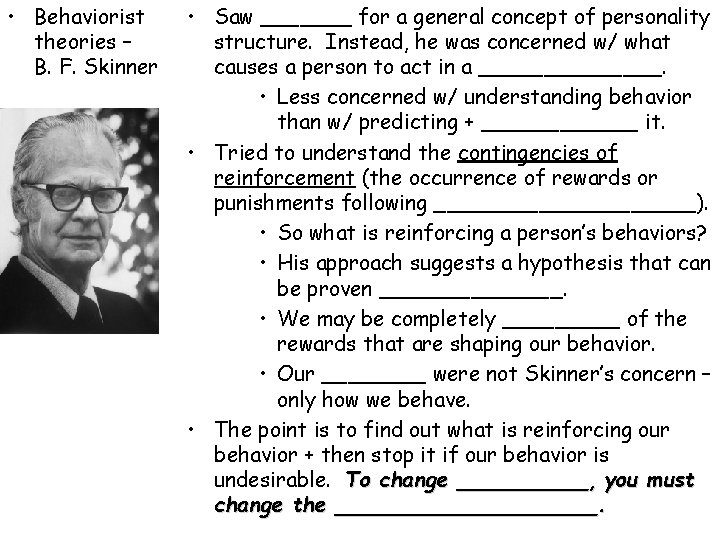
• Behaviorist theories – B. F. Skinner • Saw _______ for a general concept of personality structure. Instead, he was concerned w/ what causes a person to act in a _______. • Less concerned w/ understanding behavior than w/ predicting + ______ it. • Tried to understand the contingencies of reinforcement (the occurrence of rewards or punishments following __________). • So what is reinforcing a person’s behaviors? • His approach suggests a hypothesis that can be proven _______. • We may be completely _____ of the rewards that are shaping our behavior. • Our ____ were not Skinner’s concern – only how we behave. • The point is to find out what is reinforcing our behavior + then stop it if our behavior is undesirable. To change _____, you must change the __________.
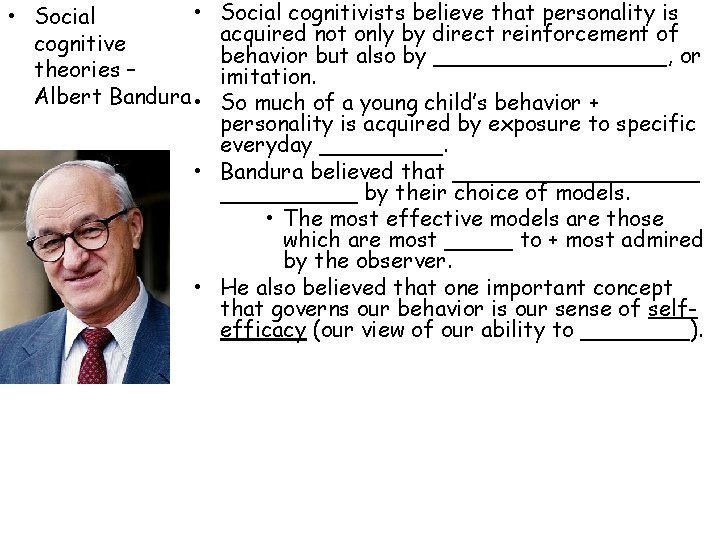
• • Social cognitive theories – Albert Bandura • Social cognitivists believe that personality is acquired not only by direct reinforcement of behavior but also by _________, or imitation. So much of a young child’s behavior + personality is acquired by exposure to specific everyday _____. • Bandura believed that _________ by their choice of models. • The most effective models are those which are most _____ to + most admired by the observer. • He also believed that one important concept that governs our behavior is our sense of selfefficacy (our view of our ability to ____).
• Another social cognitivist (Julian Rotter) stressed the importance of our locus of control (our beliefs about how much _______ we have over certain situations). • People w/ an ____ locus of control believe that they do have control over situations. People w/ an ______ locus of control believe that their fate is determined by forces _______. • “Most tests are fair if a student is prepared. ” - Agree – ____ locus -Disagree – ____ locus • People w/ an _____ locus of control are usually less anxious + more content w/ life. End Section 3
• Humanistic theories • Humanistic psychology is a school of psychology that emphasizes _____ + achievement of maximum potential by each unique individual. • _______ the more pessimistic views of psychoanalytical + behaviorist beliefs about personality. • Stresses our ability to ______ + live by personal standards + perceptions. • Founded on the belief that all humans strive for self-actualization (the realization of __________).
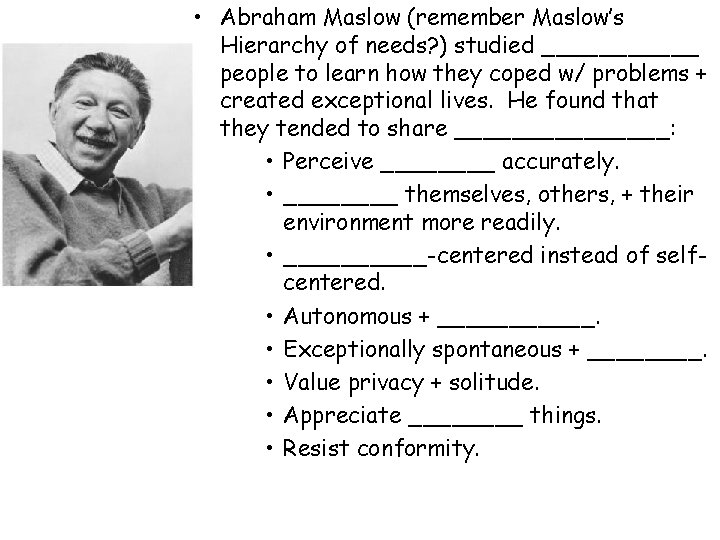
• Abraham Maslow (remember Maslow’s Hierarchy of needs? ) studied ______ people to learn how they coped w/ problems + created exceptional lives. He found that they tended to share ________: • Perceive ____ accurately. • ____ themselves, others, + their environment more readily. • _____-centered instead of selfcentered. • Autonomous + ______. • Exceptionally spontaneous + ____. • Value privacy + solitude. • Appreciate ____ things. • Resist conformity.
• Humanistic theories – Carl Rogers • Rogers developed the _____. He believed that people suffer from a conflict b/w what they value in themselves + what they believe ________ value in them. • Also believed that everyone is constantly struggling to become more ____ + perfect. Anything that furthers that end is good. • Each individual has what Rogers called a self (one’s experience or image of oneself, _______________ w/ others) which is acquired by observing how others react to us. • We all try to develop positive regard (viewing oneself in a positive light due to positive ____ received from interaction w/ others). If this doesn’t happen, we develop conditions of worth (the conditions a _________ in order to regard him/herself positively). • We may ______________ to meet these conditions of worth.
• Cognitive theory • Based on analysis of our own perceptions, thoughts, + _____. • The idea that our thoughts about _______, others, + our world shape our behavior + ______. • Emphasis is on the individual + his/her plans – including ____, errors, mistakes, + ____________. • Has to do w/ the individual’s anticipations or _______. End Section 4
• Trait theories • A trait can be described as a tendency to ________ in a way that remains stable over time or as any relatively enduring way in which one _______ from another. • Trait theorists make 2 ________ about the consistency of an individual’s behavior in different situations: 1. Every trait applies to _____. 2. These descriptions can be _______. • They want to discover the ________ of the consistency of human behavior. • The 1 st ? of trait theorists is, “What behaviors _______? ”.
• Trait theories – Gordon Allport • He defined common traits as those that ________ + individual traits as those that apply more to a ______. • He described 3 types of individual traits: 1. A cardinal trait is a characteristic that is so pervasive that the person is almost _____ w/ that trait (ex. Scrooge). 2. A central trait - is a general characteristic found in some degree in _______. It makes us _____ in most situations. 3. Secondary traits are characteristics seen only in __________ (such as likes/dislikes). They are the least important + have a less consistent ______ on us.
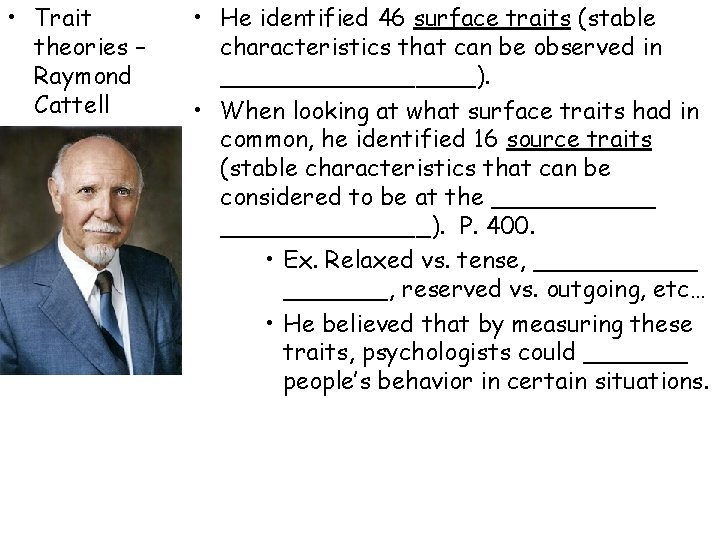
• Trait theories – Raymond Cattell • He identified 46 surface traits (stable characteristics that can be observed in _________). • When looking at what surface traits had in common, he identified 16 source traits (stable characteristics that can be considered to be at the ______________). P. 400. • Ex. Relaxed vs. tense, _______, reserved vs. outgoing, etc… • He believed that by measuring these traits, psychologists could _______ people’s behavior in certain situations.
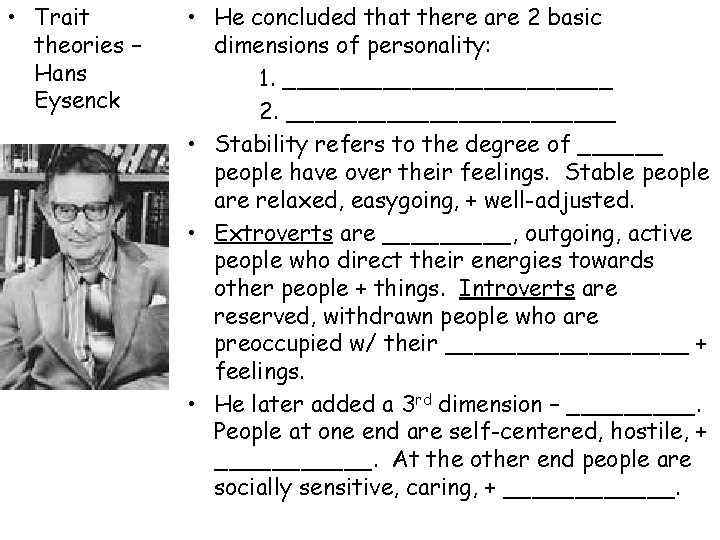
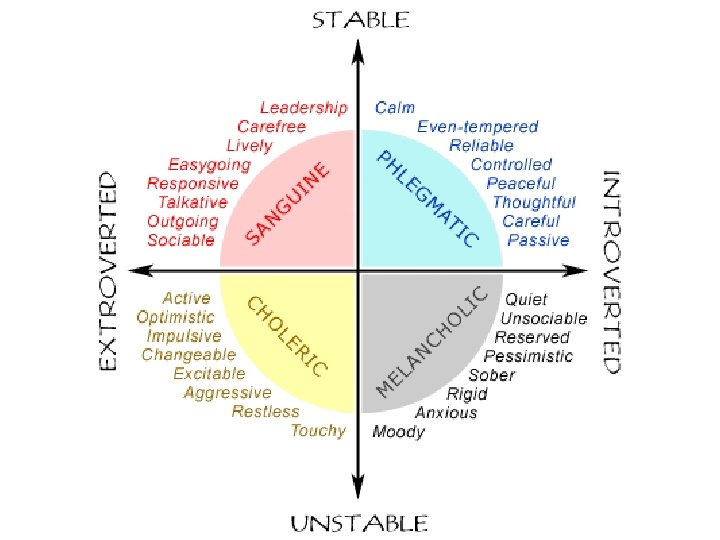
• Trait theories – Hans Eysenck • He concluded that there are 2 basic dimensions of personality: 1. ____________ 2. ____________ • Stability refers to the degree of ______ people have over their feelings. Stable people are relaxed, easygoing, + well-adjusted. • Extroverts are _____, outgoing, active people who direct their energies towards other people + things. Introverts are reserved, withdrawn people who are preoccupied w/ their _________ + feelings. • He later added a 3 rd dimension – _____. People at one end are self-centered, hostile, + ______. At the other end people are socially sensitive, caring, + ______.
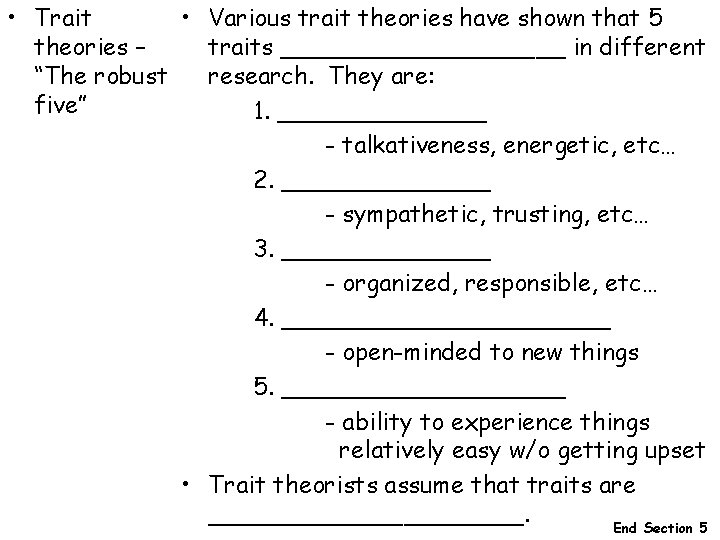
• Trait • Various trait theories have shown that 5 theories – traits __________ in different “The robust research. They are: five” 1. _______ - talkativeness, energetic, etc… 2. _______ - sympathetic, trusting, etc… 3. _______ - organized, responsible, etc… 4. ___________ - open-minded to new things 5. __________ - ability to experience things relatively easy w/o getting upset • Trait theorists assume that traits are ___________. End Section 5