
Chapter 15 Personality and Social Interaction 2014 Mc
- Slides: 25
+ Chapter 15 Personality and Social Interaction © 2014 Mc. Graw-Hill Higher Education. All rights reserved.
+ Three Mechanisms of Social Interaction n Selection n Evocation n Manipulation © 2014 Mc. Graw-Hill Higher Education. All rights reserved. 15 -2
+ Selection n Personality characteristics of others influence whether we select them as dates, friends, or marriage partners n Own personality characteristics play role in kinds of situations we select to enter and stay in © 2014 Mc. Graw-Hill Higher Education. All rights reserved. 15 -3
+ Personality Characteristics Desired in a Marriage Partner n Over 10, 000 participants, from 37 samples in 33 countries, six continents, five islands n Mutual attraction/love is the most favored characteristic n Almost as important are personality characteristics of dependable character, emotional stability, pleasing disposition © 2014 Mc. Graw-Hill Higher Education. All rights reserved. 15 -4
+ Assortative Mating for Personality: The Search for the Similar n Assortative mating: n n People are married to people who are similar to themselves Are these positive correlations caused by active selection of mates who are similar, or by-products of other causal processes (e. g. , sheer proximity)? . . . © 2014 Mc. Graw-Hill Higher Education. All rights reserved. 15 -5
+ Assortative Mating for Personality: The Search for the Similar n To answer questions, Botwin et al. (1997) studied dating and married couples n Correlated preferences for personality characteristics desired in a potential mate, and our own personality characteristics n Correlations are consistently positive: Positive correlations between spouses are due, in part, to direct social preferences, based on personality characteristics of those doing the selecting © 2014 Mc. Graw-Hill Higher Education. All rights reserved. 15 -6
+ Do People Get the Mates They Want? n Botwin et al. (1997): n Correlations between preferences for ideal personality characteristics in a mate and the actual personality characteristics of an obtained mate n Consistently positive correlations: People seem to get mates they want in terms of personality n Partner’s personality had a large effect on marital satisfaction © 2014 Mc. Graw-Hill Higher Education. All rights reserved. 15 -7
+ Do People Get the Mates They Want? n People are especially happy if they are married to partners high on agreeableness, emotional stability, and openness n But difference in scores between partner’s personality and one’s ideal for that personality did not predict happiness © 2014 Mc. Graw-Hill Higher Education. All rights reserved. 15 -8
+ Personality and the Selective Breakup of Couples n According to violation of desire theory (Buss, 1994), break-ups should be more common when one’s desires are violated than when they are fulfilled n People actively seek mates who are dependable and emotionally stable, and those who fail to choose such mates are at risk for divorce n Those who fail to get what they want—including a mate who is similar—tend to selectively break-up more often than those who get what they want © 2014 Mc. Graw-Hill Higher Education. All rights reserved. 15 -9
+ Shyness and the Selection of Risky Situations n Shyness: n Tendency to feel tense, worried, and anxious during social interactions or even when anticipating social interactions n During adolescence, early adulthood, shy people tend to avoid social situations, resulting in a form of isolation n Shy women are less likely to go to a gynecologist n Shy women also are less likely to bring up contraception with potential sexual partner © 2014 Mc. Graw-Hill Higher Education. All rights reserved. 15 -10
+ Shyness and the Selection of Risky Situations n Shyness affects whether a person is willing to select risky situations in the form of gambles n Shyness, in short, has a substantial impact on selective entry into, or avoidance of, situations © 2014 Mc. Graw-Hill Higher Education. All rights reserved. 15 -11
+ Other Personality Traits and the Selection of Situations n Personality affects situations to which people are exposed through selective entry into, or avoidance of, certain activities © 2014 Mc. Graw-Hill Higher Education. All rights reserved. 15 -12
+ Evocation n Personality characteristics of others evoke responses in us n Own personality characteristics evoke responses in others n Once we select others to occupy our social environment, second class of processes set into motion—evocation of reactions from others and evocation of our own reactions by others © 2014 Mc. Graw-Hill Higher Education. All rights reserved. 15 -13
+ Aggression and the Evocation of Hostility n Aggressive people evoke hostility from others n Hostile attributional bias: n Tendency to infer hostile intent on the part of others in the face of uncertain behavior from others n Because they expect others to be hostile, aggressive people treat others aggressively—people treated aggressively tend to aggress back n Thus, hostility from others is evoked by an aggressive person © 2014 Mc. Graw-Hill Higher Education. All rights reserved. 15 -14
+ Evocation of Anger and Upset in Partners n Person can perform actions that cause emotional response in a partner n Person can elicit actions from another that upset the original elicitor n Study by Buss (1991): n Role of personality on evocation of anger and upset in married couples n Assessed personality characteristics of husbands and wives n Strongest predictors of upset are low agreeableness and emotional instability © 2014 Mc. Graw-Hill Higher Education. All rights reserved. 15 -15
+ Evocation Through Expectancy Confirmation n Expectancy confirmation: n n People’s beliefs about personality characteristics of others cause them to evoke in others actions that are consistent with initial beliefs Snyder and Swann (1978): n People’s beliefs led them to behave in an aggressive manner toward an unsuspecting target, then the target behaved in a more aggressive manner, confirming initial beliefs © 2014 Mc. Graw-Hill Higher Education. All rights reserved. 15 -16
+ Manipulation n Personality is linked to ways in which we try to influence or manipulate others n Manipulation or social influence includes ways in which people intentionally alter, change, or exploit others n Manipulation can be examined from two perspectives within personality psychology n Are some individuals consistently more manipulative than others? n Given that all people attempt to influence others, do stable personality characteristics predict tactics that are used? © 2014 Mc. Graw-Hill Higher Education. All rights reserved. 15 -17
+ A Taxonomy of 11 Tactics of Manipulation n Developed through a two-step procedure n Nominations of acts of influence n Factor analysis of self-reports and observer-reports of nominated acts n 11 tactics identified, including charm, coercion, silent treatment, reason © 2014 Mc. Graw-Hill Higher Education. All rights reserved. 15 -18
+ Sex Differences in Tactics of Manipulation n With exception of regression (crying, whining), men and women are similar in performance of tactics of manipulation © 2014 Mc. Graw-Hill Higher Education. All rights reserved. 15 -19
+ Personality Predictors of Tactics of Manipulation n High surgency: n n Low surgency: n n Coercion, responsibility invocation Self-abasement, hardball High agreeable: n Pleasure induction, reason © 2014 Mc. Graw-Hill Higher Education. All rights reserved. 15 -20
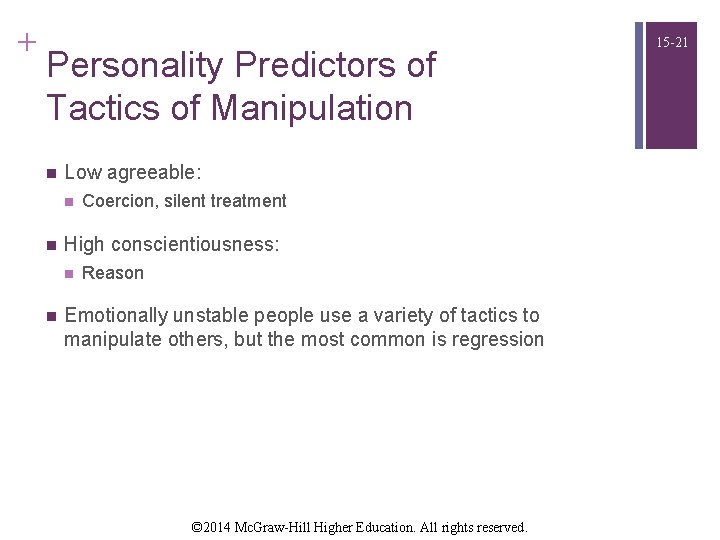
+ Personality Predictors of Tactics of Manipulation n Low agreeable: n n High conscientiousness: n n Coercion, silent treatment Reason Emotionally unstable people use a variety of tactics to manipulate others, but the most common is regression © 2014 Mc. Graw-Hill Higher Education. All rights reserved. 15 -21
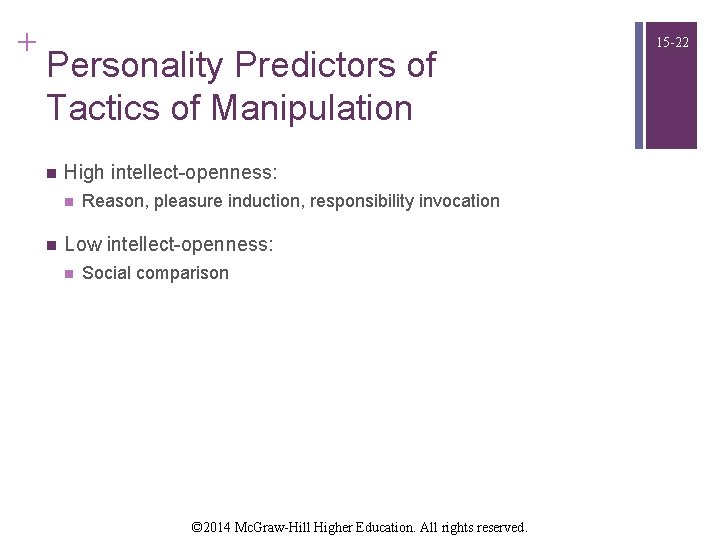
+ Personality Predictors of Tactics of Manipulation n High intellect-openness: n n Reason, pleasure induction, responsibility invocation Low intellect-openness: n Social comparison © 2014 Mc. Graw-Hill Higher Education. All rights reserved. 15 -22
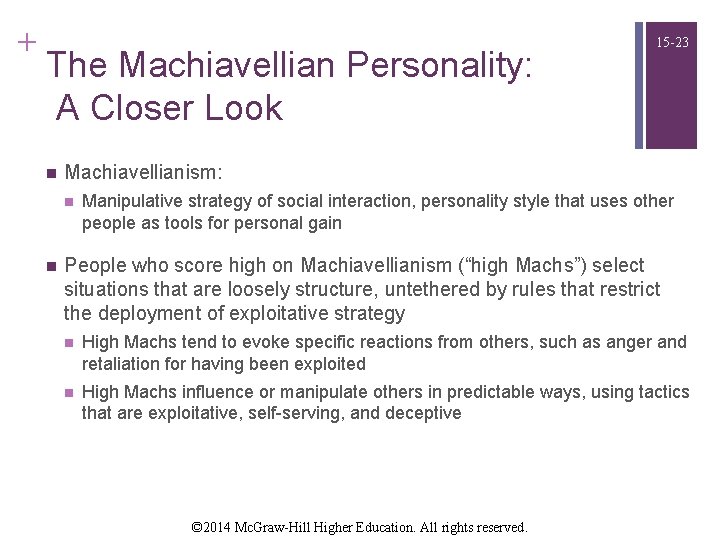
+ The Machiavellian Personality: A Closer Look n Machiavellianism: n n 15 -23 Manipulative strategy of social interaction, personality style that uses other people as tools for personal gain People who score high on Machiavellianism (“high Machs”) select situations that are loosely structure, untethered by rules that restrict the deployment of exploitative strategy n High Machs tend to evoke specific reactions from others, such as anger and retaliation for having been exploited n High Machs influence or manipulate others in predictable ways, using tactics that are exploitative, self-serving, and deceptive © 2014 Mc. Graw-Hill Higher Education. All rights reserved.
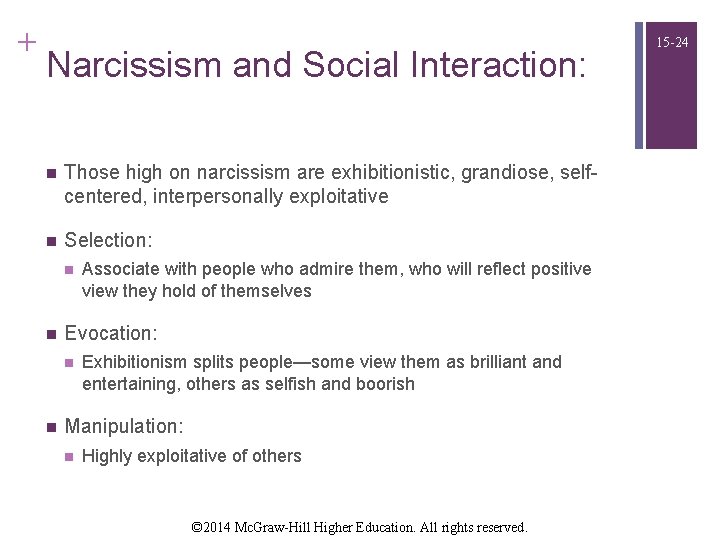
+ Narcissism and Social Interaction: n Those high on narcissism are exhibitionistic, grandiose, selfcentered, interpersonally exploitative n Selection: n n Evocation: n n Associate with people who admire them, who will reflect positive view they hold of themselves Exhibitionism splits people—some view them as brilliant and entertaining, others as selfish and boorish Manipulation: n Highly exploitative of others © 2014 Mc. Graw-Hill Higher Education. All rights reserved. 15 -24
+ Summary and Evaluation 15 -25 n Personality does not exist solely in the heads of individuals n Personality affects the ways in which we interact with others in our social world n We select people and environments, choosing social situations to which we will expose ourselves—personality plays a key role in the selection process n We evoke emotions and actions in others, based in part on our personality characteristics n Personality plays a key role in which we use tactics to influence or manipulate others © 2014 Mc. Graw-Hill Higher Education. All rights reserved.