9 1 2 include iostream using namespace std


- Slides: 30
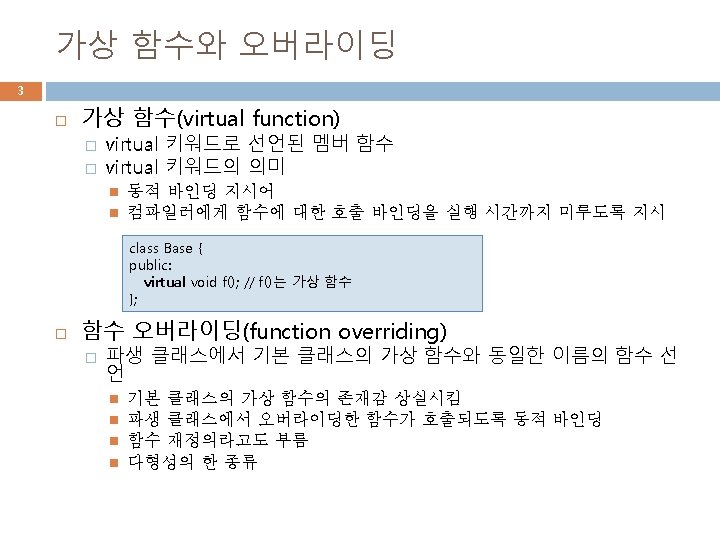
예제 9 -1 상속 관계에서 함수를 중복하는 경우 2 #include <iostream> using namespace std; class Base { public: void f() { cout << “Base: : f() called” << endl; } }; 함수 중복 객체 d Derived d; } p. Der void f() class Derived : public Base { public: void f() { cout << “Derived: : f() called” << endl; } }; void main() { Derived d, *p. Der; p. Der = &d; p. Der->f(); // Derived: : f() 호출 p. Base Derived 멤버 객체 d p. Der void f() p. Der->f(); void f() Base* p. Base; p. Base = p. Der; // 업캐스팅 p. Base->f(); // Base: : f() 호출 실행 객체 d p. Base void f() p. Base->f(); void f() Derived: : f() called Base 멤버 실행
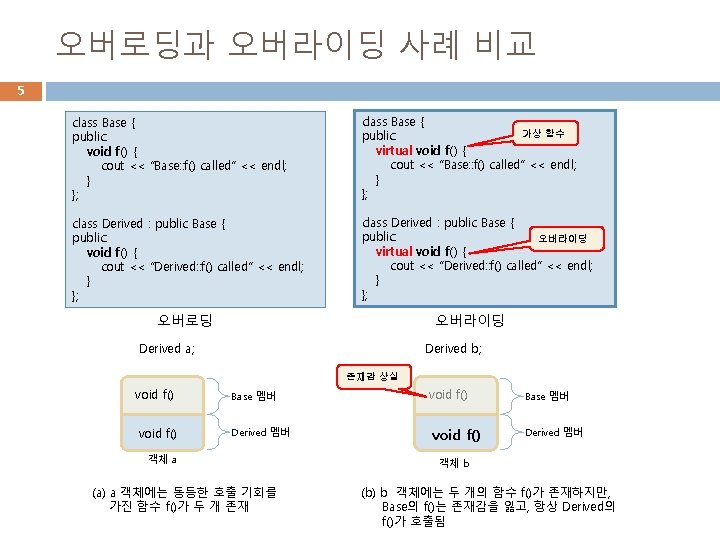
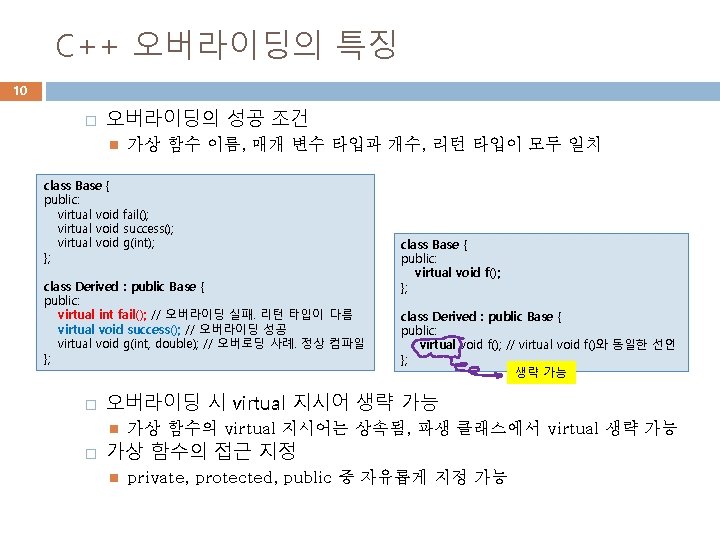
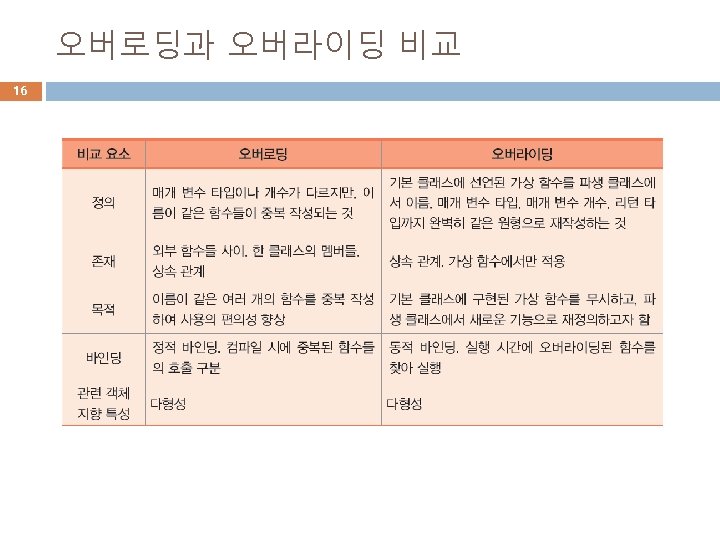
오버로딩과 오버라이딩 사례 비교 5 class Base { public: void f() { cout << “Base: : f() called” << endl; } }; class Base { 가상 함수 public: virtual void f() { cout << “Base: : f() called” << endl; } }; class Derived : public Base { public: void f() { cout << “Derived: : f() called” << endl; } }; class Derived : public Base { public: 오버라이딩 virtual void f() { cout << “Derived: : f() called” << endl; } }; 오버로딩 오버라이딩 Derived b; Derived a; 존재감 상실 void f() Base 멤버 Derived 멤버 객체 a (a) a 객체에는 동등한 호출 기회를 가진 함수 f()가 두 개 존재 void f() Base 멤버 Derived 멤버 객체 b (b) b 객체에는 두 개의 함수 f()가 존재하지만, Base의 f()는 존재감을 잃고, 항상 Derived의 f()가 호출됨
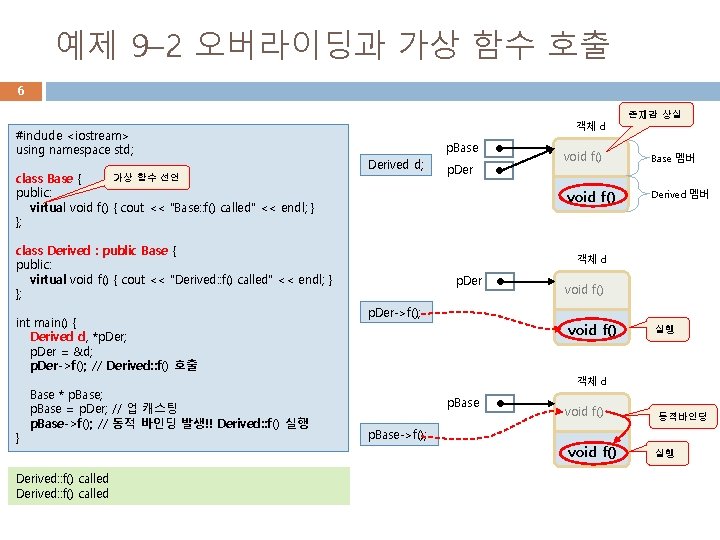
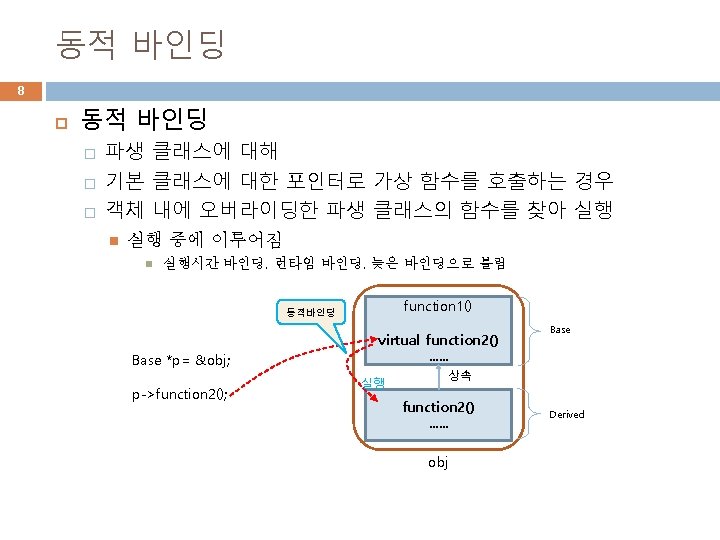
예제 9– 2 오버라이딩과 가상 함수 호출 6 #include <iostream> using namespace std; 가상 함수 선언 class Base { public: virtual void f() { cout << "Base: : f() called" << endl; } }; 객체 d Derived d; } Base * p. Base; p. Base = p. Der; // 업 캐스팅 p. Base->f(); // 동적 바인딩 발생!! Derived: : f() 실행 Derived: : f() called p. Der void f() class Derived : public Base { public: virtual void f() { cout << "Derived: : f() called" << endl; } }; int main() { Derived d, *p. Der; p. Der = &d; p. Der->f(); // Derived: : f() 호출 p. Base 존재감 상실 Base 멤버 Derived 멤버 객체 d p. Der->f(); void f() 실행 객체 d p. Base->f(); void f() 동적바인딩 실행
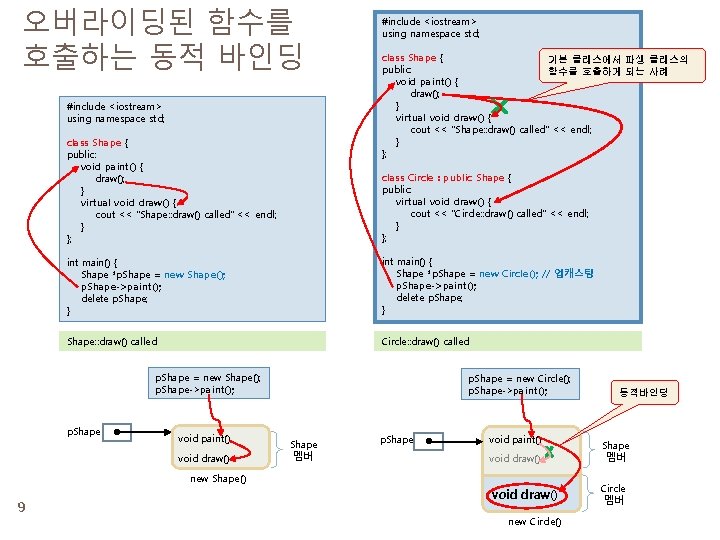
오버라이딩된 함수를 호출하는 동적 바인딩 #include <iostream> using namespace std; class Shape { public: void paint() { draw(); } virtual void draw() { cout << "Shape: : draw() called" << endl; } }; #include <iostream> using namespace std; class Shape { 기본 클래스에서 파생 클래스의 public: 함수를 호출하게 되는 사례 void paint() { draw(); } virtual void draw() { cout << "Shape: : draw() called" << endl; } }; class Circle : public Shape { public: virtual void draw() { cout << "Circle: : draw() called" << endl; } }; int main() { Shape *p. Shape = new Shape(); p. Shape->paint(); delete p. Shape; } int main() { Shape *p. Shape = new Circle(); // 업캐스팅 p. Shape->paint(); delete p. Shape; } Shape: : draw() called Circle: : draw() called p. Shape = new Shape(); p. Shape->paint(); p. Shape void paint() void draw() p. Shape = new Circle(); p. Shape->paint(); Shape 멤버 p. Shape void paint() void draw() new Shape() 9 void draw() new Circle() 동적바인딩 Shape 멤버 Circle 멤버
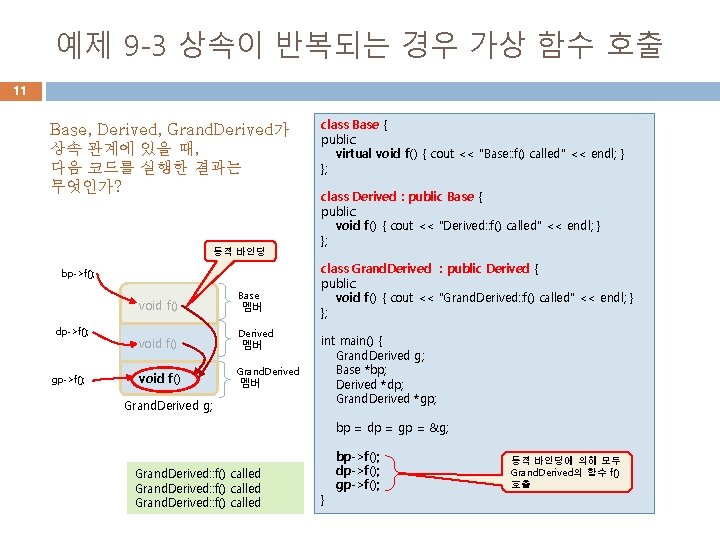
예제 9 -3 상속이 반복되는 경우 가상 함수 호출 11 Base, Derived, Grand. Derived가 상속 관계에 있을 때, 다음 코드를 실행한 결과는 무엇인가? 동적 바인딩 bp->f(); void f() dp->f(); gp->f(); void draw() void f() Base 멤버 Derived 멤버 Grand. Derived g; class Base { public: virtual void f() { cout << "Base: : f() called" << endl; } }; class Derived : public Base { public: void f() { cout << "Derived: : f() called" << endl; } }; class Grand. Derived : public Derived { public: void f() { cout << "Grand. Derived: : f() called" << endl; } }; int main() { Grand. Derived g; Base *bp; Derived *dp; Grand. Derived *gp; bp = dp = gp = &g; Grand. Derived: : f() called } bp->f(); dp->f(); gp->f(); 동적 바인딩에 의해 모두 Grand. Derived의 함수 f() 호출
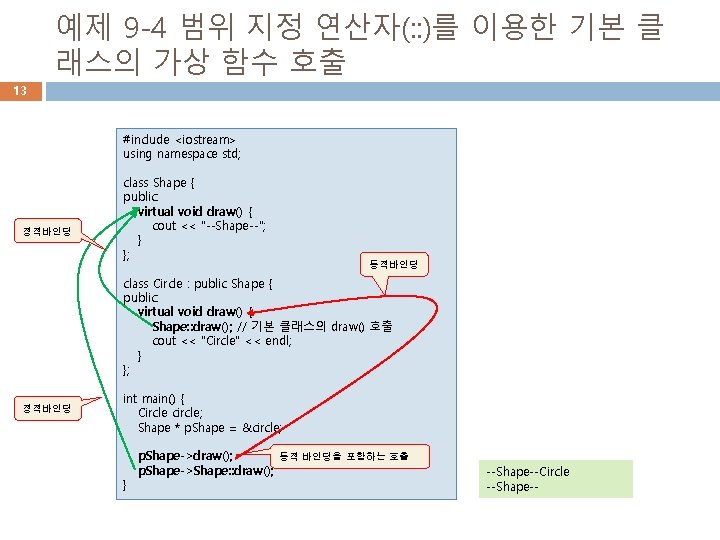
예제 9 -4 범위 지정 연산자(: : )를 이용한 기본 클 래스의 가상 함수 호출 13 #include <iostream> using namespace std; 정적바인딩 class Shape { public: virtual void draw() { cout << "--Shape--"; } }; 동적바인딩 class Circle : public Shape { public: virtual void draw() { Shape: : draw(); // 기본 클래스의 draw() 호출 cout << "Circle" << endl; } }; 정적바인딩 int main() { Circle circle; Shape * p. Shape = &circle; } 동적 바인딩을 포함하는 호출 p. Shape->draw(); p. Shape->Shape: : draw(); --Shape--Circle --Shape--
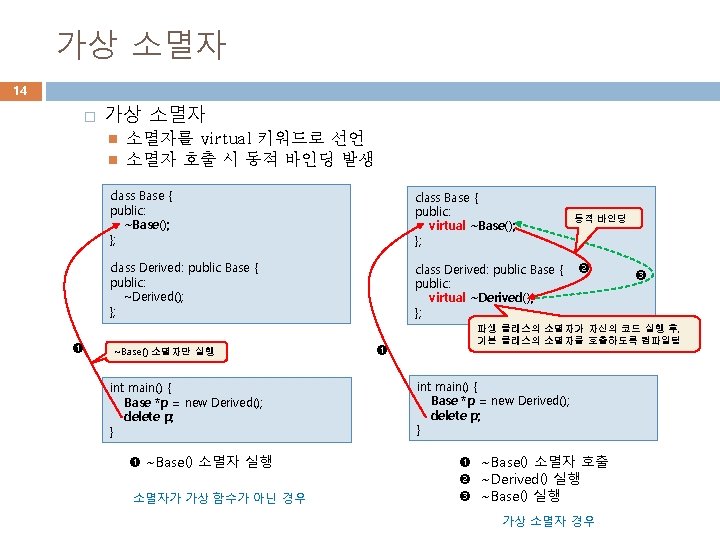
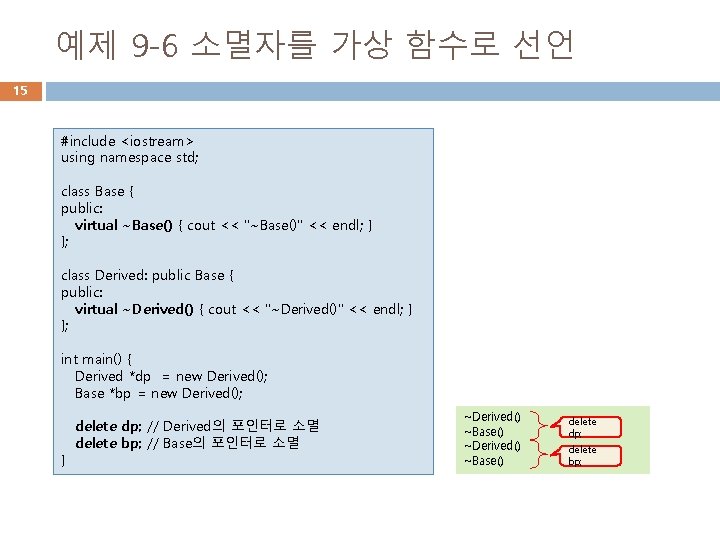
예제 9 -6 소멸자를 가상 함수로 선언 15 #include <iostream> using namespace std; class Base { public: virtual ~Base() { cout << "~Base()" << endl; } }; class Derived: public Base { public: virtual ~Derived() { cout << "~Derived()" << endl; } }; int main() { Derived *dp = new Derived(); Base *bp = new Derived(); } delete dp; // Derived의 포인터로 소멸 delete bp; // Base의 포인터로 소멸 ~Derived() ~Base() delete dp; delete bp;
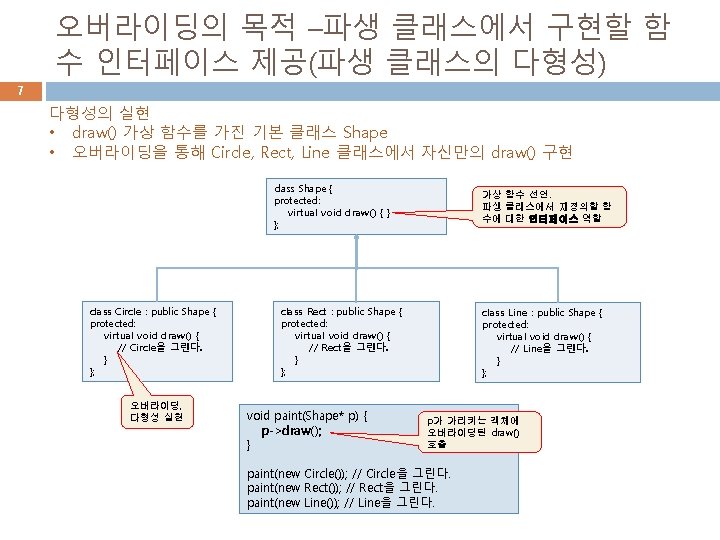
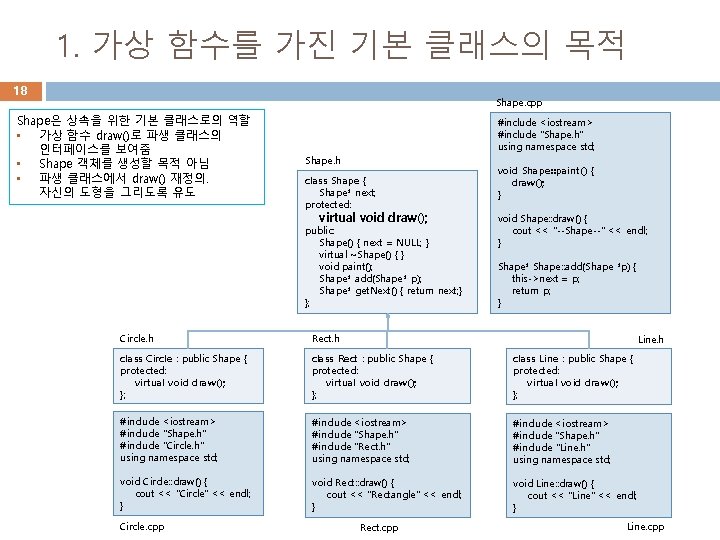
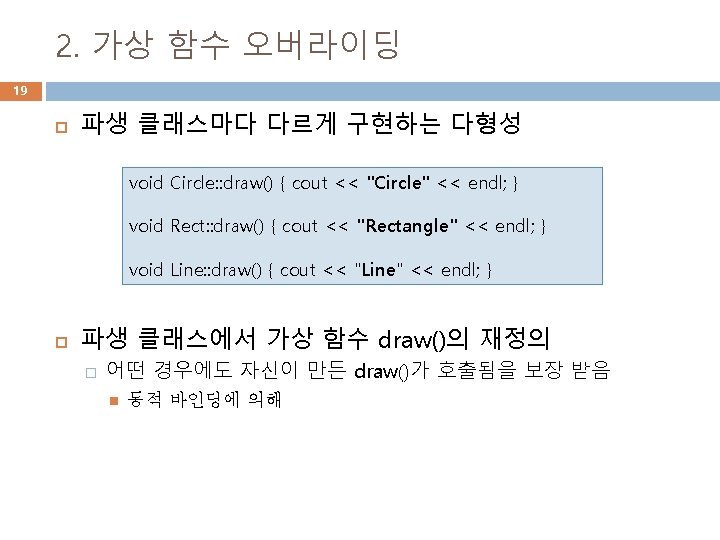
1. 가상 함수를 가진 기본 클래스의 목적 18 Shape. cpp Shape은 상속을 위한 기본 클래스로의 역할 • 가상 함수 draw()로 파생 클래스의 인터페이스를 보여줌 • Shape 객체를 생성할 목적 아님 • 파생 클래스에서 draw() 재정의. 자신의 도형을 그리도록 유도 #include <iostream> #include "Shape. h" using namespace std; Shape. h class Shape { Shape* next; protected: virtual void draw(); public: Shape() { next = NULL; } virtual ~Shape() { } void paint(); Shape* add(Shape* p); Shape* get. Next() { return next; } }; void Shape: : paint() { draw(); } void Shape: : draw() { cout << "--Shape--" << endl; } Shape* Shape: : add(Shape *p) { this->next = p; return p; } Circle. h Rect. h class Circle : public Shape { protected: virtual void draw(); }; class Rect : public Shape { protected: virtual void draw(); }; class Line : public Shape { protected: virtual void draw(); }; #include <iostream> #include "Shape. h" #include "Circle. h" using namespace std; #include <iostream> #include "Shape. h" #include "Rect. h" using namespace std; #include <iostream> #include "Shape. h" #include "Line. h" using namespace std; void Circle: : draw() { cout << "Circle" << endl; } void Rect: : draw() { cout << "Rectangle" << endl; } void Line: : draw() { cout << "Line" << endl; } Circle. cpp Line. h Rect. cpp Line. cpp
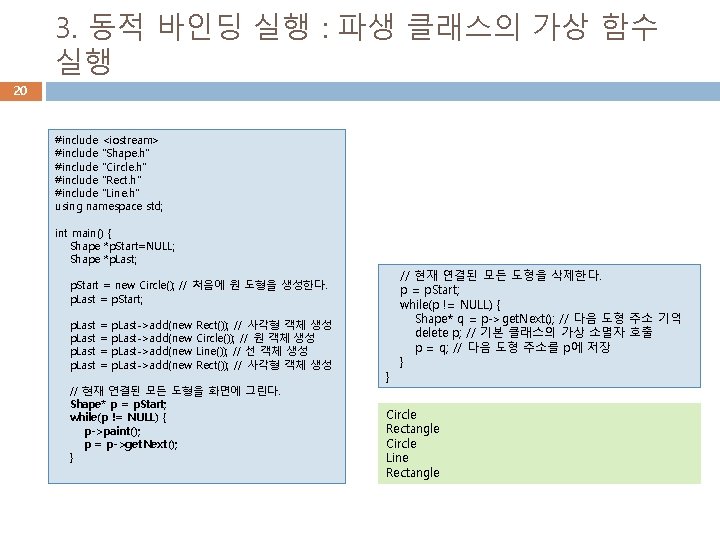
3. 동적 바인딩 실행 : 파생 클래스의 가상 함수 실행 20 #include <iostream> #include "Shape. h" #include "Circle. h" #include "Rect. h" #include "Line. h" using namespace std; int main() { Shape *p. Start=NULL; Shape *p. Last; p. Start = new Circle(); // 처음에 원 도형을 생성한다. p. Last = p. Start; p. Last = = p. Last->add(new Rect()); // 사각형 객체 생성 Circle()); // 원 객체 생성 Line()); // 선 객체 생성 Rect()); // 사각형 객체 생성 // 현재 연결된 모든 도형을 화면에 그린다. Shape* p = p. Start; while(p != NULL) { p->paint(); p = p->get. Next(); } } // 현재 연결된 모든 도형을 삭제한다. p = p. Start; while(p != NULL) { Shape* q = p->get. Next(); // 다음 도형 주소 기억 delete p; // 기본 클래스의 가상 소멸자 호출 p = q; // 다음 도형 주소를 p에 저장 } Circle Rectangle Circle Line Rectangle
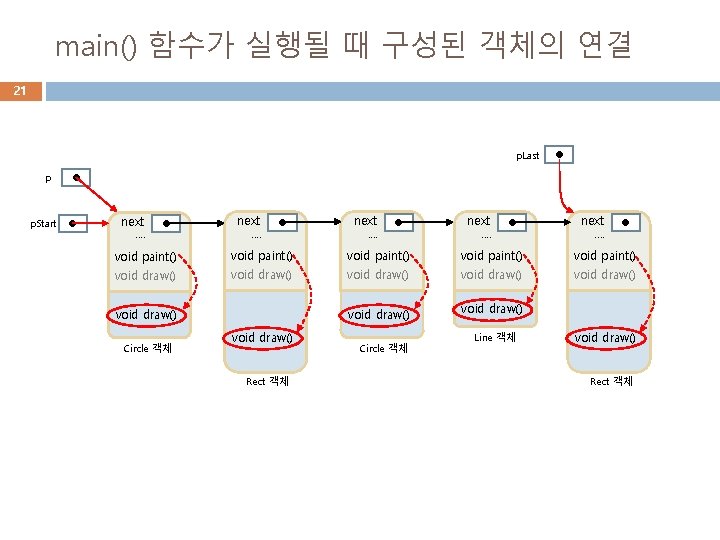
main() 함수가 실행될 때 구성된 객체의 연결 21 p. Last p p. Start next. . . . next. . void paint() void paint() void draw() void draw() Circle 객체 void draw() Rect 객체 Circle 객체 Line 객체 void draw() Rect 객체
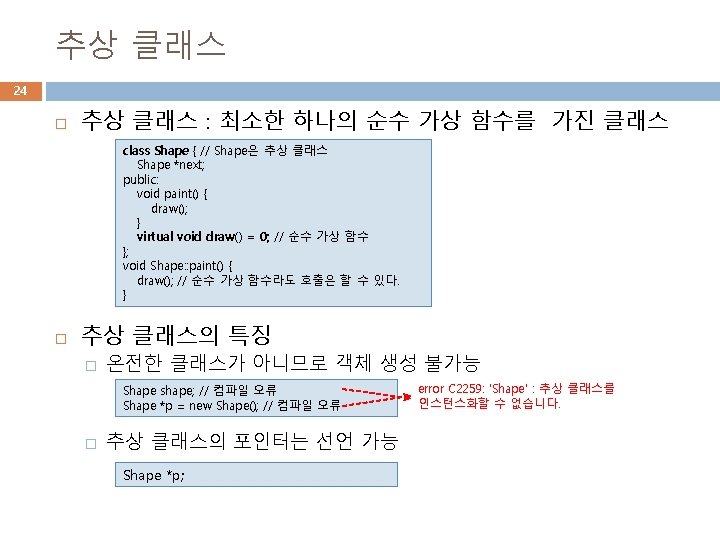
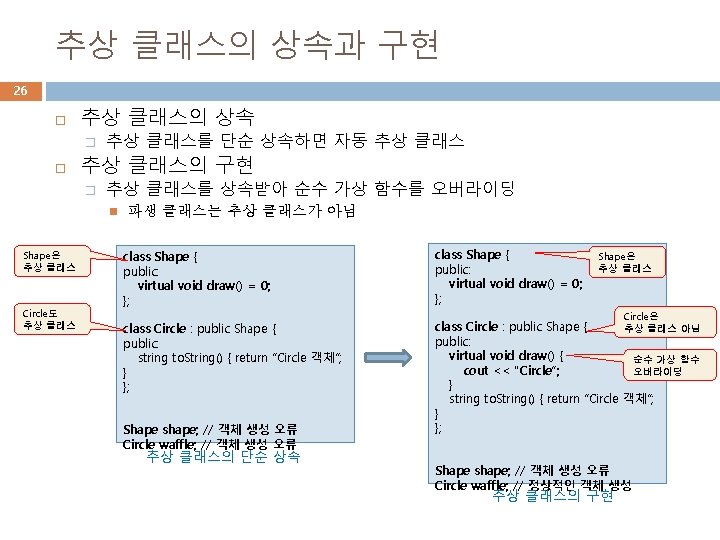
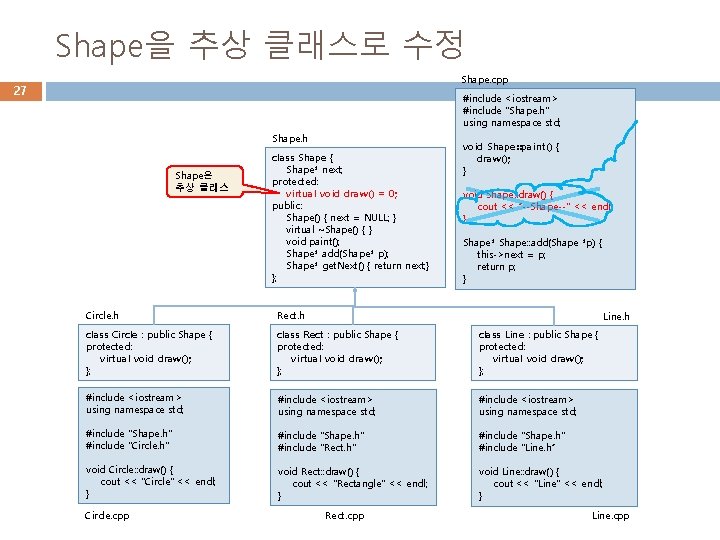
Shape을 추상 클래스로 수정 Shape. cpp 27 #include <iostream> #include "Shape. h" using namespace std; Shape. h Shape은 추상 클래스 class Shape { Shape* next; protected: virtual void draw() = 0; public: Shape() { next = NULL; } virtual ~Shape() { } void paint(); Shape* add(Shape* p); Shape* get. Next() { return next; } }; void Shape: : paint() { draw(); } void Shape: : draw() { cout << “--Shape--" << endl; } Shape* Shape: : add(Shape *p) { this->next = p; return p; } Circle. h Rect. h class Circle : public Shape { protected: virtual void draw(); }; class Rect : public Shape { protected: virtual void draw(); }; class Line : public Shape { protected: virtual void draw(); }; #include <iostream> using namespace std; #include "Shape. h" #include "Circle. h" #include "Shape. h" #include "Rect. h" #include "Shape. h" #include "Line. h“ void Circle: : draw() { cout << "Circle" << endl; } void Rect: : draw() { cout << "Rectangle" << endl; } void Line: : draw() { cout << "Line" << endl; } Circle. cpp Line. h Rect. cpp Line. cpp
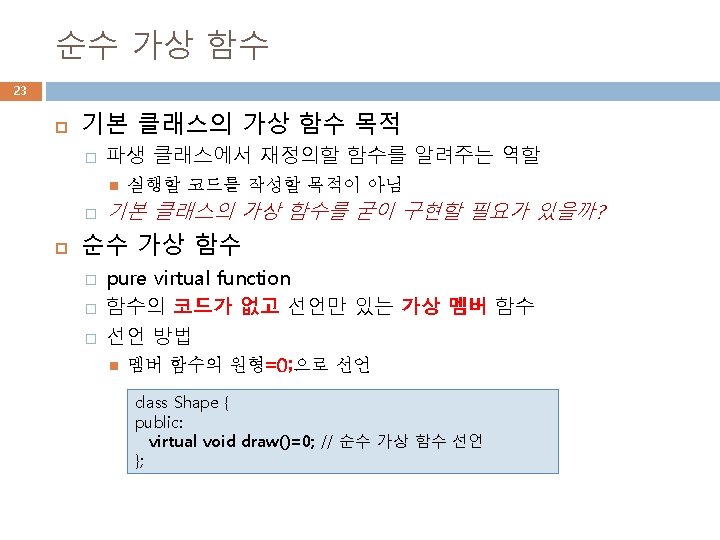
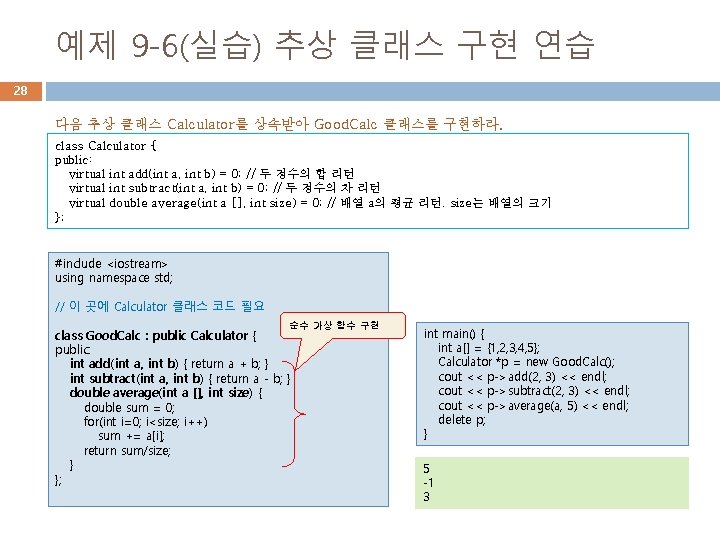
예제 9 -6(실습) 추상 클래스 구현 연습 28 다음 추상 클래스 Calculator를 상속받아 Good. Calc 클래스를 구현하라. class Calculator { public: virtual int add(int a, int b) = 0; // 두 정수의 합 리턴 virtual int subtract(int a, int b) = 0; // 두 정수의 차 리턴 virtual double average(int a [], int size) = 0; // 배열 a의 평균 리턴. size는 배열의 크기 }; #include <iostream> using namespace std; // 이 곳에 Calculator 클래스 코드 필요 순수 가상 함수 구현 class Good. Calc : public Calculator { public: int add(int a, int b) { return a + b; } int subtract(int a, int b) { return a - b; } double average(int a [], int size) { double sum = 0; for(int i=0; i<size; i++) sum += a[i]; return sum/size; } }; int main() { int a[] = {1, 2, 3, 4, 5}; Calculator *p = new Good. Calc(); cout << p->add(2, 3) << endl; cout << p->subtract(2, 3) << endl; cout << p->average(a, 5) << endl; delete p; } 5 -1 3
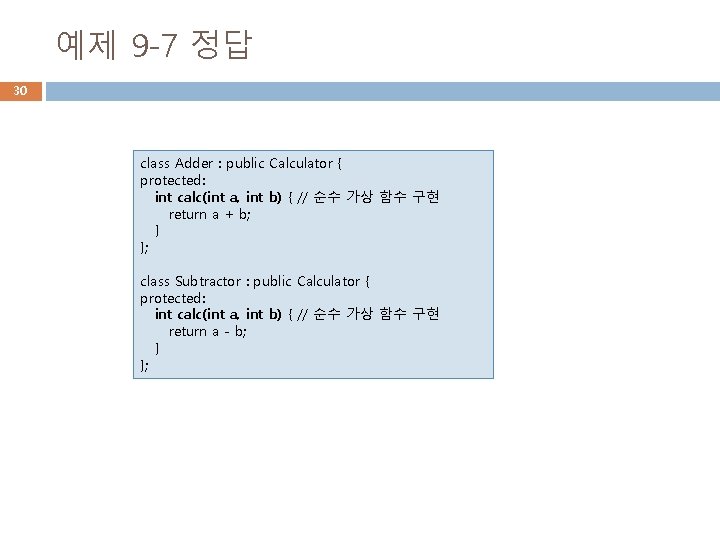
예제 9 -7 정답 30 class Adder : public Calculator { protected: int calc(int a, int b) { // 순수 가상 함수 구현 return a + b; } }; class Subtractor : public Calculator { protected: int calc(int a, int b) { // 순수 가상 함수 구현 return a - b; } };