7 4 CYCLIC QUADRILATERALS I WHAT IS A

- Slides: 19
7. 4 CYCLIC QUADRILATERALS
I) WHAT IS A CYCLIC QUADRILATERAL Quadrilateral: a polygon with four sides Square, rectangle, parallelogram, trapezoid…. . The sum of all the interior angles is equal to 360 degrees Cyclic Quadrilateral (CQ) A quadrilateral with all four vertices (corners) on the circumference of the circle
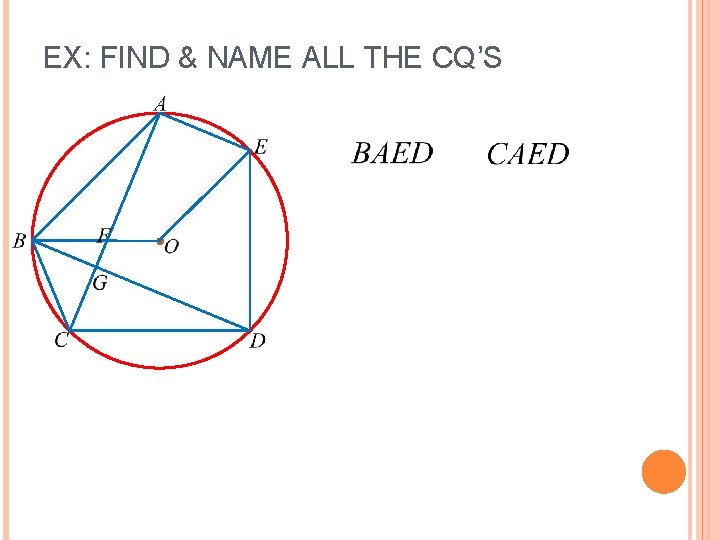
EX: FIND & NAME ALL THE CQ’S
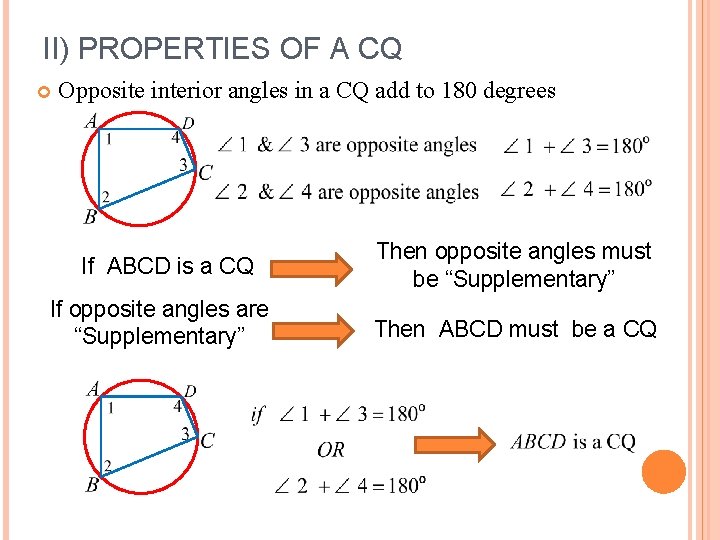
II) PROPERTIES OF A CQ Opposite interior angles in a CQ add to 180 degrees If ABCD is a CQ If opposite angles are “Supplementary” Then opposite angles must be “Supplementary” Then ABCD must be a CQ
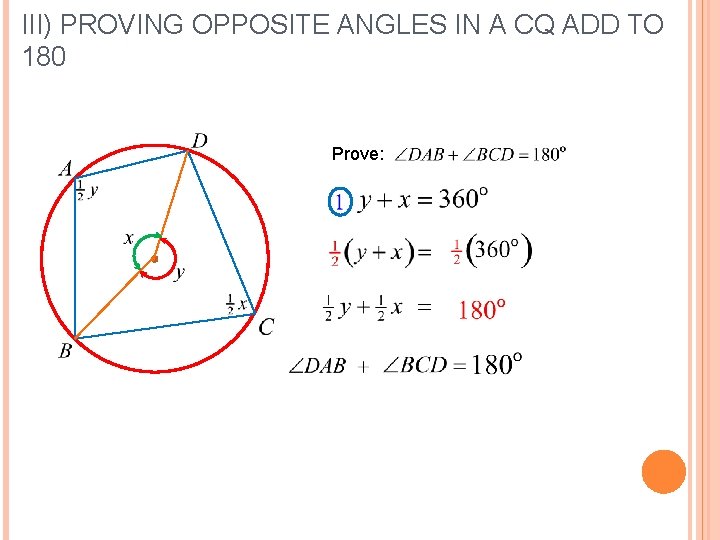
III) PROVING OPPOSITE ANGLES IN A CQ ADD TO 180 Prove:
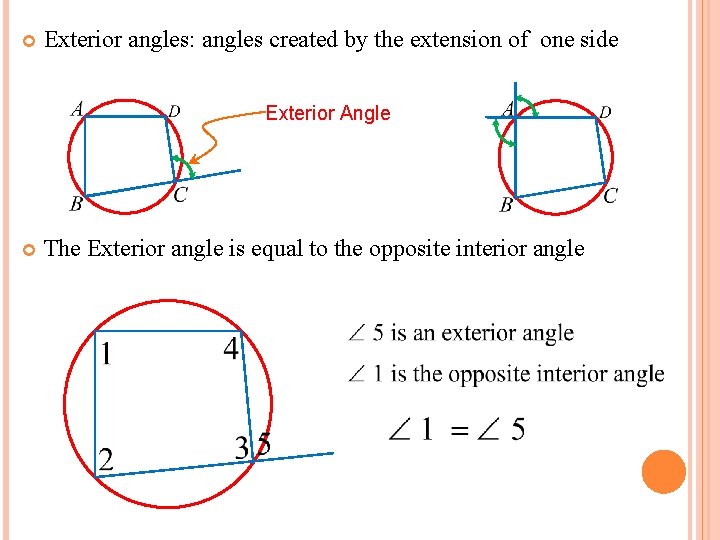
Exterior angles: angles created by the extension of one side Exterior Angle The Exterior angle is equal to the opposite interior angle
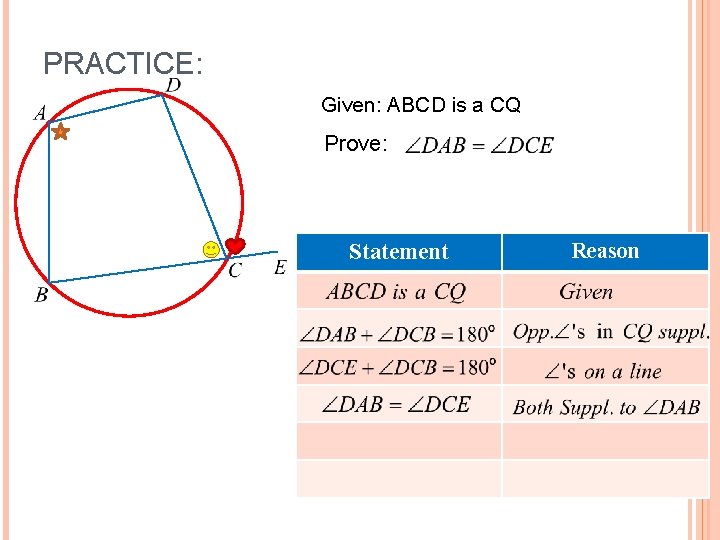
PRACTICE: Given: ABCD is a CQ Prove: Statement Reason
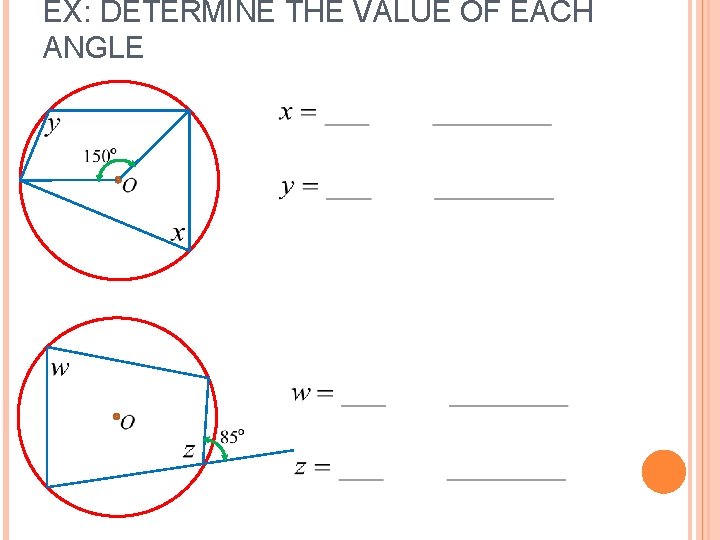
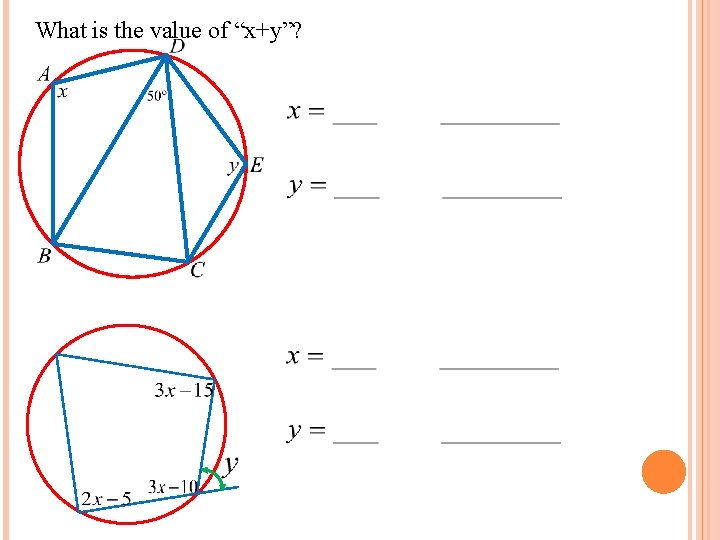
EX: DETERMINE THE VALUE OF EACH ANGLE
What is the value of “x+y”?
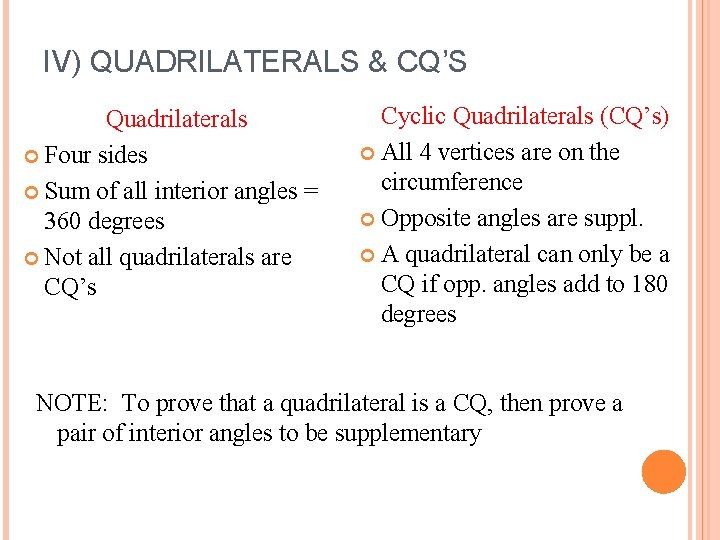
IV) QUADRILATERALS & CQ’S Quadrilaterals Four sides Sum of all interior angles = 360 degrees Not all quadrilaterals are CQ’s Cyclic Quadrilaterals (CQ’s) All 4 vertices are on the circumference Opposite angles are suppl. A quadrilateral can only be a CQ if opp. angles add to 180 degrees NOTE: To prove that a quadrilateral is a CQ, then prove a pair of interior angles to be supplementary
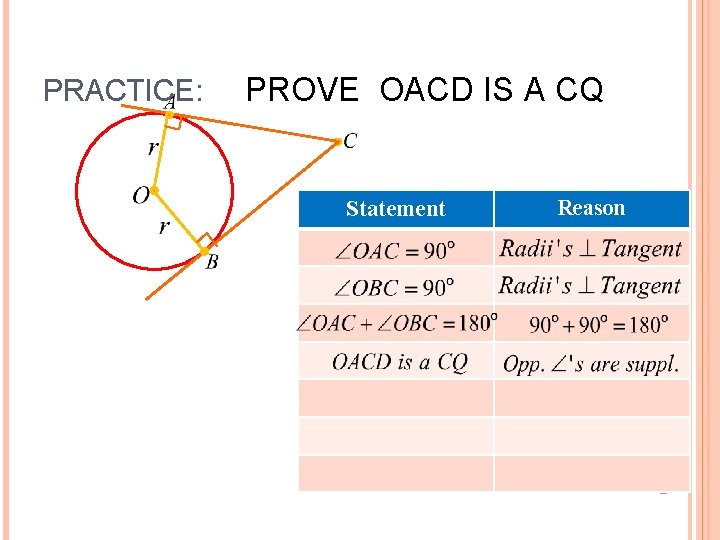
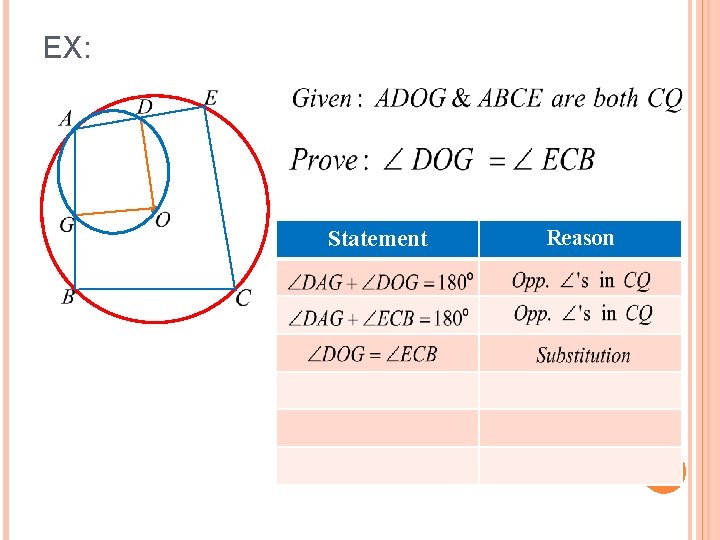
PRACTICE: PROVE OACD IS A CQ Statement Reason
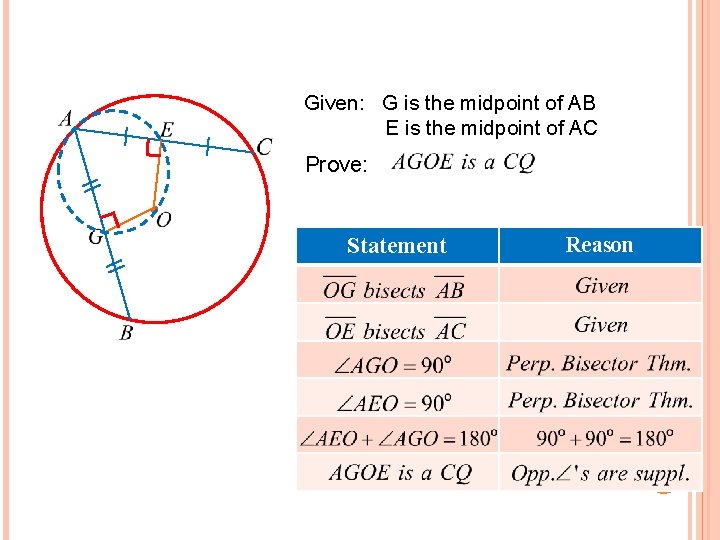
Given: G is the midpoint of AB E is the midpoint of AC Prove: Statement Reason
EX: Statement Reason
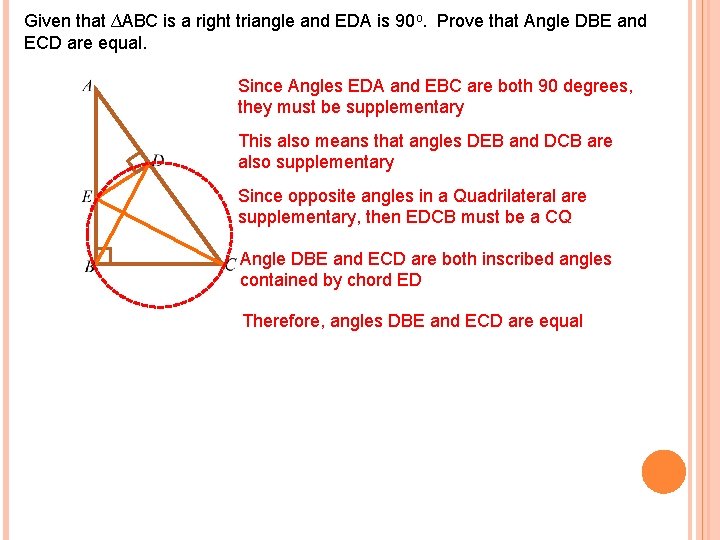
Given that ∆ABC is a right triangle and EDA is 90 o. Prove that Angle DBE and ECD are equal. Since Angles EDA and EBC are both 90 degrees, they must be supplementary This also means that angles DEB and DCB are also supplementary Since opposite angles in a Quadrilateral are supplementary, then EDCB must be a CQ Angle DBE and ECD are both inscribed angles contained by chord ED Therefore, angles DBE and ECD are equal
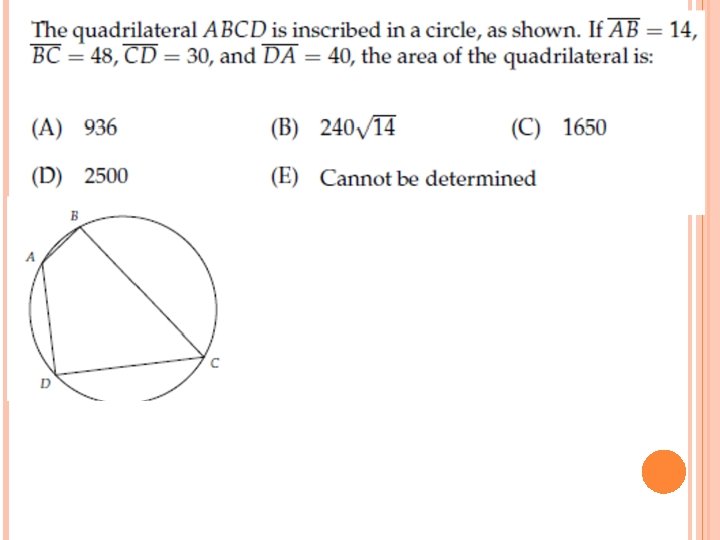
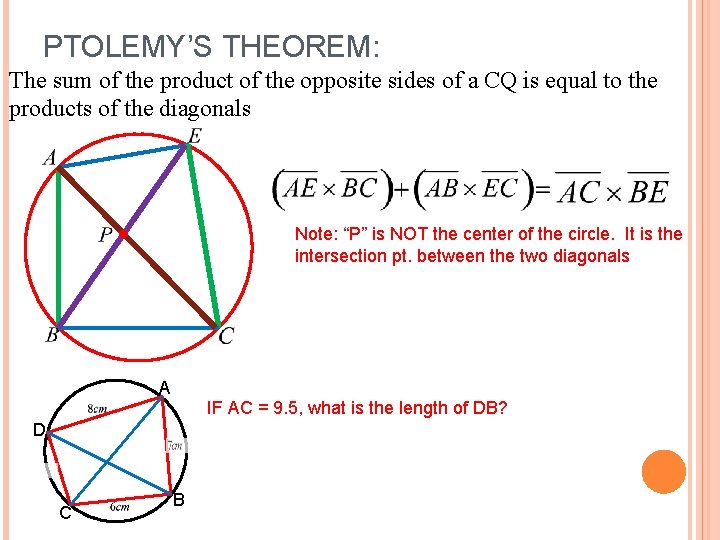
PTOLEMY’S THEOREM: The sum of the product of the opposite sides of a CQ is equal to the products of the diagonals Note: “P” is NOT the center of the circle. It is the intersection pt. between the two diagonals A IF AC = 9. 5, what is the length of DB? D C B
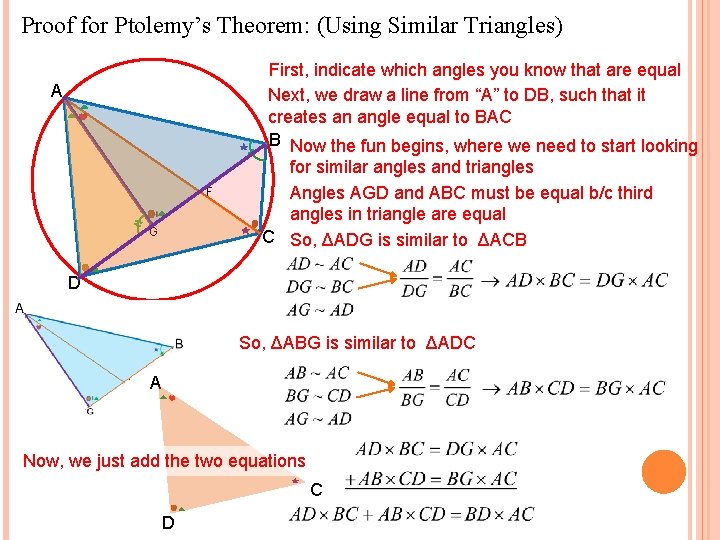
Proof for Ptolemy’s Theorem: (Using Similar Triangles) First, indicate which angles you know that are equal Next, we draw a line from “A” to DB, such that it creates an angle equal to BAC B Now the fun begins, where we need to start looking A F G for similar angles and triangles AGD and ABC must be equal b/c third angles in triangle are equal C So, ΔADG is similar to ΔACB D So, ΔABG is similar to ΔADC A Now, we just add the two equations C D
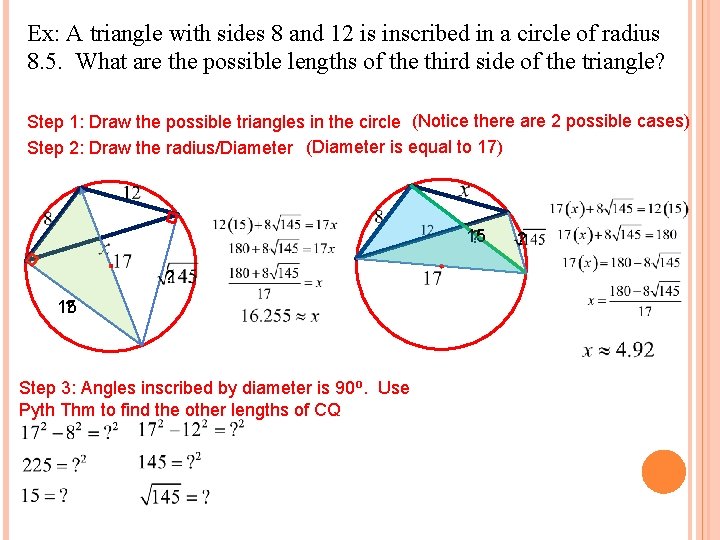
Ex: A triangle with sides 8 and 12 is inscribed in a circle of radius 8. 5. What are the possible lengths of the third side of the triangle? Step 1: Draw the possible triangles in the circle (Notice there are 2 possible cases) Step 2: Draw the radius/Diameter (Diameter is equal to 17) 15 ? ? 15 ? Step 3: Angles inscribed by diameter is 90ᴼ. Use Pyth Thm to find the other lengths of CQ ?