3 A Testing Framework P 2 A Testing
- Slides: 39
3. A Testing Framework
P 2 — A Testing Framework Sources > JUnit 4. 0 documentation (from www. junit. org) © O. Nierstrasz 2
P 2 — A Testing Framework Roadmap > Junit — a testing framework — Testing practices — Frameworks vs. Libraries — Junit 3. x vs. Junit 4. x (annotations) > Money and Money. Bag — a testing case study > Double Dispatch — how to add different types of objects © O. Nierstrasz 3
P 2 — A Testing Framework Roadmap > Junit — a testing framework — Testing practices — Frameworks vs. Libraries — Junit 3. x vs. Junit 4. x (annotations) > Money and Money. Bag — a testing case study > Double Dispatch — how to add different types of objects © O. Nierstrasz 4
P 2 — A Testing Framework The Problem “Testing is not closely integrated with development. This prevents you from measuring the progress of development — you can't tell when something starts working or when something stops working. ” Interactive testing is tedious and seldom exhaustive. Automated tests are better, but, — how to introduce tests interactively? — how to organize suites of tests? © O. Nierstrasz 5
P 2 — A Testing Framework Testing Practices During Development > When you need to add new functionality, write the tests first. — You will be done when the test runs. > When you need to redesign your software to add new features, refactor in small steps, and run the (regression) tests after each step. — Fix what’s broken before proceeding. During Debugging > When someone discovers a defect in your code, first write a test that demonstrates the defect. — Then debug until the test succeeds. “Whenever you are tempted to type something into a print statement or a debugger expression, write it as a test instead. ” Martin Fowler © O. Nierstrasz 6
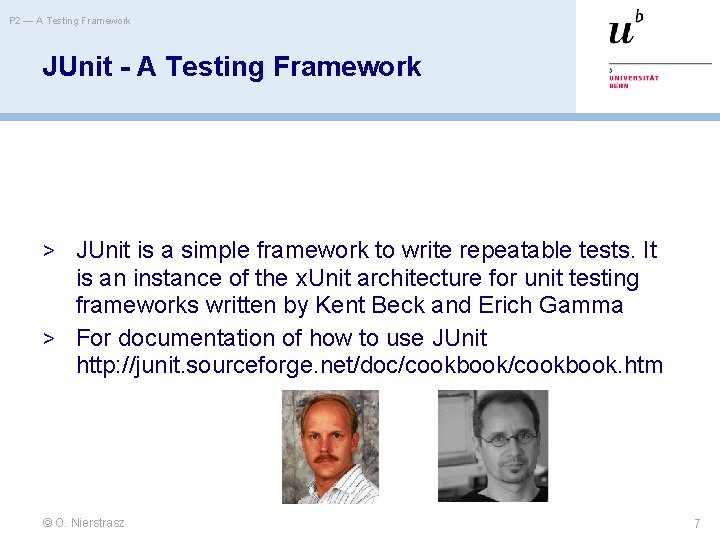
P 2 — A Testing Framework JUnit - A Testing Framework > JUnit is a simple framework to write repeatable tests. It is an instance of the x. Unit architecture for unit testing frameworks written by Kent Beck and Erich Gamma > For documentation of how to use JUnit http: //junit. sourceforge. net/doc/cookbook. htm © O. Nierstrasz 7
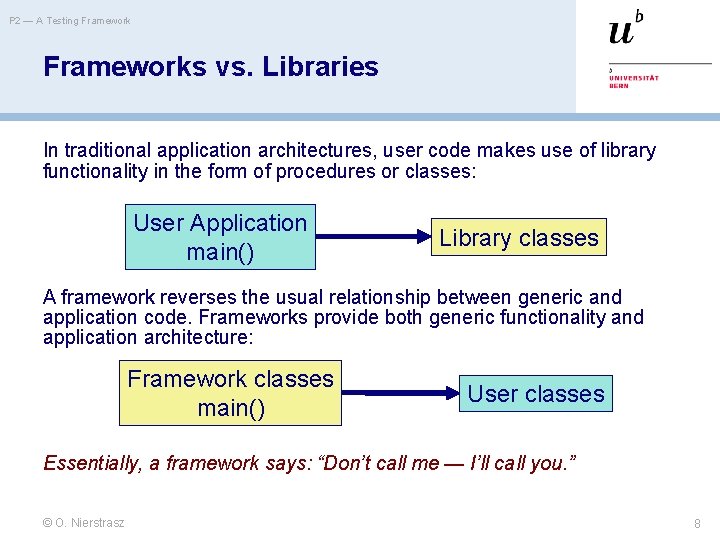
P 2 — A Testing Frameworks vs. Libraries In traditional application architectures, user code makes use of library functionality in the form of procedures or classes: User Application main() Library classes A framework reverses the usual relationship between generic and application code. Frameworks provide both generic functionality and application architecture: Framework classes main() User classes Essentially, a framework says: “Don’t call me — I’ll call you. ” © O. Nierstrasz 8
P 2 — A Testing Framework JUnit 3. 8 JUnit is a simple “testing framework” that provides: > classes for writing Test Cases and Test Suites > methods for setting up and cleaning up test data (“fixtures”) > methods for making assertions > textual and graphical tools for running tests JUnit distinguishes between failures and errors: > A failure is a failed assertion, i. e. , an anticipated problem that you test. > An error is a condition you didn’t check for, i. e. , a runtime error. © O. Nierstrasz 9
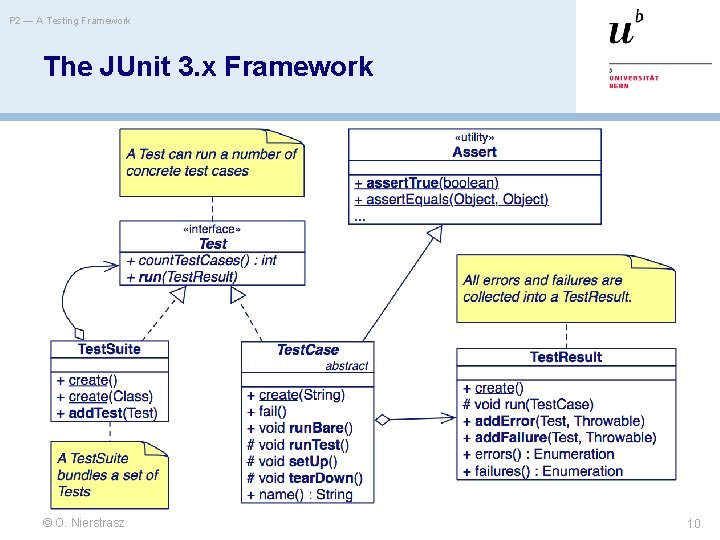
P 2 — A Testing Framework The JUnit 3. x Framework © O. Nierstrasz 10
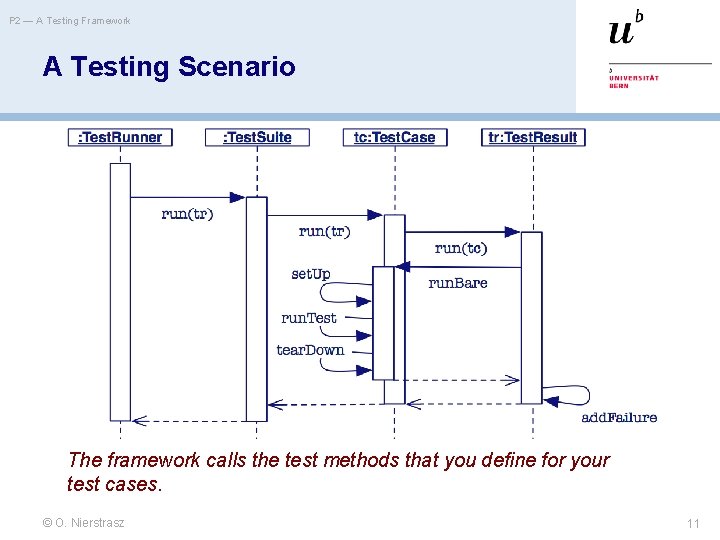
P 2 — A Testing Framework A Testing Scenario The framework calls the test methods that you define for your test cases. © O. Nierstrasz 11
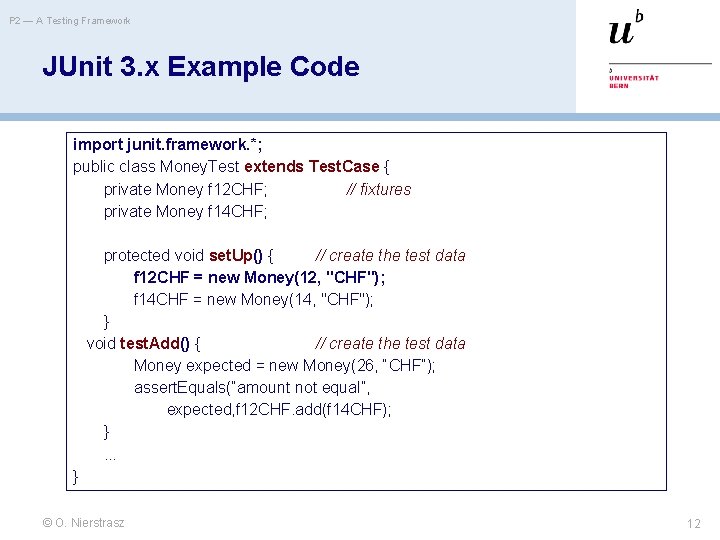
P 2 — A Testing Framework JUnit 3. x Example Code import junit. framework. *; public class Money. Test extends Test. Case { private Money f 12 CHF; // fixtures private Money f 14 CHF; protected void set. Up() { // create the test data f 12 CHF = new Money(12, "CHF"); f 14 CHF = new Money(14, "CHF"); } void test. Add() { // create the test data Money expected = new Money(26, “CHF”); assert. Equals(“amount not equal”, expected, f 12 CHF. add(f 14 CHF); }. . . } © O. Nierstrasz 12
P 2 — A Testing Framework Annotations in J 2 SE 5 > J 2 SE 5 introduces the Metadata feature (data about data) > Annotations allow you to add decorations to your code (remember javadoc tags: @author ) > Annotations are used for code documentation, compiler processing (@Deprecated ), code generation, runtime processing > ( http: //java. sun. com/docs/books/tutorial/java. OO/annotations. html ) © O. Nierstrasz 13
P 2 — A Testing Framework JUnit 4. x JUnit is a simple “testing framework” that provides: > Annotations for marking methods as tests > Annotations for marking methods that setting up and cleaning up test data (“fixtures”) > methods for making assertions > textual and graphical tools for running tests © O. Nierstrasz 14
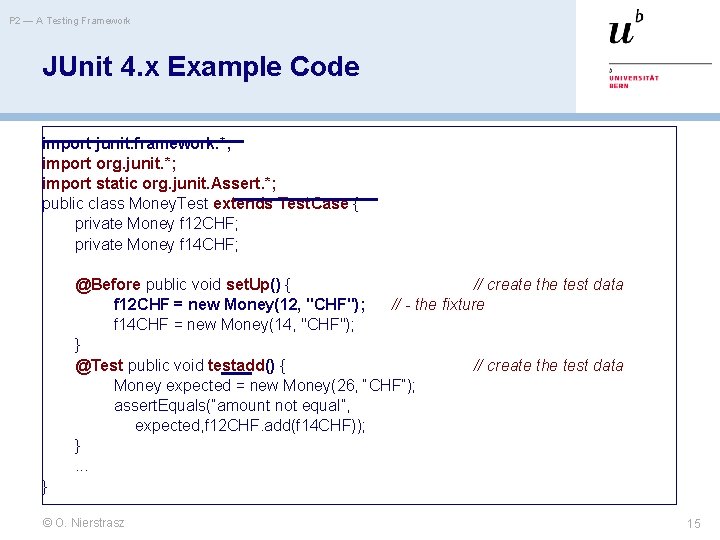
P 2 — A Testing Framework JUnit 4. x Example Code import junit. framework. *; import org. junit. *; import static org. junit. Assert. *; public class Money. Test extends Test. Case { private Money f 12 CHF; private Money f 14 CHF; @Before public void set. Up() { // create the test data f 12 CHF = new Money(12, "CHF"); // - the fixture f 14 CHF = new Money(14, "CHF"); } @Test public void testadd() { // create the test data Money expected = new Money(26, “CHF”); assert. Equals(“amount not equal”, expected, f 12 CHF. add(f 14 CHF)); }. . . } © O. Nierstrasz 15
P 2 — A Testing Framework Testing Style “The style here is to write a few lines of code, then a test that should run, or even better, to write a test that won't run, then write the code that will make it run. ” > write unit tests that thoroughly test a single class > write tests as you develop (even before you implement) > write tests for every new piece of functionality “Developers should spend 25 -50% of their time developing tests. ” © O. Nierstrasz 16
P 2 — A Testing Framework Roadmap > Junit — a testing framework — Testing practices — Frameworks vs. Libraries — Junit 3. x vs. Junit 4. x (annotations) > Money and Money. Bag — a testing case study > Double Dispatch — how to add different types of objects © O. Nierstrasz 17
P 2 — A Testing Framework Representing multiple currencies The problem. . . “The program we write will solve the problem of representing arithmetic with multiple currencies. Arithmetic between single currencies is trivial, you can just add the two amounts. . Things get more interesting once multiple currencies are involved. ” © O. Nierstrasz 18
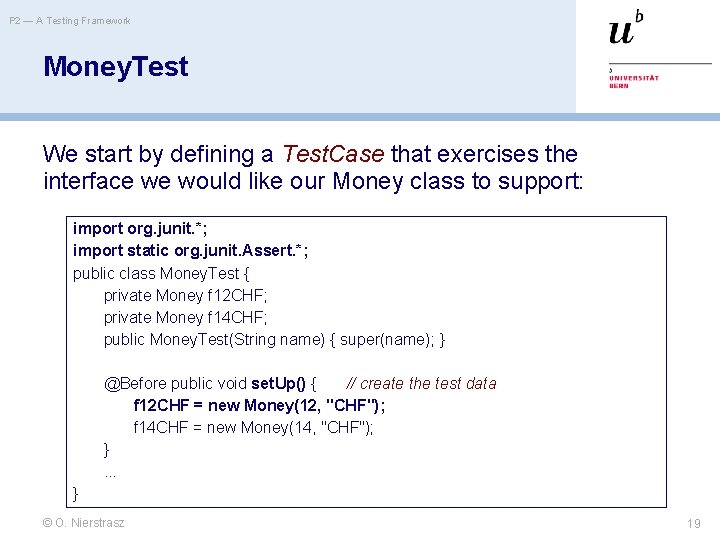
P 2 — A Testing Framework Money. Test We start by defining a Test. Case that exercises the interface we would like our Money class to support: import org. junit. *; import static org. junit. Assert. *; public class Money. Test { private Money f 12 CHF; private Money f 14 CHF; public Money. Test(String name) { super(name); } @Before public void set. Up() { // create the test data f 12 CHF = new Money(12, "CHF"); f 14 CHF = new Money(14, "CHF"); }. . . } © O. Nierstrasz 19
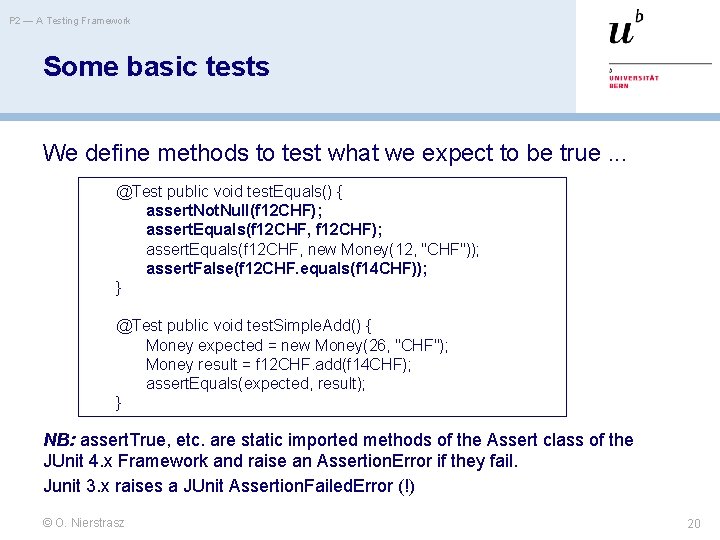
P 2 — A Testing Framework Some basic tests We define methods to test what we expect to be true. . . @Test public void test. Equals() { assert. Not. Null(f 12 CHF); assert. Equals(f 12 CHF, new Money(12, "CHF")); assert. False(f 12 CHF. equals(f 14 CHF)); } @Test public void test. Simple. Add() { Money expected = new Money(26, "CHF"); Money result = f 12 CHF. add(f 14 CHF); assert. Equals(expected, result); } NB: assert. True, etc. are static imported methods of the Assert class of the JUnit 4. x Framework and raise an Assertion. Error if they fail. Junit 3. x raises a JUnit Assertion. Failed. Error (!) © O. Nierstrasz 20
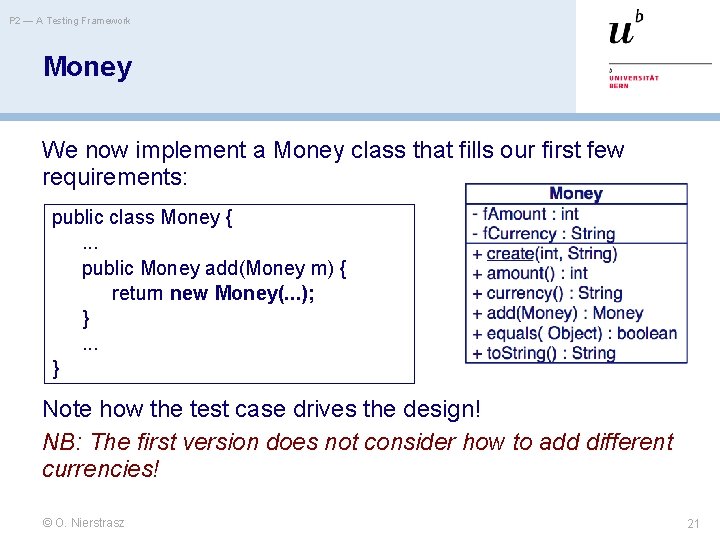
P 2 — A Testing Framework Money We now implement a Money class that fills our first few requirements: public class Money {. . . public Money add(Money m) { return new Money(. . . ); }. . . } Note how the test case drives the design! NB: The first version does not consider how to add different currencies! © O. Nierstrasz 21
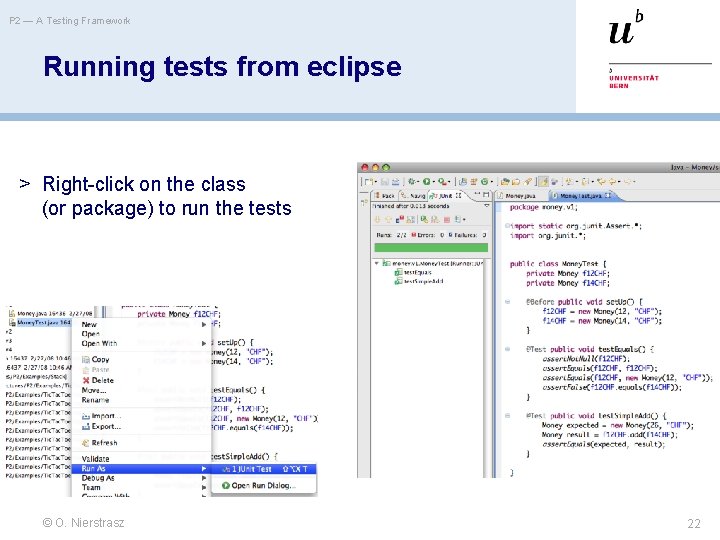
P 2 — A Testing Framework Running tests from eclipse > Right-click on the class (or package) to run the tests © O. Nierstrasz 22
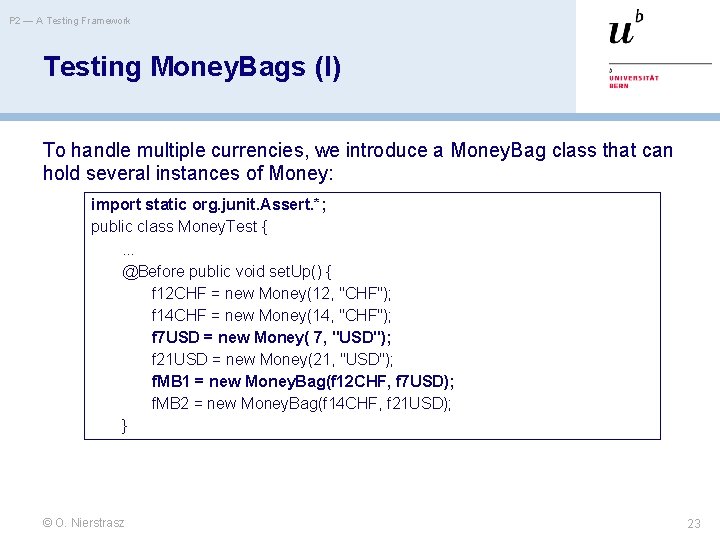
P 2 — A Testing Framework Testing Money. Bags (I) To handle multiple currencies, we introduce a Money. Bag class that can hold several instances of Money: import static org. junit. Assert. *; public class Money. Test {. . . @Before public void set. Up() { f 12 CHF = new Money(12, "CHF"); f 14 CHF = new Money(14, "CHF"); f 7 USD = new Money( 7, "USD"); f 21 USD = new Money(21, "USD"); f. MB 1 = new Money. Bag(f 12 CHF, f 7 USD); f. MB 2 = new Money. Bag(f 14 CHF, f 21 USD); } © O. Nierstrasz 23
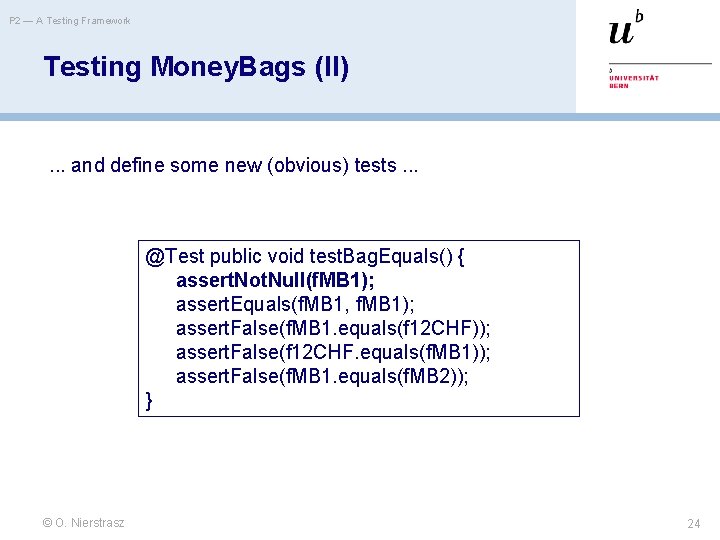
P 2 — A Testing Framework Testing Money. Bags (II) . . . and define some new (obvious) tests. . . @Test public void test. Bag. Equals() { assert. Not. Null(f. MB 1); assert. Equals(f. MB 1, f. MB 1); assert. False(f. MB 1. equals(f 12 CHF)); assert. False(f 12 CHF. equals(f. MB 1)); assert. False(f. MB 1. equals(f. MB 2)); } © O. Nierstrasz 24
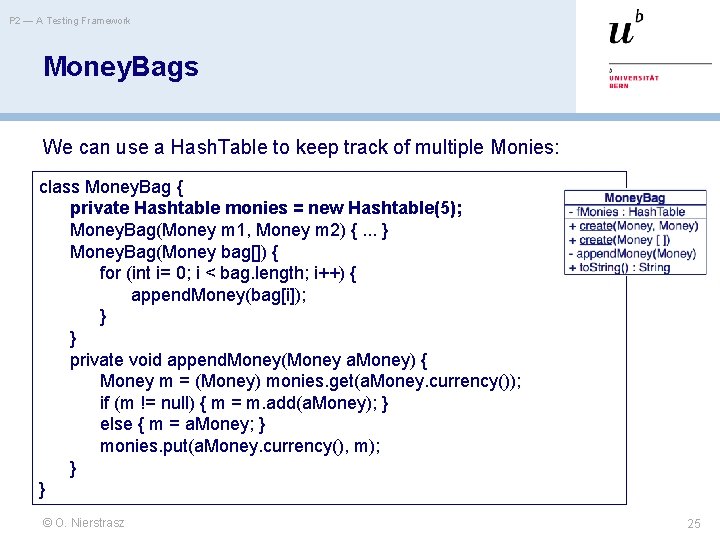
P 2 — A Testing Framework Money. Bags We can use a Hash. Table to keep track of multiple Monies: class Money. Bag { private Hashtable monies = new Hashtable(5); Money. Bag(Money m 1, Money m 2) {. . . } Money. Bag(Money bag[]) { for (int i= 0; i < bag. length; i++) { append. Money(bag[i]); } } private void append. Money(Money a. Money) { Money m = (Money) monies. get(a. Money. currency()); if (m != null) { m = m. add(a. Money); } else { m = a. Money; } monies. put(a. Money. currency(), m); } } © O. Nierstrasz 25
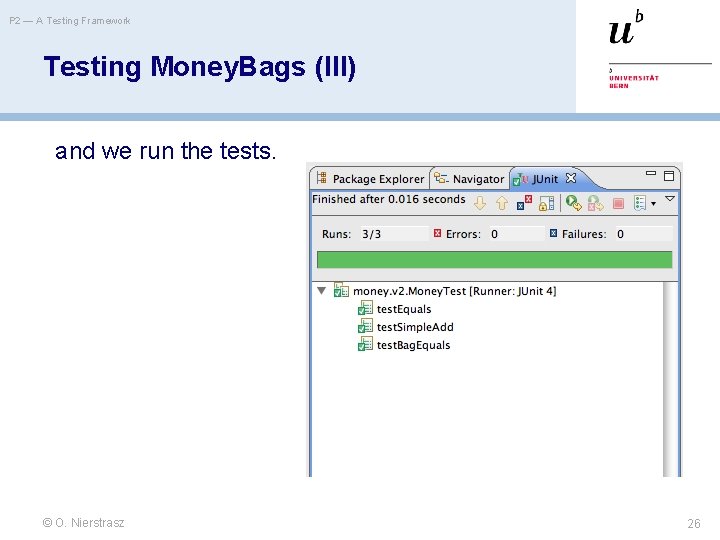
P 2 — A Testing Framework Testing Money. Bags (III) and we run the tests. © O. Nierstrasz 26
P 2 — A Testing Framework Roadmap > Junit — a testing framework — Testing practices — Frameworks vs. Libraries — Junit 3. x vs. Junit 4. x (annotations) > Money and Money. Bag — a testing case study > Double Dispatch — how to add different types of objects © O. Nierstrasz 27
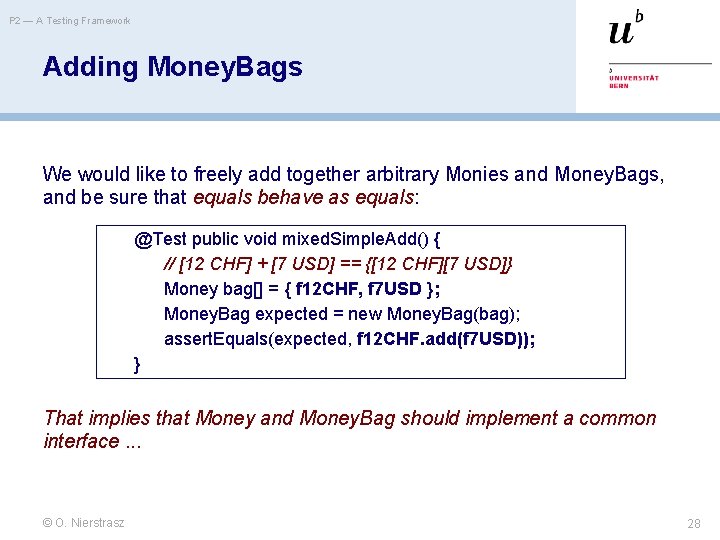
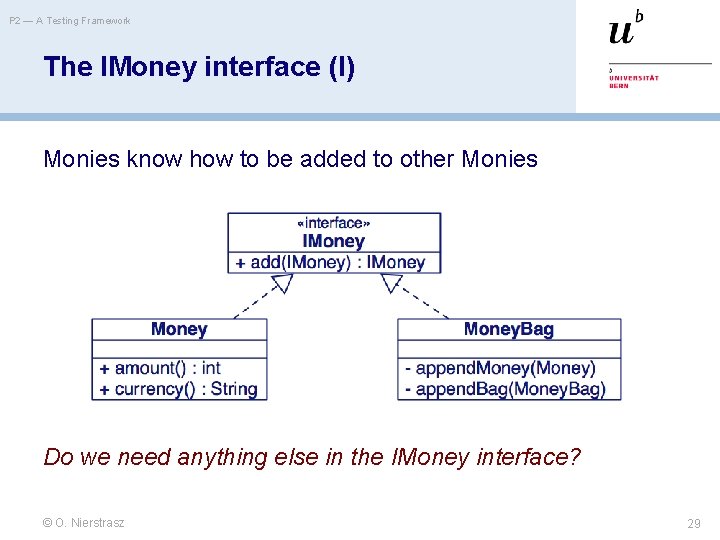
P 2 — A Testing Framework Adding Money. Bags We would like to freely add together arbitrary Monies and Money. Bags, and be sure that equals behave as equals: @Test public void mixed. Simple. Add() { // [12 CHF] + [7 USD] == {[12 CHF][7 USD]} Money bag[] = { f 12 CHF, f 7 USD }; Money. Bag expected = new Money. Bag(bag); assert. Equals(expected, f 12 CHF. add(f 7 USD)); } That implies that Money and Money. Bag should implement a common interface. . . © O. Nierstrasz 28
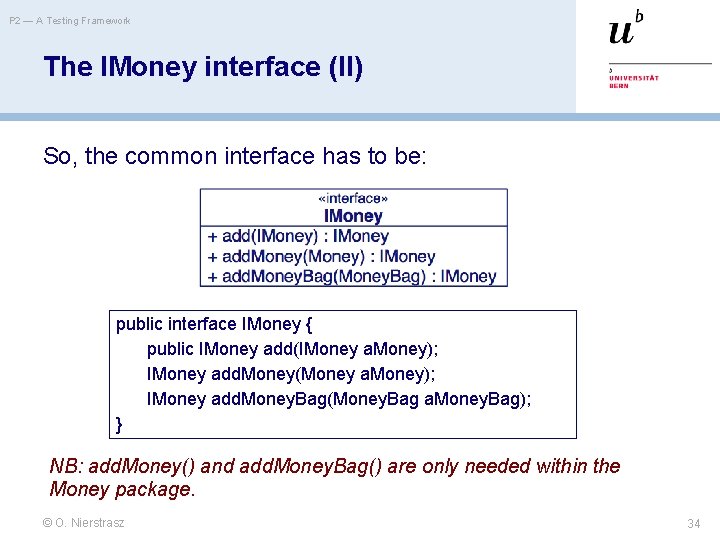
P 2 — A Testing Framework The IMoney interface (I) Monies know how to be added to other Monies Do we need anything else in the IMoney interface? © O. Nierstrasz 29
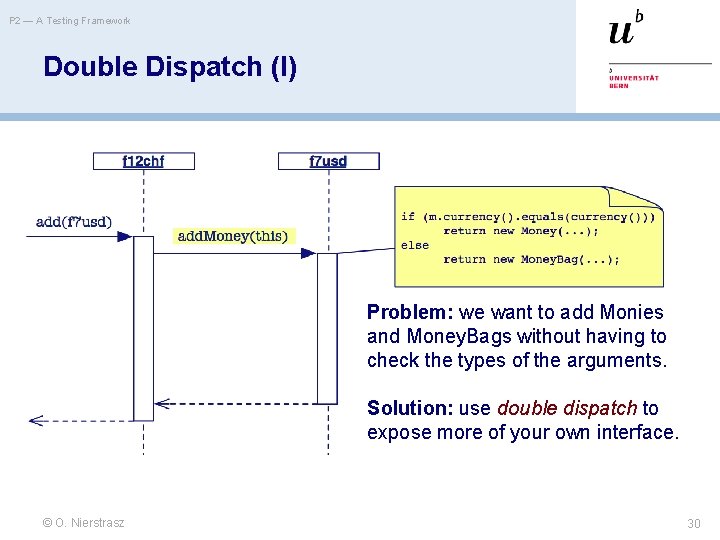
P 2 — A Testing Framework Double Dispatch (I) Problem: we want to add Monies and Money. Bags without having to check the types of the arguments. Solution: use double dispatch to expose more of your own interface. © O. Nierstrasz 30
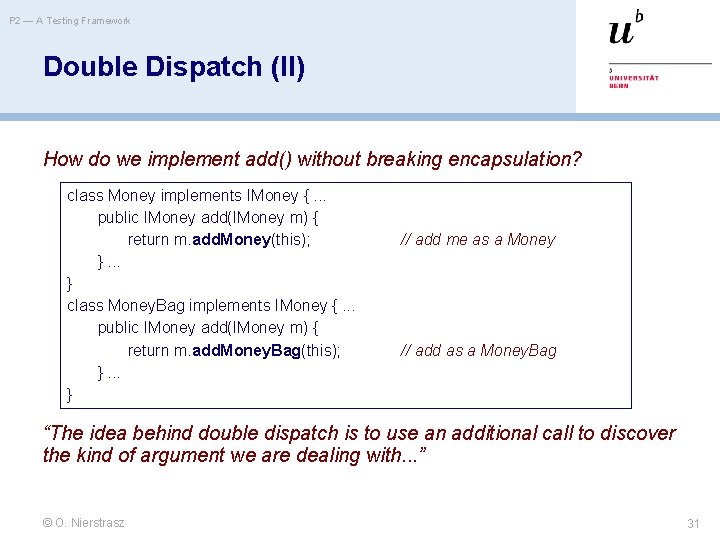
P 2 — A Testing Framework Double Dispatch (II) How do we implement add() without breaking encapsulation? class Money implements IMoney {. . . public IMoney add(IMoney m) { return m. add. Money(this); }. . . } class Money. Bag implements IMoney {. . . public IMoney add(IMoney m) { return m. add. Money. Bag(this); }. . . } // add me as a Money // add as a Money. Bag “The idea behind double dispatch is to use an additional call to discover the kind of argument we are dealing with. . . ” © O. Nierstrasz 31
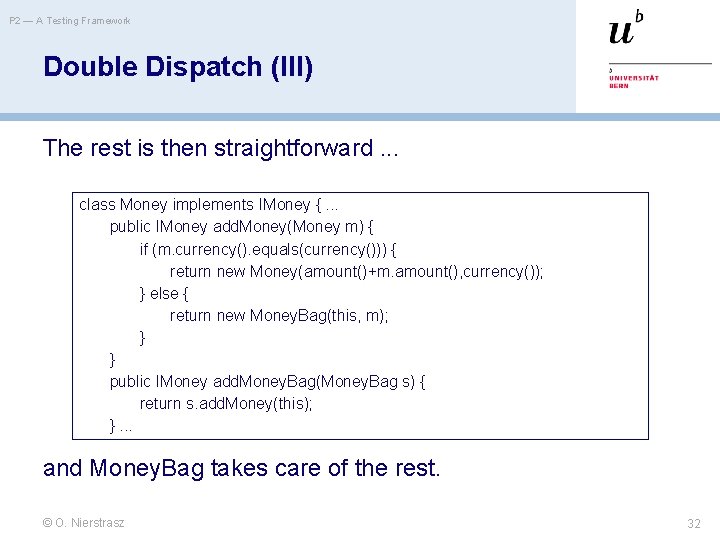
P 2 — A Testing Framework Double Dispatch (III) The rest is then straightforward. . . class Money implements IMoney {. . . public IMoney add. Money(Money m) { if (m. currency(). equals(currency())) { return new Money(amount()+m. amount(), currency()); } else { return new Money. Bag(this, m); } } public IMoney add. Money. Bag(Money. Bag s) { return s. add. Money(this); }. . . and Money. Bag takes care of the rest. © O. Nierstrasz 32
P 2 — A Testing Framework Double Dispatch (IV) > Pros: — No violation of encapsulation (no downcasting) — Smaller methods; easier to debug — Easy to add a new type > Cons: — No centralized control — May lead to an explosion of helper methods © O. Nierstrasz 33
P 2 — A Testing Framework The IMoney interface (II) So, the common interface has to be: public interface IMoney { public IMoney add(IMoney a. Money); IMoney add. Money(Money a. Money); IMoney add. Money. Bag(Money. Bag a. Money. Bag); } NB: add. Money() and add. Money. Bag() are only needed within the Money package. © O. Nierstrasz 34
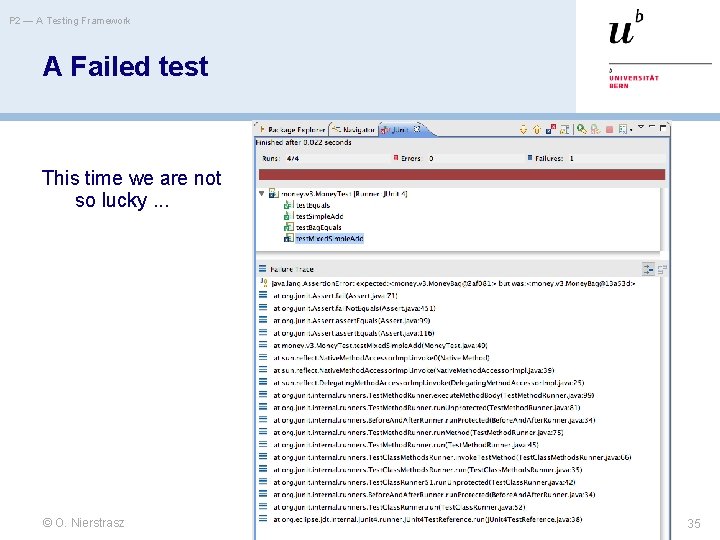
P 2 — A Testing Framework A Failed test This time we are not so lucky. . . © O. Nierstrasz 35
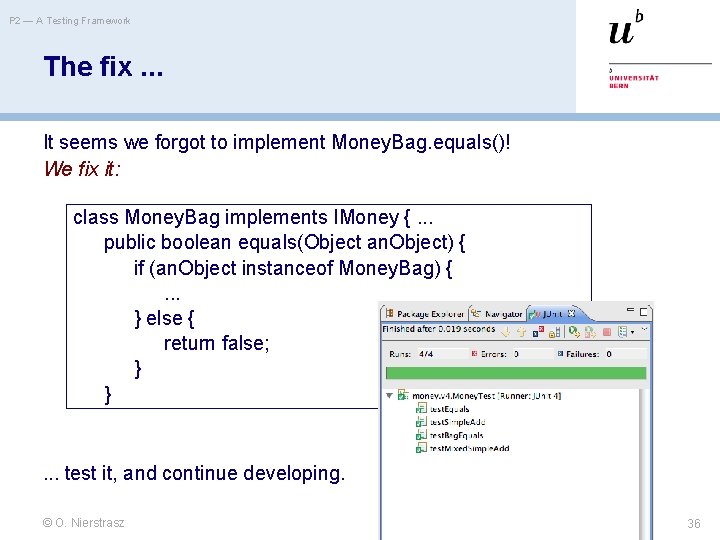
P 2 — A Testing Framework The fix. . . It seems we forgot to implement Money. Bag. equals()! We fix it: class Money. Bag implements IMoney {. . . public boolean equals(Object an. Object) { if (an. Object instanceof Money. Bag) {. . . } else { return false; } } . . . test it, and continue developing. © O. Nierstrasz 36
P 2 — A Testing Framework What you should know! How does a framework differ from a library? What is a unit test? What is an annotation? How does JUnit 3. x differ from JUnit 4. x What is a test “fixture”? What should you test in a Test. Case? How can testing drive design? What is “double dispatch”? What does the name mean? © O. Nierstrasz 37
P 2 — A Testing Framework Can you answer these questions? How does implementing to. String() help in debugging? How does the Money. Test suite know which test methods to run? How does the Test. Runner invoke the right suite() method? Why doesn’t the Java compiler complain that Money. Bag. equals() is used without being declared? © O. Nierstrasz 38
P 2 — A Testing Framework License > http: //creativecommons. org/licenses/by-sa/2. 5/ Attribution-Share. Alike 2. 5 You are free: • to copy, distribute, display, and perform the work • to make derivative works • to make commercial use of the work Under the following conditions: Attribution. You must attribute the work in the manner specified by the author or licensor. Share Alike. If you alter, transform, or build upon this work, you may distribute the resulting work only under a license identical to this one. • For any reuse or distribution, you must make clear to others the license terms of this work. • Any of these conditions can be waived if you get permission from the copyright holder. Your fair use and other rights are in no way affected by the above. © O. Nierstrasz 39