2020 REVISED CURRICULUM AND ASSESSMENT PLANS LIFE SKILLS



- Slides: 40
2020 REVISED CURRICULUM AND ASSESSMENT PLANS LIFE SKILLS GRADE 4 Implementation: June 2020
Presentation Outline 1. Purpose 2. Amendments to the Content Overview for the Phase; 3. Amendments to the Annual Teaching Plan; 4. Amendments School Based Assessment (SBA) 5. Conclusion
1. Purpose • To mediate the amendments of the trimmed and re-organised 2020 Annual Teaching Plan including School Based Assessment for Life Skills, Grade 4 for implementation in June 2020 as stipulated in Circular No S 2 of 2020. • To ensure that meaningful teaching proceeds during the remaining teaching time as per the revised school calendar. • To assist teachers with guided pacing and sequencing of curriculum content and assessment.
1. Purpose (continued) • To enable teachers to cover the essential core content /skills in each grade within the available time. • To assist teachers with planning for the different forms of assessment. • To ensure learners are adequately prepared for the subsequent year/s in terms of content, skills, knowledge, attitudes and values
2. Amendments to the Content Overview for the Phase
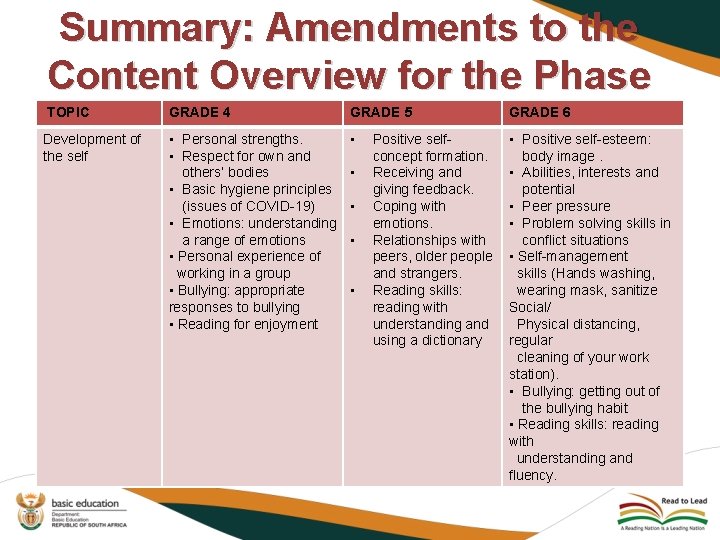
Summary: Amendments to the Content Overview for the Phase TOPIC GRADE 4 GRADE 5 GRADE 6 Development of the self • Personal strengths. • Respect for own and others’ bodies • Basic hygiene principles (issues of COVID-19) • Emotions: understanding a range of emotions • Personal experience of working in a group • Bullying: appropriate responses to bullying • Reading for enjoyment • • Positive self-esteem: body image. • Abilities, interests and potential • Peer pressure • Problem solving skills in conflict situations • Self-management skills (Hands washing, wearing mask, sanitize Social/ Physical distancing, regular cleaning of your work station). • Bullying: getting out of the bullying habit • Reading skills: reading with understanding and fluency. • • Positive selfconcept formation. Receiving and giving feedback. Coping with emotions. Relationships with peers, older people and strangers. Reading skills: reading with understanding and using a dictionary
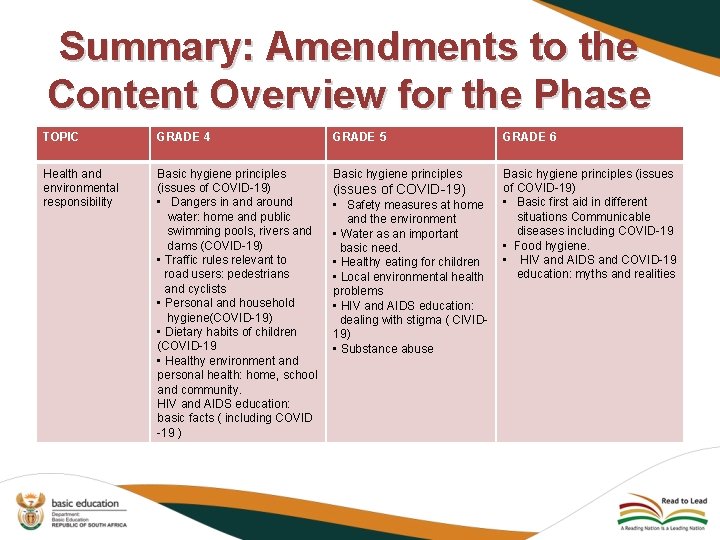
Summary: Amendments to the Content Overview for the Phase TOPIC GRADE 4 GRADE 5 GRADE 6 Health and environmental responsibility Basic hygiene principles (issues of COVID-19) • Dangers in and around water: home and public swimming pools, rivers and dams (COVID-19) • Traffic rules relevant to road users: pedestrians and cyclists • Personal and household hygiene(COVID-19) • Dietary habits of children (COVID-19 • Healthy environment and personal health: home, school and community. HIV and AIDS education: basic facts ( including COVID -19 ) Basic hygiene principles (issues of COVID-19) • Safety measures at home and the environment • Water as an important basic need. • Healthy eating for children • Local environmental health problems • HIV and AIDS education: dealing with stigma ( CIVID 19) • Substance abuse Basic hygiene principles (issues of COVID-19) • Basic first aid in different situations Communicable diseases including COVID-19 • Food hygiene. • HIV and AIDS and COVID-19 education: myths and realities
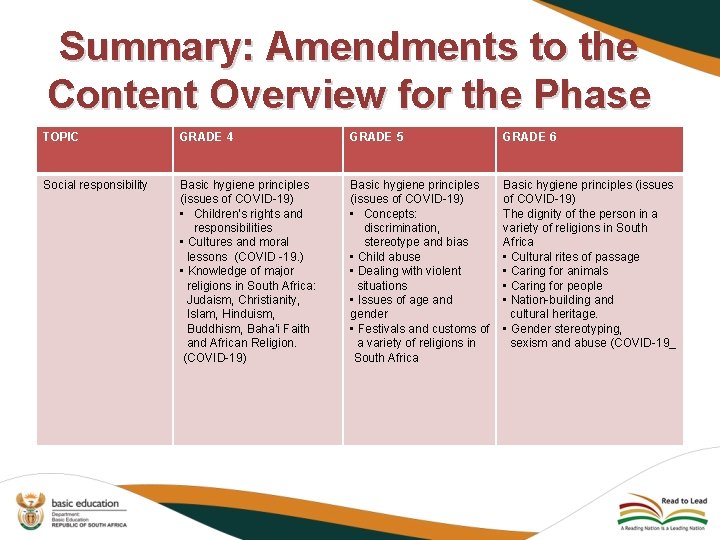
Summary: Amendments to the Content Overview for the Phase TOPIC GRADE 4 GRADE 5 GRADE 6 Social responsibility Basic hygiene principles (issues of COVID-19) • Children’s rights and responsibilities • Cultures and moral lessons (COVID -19. ) • Knowledge of major religions in South Africa: Judaism, Christianity, Islam, Hinduism, Buddhism, Baha’i Faith and African Religion. (COVID-19) Basic hygiene principles (issues of COVID-19) • Concepts: discrimination, stereotype and bias • Child abuse • Dealing with violent situations • Issues of age and gender • Festivals and customs of a variety of religions in South Africa Basic hygiene principles (issues of COVID-19) The dignity of the person in a variety of religions in South Africa • Cultural rites of passage • Caring for animals • Caring for people • Nation-building and cultural heritage. • Gender stereotyping, sexism and abuse (COVID-19_
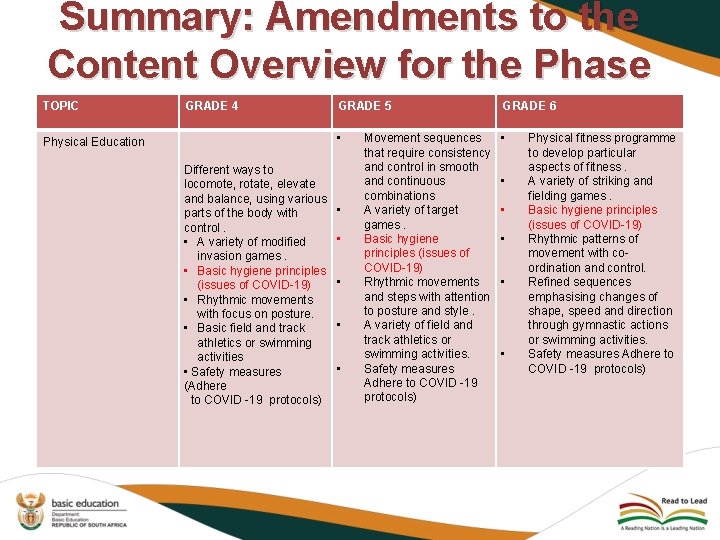
Summary: Amendments to the Content Overview for the Phase TOPIC GRADE 4 Physical Education Different ways to locomote, rotate, elevate and balance, using various parts of the body with control. • A variety of modified invasion games. • Basic hygiene principles (issues of COVID-19) • Rhythmic movements with focus on posture. • Basic field and track athletics or swimming activities • Safety measures (Adhere to COVID -19 protocols) GRADE 5 GRADE 6 • • Movement sequences that require consistency and control in smooth and continuous combinations A variety of target games. Basic hygiene principles (issues of COVID-19) Rhythmic movements and steps with attention to posture and style. A variety of field and track athletics or swimming activities. Safety measures Adhere to COVID -19 protocols) • • • Physical fitness programme to develop particular aspects of fitness. A variety of striking and fielding games. Basic hygiene principles (issues of COVID-19) Rhythmic patterns of movement with coordination and control. Refined sequences emphasising changes of shape, speed and direction through gymnastic actions or swimming activities. Safety measures Adhere to COVID -19 protocols)
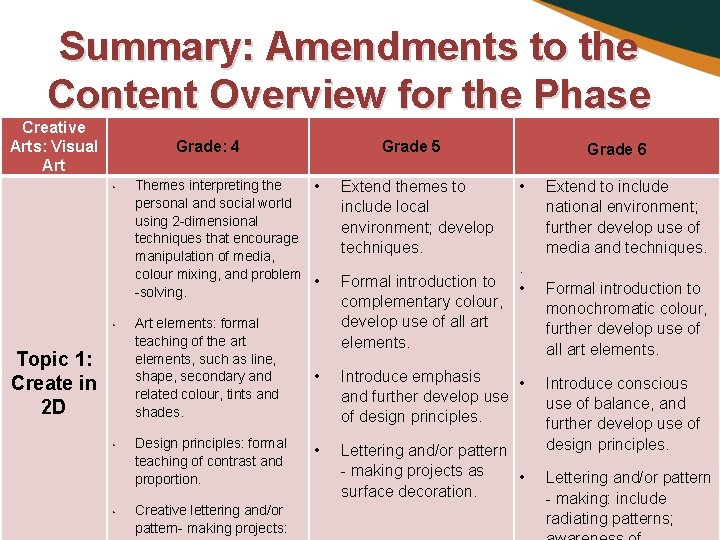
Summary: Amendments to the Content Overview for the Phase Creative Arts: Visual Art Grade: 4 • • Topic 1: Create in 2 D • • Grade 5 Themes interpreting the • personal and social world using 2 -dimensional techniques that encourage manipulation of media, colour mixing, and problem • -solving. Art elements: formal teaching of the art elements, such as line, shape, secondary and related colour, tints and shades. Design principles: formal teaching of contrast and proportion. Creative lettering and/or pattern- making projects: Extend themes to include local environment; develop techniques. Grade 6 • . Formal introduction to • complementary colour, develop use of all art elements. • Introduce emphasis • and further develop use of design principles. • Lettering and/or pattern - making projects as • surface decoration. Extend to include national environment; further develop use of media and techniques. Formal introduction to monochromatic colour, further develop use of all art elements. Introduce conscious use of balance, and further develop use of design principles. Lettering and/or pattern - making: include radiating patterns;
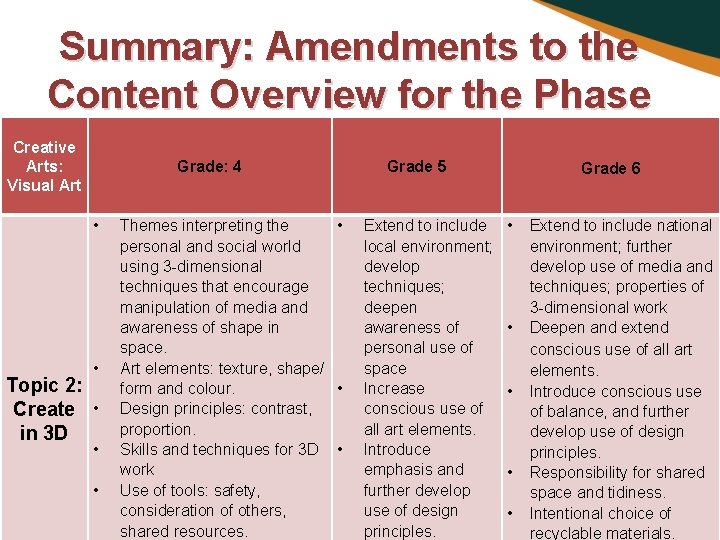
Summary: Amendments to the Content Overview for the Phase Creative Arts: Visual Art Grade: 4 • • Topic 2: Create • in 3 D • • Themes interpreting the • personal and social world using 3 -dimensional techniques that encourage manipulation of media and awareness of shape in space. Art elements: texture, shape/ form and colour. • Design principles: contrast, proportion. Skills and techniques for 3 D • work Use of tools: safety, consideration of others, shared resources. Grade 5 Extend to include local environment; develop techniques; deepen awareness of personal use of space Increase conscious use of all art elements. Introduce emphasis and further develop use of design principles. Grade 6 • • • Extend to include national environment; further develop use of media and techniques; properties of 3 -dimensional work Deepen and extend conscious use of all art elements. Introduce conscious use of balance, and further develop use of design principles. Responsibility for shared space and tidiness. Intentional choice of recyclable materials.
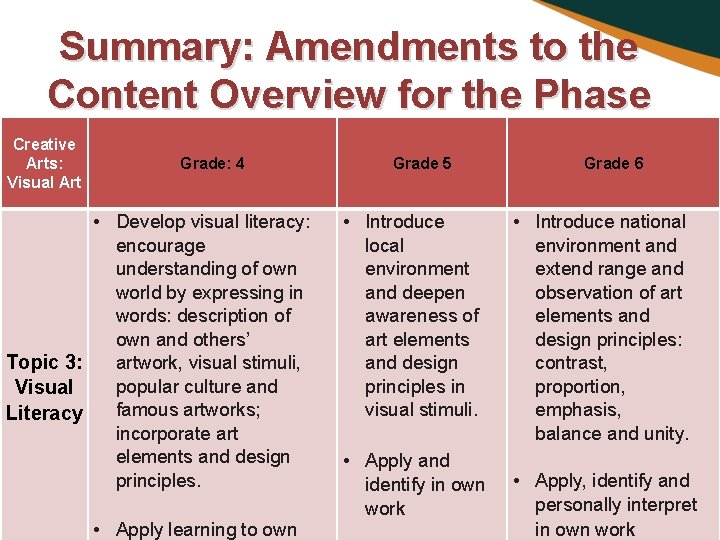
Summary: Amendments to the Content Overview for the Phase Creative Arts: Visual Art Grade: 4 • Develop visual literacy: encourage understanding of own world by expressing in words: description of own and others’ Topic 3: artwork, visual stimuli, popular culture and Visual famous artworks; Literacy incorporate art elements and design principles. • Apply learning to own Grade 5 • Introduce local environment and deepen awareness of art elements and design principles in visual stimuli. • Apply and identify in own work Grade 6 • Introduce national environment and extend range and observation of art elements and design principles: contrast, proportion, emphasis, balance and unity. • Apply, identify and personally interpret in own work
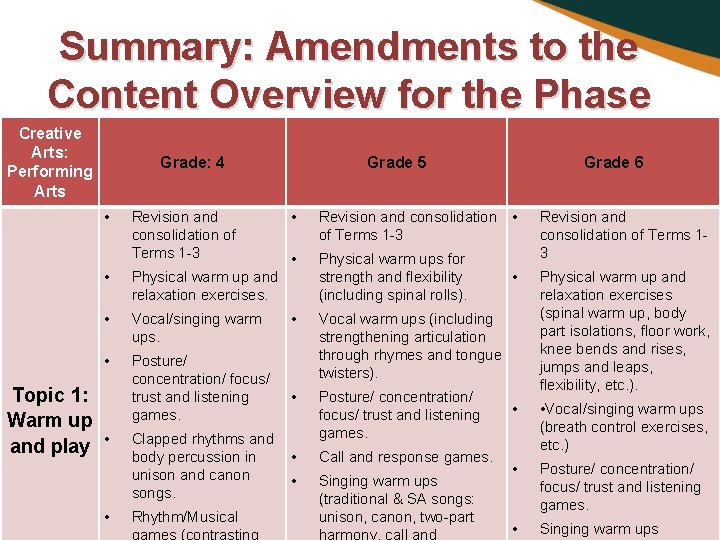
Summary: Amendments to the Content Overview for the Phase Creative Arts: Performing Arts Grade: 4 • Topic 1: Warm up and play Revision and consolidation of Terms 1 -3 • Physical warm up and relaxation exercises. • Vocal/singing warm ups. • Posture/ concentration/ focus/ trust and listening games. • • • Revision and consolidation • of Terms 1 -3 • Physical warm ups for strength and flexibility (including spinal rolls). • Vocal warm ups (including strengthening articulation through rhymes and tongue twisters). • Posture/ concentration/ focus/ trust and listening games. Clapped rhythms and body percussion in • unison and canon • songs. Rhythm/Musical games (contrasting Grade 6 Grade 5 Call and response games. Singing warm ups (traditional & SA songs: unison, canon, two-part harmony, call and Revision and consolidation of Terms 13 • Physical warm up and relaxation exercises (spinal warm up, body part isolations, floor work, knee bends and rises, jumps and leaps, flexibility, etc. ). • • Vocal/singing warm ups (breath control exercises, etc. ) • Posture/ concentration/ focus/ trust and listening games. • Singing warm ups
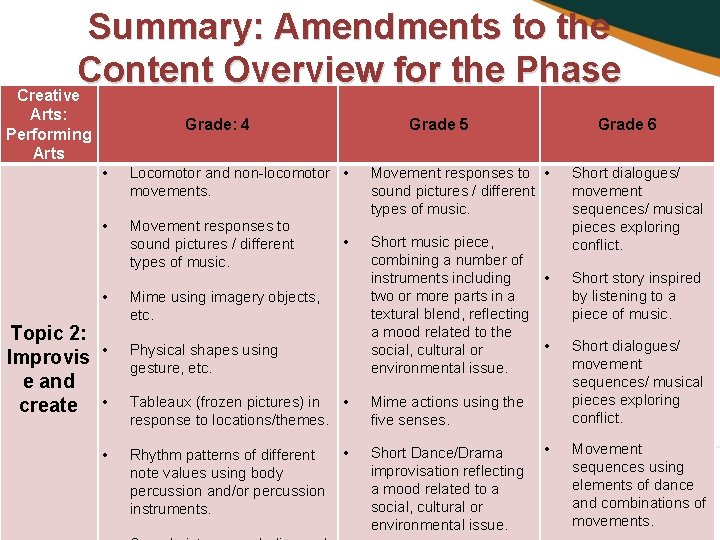
Summary: Amendments to the Content Overview for the Phase Creative Arts: Performing Arts Topic 2: Improvis e and create Grade: 4 Grade 5 • Locomotor and non-locomotor • movements. • Movement responses to sound pictures / different types of music. • Grade 6 Movement responses to • sound pictures / different types of music. • Mime using imagery objects, etc. • Physical shapes using gesture, etc. Short music piece, combining a number of instruments including • two or more parts in a textural blend, reflecting a mood related to the • social, cultural or environmental issue. • Tableaux (frozen pictures) in • response to locations/themes. Mime actions using the five senses. • • Rhythm patterns of different note values using body percussion and/or percussion instruments. Short Dance/Drama improvisation reflecting a mood related to a social, cultural or environmental issue. • Short dialogues/ movement sequences/ musical pieces exploring conflict. Short story inspired by listening to a piece of music. Short dialogues/ movement sequences/ musical pieces exploring conflict. Movement sequences using elements of dance and combinations of movements.
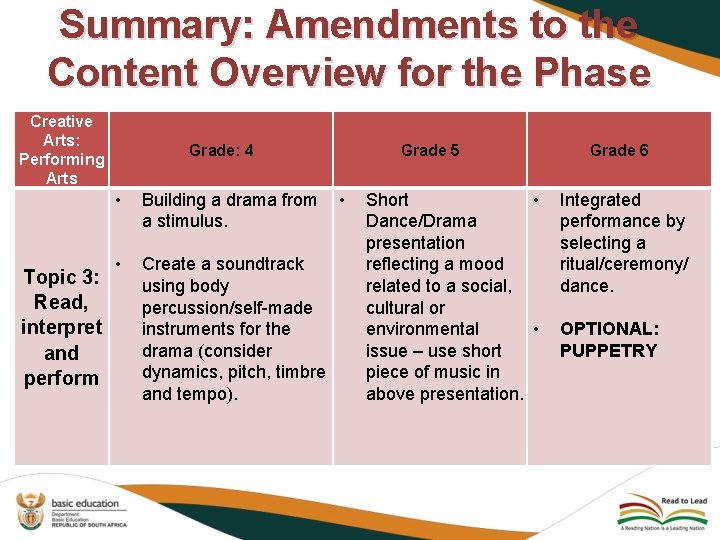
Summary: Amendments to the Content Overview for the Phase Creative Arts: Performing Arts Topic 3: Read, interpret and perform Grade: 4 • Building a drama from • a stimulus. • Create a soundtrack using body percussion/self-made instruments for the drama (consider dynamics, pitch, timbre and tempo). Grade 5 Short • Dance/Drama presentation reflecting a mood related to a social, cultural or • environmental issue – use short piece of music in above presentation. Grade 6 Integrated performance by selecting a ritual/ceremony/ dance. OPTIONAL: PUPPETRY
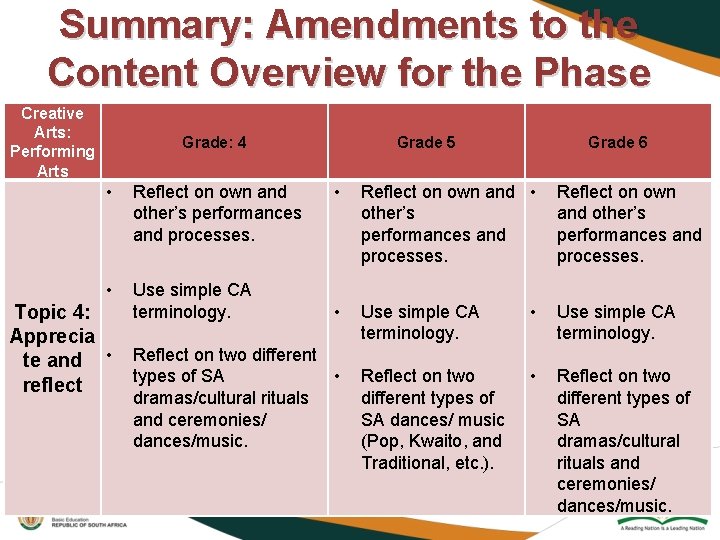
Summary: Amendments to the Content Overview for the Phase Creative Arts: Performing Arts Grade: 4 • Reflect on own and other’s performances and processes. • Use simple CA terminology. Topic 4: Apprecia te and • reflect Grade 6 Grade 5 • Reflect on own and • other’s performances and processes. • Use simple CA terminology. Reflect on two different types of SA dances/ music (Pop, Kwaito, and Traditional, etc. ). • Reflect on two different types of SA dramas/cultural rituals and ceremonies/ dances/music. Reflect on two different types of SA • dramas/cultural rituals and ceremonies/ dances/music. Reflect on own and other’s performances and processes.
3. Amendments to the Annual Teaching Plan
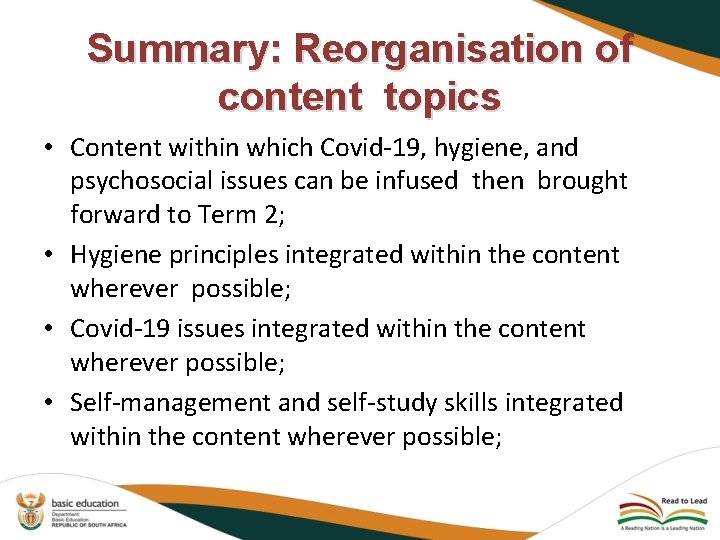
• Summary: Reorganisation of content topics Content within which Covid-19, hygiene, and psychosocial issues can be infused then brought forward to Term 2; • Hygiene principles integrated within the content wherever possible; • Covid-19 issues integrated within the content wherever possible; • Self-management and self-study skills integrated within the content wherever possible;
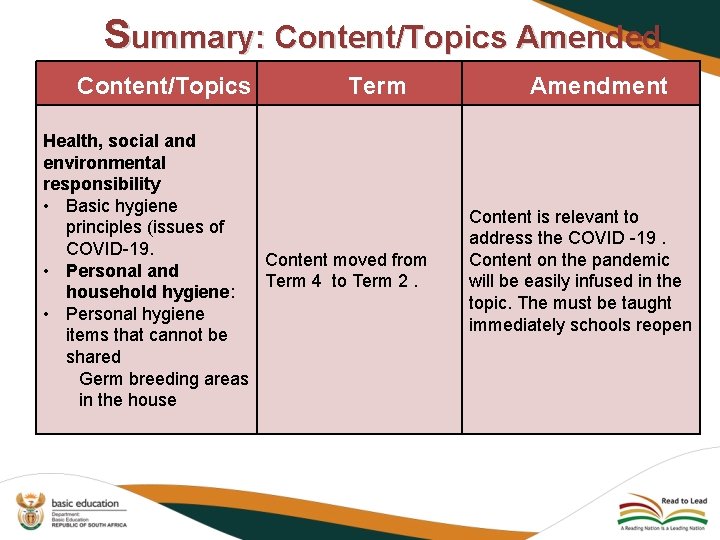
Summary: Content/Topics Amended Content/Topics Term Health, social and environmental responsibility • Basic hygiene principles (issues of COVID-19. Content moved from • Personal and Term 4 to Term 2. household hygiene: • Personal hygiene items that cannot be shared Germ breeding areas in the house Amendment Content is relevant to address the COVID -19. Content on the pandemic will be easily infused in the topic. The must be taught immediately schools reopen
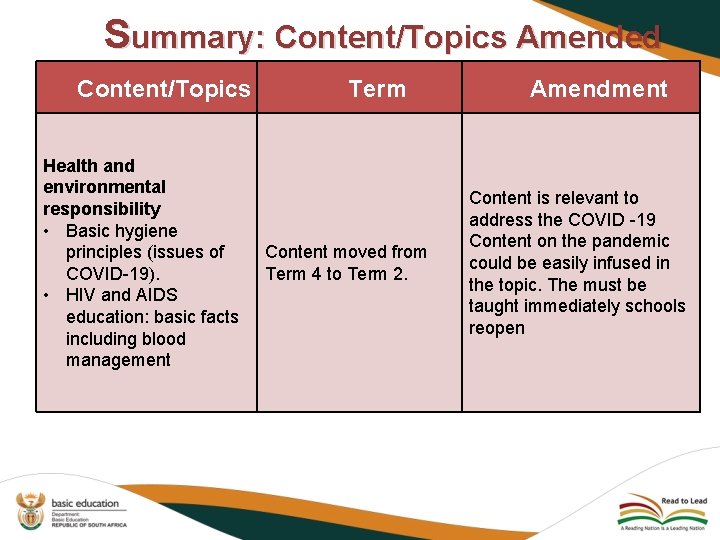
Summary: Content/Topics Amended Content/Topics Health and environmental responsibility • Basic hygiene principles (issues of COVID-19). • HIV and AIDS education: basic facts including blood management Term Content moved from Term 4 to Term 2. Amendment Content is relevant to address the COVID -19 Content on the pandemic could be easily infused in the topic. The must be taught immediately schools reopen
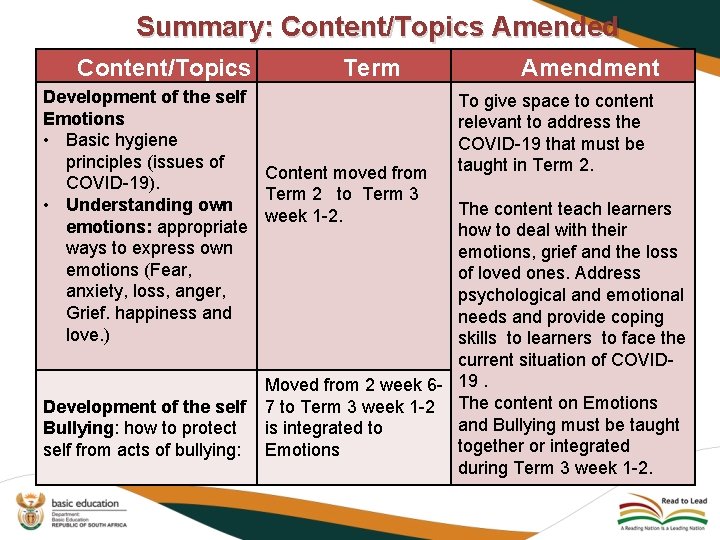
Summary: Content/Topics Amended Content/Topics Term Development of the self Emotions • Basic hygiene principles (issues of Content moved from COVID-19). Term 2 to Term 3 • Understanding own week 1 -2. emotions: appropriate ways to express own emotions (Fear, anxiety, loss, anger, Grief. happiness and love. ) Amendment To give space to content relevant to address the COVID-19 that must be taught in Term 2. The content teach learners how to deal with their emotions, grief and the loss of loved ones. Address psychological and emotional needs and provide coping skills to learners to face the current situation of COVIDMoved from 2 week 6 - 19. Development of the self 7 to Term 3 week 1 -2 The content on Emotions and Bullying must be taught Bullying: how to protect is integrated to together or integrated self from acts of bullying: Emotions during Term 3 week 1 -2.
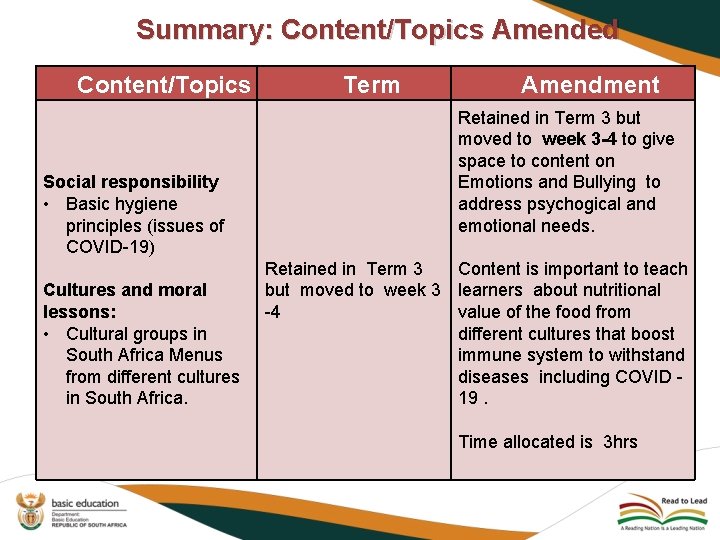
Summary: Content/Topics Amended Content/Topics Social responsibility • Basic hygiene principles (issues of COVID-19) Cultures and moral lessons: • Cultural groups in South Africa Menus from different cultures in South Africa. Term Amendment Retained in Term 3 but moved to week 3 -4 to give space to content on Emotions and Bullying to address psychogical and emotional needs. Retained in Term 3 Content is important to teach but moved to week 3 learners about nutritional value of the food from -4 different cultures that boost immune system to withstand diseases including COVID 19. Time allocated is 3 hrs
Summary: Content/Topics Amended Content/Topics Term Development of the self. • Basic hygiene principles (issues of COVID-19 • Personal experience of working in a Content moved from group: Term 2 to Term 3. at school and home. School: as member of a class, in a school or class or small group project or activity. Benefits Challenges Amendment To give space to content relevant to address the COVID 19. The content must be taught immediately schools re-open. The content teach learners hygiene skills and new behaviour to practice working in a group at school and at home.
Summary: Content/Topics Amended Content/Topics Social responsibility • Basic hygiene principles (issues of COVID-19). • Children’s rights and responsibilities: name, health, safety, education, shelter, food and environment Term Amendment To give space to content relevant to address the COVID 19 and must taught Content moved from immediately schools re-open. Term 2 to Term 3 week 7 - Term 4 The content teach learners how week 1. should rights and responsibilities be used and applied during time of COVID 19.
Summary: Content/Topics Amended Content/Topics Term Social responsibility • Basic hygiene principles (issues of COVID-19) • Knowledge of major Moved from Term 3 religions in South to term 4 week 2 -3. Africa: Judaism, Christianity, Islam, Hinduism, Buddhism, Baha’i Faith and African Amendment The content is replacing content Personal and household Hygiene moved to Term 2 week 1 because it is relevant and easily infuse issues of COVID – 19. Conscientise learners the reasons on of closing places of because COVID-19. Time allocated is 2 hrs.
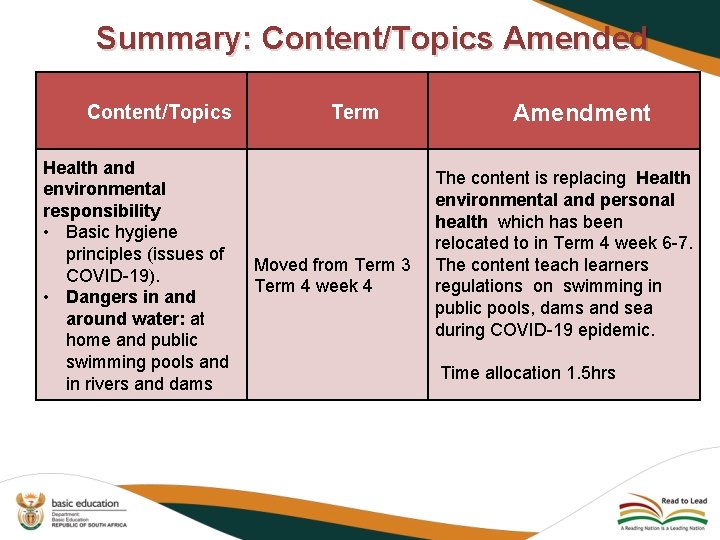
Summary: Content/Topics Amended Content/Topics Health and environmental responsibility • Basic hygiene principles (issues of COVID-19). • Dangers in and around water: at home and public swimming pools and in rivers and dams Term Amendment The content is replacing Health environmental and personal health which has been relocated to in Term 4 week 6 -7. Moved from Term 3 The content teach learners Term 4 week 4 regulations on swimming in public pools, dams and sea during COVID-19 epidemic. Time allocation 1. 5 hrs
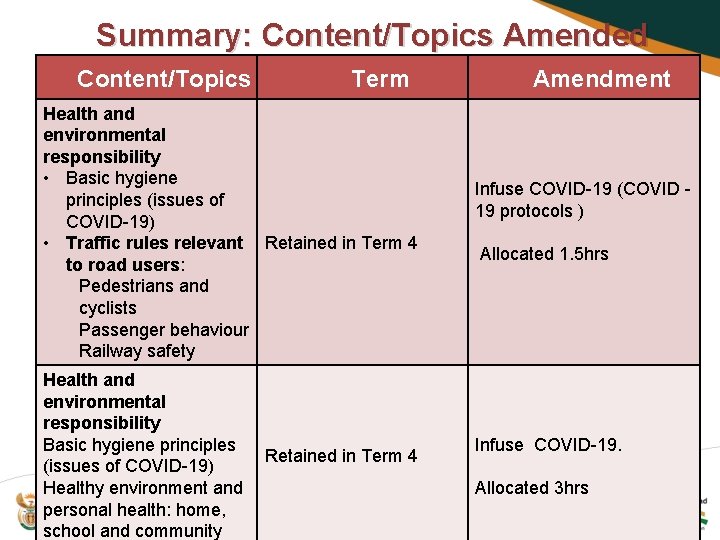
Summary: Content/Topics Amended Content/Topics Term Health and environmental responsibility • Basic hygiene principles (issues of COVID-19) • Traffic rules relevant Retained in Term 4 to road users: Pedestrians and cyclists Passenger behaviour Railway safety Health and environmental responsibility Basic hygiene principles Retained in Term 4 (issues of COVID-19) Healthy environment and personal health: home, school and community Amendment Infuse COVID-19 (COVID 19 protocols ) Allocated 1. 5 hrs Infuse COVID-19. Allocated 3 hrs
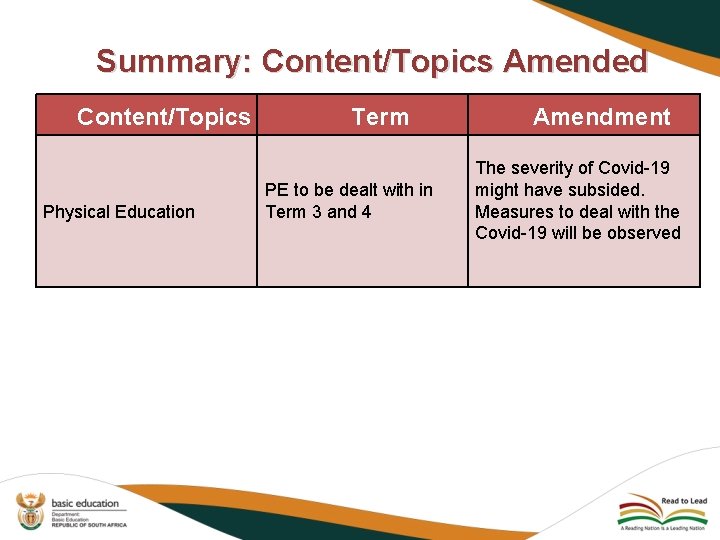
Summary: Content/Topics Amended Content/Topics Physical Education Term PE to be dealt with in Term 3 and 4 Amendment The severity of Covid-19 might have subsided. Measures to deal with the Covid-19 will be observed
Creative Arts Summary: Amendments TERM 2: • Visual Art to be taught during the very challenging Term 2 when schools are settling and finding ways to spilt classes/reorganise timetables to ensure social distancing. • Only informal formative assessment takes place. TERM 3: • Only (teach) focus on Visual Art for Formal Assessment. • Approximately 7 lessons for Visual Art for Grades 4, 5 and 6. • Periods will most likely be shortened to account for spilt classes. • It is most likely that less time would be allocated to Creative Arts, therefore the ‘extra’ time of Term 2, especially for the Grades 6 s would be useful. TERM 4: • Only (teach) focus on Performing Arts for Formal Assessment. • Approximately 7 lessons for Performing Arts for Grades 4, 5 and 6. • Schools would have most likely have settled and Performing Arts would therefore be a more appropriate choice. • It is hoped that the COVID curve has flattened by end September / October so that normal classes can continue affording the full 90 minutes per week for Performing Arts to make up for lost time.
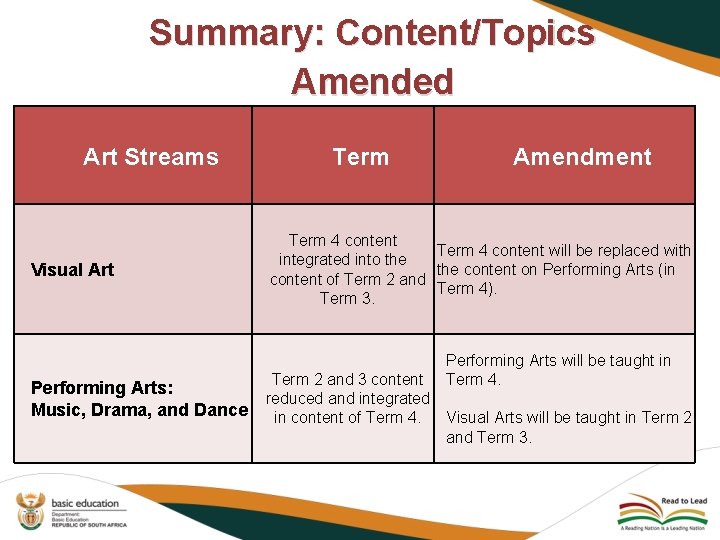
Summary: Content/Topics Amended Art Streams Visual Art Term Amendment Term 4 content will be replaced with integrated into the content on Performing Arts (in content of Term 2 and Term 4). Term 3. Term 2 and 3 content Performing Arts will be taught in Term 4. Performing Arts: reduced and integrated Music, Drama, and Dance in content of Term 4. Visual Arts will be taught in Term 2 and Term 3.
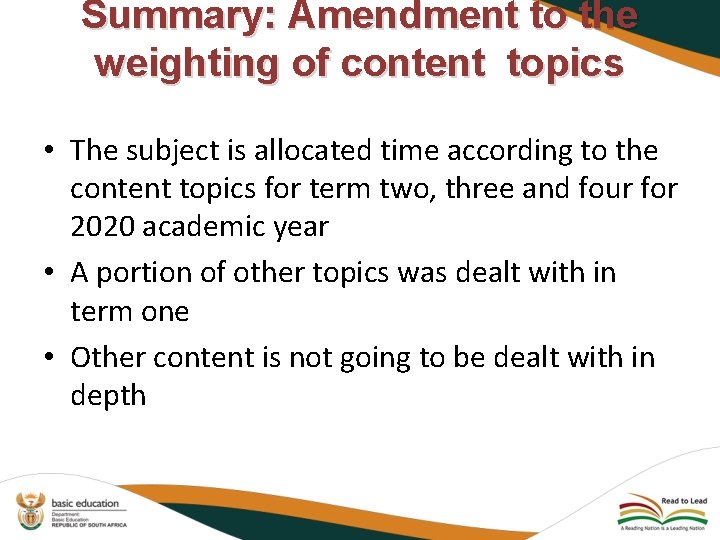
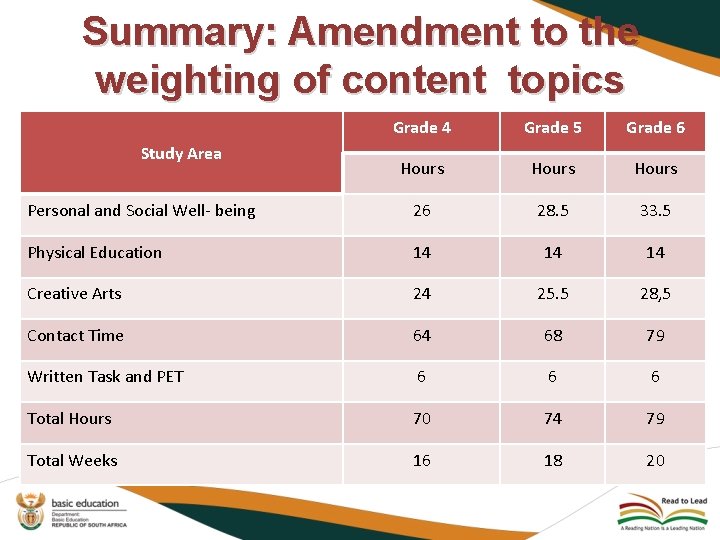
Summary: Amendment to the weighting of content topics • The subject is allocated time according to the content topics for term two, three and four for 2020 academic year • A portion of other topics was dealt with in term one • Other content is not going to be dealt with in depth
Summary: Amendment to the weighting of content topics Grade 4 Grade 5 Grade 6 Study Area Hours Personal and Social Well- being 26 28. 5 33. 5 Physical Education 14 14 14 Creative Arts 24 25. 5 28, 5 Contact Time 64 68 79 Written Task and PET 6 6 6 Total Hours 70 74 79 Total Weeks 16 18 20
4. Amendments School Based Assessment (SBA)
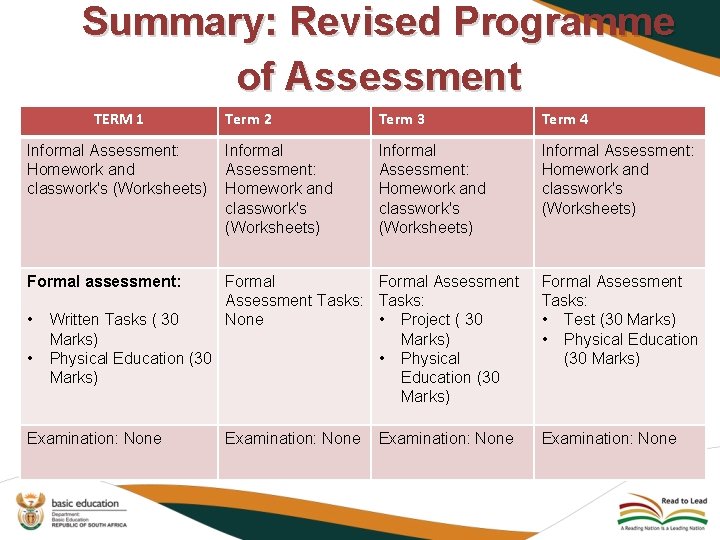
Summary: Revised Programme of Assessment TERM 1 Informal Assessment: Homework and classwork's (Worksheets) Term 2 Term 3 Term 4 Informal Assessment: Homework and classwork's (Worksheets) Formal assessment: • • Formal Assessment Tasks: Written Tasks ( 30 None • Project ( 30 Marks) Physical Education (30 • Physical Marks) Education (30 Marks) Examination: None Formal Assessment Tasks: • Test (30 Marks) • Physical Education (30 Marks) Examination: None
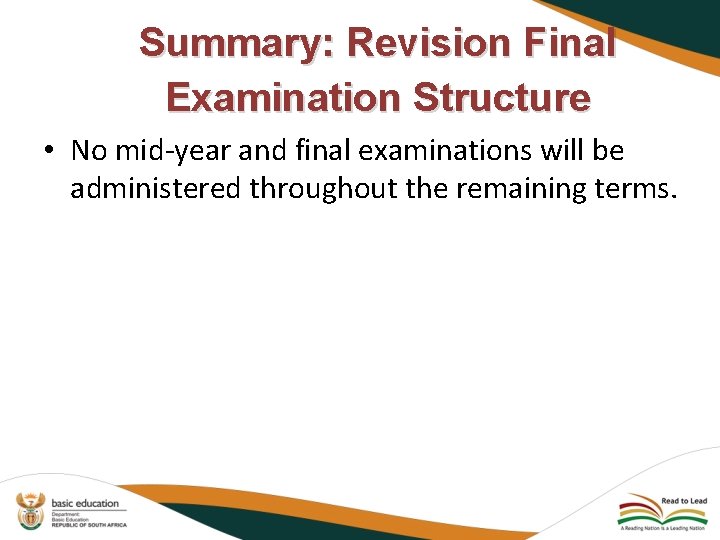
Summary: Revision Final Examination Structure • No mid-year and final examinations will be administered throughout the remaining terms.
Summary: Physical Education Task (PET) • Physical Education will only take place in Term 3 and 4. • The Social Distancing Guidelines on adhering to COVID-19 regulations will need to be used and followed for Physical Education.
Summary: Revised Creative Arts Assessment Task (CAT) • Participation in both streams will be assessed informally through class observation in each term. • Visual Arts CATs (formal assessment) can take the form of any creative task which takes a minimum of 3 periods to complete. • Performing Arts CATs (formal assessment) can be taken from any of the tasks in Topics 2 or 3 for the term, which combine the use of at least TWO of three art forms. • The Social Distancing Guidelines on adhering to COVID-19 regulations will need to be used and followed for Performing Arts.
4. Conclusion
Conclusion • Grade 4 learners completed Term 1 in 2020 of schooling before COVID-19 forced the closure of schools; • The ATP will be implemented during Term 2 on the opening of schools; • COVID-19 issues were included in the ATP to conscientise learners on the pandemic gripping the whole world; and • Self-management (self-study skills) and preparation of learners to deal with grief and emotions etc. are dealt with in the ATP.
Contact Details Name: CES: J Zitha Department of Basic Education Tel: 012 357 3685 Email: Zitha. J@dbe. gov. za