1 INTRODUCTION 1 CE 382 Geotechnical Engineering I

- Slides: 17
1. INTRODUCTION 1
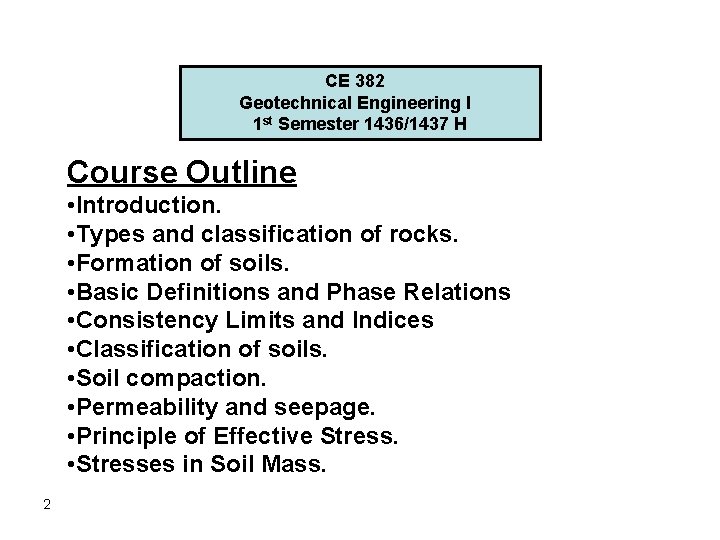
CE 382 Geotechnical Engineering I 1 st Semester 1436/1437 H Course Outline • Introduction. • Types and classification of rocks. • Formation of soils. • Basic Definitions and Phase Relations • Consistency Limits and Indices • Classification of soils. • Soil compaction. • Permeability and seepage. • Principle of Effective Stress. • Stresses in Soil Mass. 2
• Instructor: Prof. AWAD Ali Al-Karni Office: 2 A-6 Office hours: As Posted Phone: 467 -7041 email: akarni@ksu. edu. sa • Text Book: o Das, B. M. Principles of Geotechnical Engineering, Latest edition. • Supplementary References: o Holtz, R. D. and Kovacs, W. D. (1981). An Introduction to Geotechnical Engineering, Prentice Hall. o Bowles, J. (1992). Engineering Properties of Soils and their Measurement, Mc. Graw Hill. 3
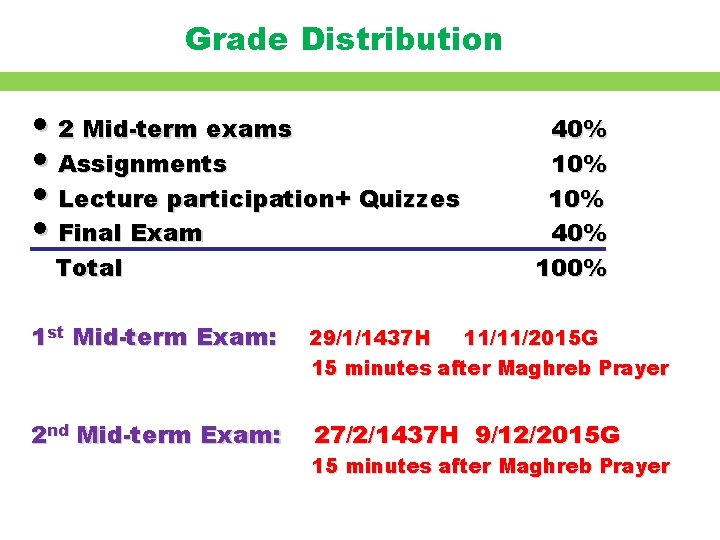
Grade Distribution • 2 Mid-term exams • Assignments • Lecture participation+ Quizzes • Final Exam Total 40% 10% 40% 100% 1 st Mid-term Exam: 29/1/1437 H 11/11/2015 G 15 minutes after Maghreb Prayer 2 nd Mid-term Exam: 27/2/1437 H 9/12/2015 G 15 minutes after Maghreb Prayer
1. Civil Engineering Materials o o Steel Concrete Earthen Materials Others (wood, aluminum, plastic ……. etc. ) Many courses in our department are linked to the first three materials in various aspects: • Measurement and testing (ex. Lab. course) • Theoretical bases (ex. Geotechnical Engineering I) • Applications (ex. Foundation Engineering) 5
2. Earthen Materials 6 • • The earth crust is composed of soils and rocks. • Soil The word soil could mean different meanings to different scientific disciplines like pedology, soil science (agronomy) , geology, and civil engineering. • To the civil engineer soil is defined as the uncemented or weekly cemented accumulation of solid particles that have resulted from disintegration of rocks. Rock can be defined as a natural aggregate of minerals and mineraloids that are connected by strong bonding or attractive forces.
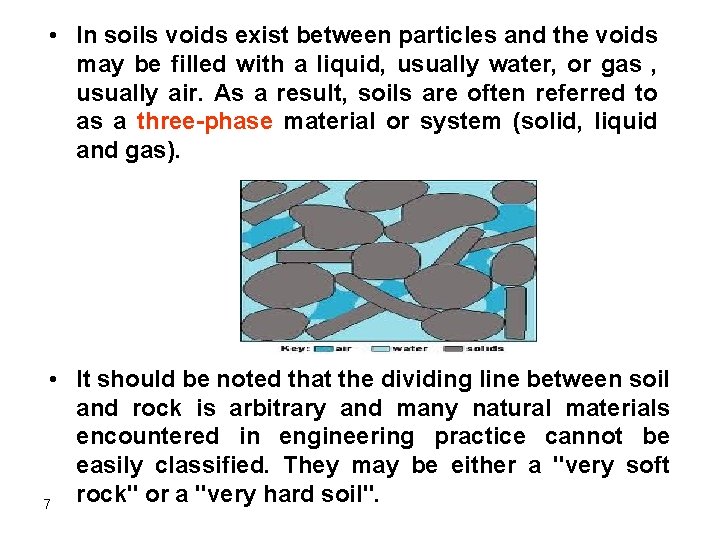
• In soils voids exist between particles and the voids may be filled with a liquid, usually water, or gas , usually air. As a result, soils are often referred to as a three-phase material or system (solid, liquid and gas). • It should be noted that the dividing line between soil and rock is arbitrary and many natural materials encountered in engineering practice cannot be easily classified. They may be either a "very soft rock" or a "very hard soil". 7
3. Importance of Soil in Civil Engineering • Soil is one of the most widely encountered materials in civil engineering. • All structure regardless of the material of which they are constructed , rest ultimately upon soil or rock. • Soil is the medium through which loads applied at the surface are transmitted to underground structure like sewers, culverts, tunnels etc. • It is used as a construction material in many engineering structures like earth-fill and rock-fill dams, levees. 8
4. Why soil is unique compared to other engineering materials? 9 • Most of civil engineering materials are man-made and their properties are controlled and easily measured. Soil on the other hand is naturally deposited. • Behavior is usually: inelastic, anisotropic, time-dependent. • soils are heterogeneous, i, e. different from one location to another location. nonlinear,
5. Why do we care more about soils (core courses involve soils, rock is left for electives)? • Soil formations are frequently found in urban areas. • Contrary to soils, rocks are generally more sound and pose no problems with regard to both bearing and deformations. 10
6. Geotechnical Engineering Geotechnical engineering is the sub discipline of civil engineering that involves natural materials found close to the surface of the earth. The term geotechnical engineering is defined as the science and practice of that part of civil engineering involving the interrelationship between the geological environment and the works of man. The engineer doing this specific type of eng. Work is "GEOTEHNICAL ENGINEER". The geotechnical commission of the Swedish railways was the first to use the word geotechnical (GEOTEKNISKA), the combination of geology and civil engineering technology. 11
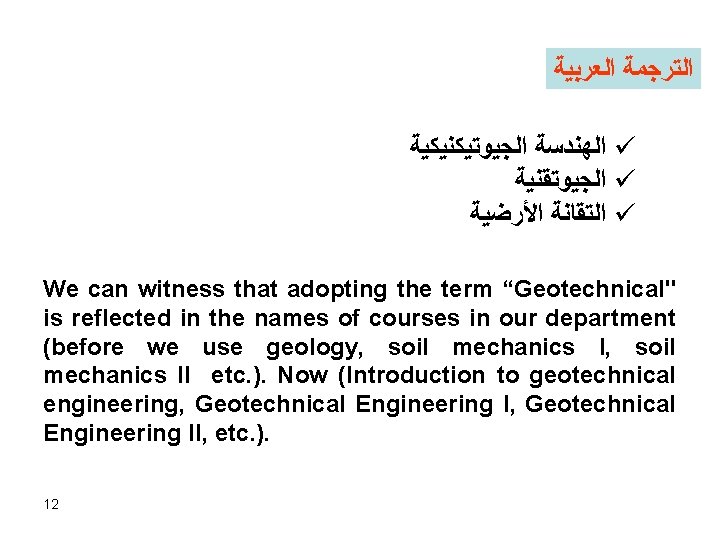
ﺍﻟﺘﺮﺟﻤﺔ ﺍﻟﻌﺮﺑﻴﺔ ﺍﻟﻬﻨﺪﺳﺔ ﺍﻟﺠﻴﻮﺗﻴﻜﻨﻴﻜﻴﺔ ü ﺍﻟﺠﻴﻮﺗﻘﻨﻴﺔ ü ﺍﻟﺘﻘﺎﻧﺔ ﺍﻷﺮﺿﻴﺔ ü We can witness that adopting the term “Geotechnical" is reflected in the names of courses in our department (before we use geology, soil mechanics II etc. ). Now (Introduction to geotechnical engineering, Geotechnical Engineering II, etc. ). 12
7. Branches of Geotechnical Engineering In a general sense, geotechnical engineering has two branches: • Soil Engineering • Rock Engineering Soil engineering is the application of the principles of soil mechanics to practical problems. Soil Mechanics is the branch of geotechnical engineering that deals with the physical properties of soil and behavior of soil masses subjected to various types of forces. It applies the basic principles of mechanics including kinematics, dynamics, fluid mechanics and the mechanics of materials to soils. Rock Engineering is the application of the principles of rock mechanics to practical problems. 13
8. Applications of Geotechnical Engineering • • • 14 Foundation Engineering Tunnel Engineering Dam Engineering Retaining Walls Slope Stability Geoenvironmental Engineering Pavement Engineering Earthquake Engineering Geosynthetics Etc.
9. Historical Development Historically soil mechanics or geotechnical engineering has gone through four stages: • • 15 Before mid -1700's only experience and rule of thumb Mid 1700's to 1925 some theories were developed Coulomb (1776), Rankine (1856), D'Arcy (1856), Atterberg (1911), Boussinesq (1885). (However, still not accepted as independent discipline) 1925 – 1960 many authorities date the beginning of soil mechanics as an engineering science to the publication of "Erdbaumechanik" by Karl Terzaghi. 1960 – Present: There has been a real information explosion in the number of conferences, technical journals, and books.
q Based on the emphasis and the nature of study in the area of geotechnical engineering, the time span extending from 1700 to 1927 can be divided into four major periods: 1. Pre-classical (1700 to 1776 A. D. ) 2. Classical soil mechanics—Phase I (1776 to 1856 A. D. ) 3. Classical soil mechanics—Phase II (1856 to 1910 A. D. ) 4. Modern soil mechanics (1910 to 1927 A. D. ) q The profession of geotechnical engineering has matured and is now an established branch of civil engineering, and thousands of civil engineers declare geotechnical engineering to be their preferred area of specialty. 16
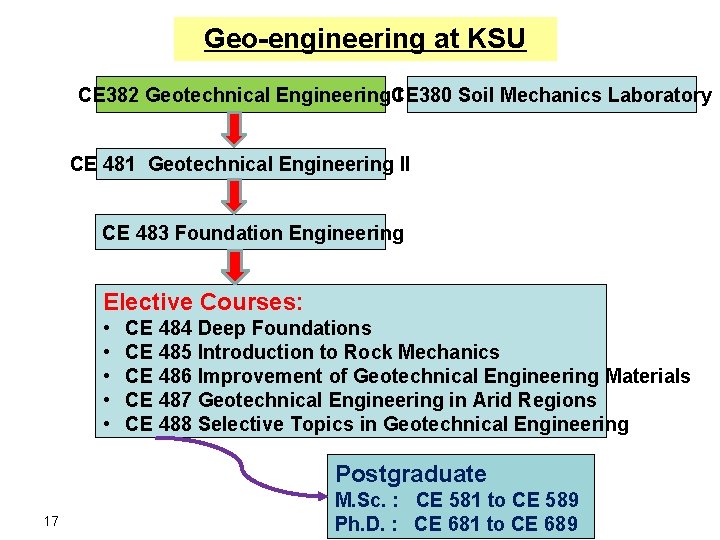
Geo-engineering at KSU CE 382 Geotechnical Engineering. CE 380 I Soil Mechanics Laboratory CE 481 Geotechnical Engineering II CE 483 Foundation Engineering Elective Courses: • • • CE 484 Deep Foundations CE 485 Introduction to Rock Mechanics CE 486 Improvement of Geotechnical Engineering Materials CE 487 Geotechnical Engineering in Arid Regions CE 488 Selective Topics in Geotechnical Engineering Postgraduate 17 M. Sc. : CE 581 to CE 589 Ph. D. : CE 681 to CE 689