World Meteorological Organization WMO Severe Weather Forecasting and

- Slides: 17
World Meteorological Organization (WMO) Severe Weather Forecasting and Disaster risk reduction Demonstration Project (SWFDDP) Steve Ready
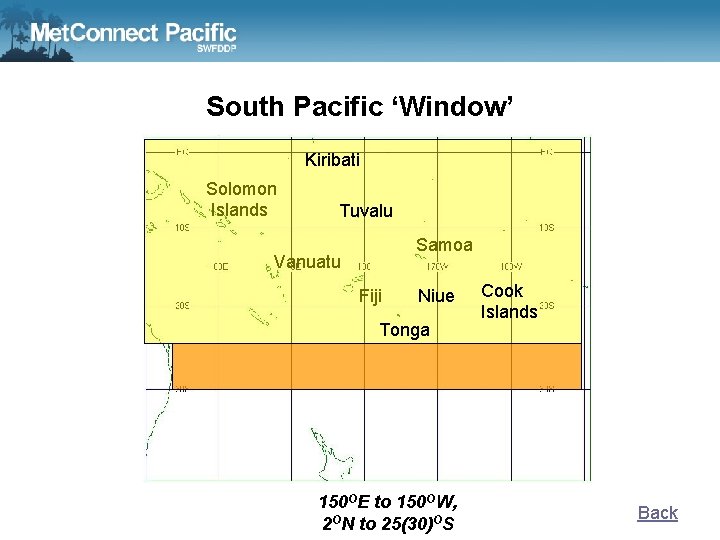
South Pacific ‘Window’ Kiribati Solomon Islands Tuvalu Samoa Vanuatu Fiji Niue Tonga 150 OE to 150 OW, 2 ON to 25(30)OS Cook Islands Back
Background to Project n Initiated by WMO Commission for Basic Systems in 2005 to tap into global network of Numerical Weather Prediction (NWP) and Ensemble Prediction System (EPS) products n Project is really a series of subprojects n 1 st subproject for south-eastern Africa started in Nov 2006 n 2 nd subproject for South Pacific area started up as a Pilot on 1 Nov 2009
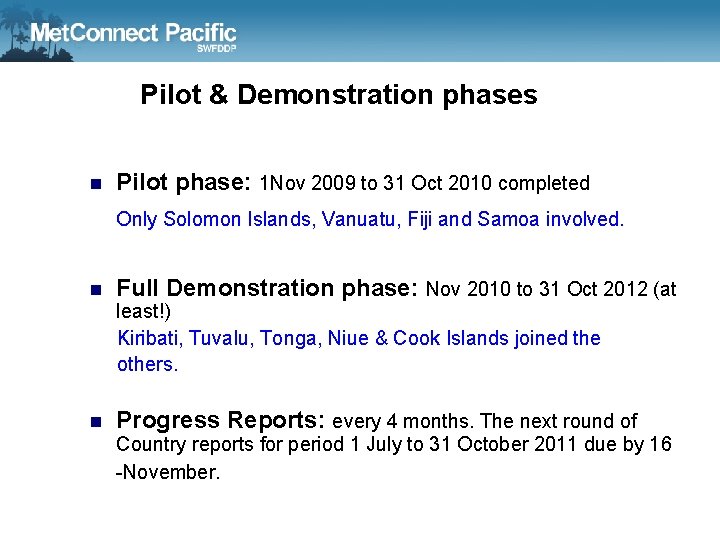
Pilot & Demonstration phases n Pilot phase: 1 Nov 2009 to 31 Oct 2010 completed Only Solomon Islands, Vanuatu, Fiji and Samoa involved. n Full Demonstration phase: Nov 2010 to 31 Oct 2012 (at least!) Kiribati, Tuvalu, Tonga, Niue & Cook Islands joined the others. n Progress Reports: every 4 months. The next round of Country reports for period 1 July to 31 October 2011 due by 16 -November.
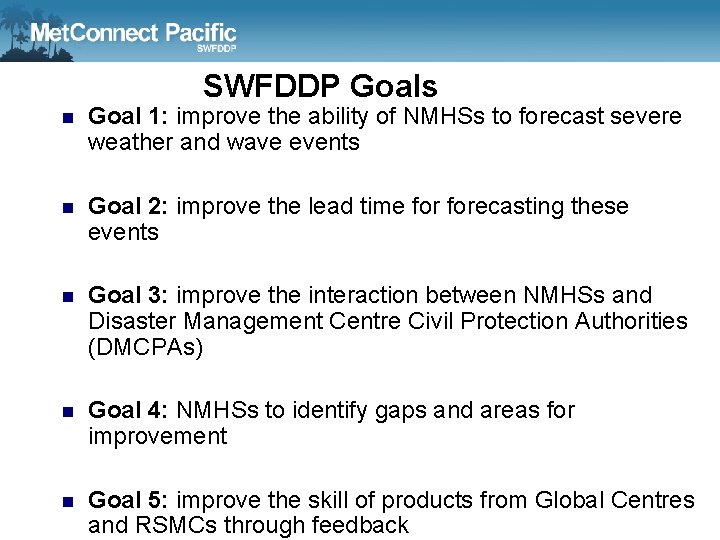
SWFDDP Goals n Goal 1: improve the ability of NMHSs to forecast severe weather and wave events n Goal 2: improve the lead time forecasting these events n Goal 3: improve the interaction between NMHSs and Disaster Management Centre Civil Protection Authorities (DMCPAs) n Goal 4: NMHSs to identify gaps and areas for improvement n Goal 5: improve the skill of products from Global Centres and RSMCs through feedback
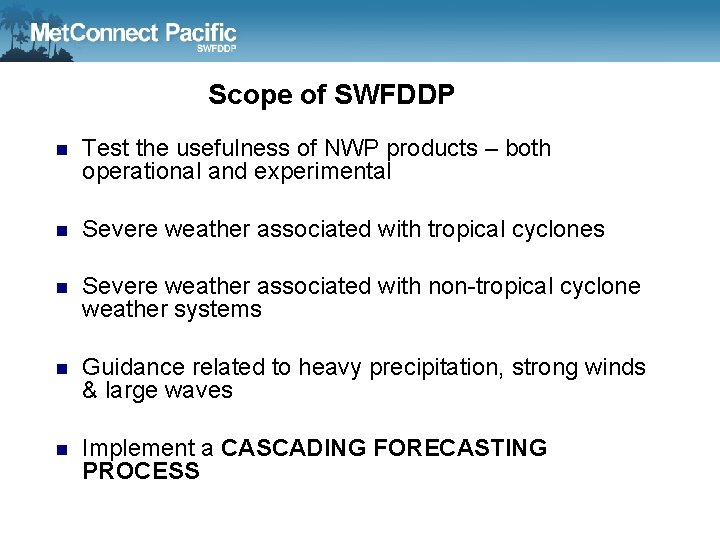
Scope of SWFDDP n Test the usefulness of NWP products – both operational and experimental n Severe weather associated with tropical cyclones n Severe weather associated with non-tropical cyclone weather systems n Guidance related to heavy precipitation, strong winds & large waves n Implement a CASCADING FORECASTING PROCESS
Cascading Forecasting Process GLOBAL CENTRES (UK, EC, NCEP (USA), JMA) RSMCs (Wellington, Darwin, Nadi) & regional support = New Caledonia & French Polynesia Met. Connect Pacific NMHSs (Solomon Is, Vanuatu, Fiji, Samoa, Kiribati, Tuvalu, Tonga, Niue & Cook Islands) Emergency management authorities, media & public
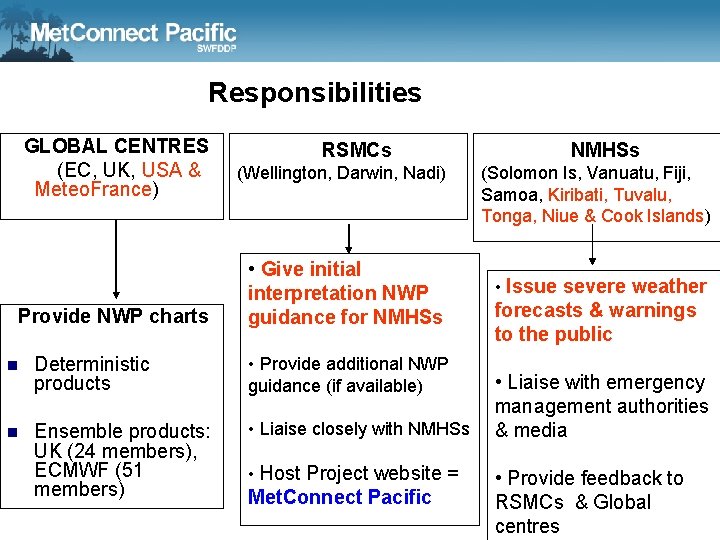
Responsibilities GLOBAL CENTRES (EC, UK, USA & Meteo. France) Provide NWP charts RSMCs (Wellington, Darwin, Nadi) • Give initial interpretation NWP guidance for NMHSs n Deterministic products • Provide additional NWP guidance (if available) n Ensemble products: UK (24 members), ECMWF (51 members) • Liaise closely with NMHSs • Host Project website = Met. Connect Pacific NMHSs (Solomon Is, Vanuatu, Fiji, Samoa, Kiribati, Tuvalu, Tonga, Niue & Cook Islands) • Issue severe weather forecasts & warnings to the public • Liaise with emergency management authorities & media • Provide feedback to RSMCs & Global centres
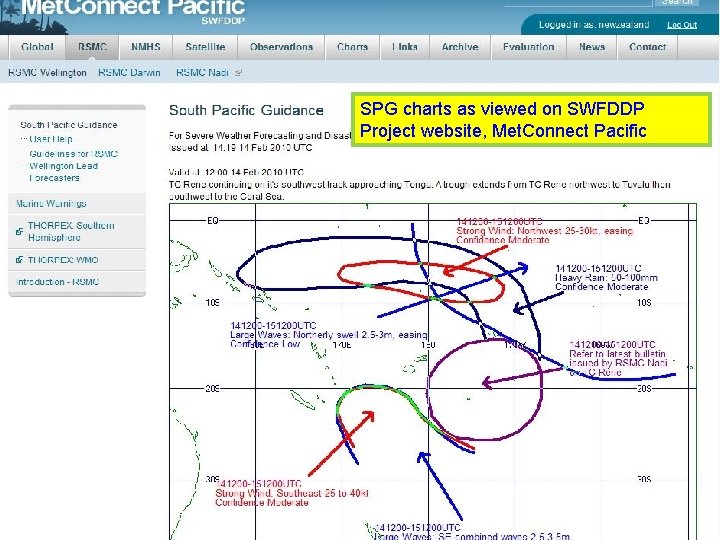
SPG charts as viewed on SWFDDP Project website, Met. Connect Pacific
South Pacific Guidance (SPG) charts (1) n SPG charts represent the RSMC Wellington forecaster’s interpretation of the various NWP/Ensemble guidance for NMHSs to help in the production of their severe weather & wave forecasts & warnings n They contain Heavy rain/Strong wind/Large wave/TC information according to agreed criteria n TC information refers users to the latest TC Outlook or advisory/warning bulletin issued by RSMC Nadi, Brisbane TCWC, Port Moresby TCWC or Wellington TCWC n Before a TC is named, RSMC Wellington provides additional rain/wind/wave information in the TC Outlook zone.
SPG charts (2) n Updated around 0300 and 1500 UTC daily n SPG charts viewed on the landing page of the project website, Met. Connect Pacific
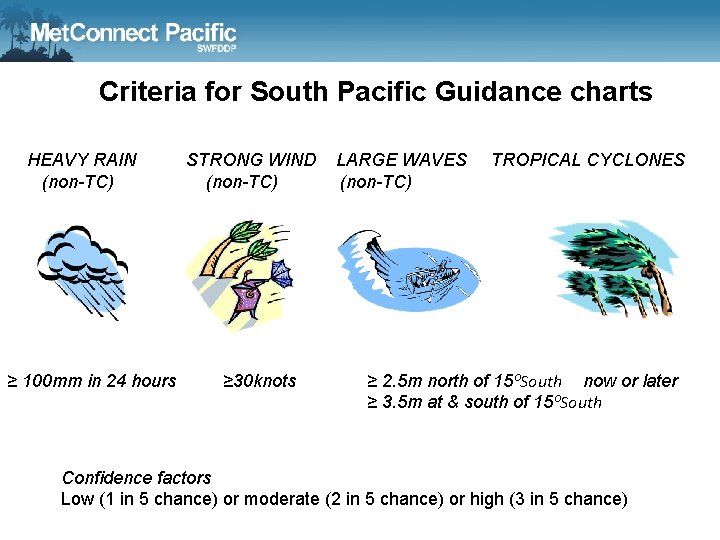
Criteria for South Pacific Guidance charts HEAVY RAIN (non-TC) ≥ 100 mm in 24 hours STRONG WIND (non-TC) ≥ 30 knots LARGE WAVES (non-TC) TROPICAL CYCLONES ≥ 2. 5 m north of 15⁰South now or later ≥ 3. 5 m at & south of 15⁰South Confidence factors Low (1 in 5 chance) or moderate (2 in 5 chance) or high (3 in 5 chance)
Training initiatives • In-country except for Niue visits (round 1): 1 st round completed • In-country visits (round 2): To be carried out in 2012 before the 2012/2013 cyclone season
Achievements (1) n One year Pilot Phase (involving just 4 Pacific Island Coutries) completed on 31 -October-2010 n Demonstration Phase (involving 9 Pacific Island countries) in fu. Il swing n Progress reports completed by each country every 4 months, plus an overall report compiled for wider dissemination n One round of in-country training completed and a 2 nd round pending in 2012 n Interactions between RSMC Wellington and various countries especially for wave events has been very useful
Achievements (2) n SWFDDP project management meetings held in April 2009 and at the end of the Pilot Phase, 1 -4 November 2010.
Challenges (1) n NMHSs (responsible for issuing own forecasts & warnings) taking a more objective approach to forecasting e. g. quantifying amount of rain n Verification of severe weather forecasts & warnings – requires NMHSs to take a more objective approach n NMHSs (reliant on RSMC Nadi forecasts & warnings) using the project to help them providing input into forecasts & warnings for their country n Cascading Process – bottom part needs NMHSs to be more proactive with agencies they service
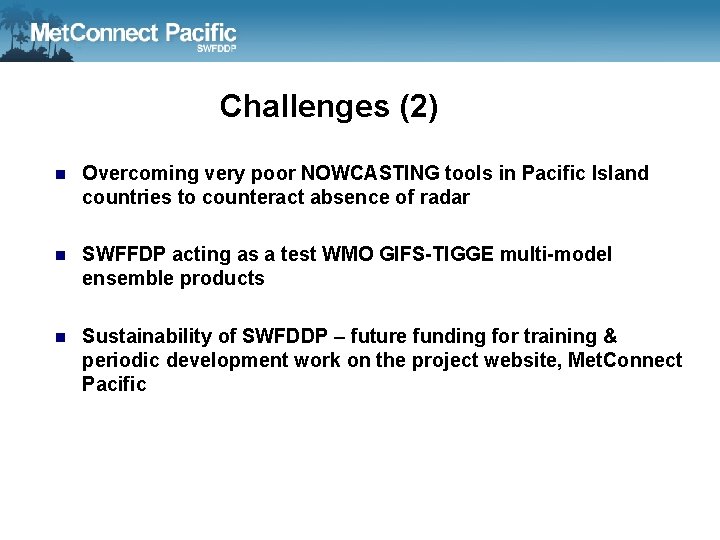
Challenges (2) n Overcoming very poor NOWCASTING tools in Pacific Island countries to counteract absence of radar n SWFFDP acting as a test WMO GIFS-TIGGE multi-model ensemble products n Sustainability of SWFDDP – future funding for training & periodic development work on the project website, Met. Connect Pacific