Wireless Sensor Networks Prof Ravindra Joshi Department of

- Slides: 24
Wireless Sensor Networks Prof. Ravindra Joshi Department of Engineering Sciences International Institute of Information Technology, I²IT www. isquareit. edu. in
Agenda v Introduction to Wireless Sensor Networks (WSN) v Wireless Sensor Networks and Mobile Ad-hoc Networks (MANETs) v Current Research in Wireless Sensor Networks v Key Challenges International Institute of Information Technology, I²IT, P-14, Rajiv Gandhi Infotech Park, Hinjawadi Phase 1, Pune - 411 057 Phone - +91 20 22933441/2/3 | Website - www. isquareit. edu. in | Email - info@isquareit. edu. in 2
Wireless sensor networks v Wireless sensor network is a distributed system consisting of a large number of low-cost wireless sensor nodes equipped with a small processor with limited memory, RF trans-receiver, antenna, sensing elements and are powered with small batteries and solar cells. v It’s a heterogeneous system, consisting of various types of sensor nodes, actuators and operating systems. v Sensor nodes operate under constraints of memory, size, computational power, overall cost and limited energy sources such as batteries / solar cells. International Institute of Information Technology, I²IT, P-14, Rajiv Gandhi Infotech Park, Hinjawadi Phase 1, Pune - 411 057 Phone - +91 20 22933441/2/3 | Website - www. isquareit. edu. in | Email - info@isquareit. edu. in 3
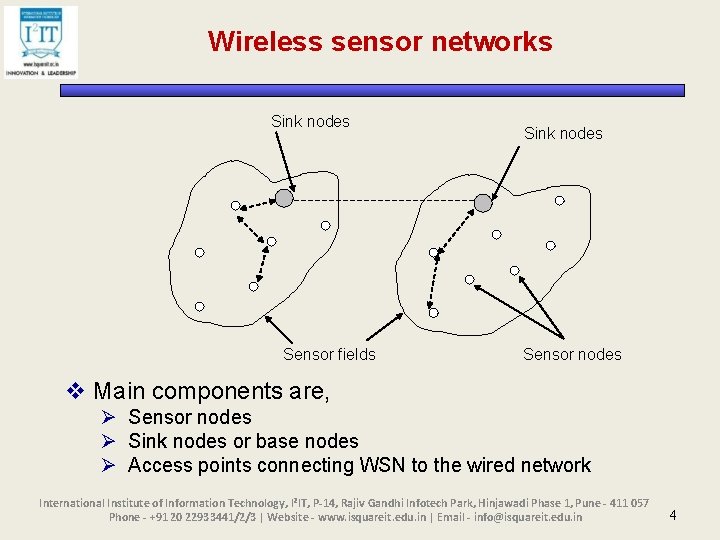
Wireless sensor networks Sink nodes Sensor fields Sink nodes Sensor nodes v Main components are, Ø Sensor nodes Ø Sink nodes or base nodes Ø Access points connecting WSN to the wired network International Institute of Information Technology, I²IT, P-14, Rajiv Gandhi Infotech Park, Hinjawadi Phase 1, Pune - 411 057 Phone - +91 20 22933441/2/3 | Website - www. isquareit. edu. in | Email - info@isquareit. edu. in 4
Components of Wireless sensor networks v Sensor node is a basic component in any wireless sensor network. Ø It consists of sensing, computing and communication capabilities and also has an “on-board” power source. Ø After the field deployment, sensor nodes communicate with each other with a multi-hop approach and collect information using either continuous or event driven modes. Ø Location and positioning information is also exchanged with GPS or Local positioning algorithms. Ø Global view of the phenomena or object is constructed after processing the information collected from sensor nodes Ø Once the battery get exhausted, sensor node can’t be used any further. International Institute of Information Technology, I²IT, P-14, Rajiv Gandhi Infotech Park, Hinjawadi Phase 1, Pune - 411 057 Phone - +91 20 22933441/2/3 | Website - www. isquareit. edu. in | Email - info@isquareit. edu. in 5
Components of Wireless sensor networks v Sink node (or base node) is another important component in any wireless sensor network. Ø They have enhanced capabilities such as more computational power, memory, energy, storage and communication capabilities Ø All sensor nodes within a sensor field communicate with this base node periodically and to exchange the field information Ø The processing capability of the individual node is limited but the aggregate processing power of the entire network is sizable. Ø Sink nodes are connected to wired network through access points and act as interface between users and the sensor network. Ø Users can inject queries and gather information of their interest from the base nodes. International Institute of Information Technology, I²IT, P-14, Rajiv Gandhi Infotech Park, Hinjawadi Phase 1, Pune - 411 057 Phone - +91 20 22933441/2/3 | Website - www. isquareit. edu. in | Email - info@isquareit. edu. in 6
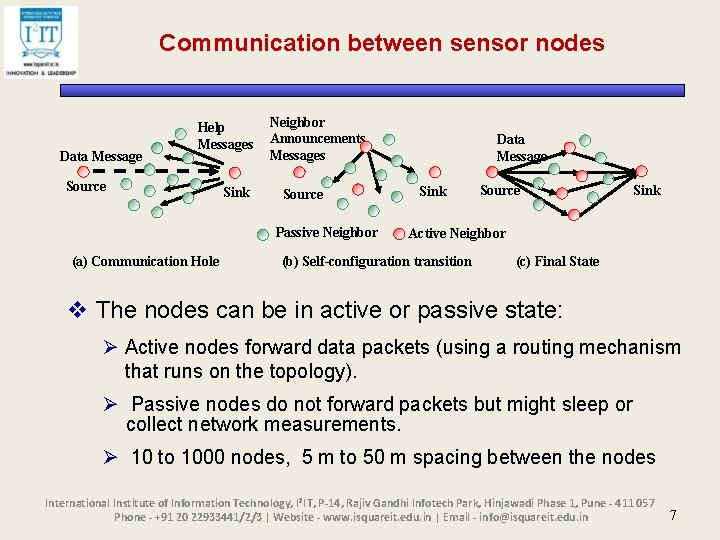
Communication between sensor nodes Data Message Help Messages Source Sink Neighbor Announcements Messages Source Passive Neighbor (a) Communication Hole Data Message Sink Source Sink Active Neighbor (b) Self-configuration transition (c) Final State v The nodes can be in active or passive state: Ø Active nodes forward data packets (using a routing mechanism that runs on the topology). Ø Passive nodes do not forward packets but might sleep or collect network measurements. Ø 10 to 1000 nodes, 5 m to 50 m spacing between the nodes International Institute of Information Technology, I²IT, P-14, Rajiv Gandhi Infotech Park, Hinjawadi Phase 1, Pune - 411 057 Phone - +91 20 22933441/2/3 | Website - www. isquareit. edu. in | Email - info@isquareit. edu. in 7
Applications of wireless sensor networks v Wireless Sensor Networks find numerous applications in various areas as mentioned below, v Environment monitoring and protection: Ø Monitoring of seismic activities/ data collection Ø Warning of earthquakes and floods Ø Weather monitoring and forecasting v Agricultural applications: Ø Ø Ø Monitoring of soil humidity and temperature Detection of toxic levels in soil and water contamination Leakage in pipelines, risk of explosions for gas/oil pipelines Water pressure monitoring in dams and reservoirs Understanding of soil structure International Institute of Information Technology, I²IT, P-14, Rajiv Gandhi Infotech Park, Hinjawadi Phase 1, Pune - 411 057 Phone - +91 20 22933441/2/3 | Website - www. isquareit. edu. in | Email - info@isquareit. edu. in 8
Applications of wireless sensor networks v Protection of buildings: Ø Fire alarms Ø Burglar alarms/ Intruder detection Ø Structural condition assessment of buildings, bridges v Military applications: Ø Soldier tracking Ø Battlefield tanks / vehicles tracking Ø Invading remote and inaccessible areas v Industrial applications: Ø Inventory control Ø Process automation International Institute of Information Technology, I²IT, P-14, Rajiv Gandhi Infotech Park, Hinjawadi Phase 1, Pune - 411 057 Phone - +91 20 22933441/2/3 | Website - www. isquareit. edu. in | Email - info@isquareit. edu. in 9
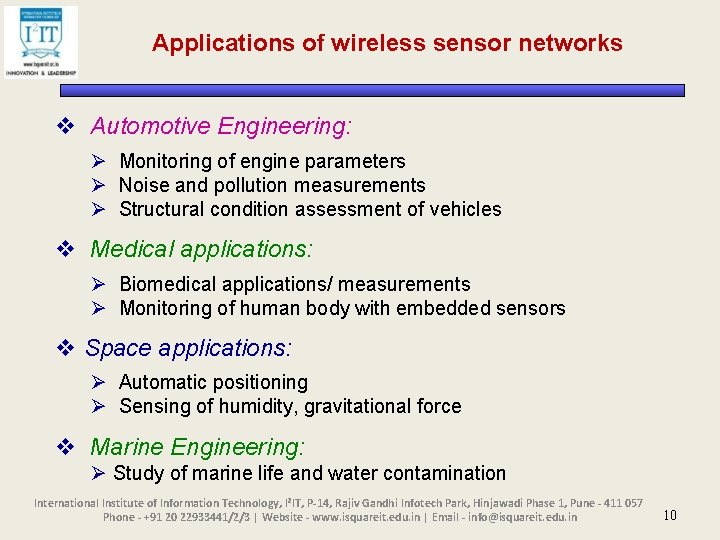
Applications of wireless sensor networks v Automotive Engineering: Ø Monitoring of engine parameters Ø Noise and pollution measurements Ø Structural condition assessment of vehicles v Medical applications: Ø Biomedical applications/ measurements Ø Monitoring of human body with embedded sensors v Space applications: Ø Automatic positioning Ø Sensing of humidity, gravitational force v Marine Engineering: Ø Study of marine life and water contamination International Institute of Information Technology, I²IT, P-14, Rajiv Gandhi Infotech Park, Hinjawadi Phase 1, Pune - 411 057 Phone - +91 20 22933441/2/3 | Website - www. isquareit. edu. in | Email - info@isquareit. edu. in 10
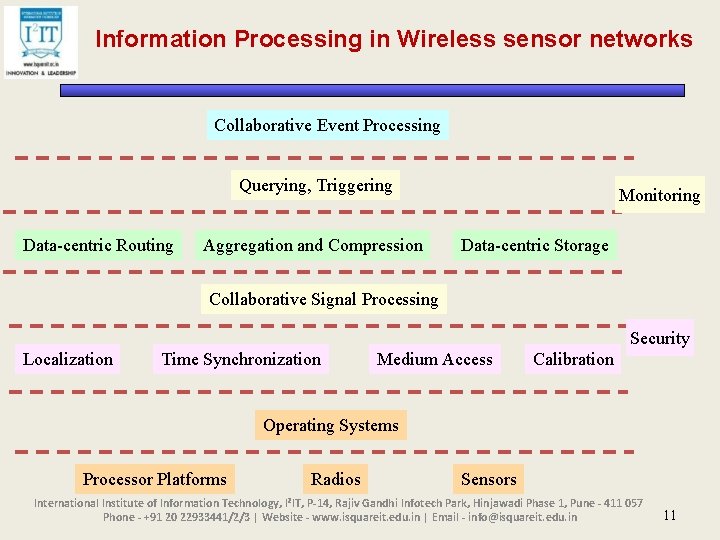
Information Processing in Wireless sensor networks Collaborative Event Processing Querying, Triggering Data-centric Routing Aggregation and Compression Monitoring Data-centric Storage Collaborative Signal Processing Security Localization Time Synchronization Medium Access Calibration Operating Systems Processor Platforms Radios Sensors International Institute of Information Technology, I²IT, P-14, Rajiv Gandhi Infotech Park, Hinjawadi Phase 1, Pune - 411 057 Phone - +91 20 22933441/2/3 | Website - www. isquareit. edu. in | Email - info@isquareit. edu. in 11
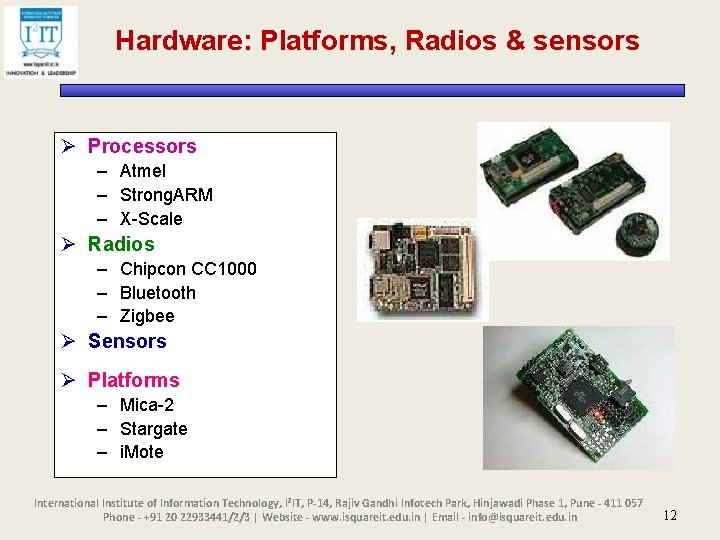
Hardware: Platforms, Radios & sensors Ø Processors – Atmel – Strong. ARM – X-Scale Ø Radios – Chipcon CC 1000 – Bluetooth – Zigbee Ø Sensors Ø Platforms – Mica-2 – Stargate – i. Mote International Institute of Information Technology, I²IT, P-14, Rajiv Gandhi Infotech Park, Hinjawadi Phase 1, Pune - 411 057 Phone - +91 20 22933441/2/3 | Website - www. isquareit. edu. in | Email - info@isquareit. edu. in 12
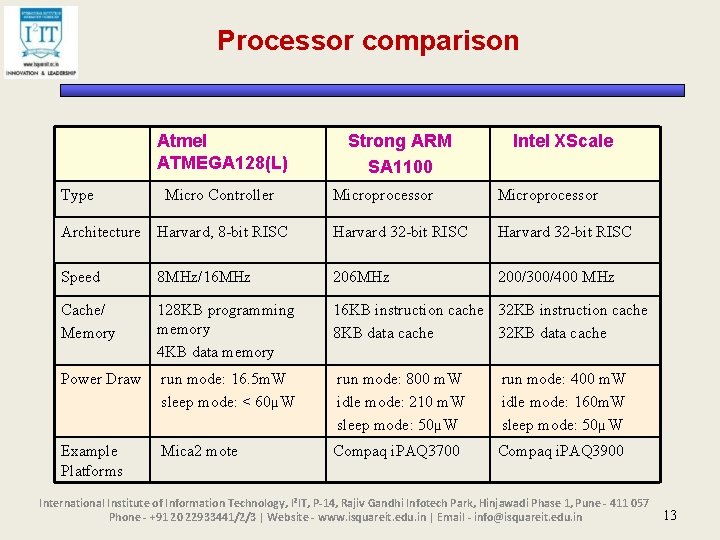
Processor comparison Atmel ATMEGA 128(L) Type Micro Controller Strong ARM SA 1100 Intel XScale Microprocessor Architecture Harvard, 8 -bit RISC Harvard 32 -bit RISC Speed 8 MHz/16 MHz 200/300/400 MHz Cache/ Memory 128 KB programming memory 4 KB data memory 16 KB instruction cache 32 KB instruction cache 8 KB data cache 32 KB data cache Power Draw run mode: 16. 5 m. W sleep mode: < 60µW run mode: 800 m. W idle mode: 210 m. W sleep mode: 50µW run mode: 400 m. W idle mode: 160 m. W sleep mode: 50µW Example Platforms Mica 2 mote Compaq i. PAQ 3700 Compaq i. PAQ 3900 International Institute of Information Technology, I²IT, P-14, Rajiv Gandhi Infotech Park, Hinjawadi Phase 1, Pune - 411 057 Phone - +91 20 22933441/2/3 | Website - www. isquareit. edu. in | Email - info@isquareit. edu. in 13
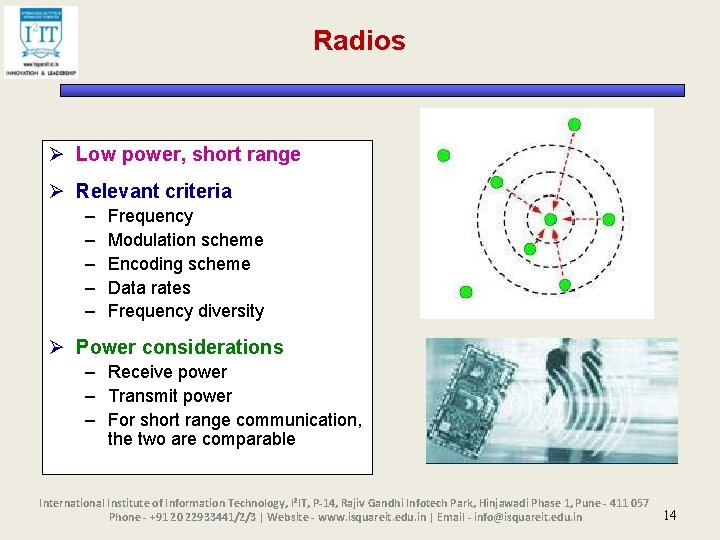
Radios Ø Low power, short range Ø Relevant criteria – – – Frequency Modulation scheme Encoding scheme Data rates Frequency diversity Ø Power considerations – Receive power – Transmit power – For short range communication, the two are comparable International Institute of Information Technology, I²IT, P-14, Rajiv Gandhi Infotech Park, Hinjawadi Phase 1, Pune - 411 057 Phone - +91 20 22933441/2/3 | Website - www. isquareit. edu. in | Email - info@isquareit. edu. in 14
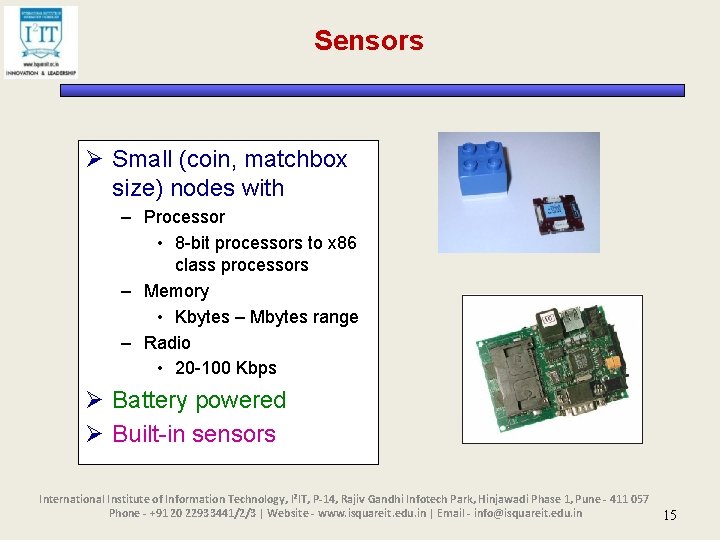
Sensors Ø Small (coin, matchbox size) nodes with – Processor • 8 -bit processors to x 86 class processors – Memory • Kbytes – Mbytes range – Radio • 20 -100 Kbps Ø Battery powered Ø Built-in sensors International Institute of Information Technology, I²IT, P-14, Rajiv Gandhi Infotech Park, Hinjawadi Phase 1, Pune - 411 057 Phone - +91 20 22933441/2/3 | Website - www. isquareit. edu. in | Email - info@isquareit. edu. in 15
Operating systems v Depending the platform, various choices are available Ø Tiny OS Ø Embedded Linux Ø -OS v Tiny OS is most suitable Ø Ø Ø Developed by University of California, Berkley Event driven execution, No polling, No blocking Concurrency intensive operation, multi-threads based Light weight Easy to integrate with hardware International Institute of Information Technology, I²IT, P-14, Rajiv Gandhi Infotech Park, Hinjawadi Phase 1, Pune - 411 057 Phone - +91 20 22933441/2/3 | Website - www. isquareit. edu. in | Email - info@isquareit. edu. in 16
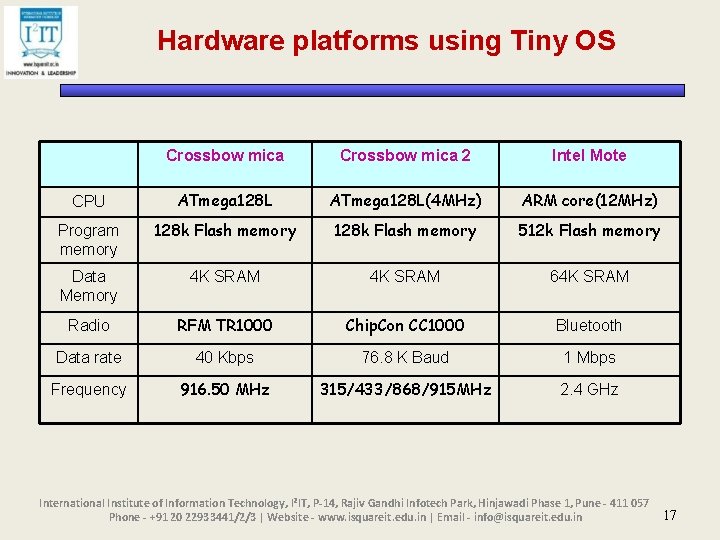
Hardware platforms using Tiny OS Crossbow mica 2 Intel Mote CPU ATmega 128 L(4 MHz) ARM core(12 MHz) Program memory 128 k Flash memory 512 k Flash memory Data Memory 4 K SRAM 64 K SRAM Radio RFM TR 1000 Chip. Con CC 1000 Bluetooth Data rate 40 Kbps 76. 8 K Baud 1 Mbps Frequency 916. 50 MHz 315/433/868/915 MHz 2. 4 GHz International Institute of Information Technology, I²IT, P-14, Rajiv Gandhi Infotech Park, Hinjawadi Phase 1, Pune - 411 057 Phone - +91 20 22933441/2/3 | Website - www. isquareit. edu. in | Email - info@isquareit. edu. in 17
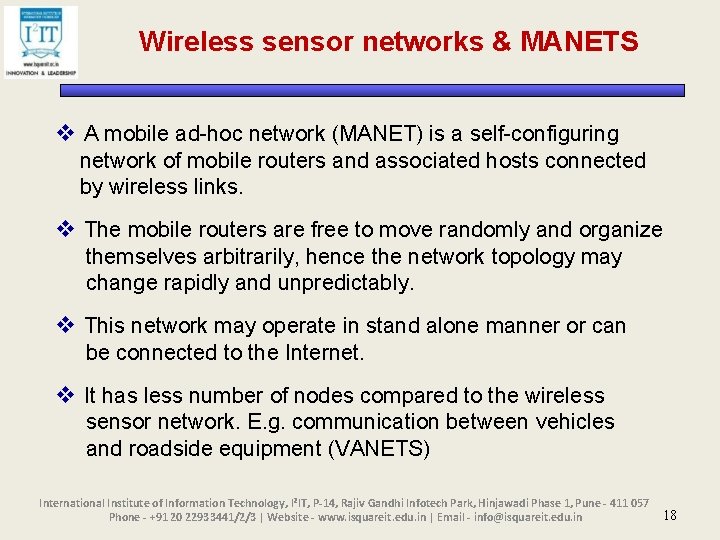
Wireless sensor networks & MANETS v A mobile ad-hoc network (MANET) is a self-configuring network of mobile routers and associated hosts connected by wireless links. v The mobile routers are free to move randomly and organize themselves arbitrarily, hence the network topology may change rapidly and unpredictably. v This network may operate in stand alone manner or can be connected to the Internet. v It has less number of nodes compared to the wireless sensor network. E. g. communication between vehicles and roadside equipment (VANETS) International Institute of Information Technology, I²IT, P-14, Rajiv Gandhi Infotech Park, Hinjawadi Phase 1, Pune - 411 057 Phone - +91 20 22933441/2/3 | Website - www. isquareit. edu. in | Email - info@isquareit. edu. in 18
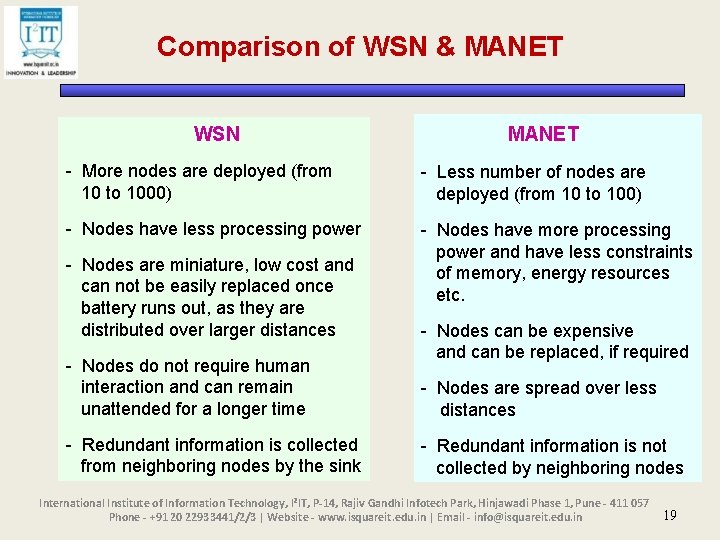
Comparison of WSN & MANET WSN MANET - More nodes are deployed (from 10 to 1000) - Less number of nodes are deployed (from 10 to 100) - Nodes have less processing power - Nodes have more processing power and have less constraints of memory, energy resources etc. - Nodes are miniature, low cost and can not be easily replaced once battery runs out, as they are distributed over larger distances - Nodes do not require human interaction and can remain unattended for a longer time - Redundant information is collected from neighboring nodes by the sink - Nodes can be expensive and can be replaced, if required - Nodes are spread over less distances - Redundant information is not collected by neighboring nodes International Institute of Information Technology, I²IT, P-14, Rajiv Gandhi Infotech Park, Hinjawadi Phase 1, Pune - 411 057 Phone - +91 20 22933441/2/3 | Website - www. isquareit. edu. in | Email - info@isquareit. edu. in 19
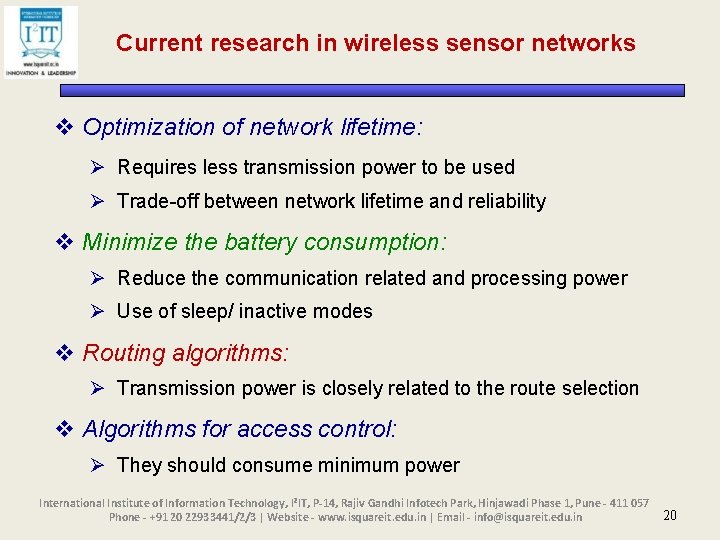
Current research in wireless sensor networks v Optimization of network lifetime: Ø Requires less transmission power to be used Ø Trade-off between network lifetime and reliability v Minimize the battery consumption: Ø Reduce the communication related and processing power Ø Use of sleep/ inactive modes v Routing algorithms: Ø Transmission power is closely related to the route selection v Algorithms for access control: Ø They should consume minimum power International Institute of Information Technology, I²IT, P-14, Rajiv Gandhi Infotech Park, Hinjawadi Phase 1, Pune - 411 057 Phone - +91 20 22933441/2/3 | Website - www. isquareit. edu. in | Email - info@isquareit. edu. in 20
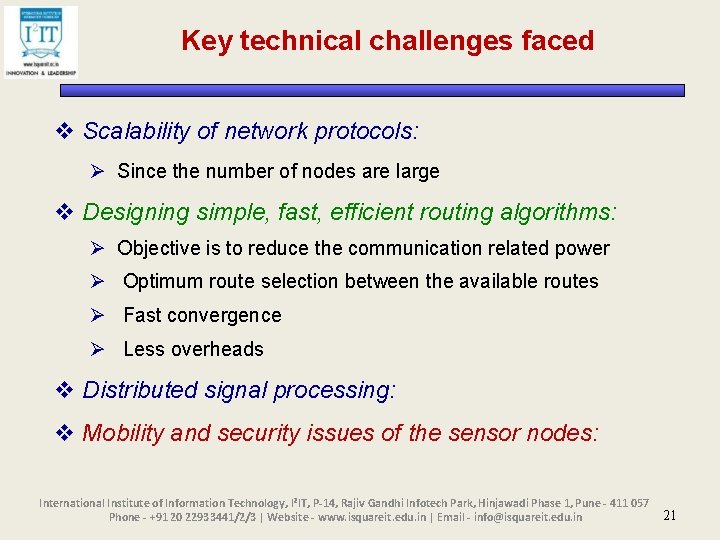
Key technical challenges faced v Scalability of network protocols: Ø Since the number of nodes are large v Designing simple, fast, efficient routing algorithms: Ø Objective is to reduce the communication related power Ø Optimum route selection between the available routes Ø Fast convergence Ø Less overheads v Distributed signal processing: v Mobility and security issues of the sensor nodes: International Institute of Information Technology, I²IT, P-14, Rajiv Gandhi Infotech Park, Hinjawadi Phase 1, Pune - 411 057 Phone - +91 20 22933441/2/3 | Website - www. isquareit. edu. in | Email - info@isquareit. edu. in 21
Key technical challenges faced v Designing simple algorithms for localization and discovery of nodes, time synchronization. v Media Access Control (MAC) layer issues: Ø Collision avoidance Ø Topology control for higher energy efficiency Ø Trade-off between energy efficiency and latency, errors Ø Bandwidth utilization Ø Scalability in node density Ø Reduce idle listening, collisions, control overheads, overhearing Ø Improve physical/ radio layer performance International Institute of Information Technology, I²IT, P-14, Rajiv Gandhi Infotech Park, Hinjawadi Phase 1, Pune - 411 057 Phone - +91 20 22933441/2/3 | Website - www. isquareit. edu. in | Email - info@isquareit. edu. in 22
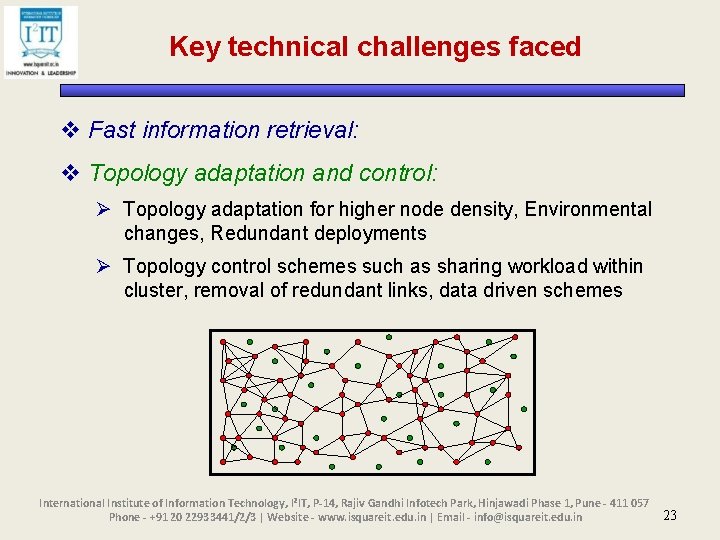
Key technical challenges faced v Fast information retrieval: v Topology adaptation and control: Ø Topology adaptation for higher node density, Environmental changes, Redundant deployments Ø Topology control schemes such as sharing workload within cluster, removal of redundant links, data driven schemes International Institute of Information Technology, I²IT, P-14, Rajiv Gandhi Infotech Park, Hinjawadi Phase 1, Pune - 411 057 Phone - +91 20 22933441/2/3 | Website - www. isquareit. edu. in | Email - info@isquareit. edu. in 23
For further queries, Kindly contact: Prof. Ravindra Joshi Associate Professor, Dept. of Engg. Sciences International Institute of Information Technology (I 2 IT) Email: ravindraj@isquareit. edu. in Cell: 9822021594 International Institute of Information Technology, I²IT, P-14, Rajiv Gandhi Infotech Park, Hinjawadi Phase 1, Pune - 411 057 Phone - +91 20 22933441/2/3 | Website - www. isquareit. edu. in | Email - info@isquareit. edu. in