William Faulkner 1897 1962 Overview American novelist known
- Slides: 19
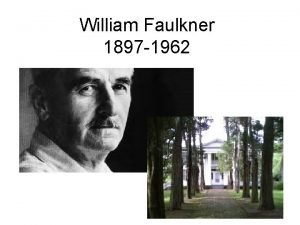
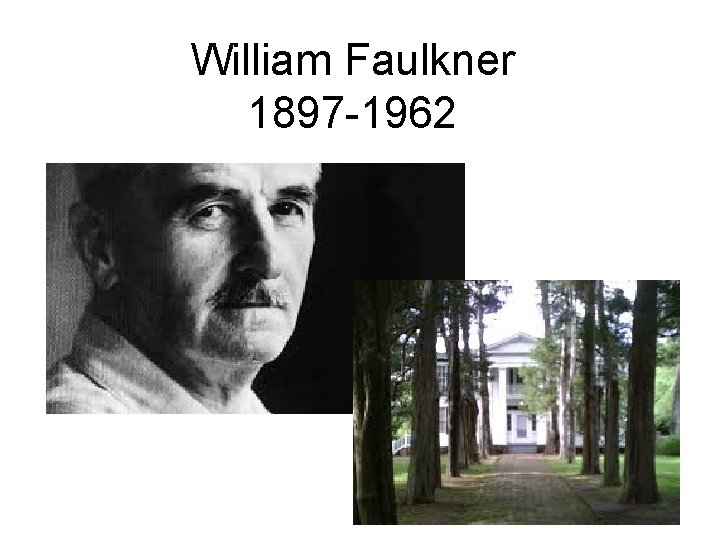
William Faulkner 1897 -1962
Overview • American novelist, known for his epic portrayal, in some twenty novels, of the tragic conflict between the old and new South. • Faulkner’s complex plots and narrative style alienated many readers of his early work. However, later, he was recognized as one of the best writers of the 20 th century.
Early Life • Born in New Albany, Mississippi, Faulkner was raised in nearby Oxford as the oldest of four sons of an old-line southern family. • In 1915 he dropped out of high school, which he detested, to work in his grandfather’s bank. In World War I (1914 -1918) he joined the Royal Canadian Air Force but never saw battle action. • Back home in Oxford, he was admitted to the University of Mississippi as a veteran, but he soon quit school to write, supporting himself with odd jobs.
Career • Faulkner’s first book, The Marble Faun, was a collection of pastoral poems and privately printed in 1924. • The following year he moved to New Orleans, worked as a journalist, and met the American short-story writer Sherwood Anderson, who helped him find a publisher for his first novel, Soldier’s Pay (1926), and also convinced him to write about the people and places he knew best.
Works • After a brief tour of Europe, Faulkner returned home and began his series of baroque, brooding novels set in the mythical Yoknapatawpha County (based on Lafayette County, Mississippi), peopling it with his own ancestors, Native Americans, blacks, shadowy backwoods hermits, and loutish poor whites. • In the first of these novels, Sartoris (1929), he patterned the character Colonel Sartoris after his own greatgrandfather, William Cuthbert Falkner, a soldier, politician, railroad builder, and author. (Faulkner restored the “u” that had been removed from the family name. )
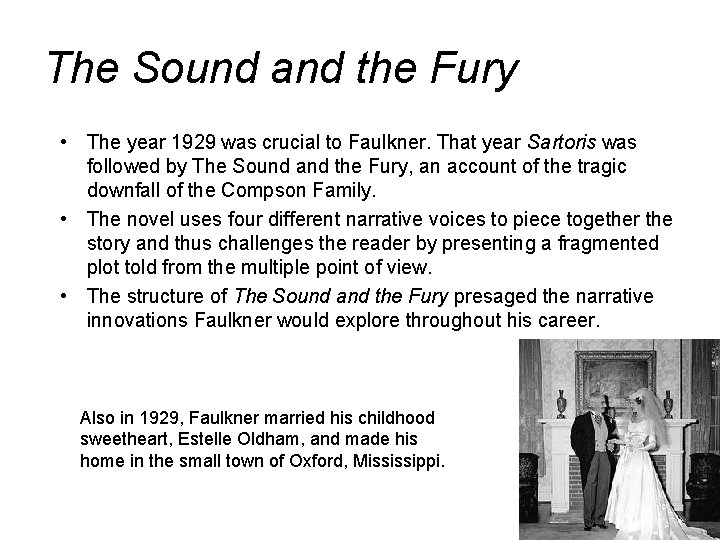
The Sound and the Fury • The year 1929 was crucial to Faulkner. That year Sartoris was followed by The Sound and the Fury, an account of the tragic downfall of the Compson Family. • The novel uses four different narrative voices to piece together the story and thus challenges the reader by presenting a fragmented plot told from the multiple point of view. • The structure of The Sound and the Fury presaged the narrative innovations Faulkner would explore throughout his career. Also in 1929, Faulkner married his childhood sweetheart, Estelle Oldham, and made his home in the small town of Oxford, Mississippi.
Other Works • Most of the books he wrote over the rest of his life received favorable reviews, but only one, Sanctuary (1931), sold well. • Despite its sensational brutality, its underlying concerns were with corruption and disillusionment. • The book’s success led to a lucrative work as a scriptwriter for Hollywood, which, for a short time, freed Faulkner to write his novels as his imagination directed. • Faulkner’s two most successful screenplays were written for movies that were directed by Howard Hawks: To Have and Have Not (1945) was adapted from the novel by Ernest Hemingway, and The Big Sleep (1946) was adapted from the novel by novelist Raymond Chandler.
Style • Faulkner’s works demanded much of his readers. • To create a mood, he might let one of his complex, convoluted sentences run on for more than a page
Style • He juggled time, spliced narratives, experimented with multiple narrators, and interrupted simple stories with rambling, stream-of-consciousness soliloquies. • Consequently, his readership dwindled.
Malcolm Cowley • In 1924, the critic Malcolm Cowley, concerned that Faulkner was insufficiently appreciated, put together The Portable Faulkner, arranging extracts from Faulkner’s novels into a chronological sequence that gave the entire Yoknapatawpha saga a new clarity, thus making Faulkner’s genius accessible to a new generation of readers.
Recognition • Faulkner’s work, long out of print, began to be reissued. • No longer was he regarded as a regional curiosity, but as a literary giant whose finest writing held meaning far beyond the agonies and conflicts of his own troubled South.
The Nobel Prize • His accomplishment was internationally recognized in 1949, when he was awarded the Nobel Prize in literature. • His major works include As I Lay Dying (1930), the story of a family’s journey to bury a mother; Light in August (1932); Absalom, Absalom! (1936), about Thomas Sutpen’s attempt to found a Southern dynasty; The Unvanquished (1938); The Hamlet (1940), the first novel in a trilogy about the rise of the Snopes family; Go Down Moses (1942), a collection of Yoknapatawpha County stories of which the novella The Bear is the best known; Intruders in the Dust (1948); A Fable (1954); The Town (1957), The Mansion (1959), and The Reivers (1962). • His short story, “A Rose for Emily, ” is a condensed version of his favorite theme: a Southern dynasty in decline, and is his most widely recognized short fiction.
Theme • Faulkner especially was interested in multigenerational family chronicles, and many characters appear in more than one book; this gives the Yoknapatawpha County saga a sense of continuity that makes the area and its inhabitants seem real. • Faulkner continued to write—both novels and short stories—until his death.
Speech • In his famous speech upon being awarded the 1949 Nobel Prize for literature, Faulkner charged writers with the responsibility of chronicling the human condition and the human spirit. • In his first sentence of the speech, Faulkner describes how he regards his own work:
• I feel that this award was not made to me as a man, but to my work’s a life’s work in the agony and sweat of the human spirit, not for glory and least of all for profit, but to create out of the materials of the human spirit something which did not exist before. So this award is only mine in trust.
• It will be difficult to find a dedication for the money part of it commensurate with the purpose and significance of its origin. But I would like to do the same with the acclaim too, by using this moment as a pinnacle from which I might be listened to by the young men and women already dedicated to the same anguish and travail, among whom is already that one who will some day stand where I am standing.
… Our tragedy today is a general and universal physical fear so long sustained by now that we can never bear it. There are no longer problems of the spirit. There is only one question: When will I be blown up? Because of this, the young man or woman writing today has forgotten the problems of the human heart in conflict with itself which alone can make good writing because only that is worth writing about, worth the agony and the sweat.
… • He must learn them again. He must teach himself that the basest of all things is to be afraid; and, teaching himself that, forget it forever, leaving no room in his workshop for anything but the old verities and truths of the heart, the old universal truths lacking which any story is ephemeral and doomed—love and honor and pity and pride and compassion and sacrifice. Until he does so, he labors under a curse. He writes not of love but of lust, of defeats in which nobody loses anything of value, of victories without hope and, worst of all, without pity or compassion. His griefs grieve on no universal bones, leaving no scars. He writes not of the heart but of the glands.
… • Until he relearns these things, he will write as though he stood among and watched the end of man. I decline to accept the end of man. It is easy enough to say that man is immortal simply because he will endure: that when the last ding-dong of doom has clanged and faded from the last worthless rock hanging tideless in the last red and dying evening, that even there will be one more sound: that of his puny inexhaustible voice, still talking. I refuse to accept this. I believe that man will not merely endure: he will prevail. He is immortal, not because he alone among creatures has an inexhaustible voice, but because he has a soul, a spirit capable of compassion and sacrifice and endurance. The poet’s, the writer’s, duty is to write about these things. It is his privilege to help man endure by lifting his heart, by reminding him of the courage and honor and hope and pride and compassion and pity and sacrifice which have been the glory of his past. The poet’s voice need not merely be the record of man, it can be one of the props, the pillars to help him endure and prevail. ”