What is an algorithm An algorithm is a
- Slides: 13
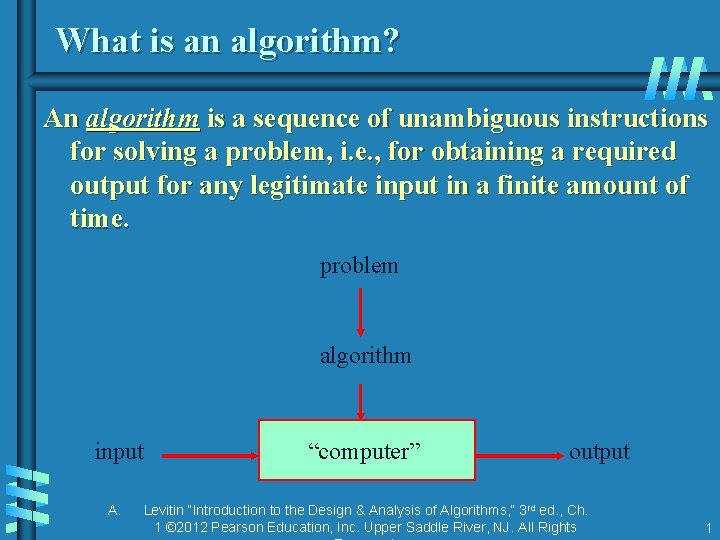
What is an algorithm? An algorithm is a sequence of unambiguous instructions for solving a problem, i. e. , for obtaining a required output for any legitimate input in a finite amount of time. problem algorithm input A. “computer” output Levitin “Introduction to the Design & Analysis of Algorithms, ” 3 rd ed. , Ch. 1 © 2012 Pearson Education, Inc. Upper Saddle River, NJ. All Rights 1
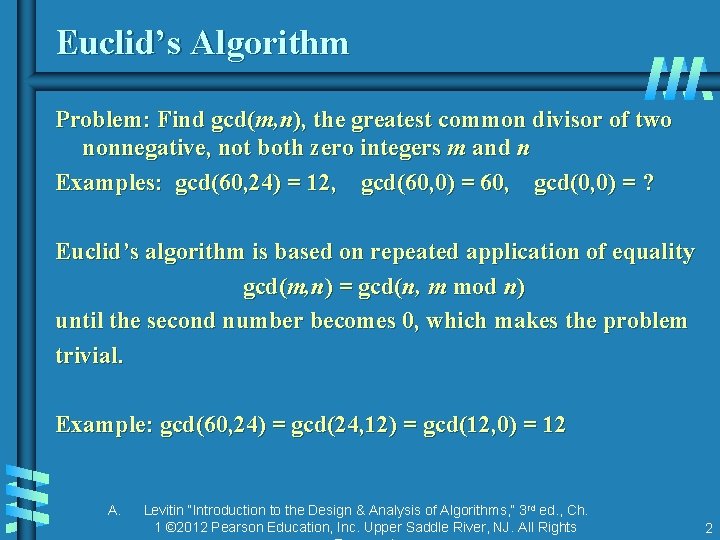
Euclid’s Algorithm Problem: Find gcd(m, n), the greatest common divisor of two nonnegative, not both zero integers m and n Examples: gcd(60, 24) = 12, gcd(60, 0) = 60, gcd(0, 0) = ? Euclid’s algorithm is based on repeated application of equality gcd(m, n) = gcd(n, m mod n) until the second number becomes 0, which makes the problem trivial. Example: gcd(60, 24) = gcd(24, 12) = gcd(12, 0) = 12 A. Levitin “Introduction to the Design & Analysis of Algorithms, ” 3 rd ed. , Ch. 1 © 2012 Pearson Education, Inc. Upper Saddle River, NJ. All Rights 2
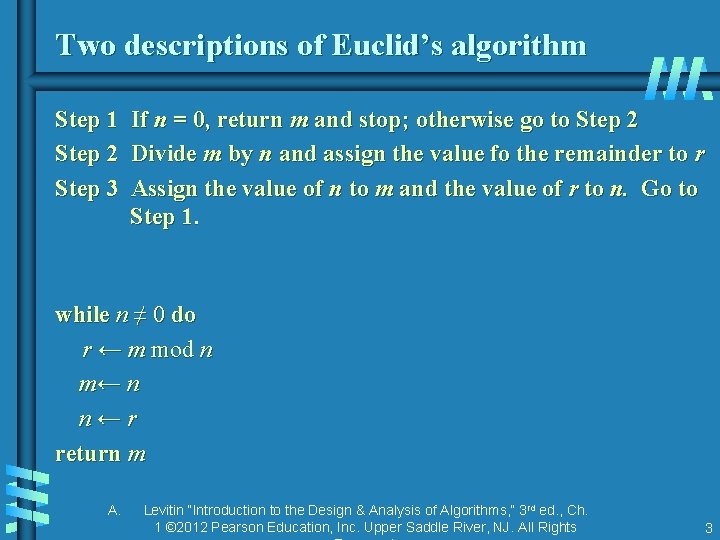
Two descriptions of Euclid’s algorithm Step 1 Step 2 Step 3 If n = 0, return m and stop; otherwise go to Step 2 Divide m by n and assign the value fo the remainder to r Assign the value of n to m and the value of r to n. Go to Step 1. while n ≠ 0 do r ← m mod n m← n n←r return m A. Levitin “Introduction to the Design & Analysis of Algorithms, ” 3 rd ed. , Ch. 1 © 2012 Pearson Education, Inc. Upper Saddle River, NJ. All Rights 3
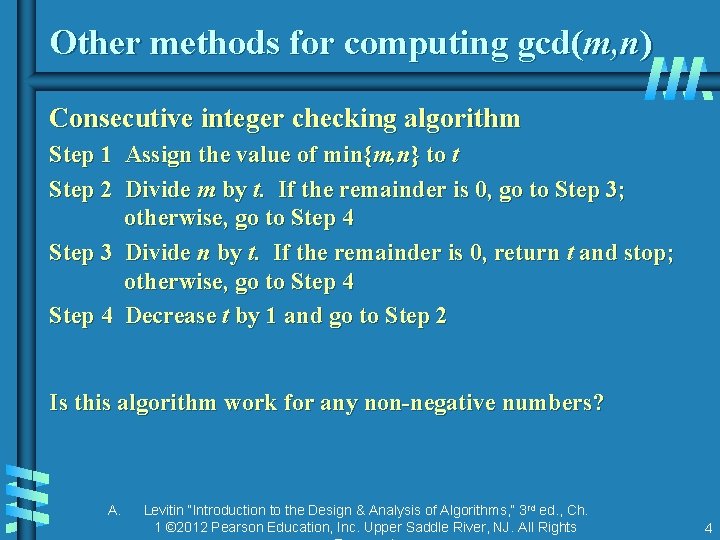
Other methods for computing gcd(m, n) Consecutive integer checking algorithm Step 1 Assign the value of min{m, n} to t Step 2 Divide m by t. If the remainder is 0, go to Step 3; otherwise, go to Step 4 Step 3 Divide n by t. If the remainder is 0, return t and stop; otherwise, go to Step 4 Decrease t by 1 and go to Step 2 Is this algorithm work for any non-negative numbers? A. Levitin “Introduction to the Design & Analysis of Algorithms, ” 3 rd ed. , Ch. 1 © 2012 Pearson Education, Inc. Upper Saddle River, NJ. All Rights 4
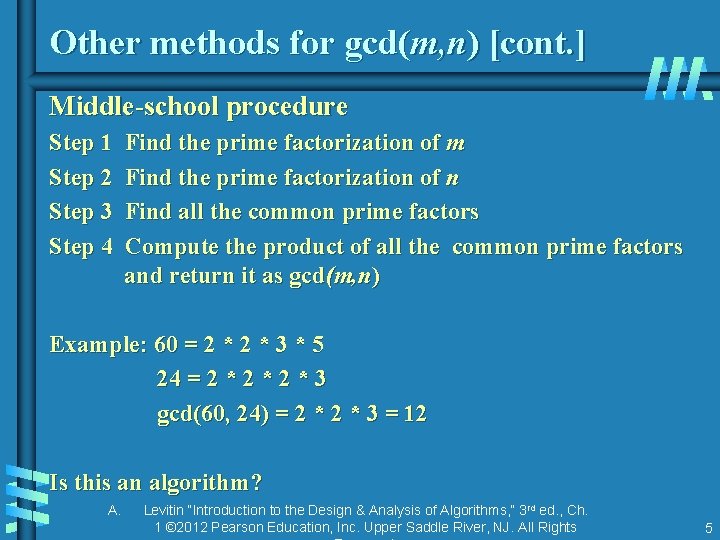
Other methods for gcd(m, n) [cont. ] Middle-school procedure Step 1 Step 2 Step 3 Step 4 Find the prime factorization of m Find the prime factorization of n Find all the common prime factors Compute the product of all the common prime factors and return it as gcd(m, n) Example: 60 = 2 * 3 * 5 24 = 2 * 2 * 3 gcd(60, 24) = 2 * 3 = 12 Is this an algorithm? A. Levitin “Introduction to the Design & Analysis of Algorithms, ” 3 rd ed. , Ch. 1 © 2012 Pearson Education, Inc. Upper Saddle River, NJ. All Rights 5
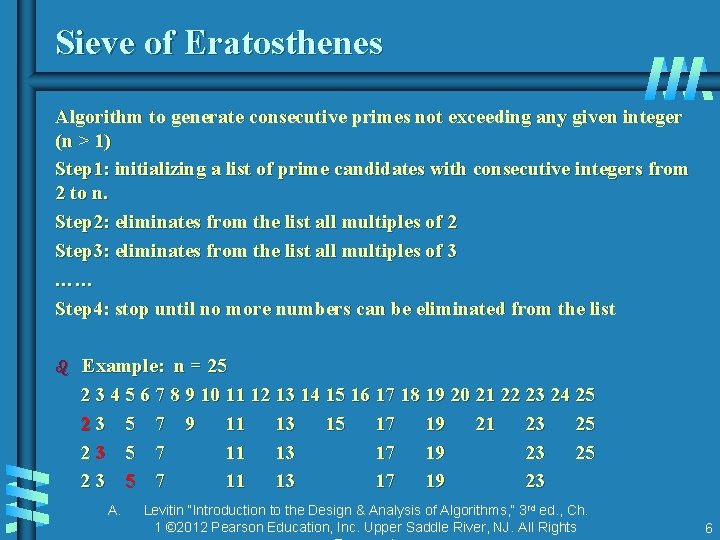
Sieve of Eratosthenes Algorithm to generate consecutive primes not exceeding any given integer (n > 1) Step 1: initializing a list of prime candidates with consecutive integers from 2 to n. Step 2: eliminates from the list all multiples of 2 Step 3: eliminates from the list all multiples of 3 …… Step 4: stop until no more numbers can be eliminated from the list b Example: n = 25 2 3 4 5 6 7 8 9 10 11 12 13 14 15 16 17 18 19 20 21 22 23 24 25 23 5 7 9 11 13 15 17 19 21 23 25 23 5 7 11 13 17 19 23 A. Levitin “Introduction to the Design & Analysis of Algorithms, ” 3 rd ed. , Ch. 1 © 2012 Pearson Education, Inc. Upper Saddle River, NJ. All Rights 6
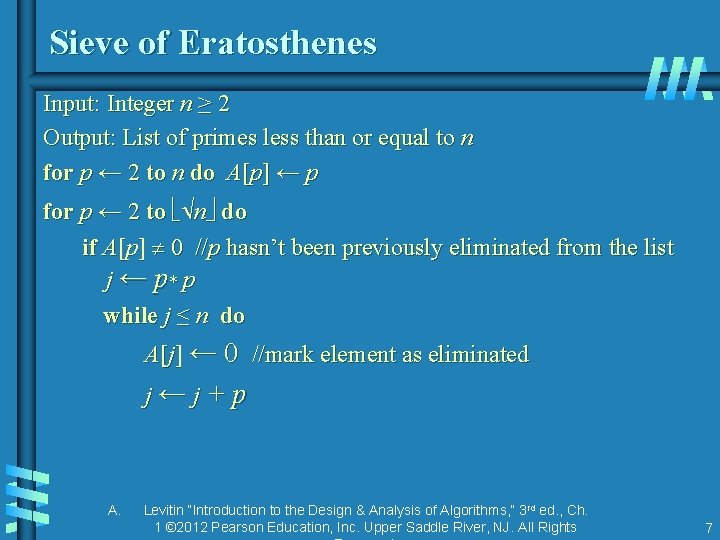
Sieve of Eratosthenes Input: Integer n ≥ 2 Output: List of primes less than or equal to n for p ← 2 to n do A[p] ← p for p ← 2 to n do if A[p] 0 //p hasn’t been previously eliminated from the list j ← p* p while j ≤ n do A[j] ← 0 //mark element as eliminated j←j+p A. Levitin “Introduction to the Design & Analysis of Algorithms, ” 3 rd ed. , Ch. 1 © 2012 Pearson Education, Inc. Upper Saddle River, NJ. All Rights 7
Why study algorithms? b Theoretical importance • the core of computer science b Practical importance • A practitioner’s toolkit of known algorithms • Framework for designing and analyzing algorithms for new problems A. Levitin “Introduction to the Design & Analysis of Algorithms, ” 3 rd ed. , Ch. 1 © 2012 Pearson Education, Inc. Upper Saddle River, NJ. All Rights 8
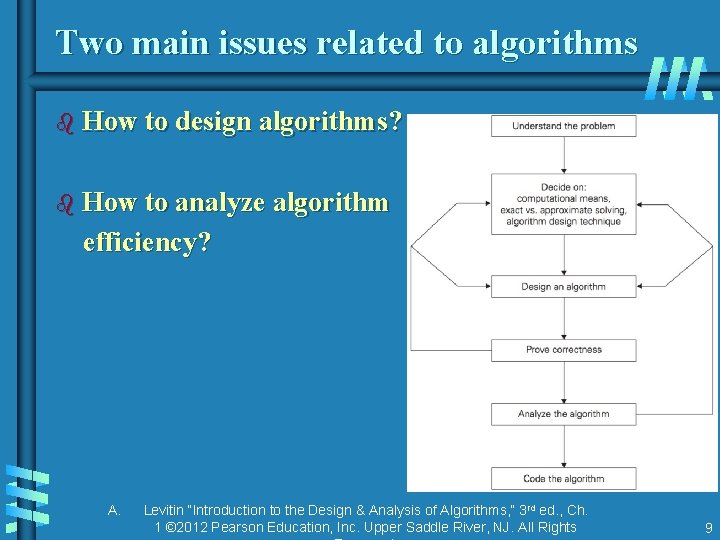
Two main issues related to algorithms b How to design algorithms? b How to analyze algorithm efficiency? A. Levitin “Introduction to the Design & Analysis of Algorithms, ” 3 rd ed. , Ch. 1 © 2012 Pearson Education, Inc. Upper Saddle River, NJ. All Rights 9
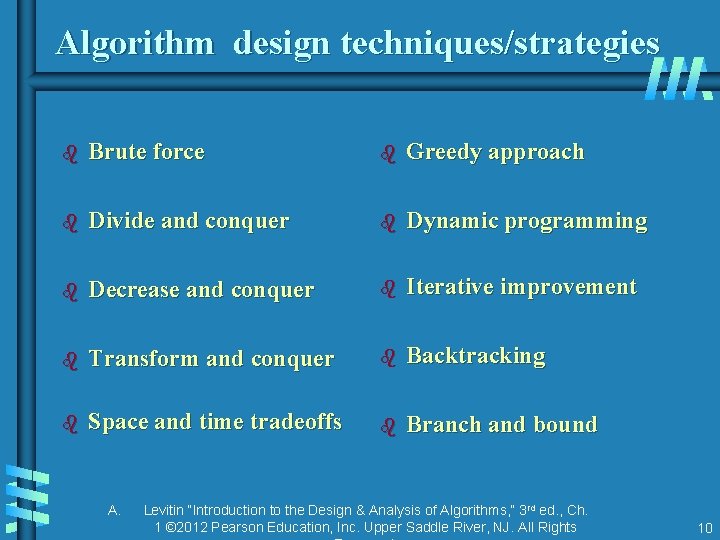
Algorithm design techniques/strategies b Brute force b Greedy approach b Divide and conquer b Dynamic programming b Decrease and conquer b Iterative improvement b Transform and conquer b Backtracking b Space and time tradeoffs b Branch and bound A. Levitin “Introduction to the Design & Analysis of Algorithms, ” 3 rd ed. , Ch. 1 © 2012 Pearson Education, Inc. Upper Saddle River, NJ. All Rights 10
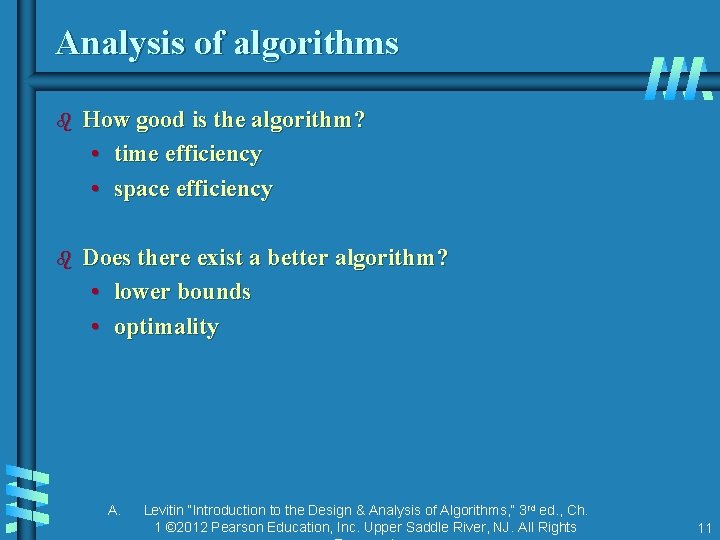
Analysis of algorithms b How good is the algorithm? • time efficiency • space efficiency b Does there exist a better algorithm? • lower bounds • optimality A. Levitin “Introduction to the Design & Analysis of Algorithms, ” 3 rd ed. , Ch. 1 © 2012 Pearson Education, Inc. Upper Saddle River, NJ. All Rights 11
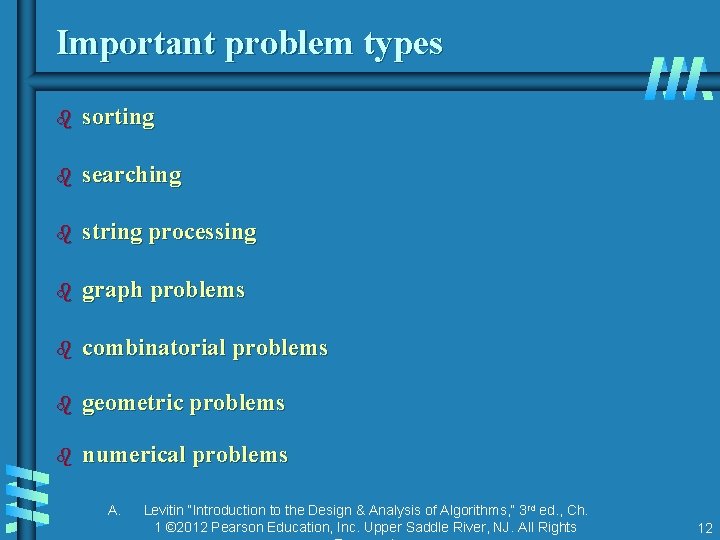
Important problem types b sorting b searching b string processing b graph problems b combinatorial problems b geometric problems b numerical problems A. Levitin “Introduction to the Design & Analysis of Algorithms, ” 3 rd ed. , Ch. 1 © 2012 Pearson Education, Inc. Upper Saddle River, NJ. All Rights 12
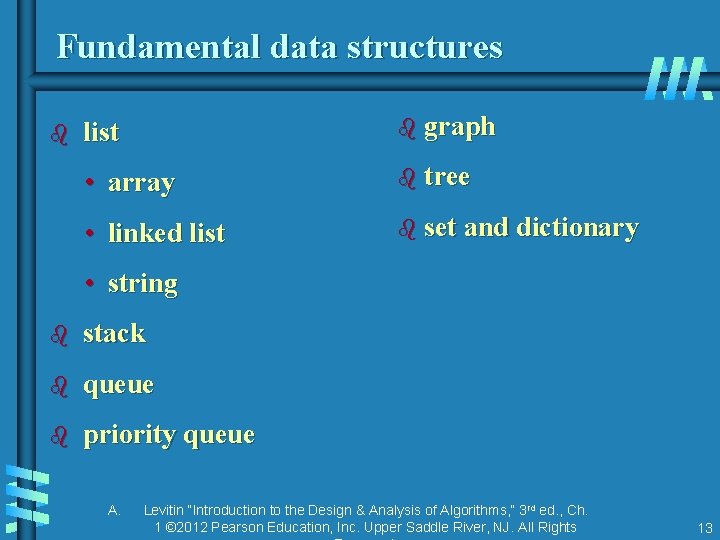
Fundamental data structures b list b graph • array b tree • linked list b set and dictionary • string b stack b queue b priority queue A. Levitin “Introduction to the Design & Analysis of Algorithms, ” 3 rd ed. , Ch. 1 © 2012 Pearson Education, Inc. Upper Saddle River, NJ. All Rights 13