What did you drink this morning Recap on
- Slides: 20
What did you drink this morning?
Recap on previous lesson Give the meaning of soluble substance Substance which can dissolve Examples of soluble substances Salt and sugar
Recap on previous lesson Give the meaning of insoluble substance Substance which does not dissolve Examples of insoluble substances Sand chalk
FILTRATION
Objectives of the lesson At the end of this lesson, you should be able to: ü state the meaning of filtration; üidentify and label the apparatus or materials required for filtration and üidentify and state the meaning of residue and filtrate.
Activities • Divide into two groups • Group A: Practical activities on filtration Group B: Completing notes on filtration • After ten minutes, swap the activities
Materials required • • 1 retort stand clamp 1 beaker 1 plastic cup 1 plastic spoon 1 filter funnel 1 filter paper Some tea leaves Some water
After the practical work, make sure you: • return all CLEAN apparatus properly to the teacher’s bench • wipe your bench dry • throw the used filter paper and the tea leaves into the dustbin
Practical Activity: Filtration 1. Add some tea leaves to a beaker of water. Stir. Do the tea leaves dissolve? ________
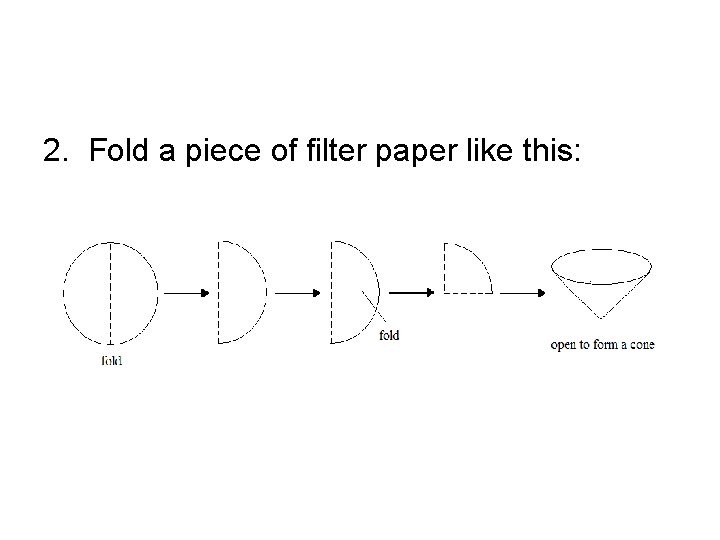
2. Fold a piece of filter paper like this:
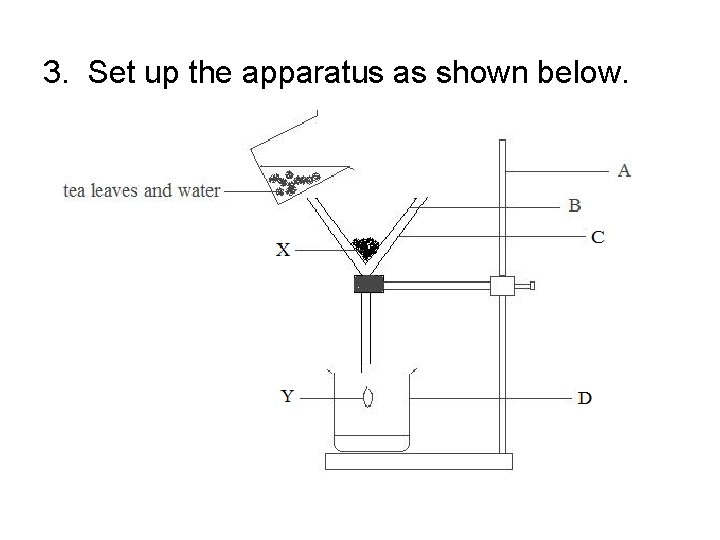
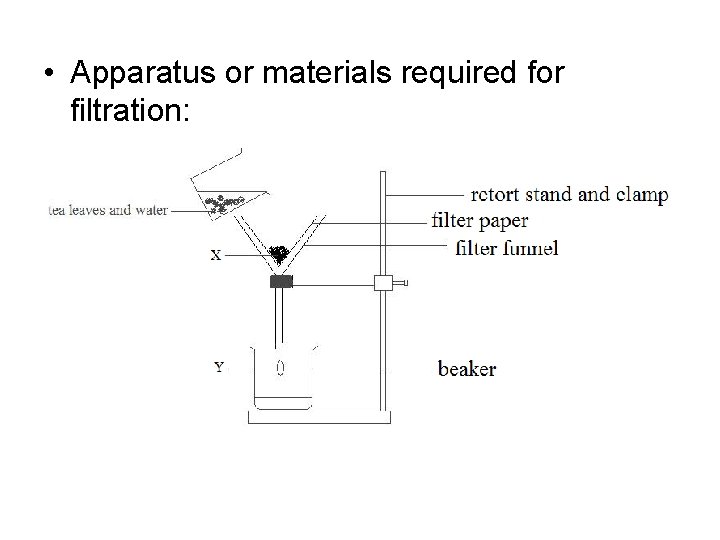
3. Set up the apparatus as shown below.
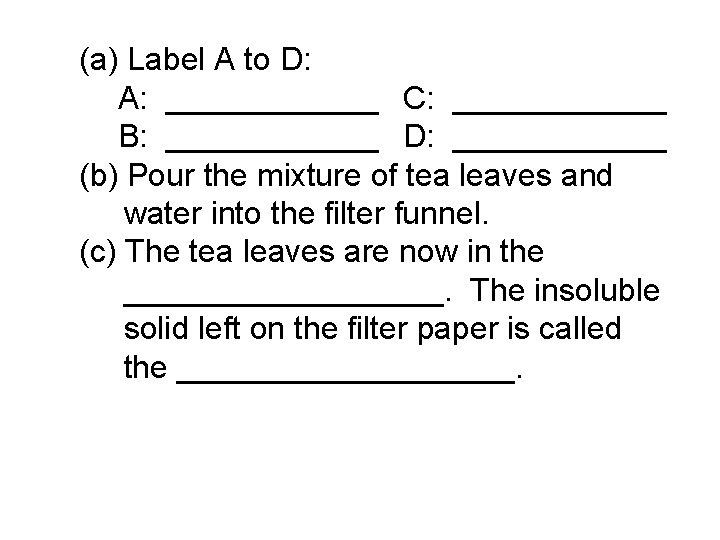
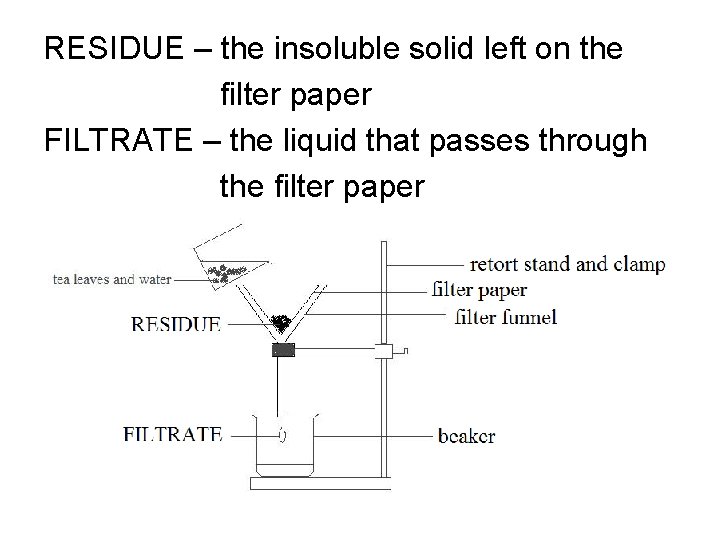
(a) Label A to D: A: ______ C: ______ B: ______ D: ______ (b) Pour the mixture of tea leaves and water into the filter funnel. (c) The tea leaves are now in the _________. The insoluble solid left on the filter paper is called the __________.
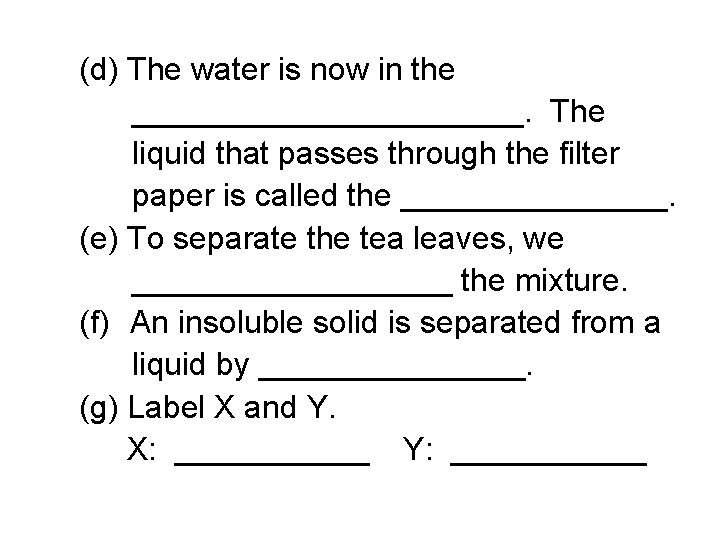
(d) The water is now in the ___________. The liquid that passes through the filter paper is called the ________. (e) To separate the tea leaves, we _________ the mixture. (f) An insoluble solid is separated from a liquid by ________. (g) Label X and Y. X: ______ Y: ______
Notes on Filtration 1. Filtration is the process of separating an _________ solid from a ________ with the help of a filter paper.
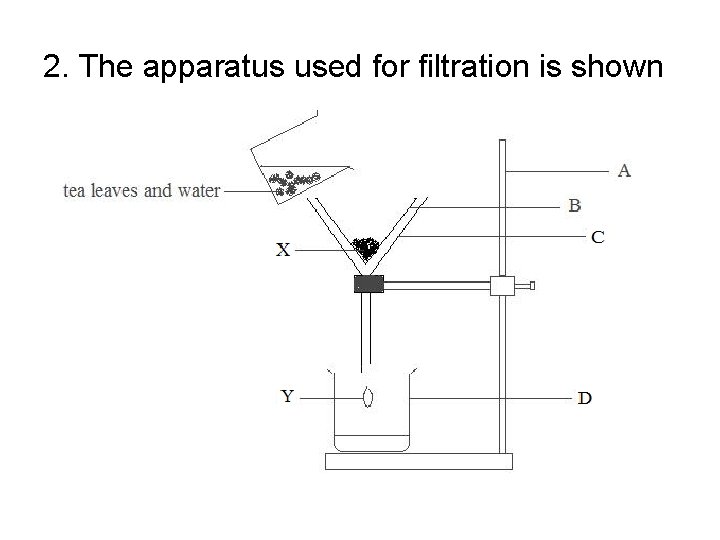
2. The apparatus used for filtration is shown below.
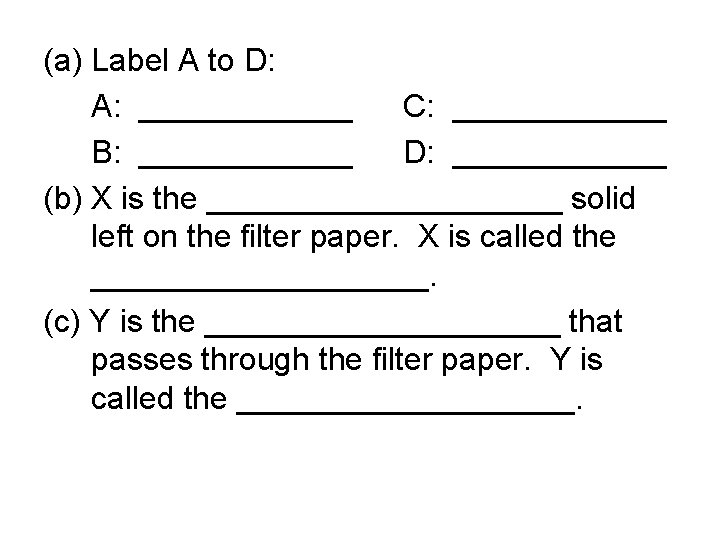
(a) Label A to D: A: ______ C: ______ B: ______ D: ______ (b) X is the __________ solid left on the filter paper. X is called the __________. (c) Y is the __________ that passes through the filter paper. Y is called the __________.
SUMMARY • Filtration is the process of separating an insoluble solid from a liquid with the help of a filter paper.
• Apparatus or materials required for filtration:
RESIDUE – the insoluble solid left on the filter paper FILTRATE – the liquid that passes through the filter paper
NEXT CLASS How will you separate a soluble solid from a liquid?