WEEK FOUR The Sunnah as a Source of


- Slides: 19
WEEK FOUR The Sunnah as a Source of Knowledge 1
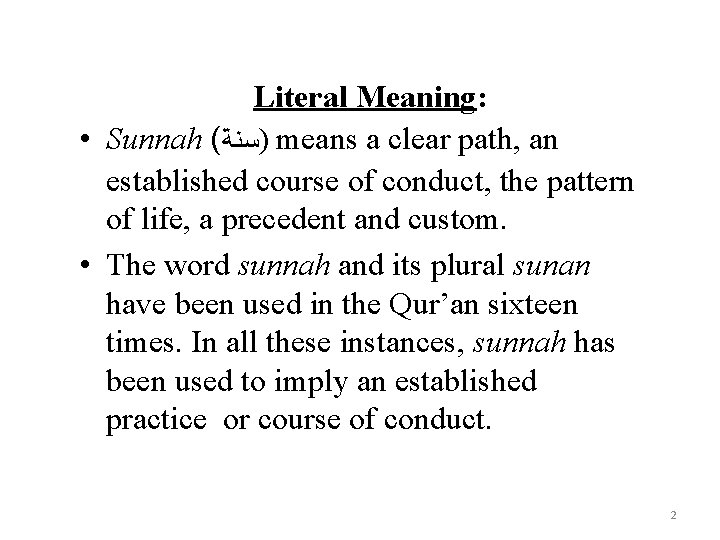
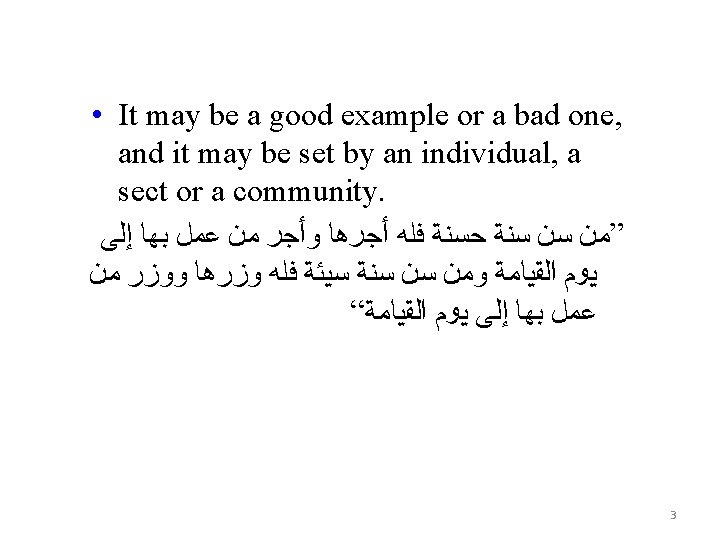
Literal Meaning: • Sunnah ( )ﺴﻨﺔ means a clear path, an established course of conduct, the pattern of life, a precedent and custom. • The word sunnah and its plural sunan have been used in the Qur’an sixteen times. In all these instances, sunnah has been used to imply an established practice or course of conduct. 2
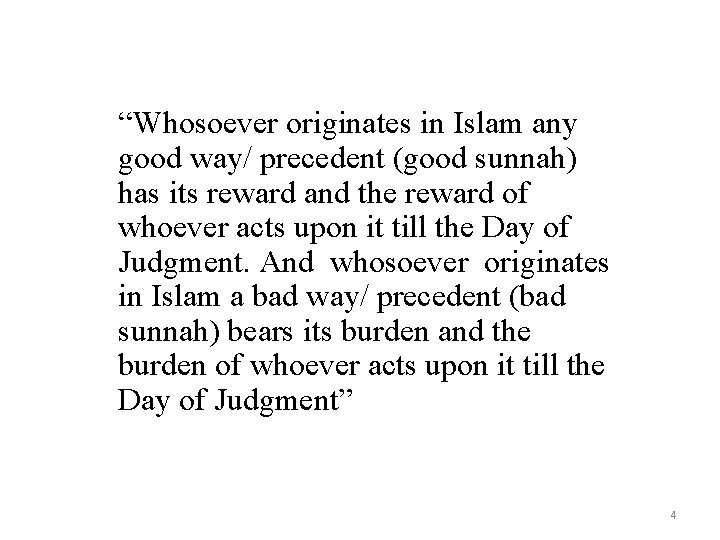
“Whosoever originates in Islam any good way/ precedent (good sunnah) has its reward and the reward of whoever acts upon it till the Day of Judgment. And whosoever originates in Islam a bad way/ precedent (bad sunnah) bears its burden and the burden of whoever acts upon it till the Day of Judgment” 4
• The opposite of sunnah is bid`ah (innovation), which is characterized by lack of precedent and continuity with the past. Technical meaning: a. The acts, sayings and approvals of the Messenger of Allah. 5
Kinds of Sunnah with respect to the channels of the ahkam 1. Sunnah which is intended to be a binding law: This kind includes the sayings, acts and approval of the Prophet (saw) through which he intended the laying down of the law or the explanation of the ahkam (law) laid down by the Qur’an. This comprises the largest part of the sunnah. 6
2 - Sunnah which is specific to the Prophet( ﻭﺴﻠﻢ ﻋﻠﻴﻪ ﺍﻟﻠﻪ )ﺻﻠﻰ This kind includes those acts which are specific to the Prophet ( ﻋﻠﻴﻪ ﺍﻟﻠﻪ ﺻﻠﻰ )ﻭﺴﻠﻢ. The number of these acts is very limited. One example is the number of his marriages, marriage without dowry, not eating out of charity ( )ﺻﺪﻗﺔ. 7
3. Ordinary physical acts performed by every human being Like eating, drinking, walking. Such acts are not meant to lay down laws. If one imitates the Prophet (saw) in these acts out of love for him and with the intention to get reward, he will be rewarded for this. But the etiquettes and manners prescribed by the Messenger of Allah for the performance of such acts are part of that which is meant to be a binding law. 8
4. Acts based on human experience • This may include acts that pertain to his experience as a human being, like the organizing of the army, tactics of war, trading skills. • These acts don’t become precedents of law, because their basis is skill and experience rather than revelation. • However, if they are still relevant to one’s situation they might be followed. 9
Status of the Sunnah with respect to the Qur’an • The Sunnah is the second source just next to the Qur’an which is the first source. • There will be no Islam without the adoption of the sunnah. 10
• The Sunnah is basically an elaboration and commentary on the Qur’an. • Some ahkam are found in the Qur’an in general, in an undetermined or unelaborated form. • The Sunnah restricts, qualifies, or elaborates these ahkam. 11
• The Sunnah is a concrete implementation, a tangible form and the actual embodiment of the Qur’an • The Sunnah may lay down some rules that are not mentioned in the Qur’an • Qur’an says: “And whatsoever the messenger brought to you, follow it. And whatsoever he forbids, abstain from it” (al-Hashr: 7) 12
The knowledge we get from The Sunnah • Worship ( )ﻋﺒﺎﺩﺓ The rulings and teachings related to ﻋﺒﺎﺩﺓ • Halal and haram: In food, drinks, clothes, and transactions: - the Sunnah interprets what needs to be interpreted in the Qur’an. - The Sunnah may add some prohibitions which are not included in the Qur’an. 13
• Law (family, criminal, commercial, procedural, international ) • Manner of conduct: The biography of the Prophet (saw) is the model of individual moral conduct. “A noble model you have in Allah’s Apostle, for all whose hope is in Allah, and in the final Day, and who often remember Allah” (al-Ahzab: 21) 14
• The model in implementing and embodying the teachings and principles of the Qur’an • The model in the relationship between humans and Allah (‘ibadah) • The model in establishing a family and treating well the wives as well as the children. 15
• A model in dealing with people. • A model in hard-working, patience, and perseverance etc. Leadership: • He was a model leader from whom we learn the requirements of a successful leader. 16
Da‘wah: • How he started from nothing and ended with hundreds of thousands of followers after two decades only. 17
Nation building and social reformation: • How he established a nation and changed an almost primitive society dominated by tribalism and rivalries among different tribes and social classes to a civilized and strong state characterized by unity, cooperation, and brotherhood. 18
• Eliminating idolatry and establishing Tawhid • Eliminating bad social values in dealing with the weak social classes: women, slaves, poor people, black people, etc. 19