
Introduction to Sunnah Hadith Literal Meaning The Arabic

Introduction to Sunnah
Hadith • Literal Meaning : The Arabic word Hadith literally means ‘statement’ or 'talk'. • Ahaadith ( )ﺃﺤﺎﺩﻳﺚ Ahaadith is plural of Hadith • In technical terms Hadith stands for the report of words and deeds, approval or disapproval of Rasulullah (Sallallahu Alaihi Wasallam).
Sunnah Literal meaning: Practice, habit. Technical meaning: • 1. Same as Hadith. • 2. Practices of Rasulullah (Sallallahu Alaihi Wasallam) • 3. That commandment which is proved by Qur’an and sunnah. • 4. Antonym of Bid'at (innovation). • 5. Demanded by Shari’ah in addition to Fardh and Wajib; on performance of which is reward and on avoidance of which there is punishment
Concept of Hadith • Hadith - The teachings of Prophet Muhammad, apart from the text of the Qur'an, are also available today and contained in verified records. • His sayings, actions and reactions in every situation throughout his life were related and recorded by those who actually witnessed or heard them. • A narration of this kind is called a hadith
Concept of Hadith • Every hadith has two parts: the text and the list of transmitters. • Even when the text seems correct and logical, it must be supported by an unbroken chain of reliable reporters going back directly to the Prophet himself in order to be accepted by jurists. • Scholars carefully scrutinize the reliability of the transmitters, accepting only those hadiths whose chain of narrators is known to be completely reliable and sound
History • The Prophet's companions learned and passed on his teachings by three methods: memorization, written records and practice • They not only memorized and recorded the revelations which made up the Qur'an, but also committed to memory the exact words used by the Prophet in his own statements as well as descriptions of his behavior and character
History • After his death, as Islam was spread by the companions into Asia and North Africa, this knowledge accompanied them, and their students faithfully preserved it for following generations. • As the narrations were subsequently conveyed from teacher to student, it is a credit to their scholarship that the narrations were always preceded by a list of narrators going back to the Prophet himself
Continued • This enabled later scholars to check out each narration and reject it if the chain of narrators contained anyone who was unknown or was known to be weak in memory or prone to error. • Only those narrations whose chains were complete and whose transmitters were unblemished could actually be attributed to the Prophet and accepted as authoritative.
Continued • This kind of scholarship became all the more essential in later years when some Muslims began to forge hadiths to support their own views and spread them among the common people. • Although they succeeded in their deception for a time, the false narrations were eventually exposed by hadith specialists. • Their strict and precise methodology enables us today to know which hadiths are authentic and which ones are weak and unacceptable as evidence.
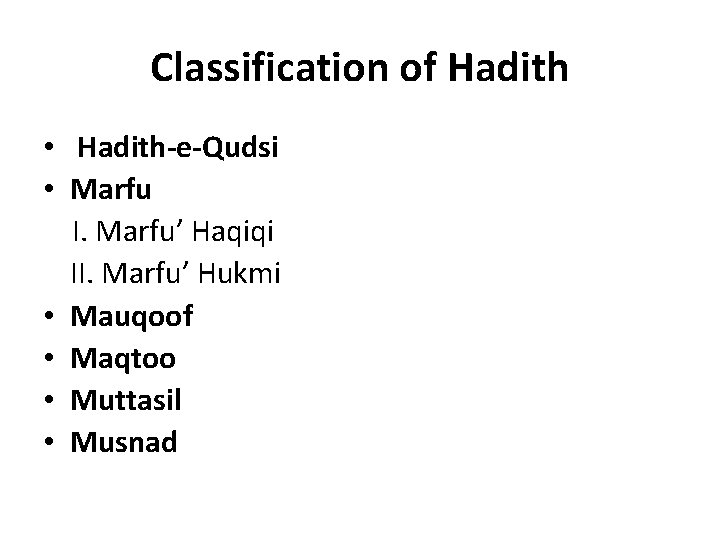
Classification of Hadith • Hadith-e-Qudsi • Marfu I. Marfu’ Haqiqi II. Marfu’ Hukmi • Mauqoof • Maqtoo • Muttasil • Musnad
Hadith-e-Qudsi • It is that Hadith which Rasulullah (Sallallahu Alaihi Wasallam) quotes from Allah Ta'ala. In other words it is a statement of Allah Ta'ala quoted by Rasulullah (Sallallahu Alaihi Wasallam) and which is not in the Qur’an.
Difference between Hadith-e-Qudsi & the Qur’an • In Qur’an both the words as well as meaning is revealed by Allah Ta'ala. • In Hadith-e-Qudsi only meaning is revealed by Allah Ta'ala which is put into words by Rasulullah (Sallallahu Alaihi Wasallam). • So Hadith-e-Qudsi is not of the same status as Qur’an. • We cannot touch Qur’an without Wadhu, such is not the case with Hadith-e-Qudsi. • The whole Qur’an was revealed to Rasulullah (Sallallahu Alaihi Wasallam) through Angel Jibraeel (AS) whereas Ahaadith-e-Qudsiyah were revealed through other agencies like dream and Ilham (intuition) in addition to Angel Jibraeel (AS).
Marfu • Literal meaning: Elevated. • Technical meaning: Traced directly. • A Hadith which is traced back directly to Rasulullah (Sallallahu Alaihi Wasallam) is called Marfu’. In this type the Sanad (chain of transmission) reaches right upto Rasulullah (Sallallahu Alaihi Wasallam). • It has two types: I. Marfu’ Haqiqi II. Marfu’ Hukmi
Marfu’ Haqiqi • It is that Hadith which is attributed to Rasulullah (Sallallahu Alaihi Wasallam) in clear terms. • It is of four types a) Marfu’ Qawli It is that Hadith which contains some statement of Rasulullah (Sallallahu Alaihi Wasallam). b) Marfu’ Fe’li It is that Hadith which describes some act or deed of Rasulullah (Sallallahu Alaihi Wasallam) e. g. , Rasulullah (Sallallahu Alaihi Wasallam) performed such and such act in such and such way.
Marfu’ Haqiqi c) Marfu’ Taqriri It is that Hadith which includes some statements or acts of some of the companions of Rasulullah (Sallallahu Alaihi Wasallam) which were said or done in his presence and he did not object to them. d) Marfu’ Wasfi It is that Hadith which describes something about physical, spiritual or moral attributes or states of Rasulullah (Sallallahu Alaihi Wasallam).
Marfu’ Hukmi • It is that Hadith which is not attributed to Rasulullah (Sallallahu Alaihi Wasallam) directly but due to some other reason. • For example, Sahaabah (say that they had been ordered in such and such way) used to do such and such thing. It indirectly means that they were doing it under the instructions of Rasulullah (Sallallahu Alaihi Wasallam).
Mauqoof • Literal meaning: Stopped. • Technical meaning: That Hadith in which chain of transmission stops at Sahaabah and does not reach Rasulullah (Sallallahu Alaihi Wasallam). • It has three types
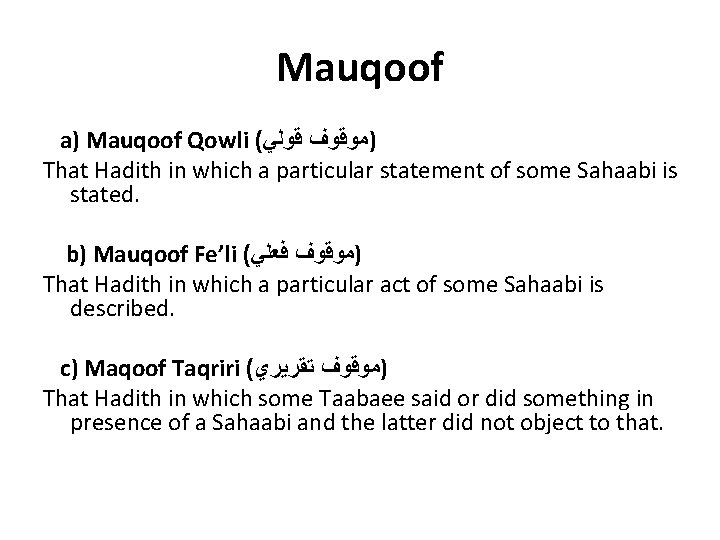
Mauqoof a) Mauqoof Qowli ( )ﻣﻮﻗﻮﻑ ﻗﻮﻟﻲ That Hadith in which a particular statement of some Sahaabi is stated. b) Mauqoof Fe’li ( )ﻣﻮﻗﻮﻑ ﻓﻌﻠﻲ That Hadith in which a particular act of some Sahaabi is described. c) Maqoof Taqriri ( )ﻣﻮﻗﻮﻑ ﺗﻘﺮﻳﺮﻱ That Hadith in which some Taabaee said or did something in presence of a Sahaabi and the latter did not object to that.
Maqtoo • Literal meaning: Cut. • Technical meaning: That statement or deed which is attributed to some Tabaee. In this Hadith chain of transmission stops at two steps-down i. e. , at the level of Taabaee.
Muttasil • Literal meaning: Joined. • Technical meaning: That Hadith which has got successive narrators continuously without any gap or omission in between. Its chain or Sanad is uninterrupted from beginning to the end. For example: • Imam Maalik (RA) says that he heard from Nafea, who heard from Ibne Umar, who in turn heard from Rasulullah (Sallallahu Alaihi Wasallam) such and such thing
Musnad • Literal Meaning: Having been related or attributed to. • Technical Meaning: That Marfu Hadith whose Sanad or chain is Muttasil (joined) is called Musnad Hadith.
Classification of Hadith as per type of chain of transmission Tabaqat (generations) of narrators of Hadith as per Ibn Hajar Asqalani (RA) • Before understanding this classification of Hadith, one must understand what is meant by Tabaqat or generations of narrators.
Tabaqat from Sahaabah-al-Kiram constitute the first three generation of narrators, who directly learned Islam from Rasulullah (Sallallahu Alaihi Wasallam). This group is divided into three groups. i) Tabaqah Al-Kubar Sahaabah (Upper level). ii) Tabaqah Al-Wusta Sahaabah (Medium level) iii) Tabaqah Al-Sugra Sahaabah (Low level).
Tabaqat from Taabaeen This constitutes the second group of generations of narrators in chain of transmission. Those Muslims who saw/witnessed the era of Sahaabah and learned Islam from them are called Tabaeeh. This group has been divided into three sub-groups i) Tabaqah al-Kubar Taabaeen like Syed Ibn-al-Musaib ii) Tabaqah al-Wusta Taabaeen like Hasan Bisri, Muhammad bin Seereaan. iii) Tabaqah al-Sugra like Imam Zuhri, Qatada.
Tabaqat from Taba-Taabaeen Taba-Taabeen constitute third group. Those Muslims who saw/witnessed the era of Taabaeen and learned Islam from them are called Tabaeeh. This group has further been sub-divided into three sub-groups: i) Tabaqah Kubar Taba-Taabaeen like Imam Maalik, Sufiyan Thouri. ii) Tabaqah al-Wusta Taba-Taabaeen like Sufiyan bin Uyainiya iii) Tabaqah al-Sugra Taba-Taabaeen like Imam Shaafaee, Abdul Razaq
Uloom ul hadith • Uloom ul Hadith (The Sciences of Hadith) 1. Ilm ar-Rijaal • In this science the condition, births, deaths, teachers and students of narrators were gathered in detail and from these details judgments on the position of the narrators, as to whether they were truthful, trustworthy or unreliable, were made. This science is very interesting; details of over 500, 000 narrators have been collated.
Continued 2. Ilm Masatalah al-Hadeeth (Usool of Hadeeth) • In the light of this knowledge the standards and rules of ahaadeeth, their authenticity and weakness were established. 3. Ilm Ghareeb al-Hadeeth • In this knowledge the meaning of difficult words (in Arabic) have been investigated and researched. 4. Ilm Takhreej al-Hadeeth • From this knowledge we find where a particular hadeeth pertaining to a particular science can be found from the well known books of tafseer (Exegesis of the Qur’aan), belief and jurisprudence.
Continued 5. Ilm al-Hadeeth al-Mawdoo’ah • In this science the people of knowledge have written books in which they separated the mawdoo (fabricated, forged) narration’s from the authentic ones. 6. Ilm Naaskh wal-Mansookh • In this science one of the most famous works is that of Muhammad Ibn Moosaa Haazamee (d. 784 H at the age of 35) called Kitaab al. Ee’tibaar.
Continued 7. Ilm at-Tawfeeq Bayn al-Hadeeth • In this science the authentic (saheeh) ahaadeeth that seem to contradict each other have been explained and resolved. 8. Ilm Mukhtalif wal-Ma’atalaf • This science mentions the names of narrators, their kunyah’s, titles, parents, fathers or teachers, whose names may have shown similarities and due to this a person may have made a mistake
Continued 9. Ilm Atraaf al-Hadeeth • This science helps to find a narration, the book of hadeeth it may be found in and its narrators. 10. Fiqh al -Hadeeth • In this science all the authentic ahaadeeth related to rulings and commands were compiled.
References • http: //archive. islamkashmir. org/publications/i ntroduction-to-alhadith/hadith. htm • http: //mercyprophet. org/mul/node/677 • http: //mrashidhai. wikidot. com/uloom-ulhadith-sciences-of-hadith
- Slides: 31