WEEK 4 Day 1 THESIS STATEMENTS ENGL 1301
- Slides: 27
WEEK 4: Day 1 - THESIS STATEMENTS ENGL 1301 EDLIN MRS.
Announcements and reminders • BA 3 – due to Raider Writer last Friday. Submit ASAP if you have not yet done so. • Reading Quiz 3 – due via email last night. Submit ASAP if you have not yet done so. • Blog post – due via the course website no later than tomorrow (Tuesday) night. Submit ASAP if you have not yet done so.
WHAT DO YOU SEE?
WRITING THESIS STATEMENTS • Can you define “thesis statement? ” • The thesis statement is a single sentence in the opening paragraph that sums up what the essay is about. • Every essay should have a thesis statement that functions like a road sign, telling the reader where the essay intends to go.
WRITING THESIS STATEMENTS • A thesis statement has three practical aims: • It tells in a single sentence what your essay is about • It helps you organize your essay • It reflects your understanding of the topic or text and the argument you intend to make about it • What does the text say? • What does the text do?
WRITING THESIS STATEMENTS • There are several faults in writing thesis statements, but the four most common are: • Too narrow – leaves you with little or nothing to discuss. • Too narrow: I had my cat declawed to protect my furniture. • Discussible: A declawed cat makes a good indoor pet.
WRITING THESIS STATEMENTS • Too broad – commits you to a topic too big to cover in a brief essay. • Too broad: The detective story is an important type of world literature. • Narrowed: Sherlock Holmes was one of the first popular detectives in the detective story.
WRITING THESIS STATEMENTS • Uncommitted or Indefinite – does not plainly state the writer’s opinion on the subject but instead tries to wriggle out of taking a stand. • Uncommitted or indefinite: People love chess. • Better: People love chess because it is cheap and engrossing and can be played almost anywhere.
WRITING THESIS STATEMENTS • Unclear – badly written; wordy, fuzzy, or pompous. • Unclear: Walking is an ideal exercise of which old and young make no difference as far as being able to improve a physical condition that is not particularly good. • Clear: Walking is an ideal exercise for both young and old people who are not in top physical condition.
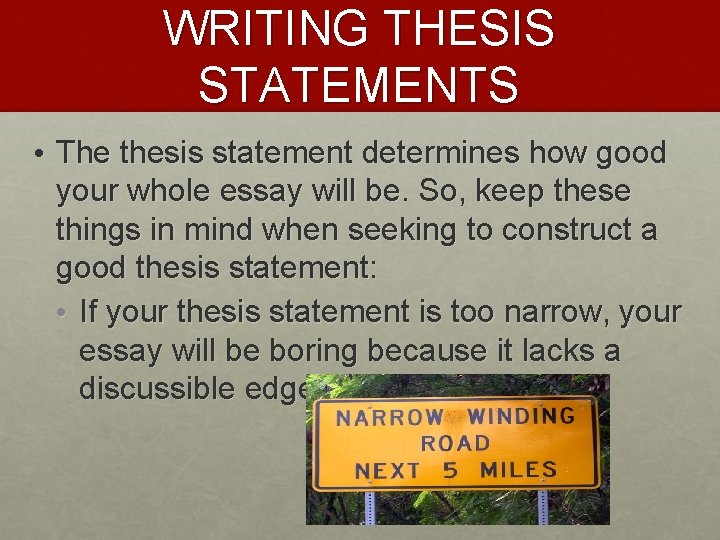
WRITING THESIS STATEMENTS • The thesis statement determines how good your whole essay will be. So, keep these things in mind when seeking to construct a good thesis statement: • If your thesis statement is too narrow, your essay will be boring because it lacks a discussible edge.
WRITING THESIS STATEMENTS • If your thesis statement is too broad, your essay will either be superficial because you didn’t deliver what you promised or too long because you did. • If your thesis statement is uncommitted, your essay will drift, not clearly making a point (because you don’t have one).
WRITING THESIS STATEMENTS • If your thesis statement is unclear because of bad writing, the point of your essay will be fuzzy; if your thesis statement is unclear because of pompous writing, your reader may not even bother to continue reading.
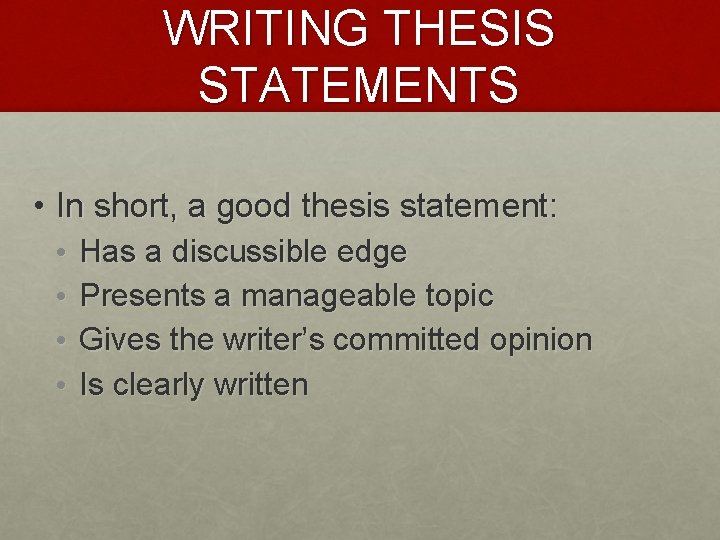
WRITING THESIS STATEMENTS • In short, a good thesis statement: • • Has a discussible edge Presents a manageable topic Gives the writer’s committed opinion Is clearly written
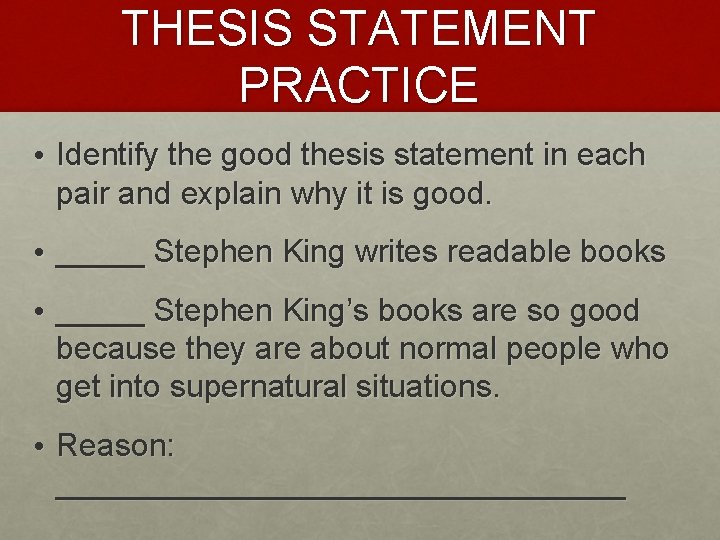
THESIS STATEMENT PRACTICE • Identify the good thesis statement in each pair and explain why it is good. • _____ Stephen King writes readable books • _____ Stephen King’s books are so good because they are about normal people who get into supernatural situations. • Reason: ________________
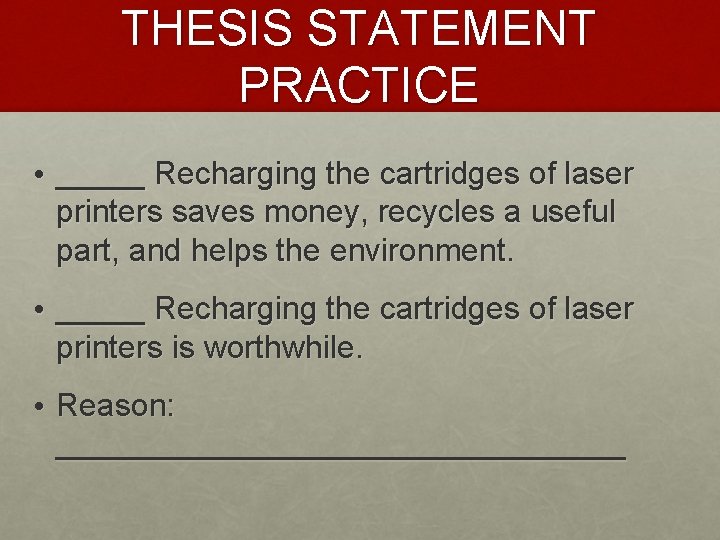
THESIS STATEMENT PRACTICE • _____ Recharging the cartridges of laser printers saves money, recycles a useful part, and helps the environment. • _____ Recharging the cartridges of laser printers is worthwhile. • Reason: ________________
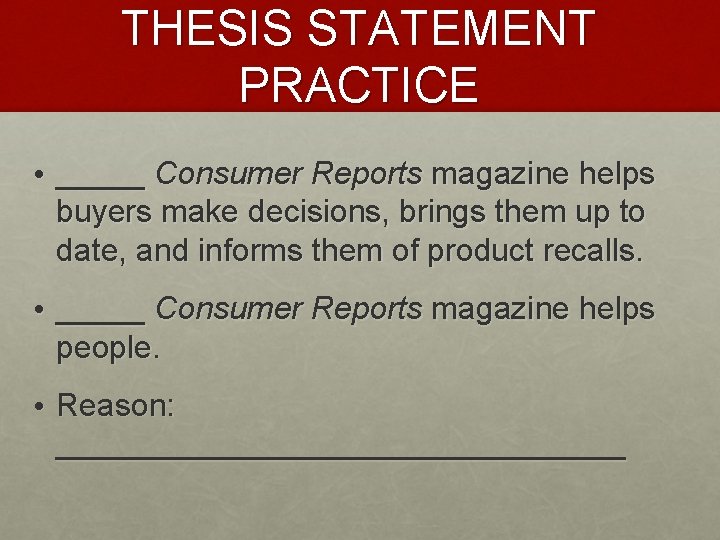
THESIS STATEMENT PRACTICE • _____ Consumer Reports magazine helps buyers make decisions, brings them up to date, and informs them of product recalls. • _____ Consumer Reports magazine helps people. • Reason: ________________
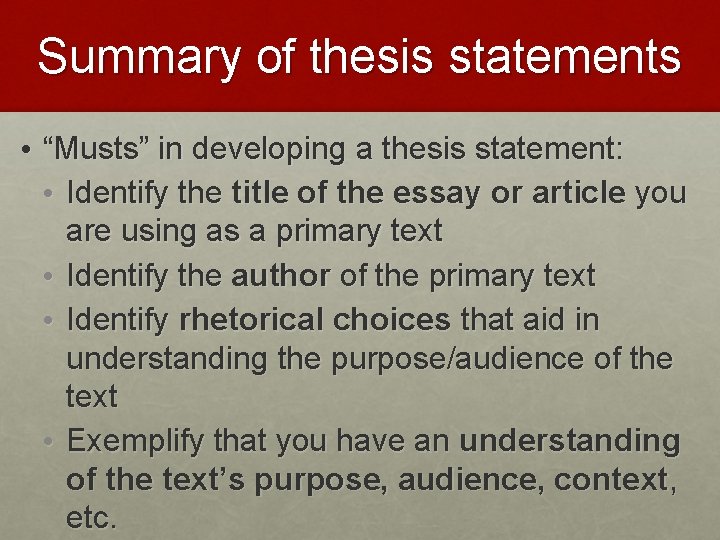
Summary of thesis statements • “Musts” in developing a thesis statement: • Identify the title of the essay or article you are using as a primary text • Identify the author of the primary text • Identify rhetorical choices that aid in understanding the purpose/audience of the text • Exemplify that you have an understanding of the text’s purpose, audience, context, etc.
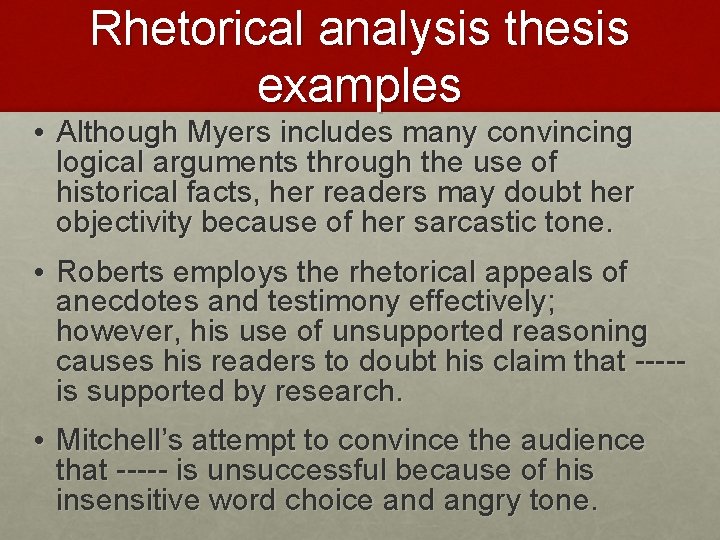
Rhetorical analysis thesis examples • Although Myers includes many convincing logical arguments through the use of historical facts, her readers may doubt her objectivity because of her sarcastic tone. • Roberts employs the rhetorical appeals of anecdotes and testimony effectively; however, his use of unsupported reasoning causes his readers to doubt his claim that ----is supported by research. • Mitchell’s attempt to convince the audience that ----- is unsuccessful because of his insensitive word choice and angry tone.
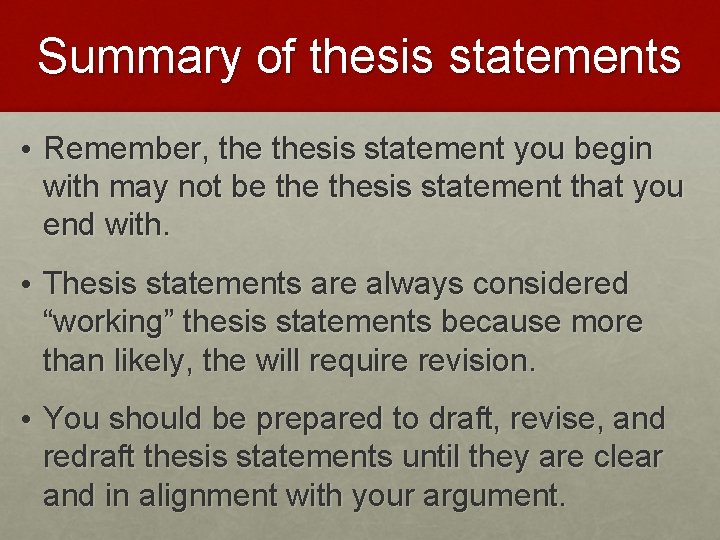
Summary of thesis statements • Remember, thesis statement you begin with may not be thesis statement that you end with. • Thesis statements are always considered “working” thesis statements because more than likely, the will require revision. • You should be prepared to draft, revise, and redraft thesis statements until they are clear and in alignment with your argument.
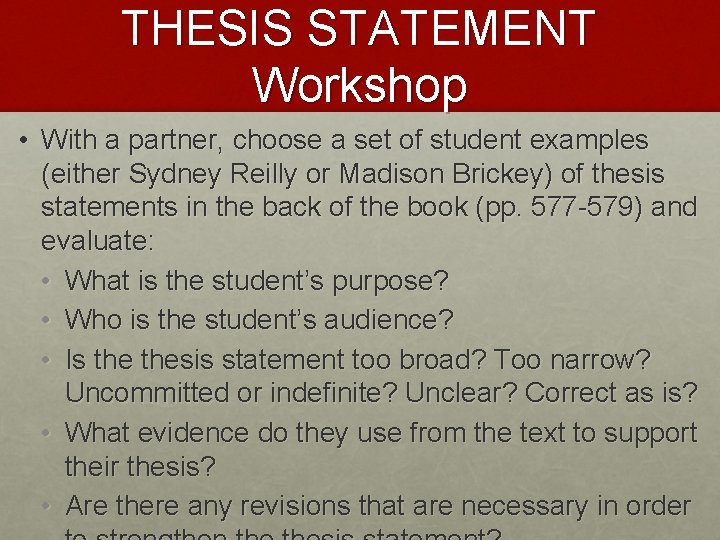
THESIS STATEMENT Workshop • With a partner, choose a set of student examples (either Sydney Reilly or Madison Brickey) of thesis statements in the back of the book (pp. 577 -579) and evaluate: • What is the student’s purpose? • Who is the student’s audience? • Is thesis statement too broad? Too narrow? Uncommitted or indefinite? Unclear? Correct as is? • What evidence do they use from the text to support their thesis? • Are there any revisions that are necessary in order
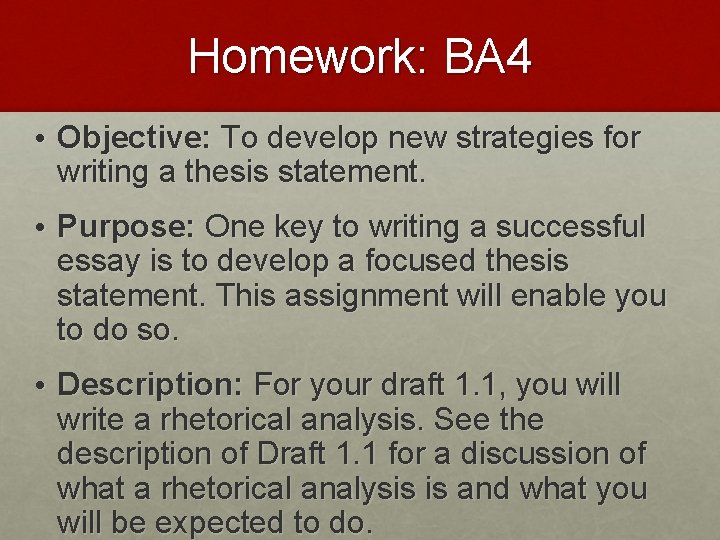
Homework: BA 4 • Objective: To develop new strategies for writing a thesis statement. • Purpose: One key to writing a successful essay is to develop a focused thesis statement. This assignment will enable you to do so. • Description: For your draft 1. 1, you will write a rhetorical analysis. See the description of Draft 1. 1 for a discussion of what a rhetorical analysis is and what you will be expected to do.
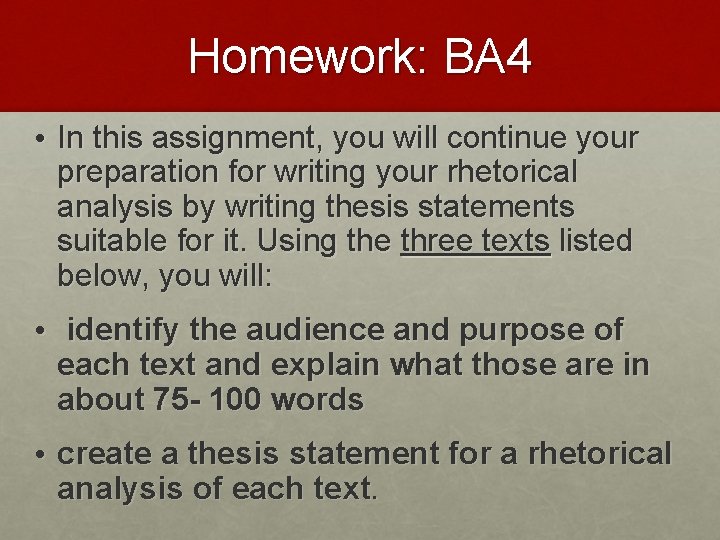
Homework: BA 4 • In this assignment, you will continue your preparation for writing your rhetorical analysis by writing thesis statements suitable for it. Using the three texts listed below, you will: • identify the audience and purpose of each text and explain what those are in about 75 - 100 words • create a thesis statement for a rhetorical analysis of each text.
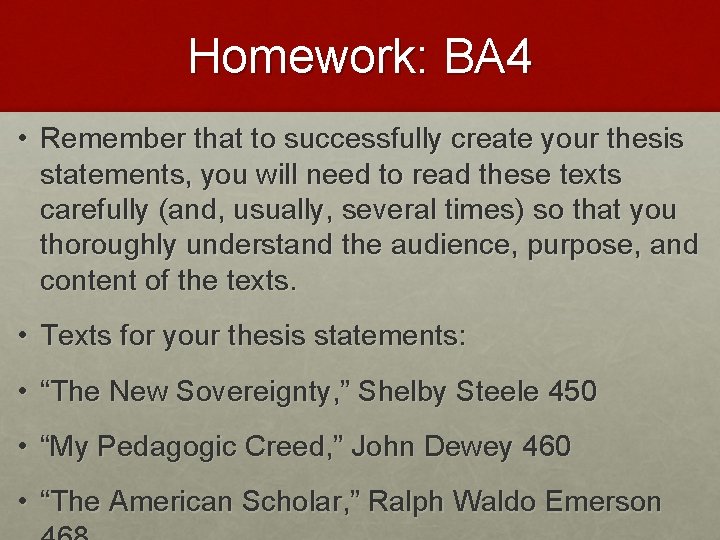
Homework: BA 4 • Remember that to successfully create your thesis statements, you will need to read these texts carefully (and, usually, several times) so that you thoroughly understand the audience, purpose, and content of the texts. • Texts for your thesis statements: • “The New Sovereignty, ” Shelby Steele 450 • “My Pedagogic Creed, ” John Dewey 460 • “The American Scholar, ” Ralph Waldo Emerson
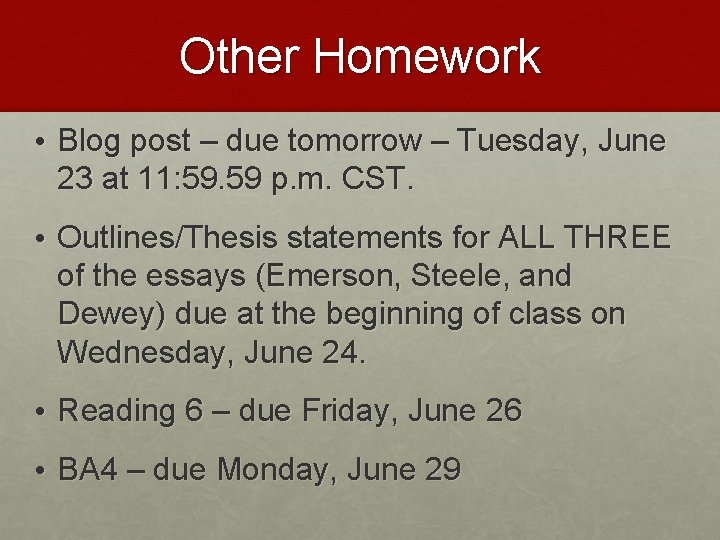
Other Homework • Blog post – due tomorrow – Tuesday, June 23 at 11: 59. 59 p. m. CST. • Outlines/Thesis statements for ALL THREE of the essays (Emerson, Steele, and Dewey) due at the beginning of class on Wednesday, June 24. • Reading 6 – due Friday, June 26 • BA 4 – due Monday, June 29
Why and how to create a useful outline • Below are the primary reasons for creating an outline: • Aids in the process of writing • Helps you organize your ideas • Presents your material in a logical form • Shows the relationships among ideas in your writing • Constructs an ordered overview of your writing • Defines boundaries and groups
Why and how to create a useful outline • How do I create an outline? • Determine the purpose of the essay paper. • Determine the audience the essay was written for. • Develop a working thesis for the essay. • Answer the question “What does the text say? ” • Answer the question “What does the text do? ”
Thanks for being here Today! • Questions? You can reach me at: ashley. edlin@ttu. edu English Room 459, M W F 9: 00 a. m. – 10: 00 a. m.