WARNING Learners please complete the Learner Survey ucalgary
- Slides: 27
WARNING Learners, please complete the Learner Survey (ucalgary. ca/codeblue/surveys) before viewing this Power. Point 1
INTRO TO CODE BLUE 2
INTRO TO CODE BLUE PURPOSE Experience management of code blues Suggest plans for acute care cases Practice leadership and teamwork skills Practice early CPR and defibrillation 3
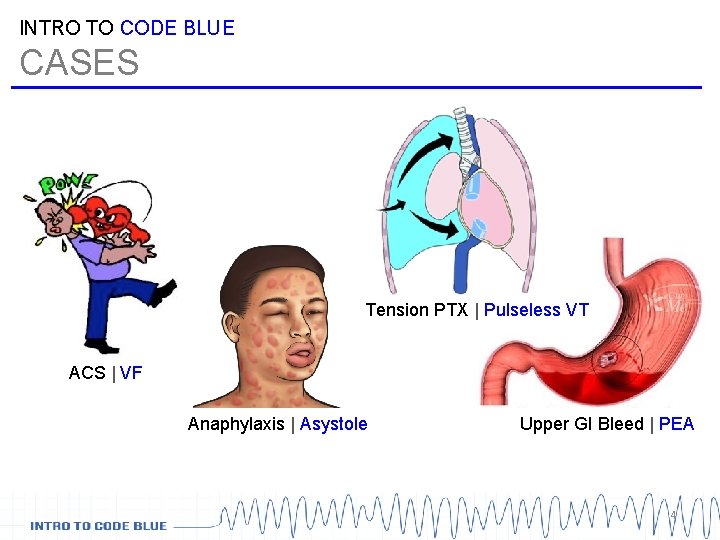
INTRO TO CODE BLUE CASES Tension PTX | Pulseless VT ACS | VF Anaphylaxis | Asystole Upper GI Bleed | PEA 4
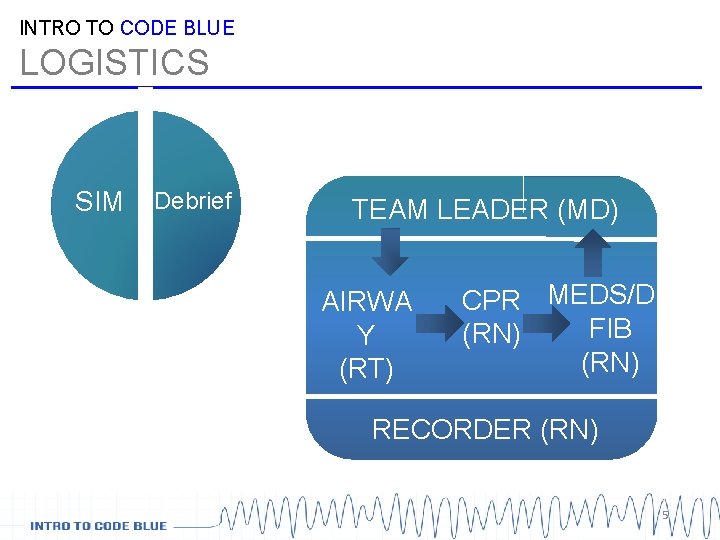
INTRO TO CODE BLUE LOGISTICS SIM Debrief TEAM LEADER (MD) AIRWA Y (RT) CPR MEDS/DE FIB (RN) RECORDER (RN) 5
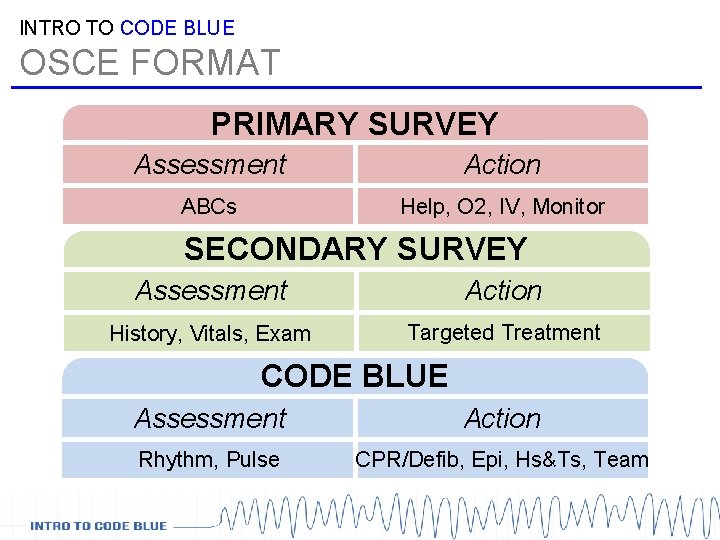
INTRO TO CODE BLUE OSCE FORMAT PRIMARY SURVEY Assessment Action ABCs Help, O 2, IV, Monitor SECONDARY SURVEY Assessment Action History, Vitals, Exam Targeted Treatment CODE BLUE Assessment Action Rhythm, Pulse CPR/Defib, Epi, Hs&Ts, Team
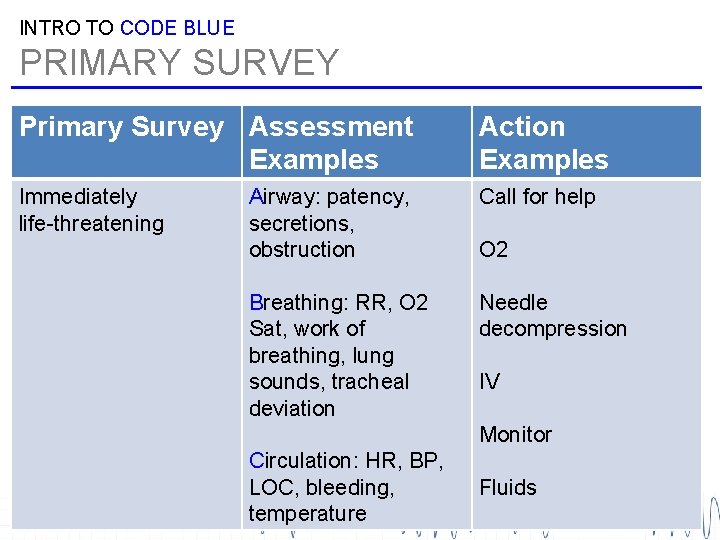
INTRO TO CODE BLUE PRIMARY SURVEY Primary Survey Assessment Examples Action Examples Immediately life-threatening Airway: patency, secretions, obstruction Call for help Breathing: RR, O 2 Sat, work of breathing, lung sounds, tracheal deviation Needle decompression O 2 IV Monitor Circulation: HR, BP, LOC, bleeding, temperature Fluids 7
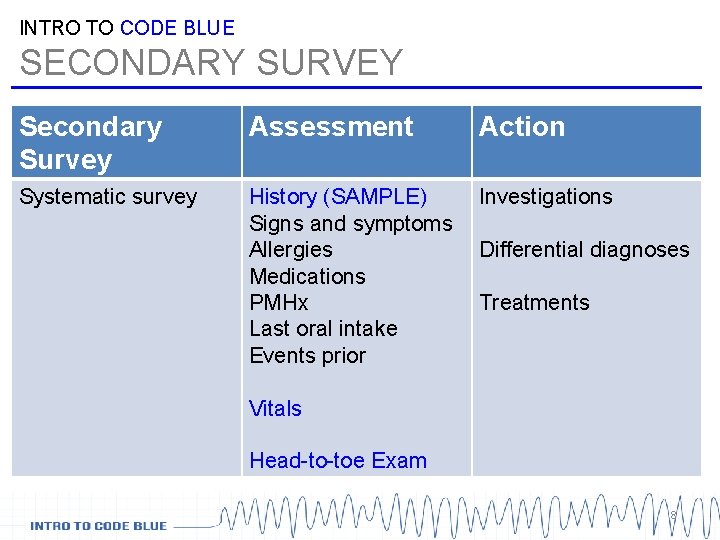
INTRO TO CODE BLUE SECONDARY SURVEY Secondary Survey Assessment Action Systematic survey History (SAMPLE) Signs and symptoms Allergies Medications PMHx Last oral intake Events prior Investigations Differential diagnoses Treatments Vitals Head-to-toe Exam 8
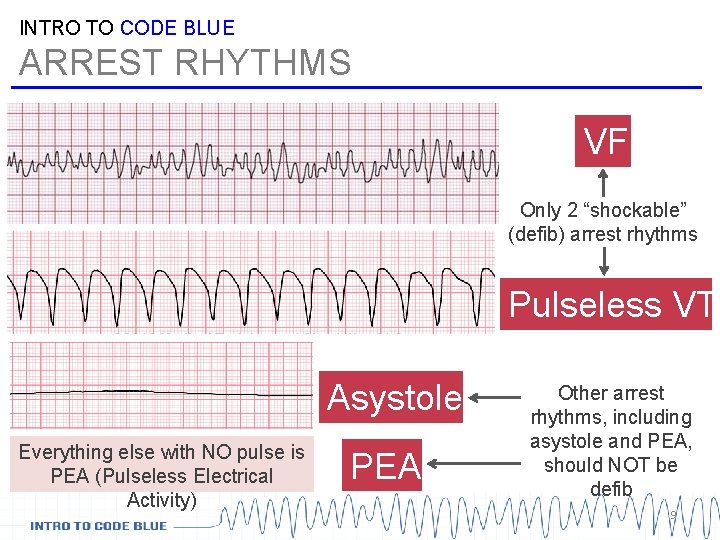
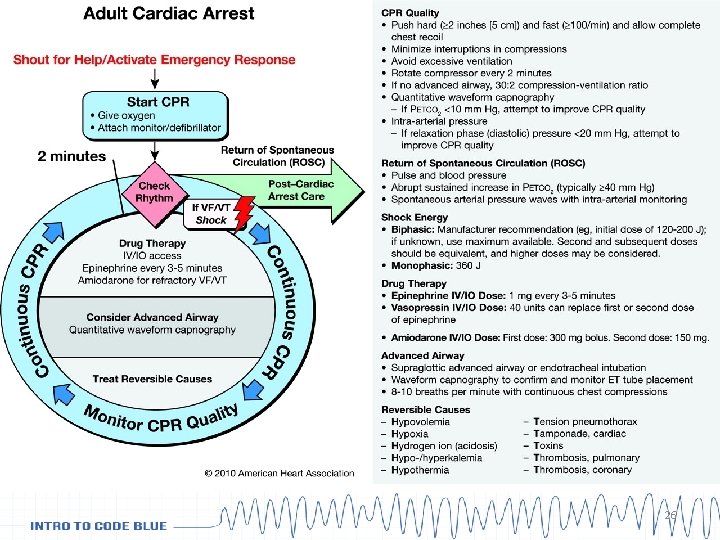
INTRO TO CODE BLUE ARREST RHYTHMS VF Only 2 “shockable” (defib) arrest rhythms Pulseless VT Asystole Everything else with NO pulse is PEA (Pulseless Electrical Activity) PEA Other arrest rhythms, including asystole and PEA, should NOT be defib 9
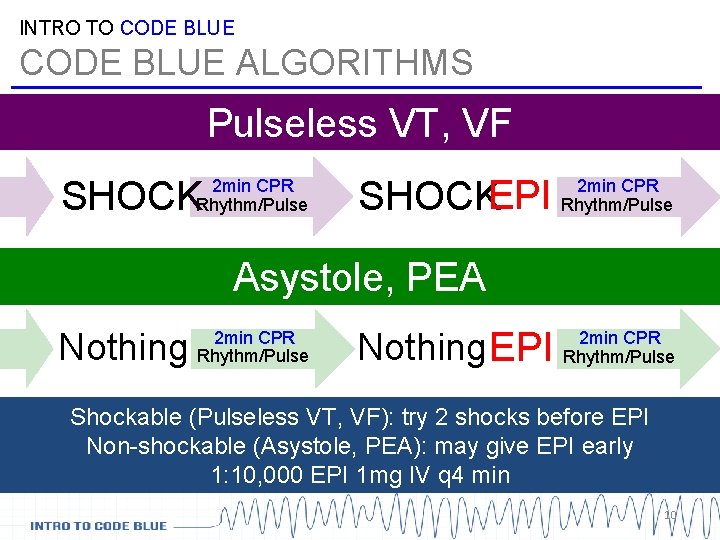
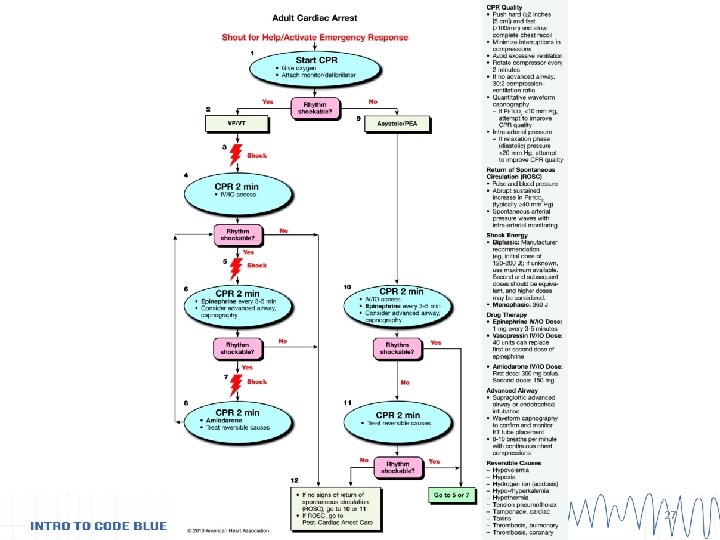
INTRO TO CODE BLUE ALGORITHMS Pulseless VT, VF SHOCK 2 min CPR Rhythm/Pulse SHOCKEPI 2 min CPR Rhythm/Pulse Asystole, PEA Nothing 2 min CPR Rhythm/Pulse Nothing EPI 2 min CPR Rhythm/Pulse Shockable (Pulseless VT, VF): try 2 shocks before EPI Non-shockable (Asystole, PEA): may give EPI early 1: 10, 000 EPI 1 mg IV q 4 min 10
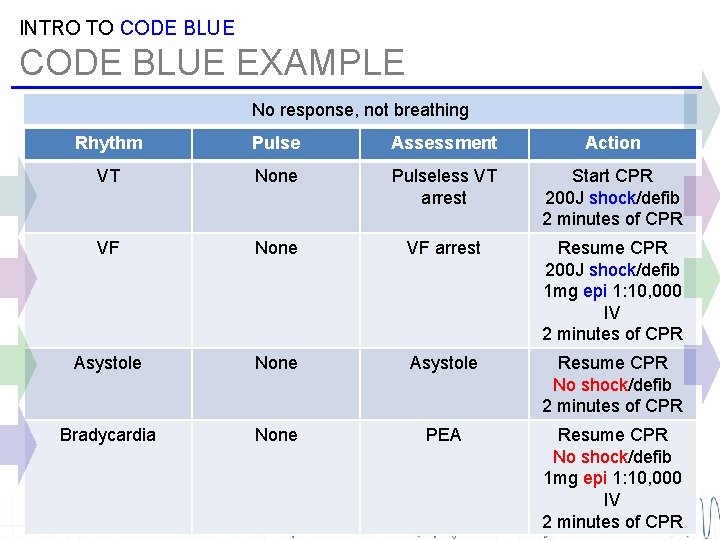
INTRO TO CODE BLUE EXAMPLE No response, not breathing Rhythm Pulse Assessment Action VT None Pulseless VT arrest Start CPR 200 J shock/defib 2 minutes of CPR VF None VF arrest Resume CPR 200 J shock/defib 1 mg epi 1: 10, 000 IV 2 minutes of CPR Asystole None Asystole Resume CPR No shock/defib 2 minutes of CPR Bradycardia None PEA Resume CPR No shock/defib 1 mg epi 1: 10, 000 IV 11 2 minutes of CPR
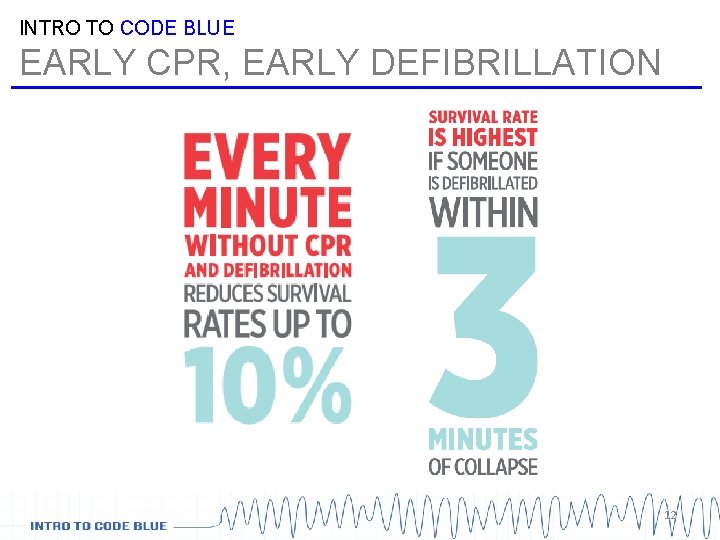
INTRO TO CODE BLUE EARLY CPR, EARLY DEFIBRILLATION 12
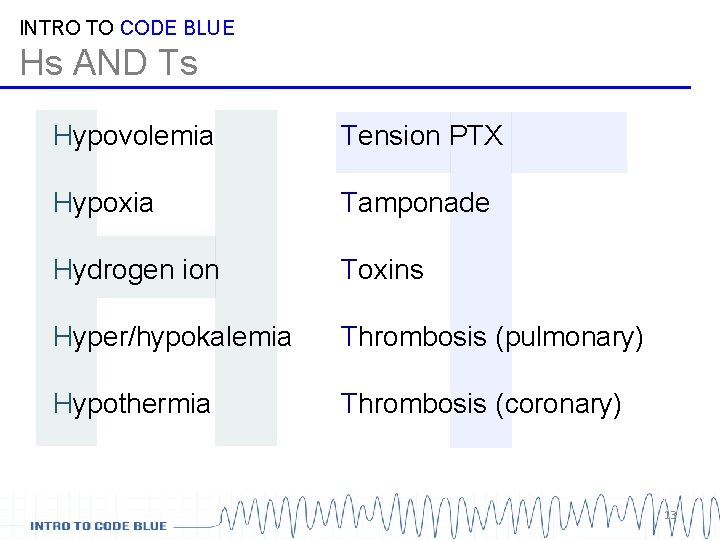
INTRO TO CODE BLUE Hs AND Ts Hypovolemia Tension PTX Hypoxia Tamponade Hydrogen ion Toxins Hyper/hypokalemia Thrombosis (pulmonary) Hypothermia Thrombosis (coronary) 13
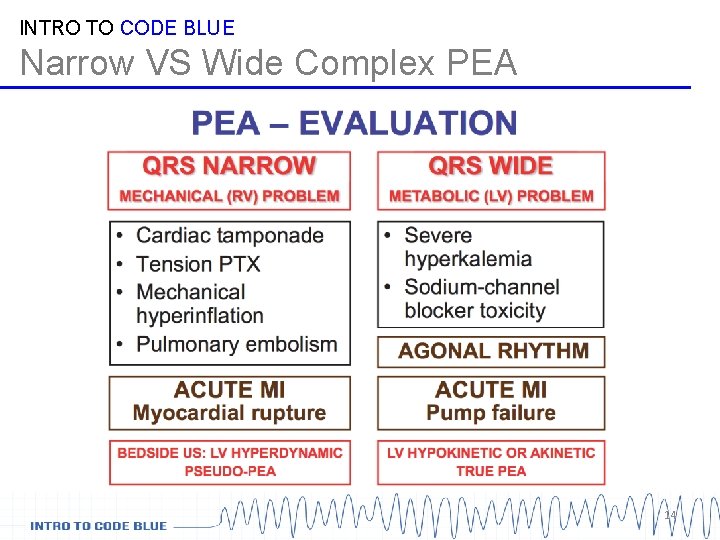
INTRO TO CODE BLUE Narrow VS Wide Complex PEA 14
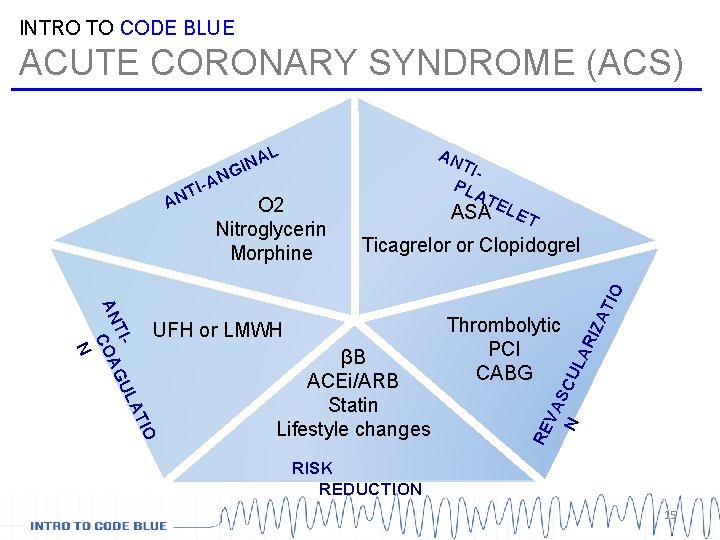
INTRO TO CODE BLUE ACUTE CORONARY SYNDROME (ACS) L TIPL A -AN T ASA ELET Ticagrelor or Clopidogrel TIO LA TIGU AN COA N UFH or LMWH βB ACEi/ARB Statin Lifestyle changes Thrombolytic PCI CABG IZA TIO O 2 Nitroglycerin Morphine RE VA SC N UL AR I T AN AN A GIN RISK REDUCTION 15
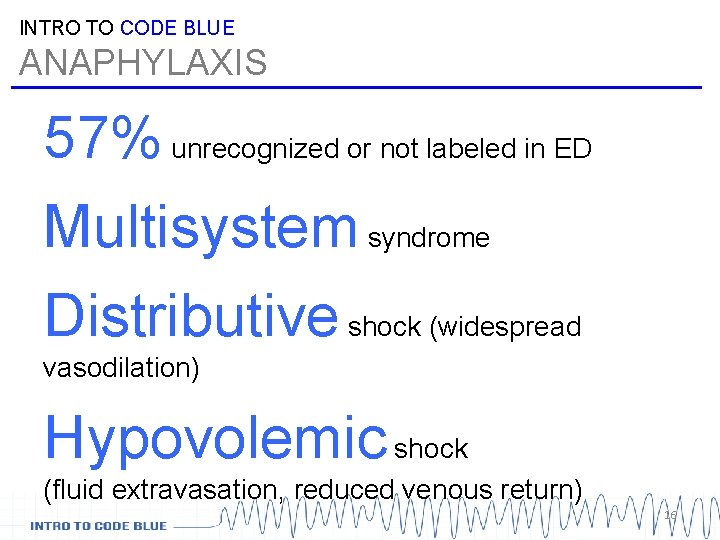
INTRO TO CODE BLUE ANAPHYLAXIS 57% unrecognized or not labeled in ED Multisystem syndrome Distributive shock (widespread vasodilation) Hypovolemic shock (fluid extravasation, reduced venous return) 16
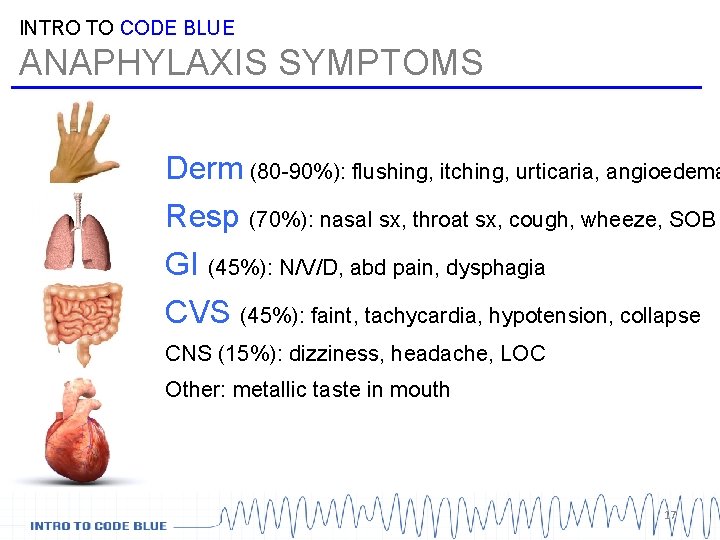
INTRO TO CODE BLUE ANAPHYLAXIS SYMPTOMS Derm (80 -90%): flushing, itching, urticaria, angioedema Resp (70%): nasal sx, throat sx, cough, wheeze, SOB GI (45%): N/V/D, abd pain, dysphagia CVS (45%): faint, tachycardia, hypotension, collapse CNS (15%): dizziness, headache, LOC Other: metallic taste in mouth 17
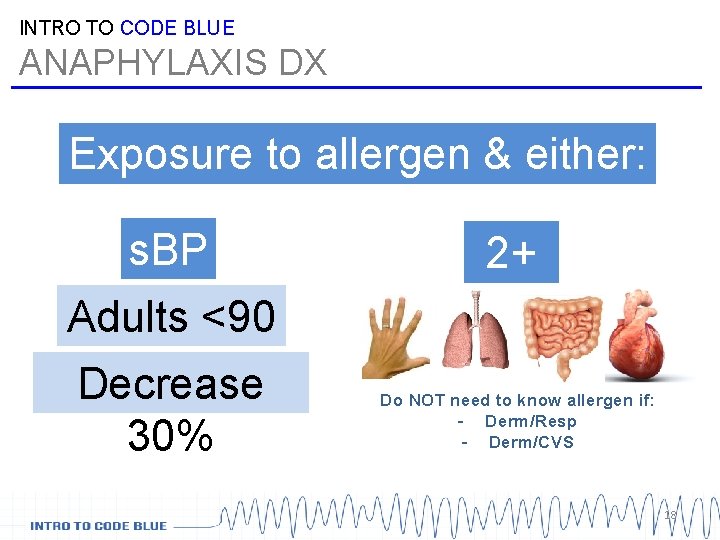
INTRO TO CODE BLUE ANAPHYLAXIS DX Exposure to allergen & either: s. BP 2+ Adults <90 Decrease 30% Do NOT need to know allergen if: - Derm/Resp - Derm/CVS 18
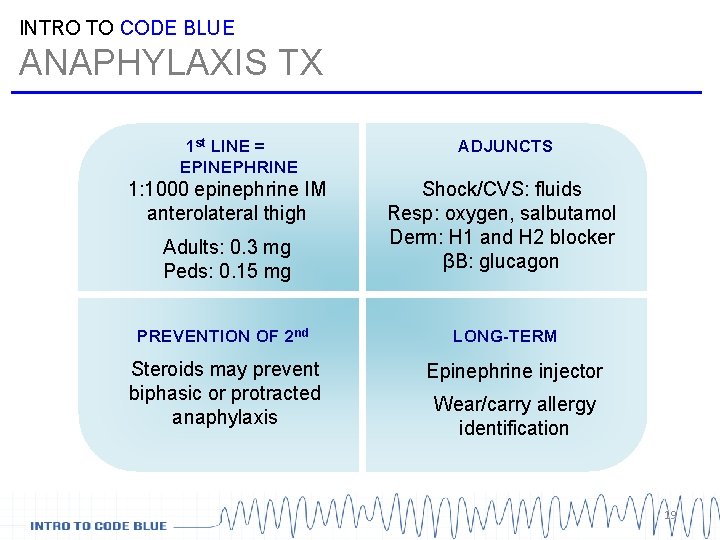
INTRO TO CODE BLUE ANAPHYLAXIS TX 1 st LINE = EPINEPHRINE 1: 1000 epinephrine IM anterolateral thigh Adults: 0. 3 mg Peds: 0. 15 mg PREVENTION OF 2 nd Steroids may prevent biphasic or protracted anaphylaxis ADJUNCTS Shock/CVS: fluids Resp: oxygen, salbutamol Derm: H 1 and H 2 blocker βB: glucagon LONG-TERM Epinephrine injector Wear/carry allergy identification 19
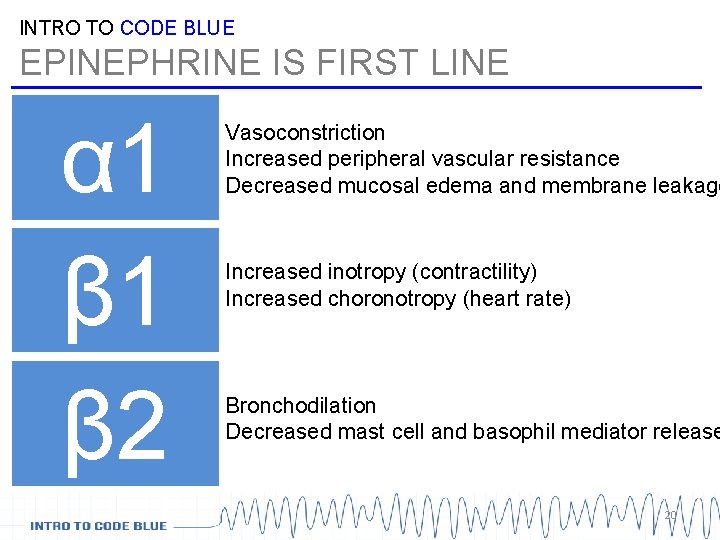
INTRO TO CODE BLUE EPINEPHRINE IS FIRST LINE α 1 β 2 Vasoconstriction Increased peripheral vascular resistance Decreased mucosal edema and membrane leakage Increased inotropy (contractility) Increased choronotropy (heart rate) Bronchodilation Decreased mast cell and basophil mediator release 20
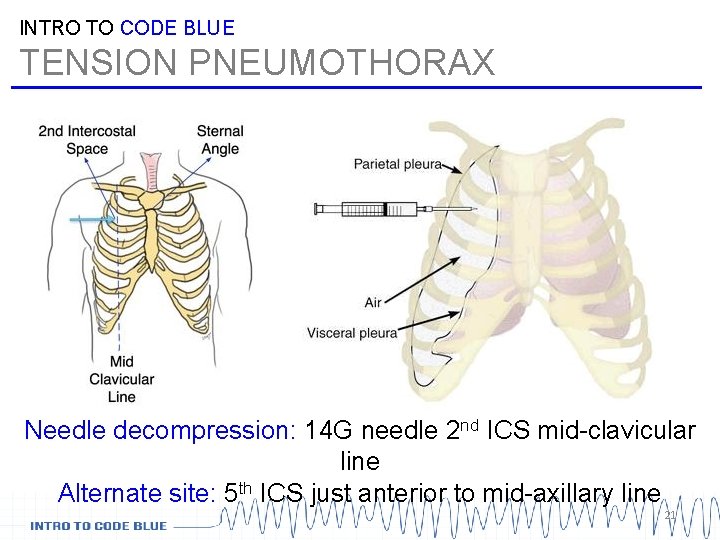
INTRO TO CODE BLUE TENSION PNEUMOTHORAX Needle decompression: 14 G needle 2 nd ICS mid-clavicular line Alternate site: 5 th ICS just anterior to mid-axillary line 21
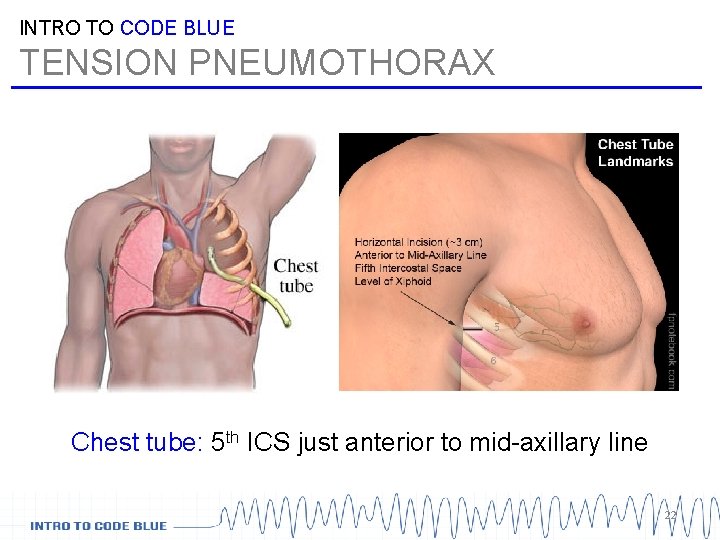
INTRO TO CODE BLUE TENSION PNEUMOTHORAX Chest tube: 5 th ICS just anterior to mid-axillary line 22
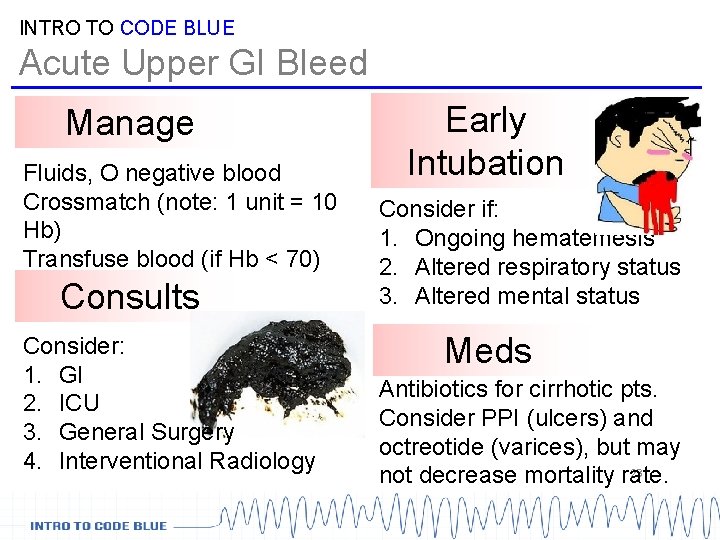
INTRO TO CODE BLUE Acute Upper GI Bleed Manage Fluids, O negative blood Crossmatch (note: 1 unit = 10 Hb) Transfuse blood (if Hb < 70) Consults Consider: 1. GI 2. ICU 3. General Surgery 4. Interventional Radiology Early Intubation Consider if: 1. Ongoing hematemesis 2. Altered respiratory status 3. Altered mental status Meds Antibiotics for cirrhotic pts. Consider PPI (ulcers) and octreotide (varices), but may 23 not decrease mortality rate.
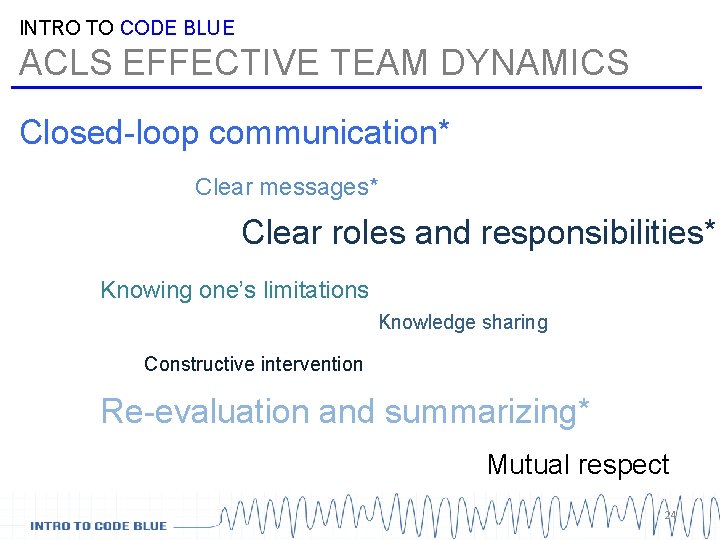
INTRO TO CODE BLUE ACLS EFFECTIVE TEAM DYNAMICS Closed-loop communication* Clear messages* Clear roles and responsibilities* Knowing one’s limitations Knowledge sharing Constructive intervention Re-evaluation and summarizing* Mutual respect 24
Slides by: Anthony Seto Cardiac Arrest Content Reviewer: Natalia Jaworska ACS Content Reviewer: Patricia Lee Anaphylaxis Content Reviewer: Kia Rokui Tension PTX Content Reviewer: Ryan Wilke UGIB Content Reviewer: Christina Yang, Niky Antony
26
27