
Welcome Please complete the survey at your place
- Slides: 42
Welcome! • Please complete the survey at your place– you’ll reflect on your answers later in the session. • Please complete the “BEFORE” section of the session evaluation. • Please turn off or “mute” cell phones and pagers. If you must take an emergency call, please step outside.
Yes I Can! Including children with special health care needs in child care programs. Presented by Missouri Child Care Health Consultants
Learning Objectives Participants will understand how: • Children with special needs can be included in the child care setting • Children without disabilities can learn from those with disabilities • Teachers can expand their knowledge about child development – what is typical and what isn’t • Communities are strengthened when acceptance of diversity is high and discrimination is diminished.
Who’s Here? ? • • • Years of experience in early childhood? Years at your current job? Teacher? Administrator? Social worker? What age group(s) do you work with? Have you ever worked with a child with special needs? What were they? • Do you have a child enrolled in your program now who has special needs?
Anyone who says including children with special needs is always easy… has never done it. Anyone who says including children with special needs never works… has never tried.
So What Is Inclusion?
Inclusion Is……. …. . including children with special needs or disabilities into classrooms with children who are typically developing. Inclusion Isn’t……. …. . running “separate but equal” programs for children with special needs.
Inclusion Is……. …. . mandated by the Americans with Disabilities Act (ADA) Inclusion Isn’t……. …. . a choice
Inclusion Is……. …. . all children included together throughout the day. Inclusion Isn’t……. …. . having children included for “special times, ” but segregated for the rest of the day.
Inclusion Is……. …. . all children being an active part of the group. Inclusion Isn’t……. …. . just having children “present” in the room but apart from the group.
Inclusion Is……. …. . an opportunity for children and adults to talk about what makes us the same, AND what makes us different. Inclusion Isn’t……. …. . an occasion to ignore or avoid children’s questions or comments.
Inclusion Is……. …. . part of an overall commitment to diversity, to civil rights, to greater tolerance in our society. Inclusion Isn’t……. …. . just one more “politically correct” thing we teachers are supposed to do.
Why Inclusion? Potential Benefits… CAROUSEL… In small groups or pairs, make your way to each of the large pieces of paper posted around the room. Write down potential benefits of inclusion for the group listed at the top of the paper. Listen for the “signal” that it’s time to switch papers.
For children with special needs… • Can avoid negative stereotypes and discrimination. • Have peer models and increased opportunities for social interaction. • Maintain their rate of development. • Can learn and use skills in “real” situations. • Display more complex play. • Can become more independent.
For children without special needs… • Learn positive attitudes towards differences • Learn helping behaviors • Learn from the child with special needs
For families of children with special needs… • Learn about typical development. • Feel less isolated. • Develop relationships with other families.
For families of children without special needs… • Expand their understanding of diversity and the challenges faced by families whose children have special needs. • Develop relationships with other families.
For teachers… • Expand their knowledge and understanding of child developmentwhat’s typical, what isn’t. • Develop new skills. • Help build a stronger future!
For communities… • Are strengthened when acceptance of diversity is high and discrimination is diminished. • Can use limited resources more efficiently.
Challenges and Barriers – What can get in the way?
Attitudes, assumptions and misunderstandings • Fear of the unknown • “But I’m not qualified!” • Assumptions about what children “should” be doing at certain ages. • Assumptions about a particular special need or disability. • Assumptions about the role of the teacher in the classroom.
Training and Support • Inclusion does not require a special degree, but teachers do need information and support in many forms. • General training (like this one!) • Specialized training • On-Site Support
Balance • As much as possible, administrators of programs need to be careful to maintain appropriate “balance” in classrooms. – Consider individual needs– DON’T just “count heads. ” – Be careful not to make assumptions about what will be harder and what won’t!
Family Concerns • From families whose children have special needs, AND • From families whose children DO NOT have special needs.
Financial Issues • Money for adaptive equipment, room rearrangement, training and support staff may be limited.
The Children • Children with special needs may need more intervention and support to interact with their peers. • Children with special needs may require more, or different, individual attention. • A child’s physical limitations or medical needs may present challenges in terms of room arrangement, transitions and travel.
So what can help? What can make it work? • Work to create a sense of “can and should” instead of “have to. ” – Acknowledge fears and nervousness – Address parent concerns – Remind yourself that ALL children • Are unique • Learn in different ways • Sometimes need more 1: 1 attention
“Can and Should” cont. • Challenge your assumptions • Notice, recognize and congratulate yourself on successes
Make Yourself A Part Of The Team Who is on the team? – Families – Therapists • • OT – Occupational Therapist ST – Speech Therapist PT – Physical Therapist DT – Developmental Therapist – Classroom Teachers – Case Workers/Social Workers – Doctors and Other Health Professionals
• Becoming a part of the team – Acknowledge your value, the information you have to offer. – Be willing to take the first step – Be willing to look honestly at roles and “turf” issues.
• With families – Try to put yourself in the parents’ shoes – Acknowledge, and act on, the importance of the family’s role and knowledge. – Work to develop relationships with families.
Take an active role in getting the information and support you need.
• Attend classes and workshops on inclusion and specific special needs • Learn more about, and practice, DAP! ALL children need it, and inclusion won’t work without it! • Use your internal resources: • Use outside resources: Don’t Be Afraid To Ask For Help!
Getting Started… When you know ahead of time that you will be enrolling a child with special needs. PREPARE! • • Gather info from the family Meet the family and the child Ask questions “Think through” potential problems and solutions ahead of time.
PLAN! • Modify activities • Modify room arrangement • Provide a range of materials • Plan for transitions • Plan to use “peer helpers”
When you think a child enrolled in your program may have special needs. . . • Review developmental milestones • Observe and document • Gather information from families
Focus on a few behaviors or skills. Try solutions and approaches consistently and over time. Refer families to public schools or outside agencies when appropriate
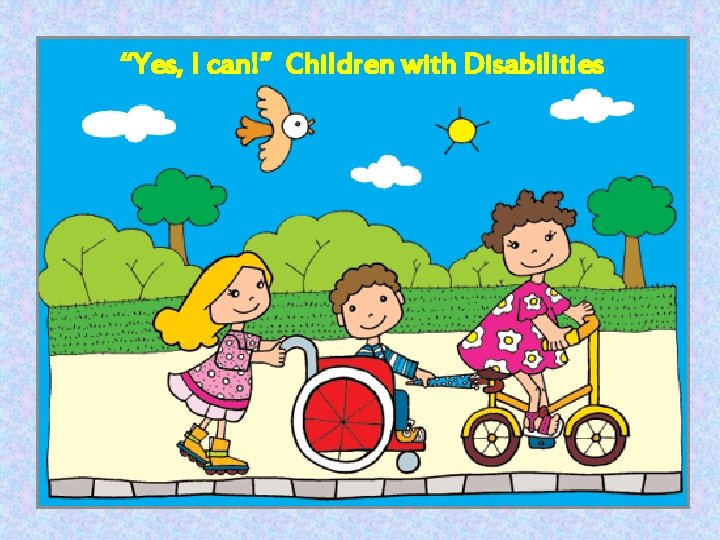
“Yes, I can!” Children with Disabilities
De. Lynn’s Story Including children with special needs is a REAL issue that affects children, families and professionals. Including children with special needs CAN work!
After the video… • Please take a few minutes to reflect on the Inclusion Survey you completed at the beginning of the session. Have any of your thoughts or ideas changed? • Please complete the “After” section of the Workshop Evaluation, and answer the other questions on the form. THANK YOU FOR COMING!
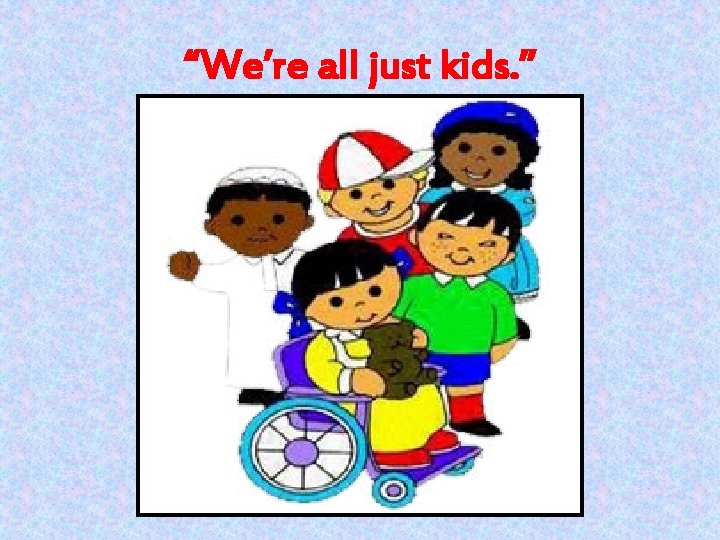
“We’re all just kids. ”
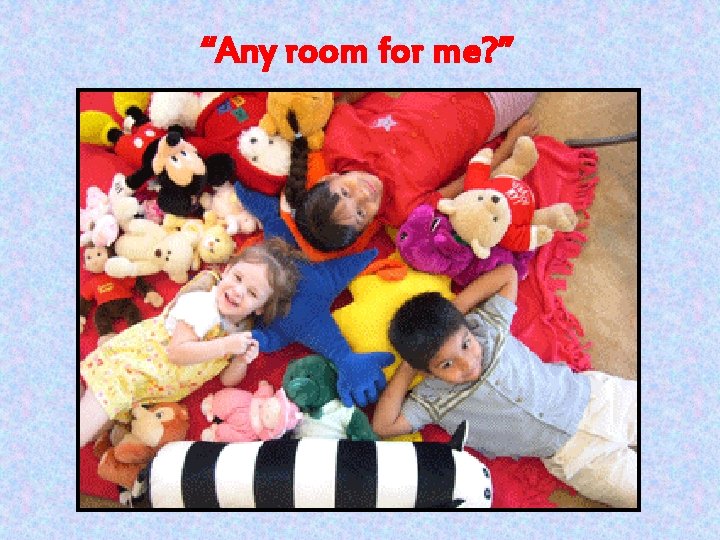
“Any room for me? ”