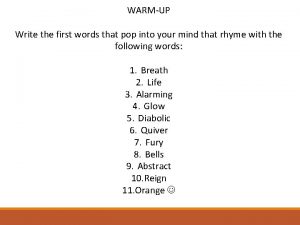
Warm Up Rhyming Game Please stand in circles


- Slides: 21
Warm Up: Rhyming Game Please stand in circles of ~10 people. © 2014 Core Knowledge Foundation. This work is licensed under a Creative Commons Attribution-Non. Commercial-Share. Alike 3. 0 Unported License. www. creativecommons. org/licenses/by-nc-sa/3. 0/ Engage. NY. org 1
Scaffolding Learning During Small Group Skills Instruction © 2014 Core Knowledge Foundation. This work is licensed under a Creative Commons Attribution-Non. Commercial-Share. Alike 3. 0 Unported License. www. creativecommons. org/licenses/by-nc-sa/3. 0/ Engage. NY. org 3
Objective By the end of this session, you will be able to scaffold a Small Group Skills activity using the Planning Tool (handout) and your knowledge of the three scaffolding strategies. © 2014 Core Knowledge Foundation. This work is licensed under a Creative Commons Attribution-Non. Commercial-Share. Alike 3. 0 Unported License. www. creativecommons. org/licenses/by-nc-sa/3. 0/ Engage. NY. org 4
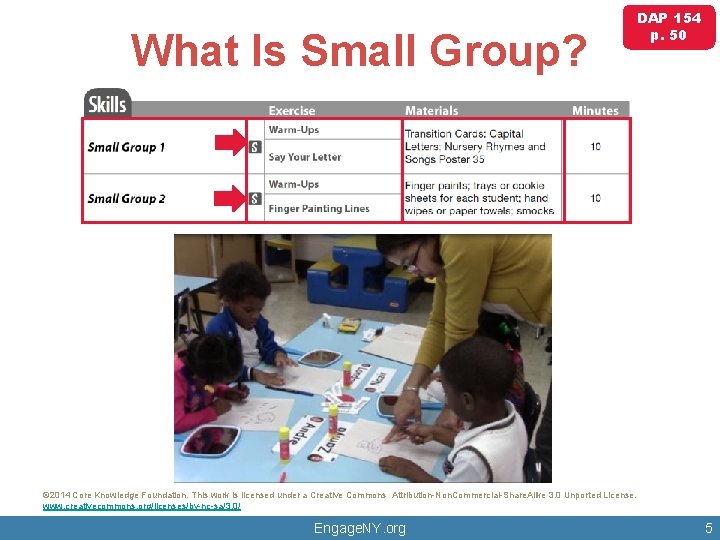
What Is Small Group? DAP 154 p. 50 © 2014 Core Knowledge Foundation. This work is licensed under a Creative Commons Attribution-Non. Commercial-Share. Alike 3. 0 Unported License. www. creativecommons. org/licenses/by-nc-sa/3. 0/ Engage. NY. org 5
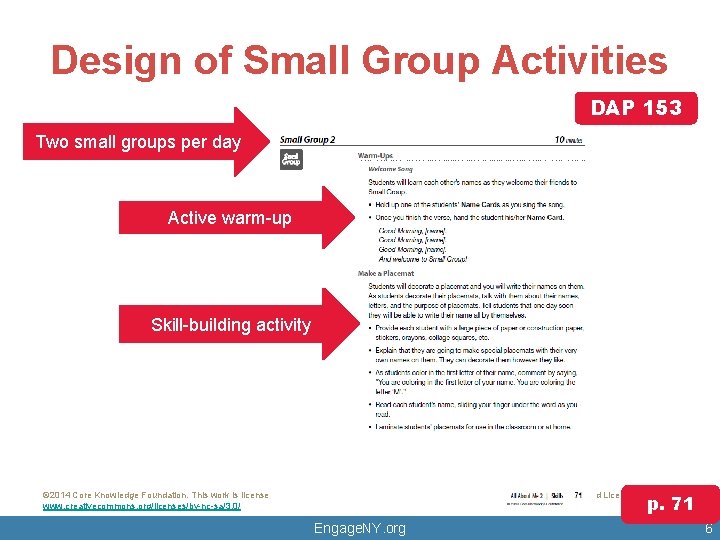
Design of Small Group Activities DAP 153 Two small groups per day Active warm-up Skill-building activity © 2014 Core Knowledge Foundation. This work is licensed under a Creative Commons Attribution-Non. Commercial-Share. Alike 3. 0 Unported License. www. creativecommons. org/licenses/by-nc-sa/3. 0/ Engage. NY. org p. 71 6
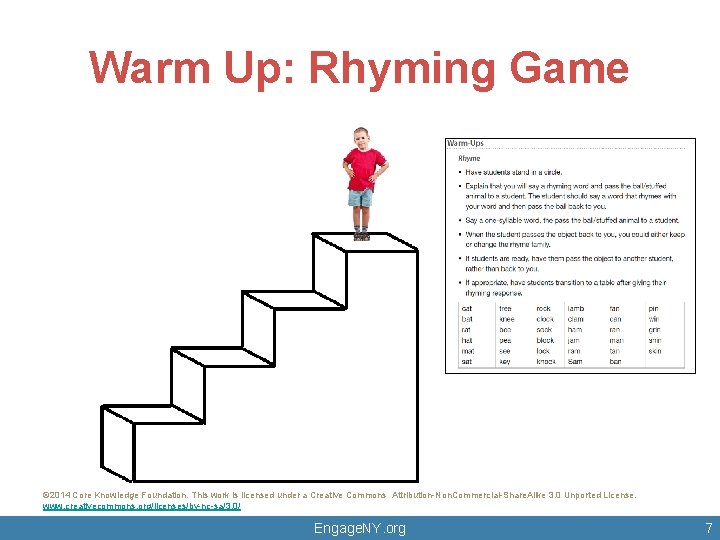
Warm Up: Rhyming Game © 2014 Core Knowledge Foundation. This work is licensed under a Creative Commons Attribution-Non. Commercial-Share. Alike 3. 0 Unported License. www. creativecommons. org/licenses/by-nc-sa/3. 0/ Engage. NY. org 7
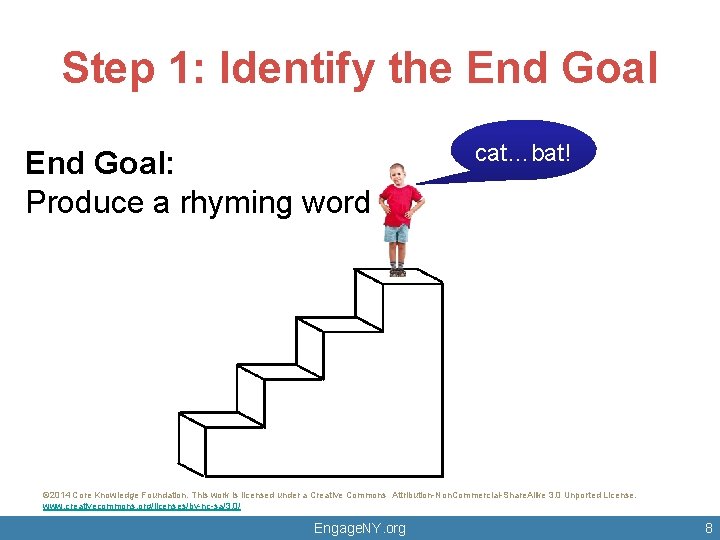
Step 1: Identify the End Goal: Produce a rhyming word cat…bat! © 2014 Core Knowledge Foundation. This work is licensed under a Creative Commons Attribution-Non. Commercial-Share. Alike 3. 0 Unported License. www. creativecommons. org/licenses/by-nc-sa/3. 0/ Engage. NY. org 8
Step 2: Identify the Steps “cat…bat!” Expressive thumbs up (yes, that rhymes) Receptive Produce a rhyming word Hear prompt word Assumed skill: identify whether two words rhyme Understand passing rules Stand quietly in a circle © 2014 Core Knowledge Foundation. This work is licensed under a Creative Commons Attribution-Non. Commercial-Share. Alike 3. 0 Unported License. www. creativecommons. org/licenses/by-nc-sa/3. 0/ Engage. NY. org 9
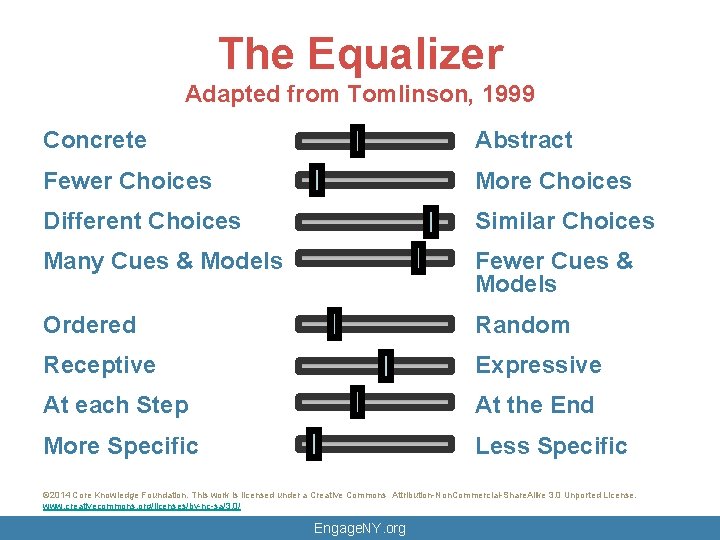
The Equalizer Adapted from Tomlinson, 1999 Concrete Abstract Fewer Choices More Choices Different Choices Similar Choices Many Cues & Models Fewer Cues & Models Ordered Random Receptive Expressive At each Step At the End More Specific Less Specific © 2014 Core Knowledge Foundation. This work is licensed under a Creative Commons Attribution-Non. Commercial-Share. Alike 3. 0 Unported License. www. creativecommons. org/licenses/by-nc-sa/3. 0/ Engage. NY. org
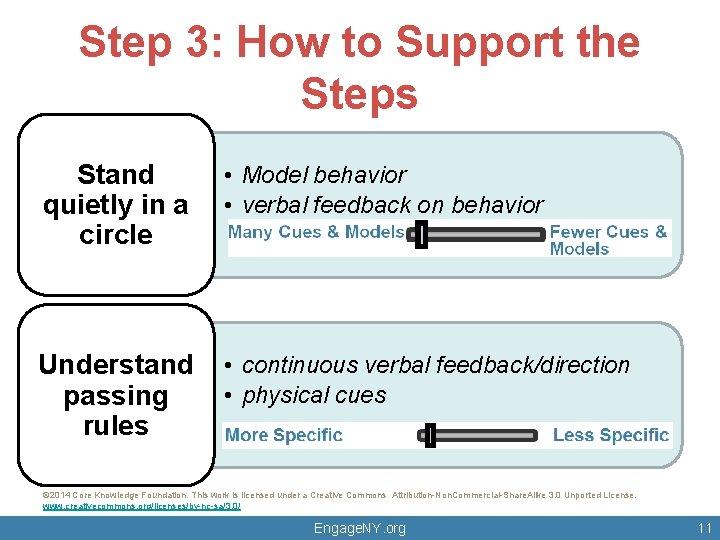
Step 3: How to Support the Steps Stand quietly in a circle • Model behavior • verbal feedback on behavior Understand passing rules • continuous verbal feedback/direction • physical cues © 2014 Core Knowledge Foundation. This work is licensed under a Creative Commons Attribution-Non. Commercial-Share. Alike 3. 0 Unported License. www. creativecommons. org/licenses/by-nc-sa/3. 0/ Engage. NY. org 11
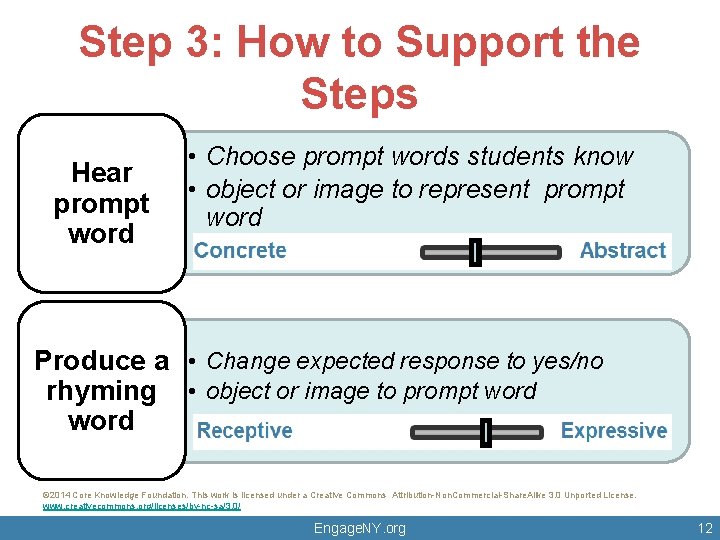
Step 3: How to Support the Steps Hear prompt word • Choose prompt words students know • object or image to represent prompt word Produce a • Change expected response to yes/no rhyming • object or image to prompt word © 2014 Core Knowledge Foundation. This work is licensed under a Creative Commons Attribution-Non. Commercial-Share. Alike 3. 0 Unported License. www. creativecommons. org/licenses/by-nc-sa/3. 0/ Engage. NY. org 12
Do Now • Read Small Group 2: Silly Animal Rhymes. • As you read think about the stair-steps. © 2014 Core Knowledge Foundation. This work is licensed under a Creative Commons Attribution-Non. Commercial-Share. Alike 3. 0 Unported License. www. creativecommons. org/licenses/by-nc-sa/3. 0/ Engage. NY. org 13
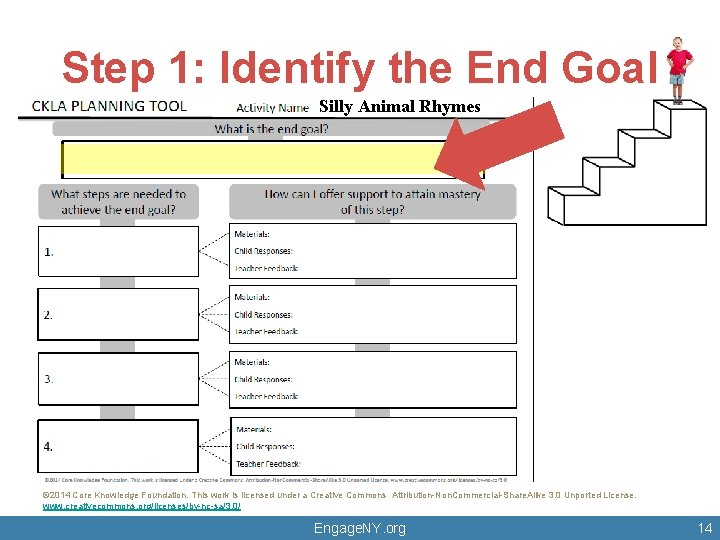
Step 1: Identify the End Goal Silly Animal Rhymes © 2014 Core Knowledge Foundation. This work is licensed under a Creative Commons Attribution-Non. Commercial-Share. Alike 3. 0 Unported License. www. creativecommons. org/licenses/by-nc-sa/3. 0/ Engage. NY. org 14
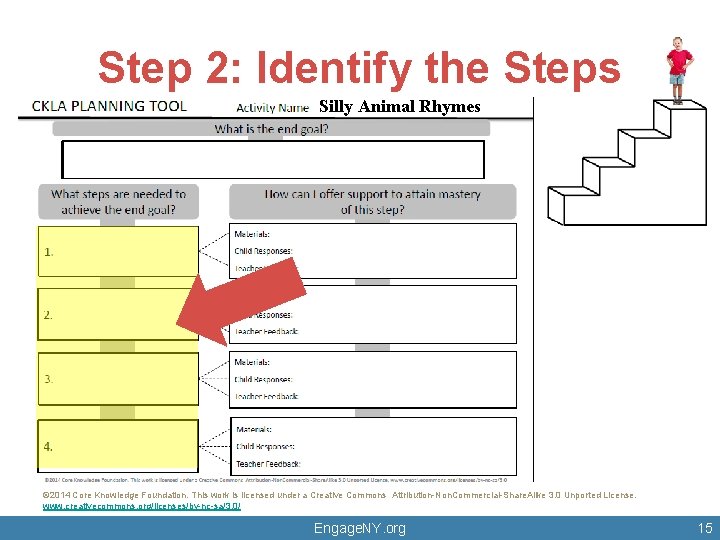
Step 2: Identify the Steps Silly Animal Rhymes © 2014 Core Knowledge Foundation. This work is licensed under a Creative Commons Attribution-Non. Commercial-Share. Alike 3. 0 Unported License. www. creativecommons. org/licenses/by-nc-sa/3. 0/ Engage. NY. org 15
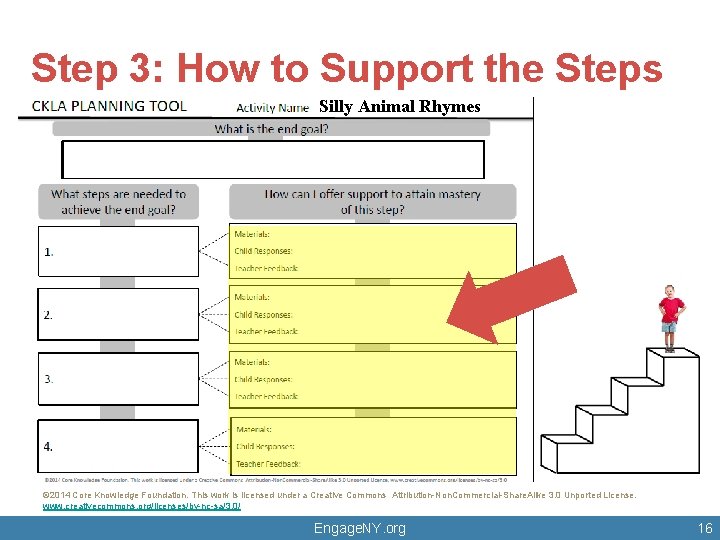
Step 3: How to Support the Steps Silly Animal Rhymes © 2014 Core Knowledge Foundation. This work is licensed under a Creative Commons Attribution-Non. Commercial-Share. Alike 3. 0 Unported License. www. creativecommons. org/licenses/by-nc-sa/3. 0/ Engage. NY. org 16
Debrief Each group share scaffolding ideas. What is being used to provide scaffolding? ¦ Materials ¦ Teacher Feedback ¦ Child Response © 2014 Core Knowledge Foundation. This work is licensed under a Creative Commons Attribution-Non. Commercial-Share. Alike 3. 0 Unported License. www. creativecommons. org/licenses/by-nc-sa/3. 0/ Engage. NY. org 17
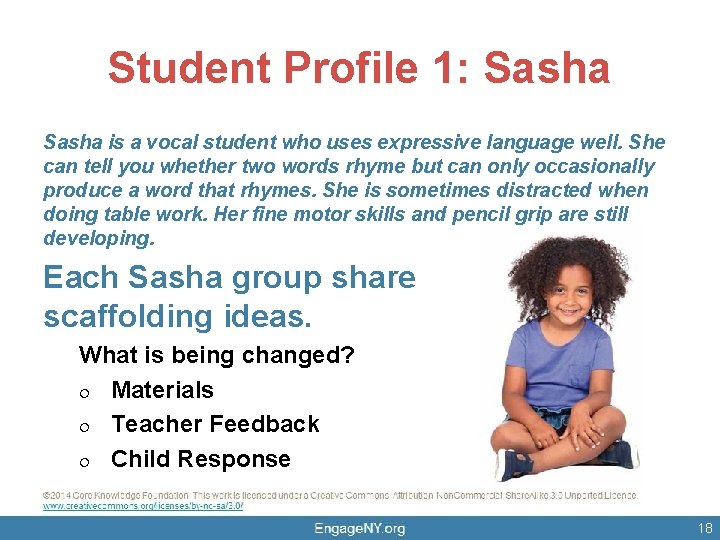
Student Profile 1: Sasha is a vocal student who uses expressive language well. She can tell you whether two words rhyme but can only occasionally produce a word that rhymes. She is sometimes distracted when doing table work. Her fine motor skills and pencil grip are still developing. Each Sasha group share scaffolding ideas. What is being changed? ¦ Materials ¦ Teacher Feedback ¦ Child Response © 2014 Core Knowledge Foundation. This work is licensed under a Creative Commons Attribution-Non. Commercial-Share. Alike 3. 0 Unported License. www. creativecommons. org/licenses/by-nc-sa/3. 0/ Engage. NY. org 18
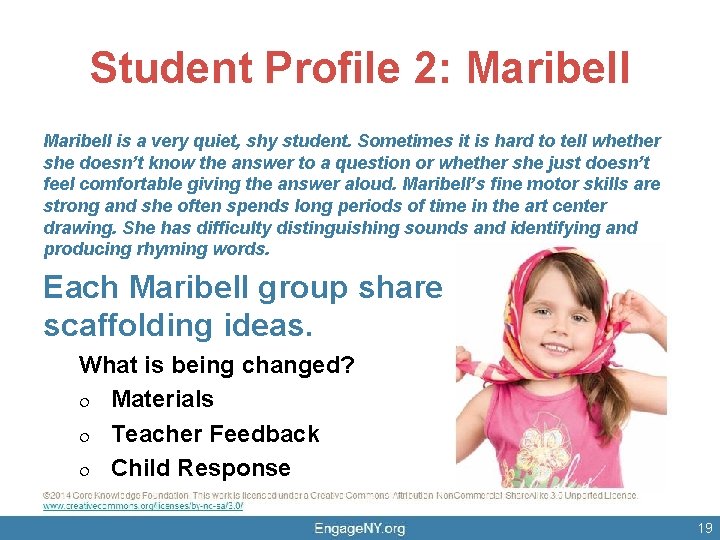
Student Profile 2: Maribell is a very quiet, shy student. Sometimes it is hard to tell whether she doesn’t know the answer to a question or whether she just doesn’t feel comfortable giving the answer aloud. Maribell’s fine motor skills are strong and she often spends long periods of time in the art center drawing. She has difficulty distinguishing sounds and identifying and producing rhyming words. Each Maribell group share scaffolding ideas. What is being changed? ¦ Materials ¦ Teacher Feedback ¦ Child Response © 2014 Core Knowledge Foundation. This work is licensed under a Creative Commons Attribution-Non. Commercial-Share. Alike 3. 0 Unported License. www. creativecommons. org/licenses/by-nc-sa/3. 0/ Engage. NY. org 19
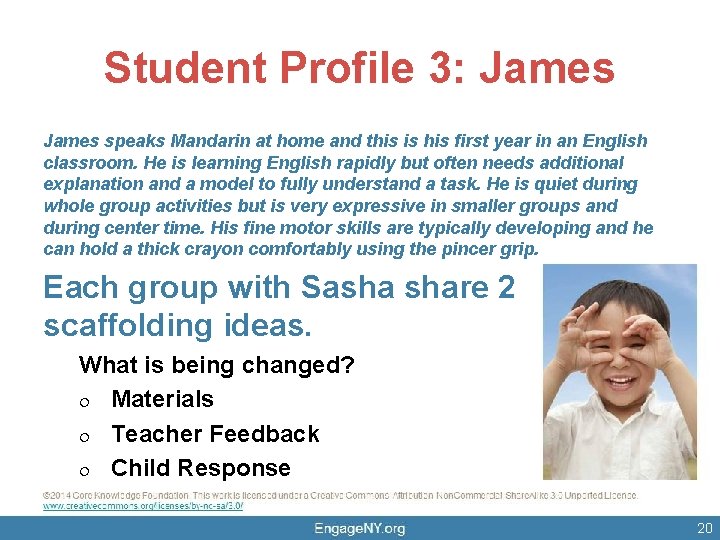
Student Profile 3: James speaks Mandarin at home and this is his first year in an English classroom. He is learning English rapidly but often needs additional explanation and a model to fully understand a task. He is quiet during whole group activities but is very expressive in smaller groups and during center time. His fine motor skills are typically developing and he can hold a thick crayon comfortably using the pincer grip. Each group with Sasha share 2 scaffolding ideas. What is being changed? ¦ Materials ¦ Teacher Feedback ¦ Child Response © 2014 Core Knowledge Foundation. This work is licensed under a Creative Commons Attribution-Non. Commercial-Share. Alike 3. 0 Unported License. www. creativecommons. org/licenses/by-nc-sa/3. 0/ Engage. NY. org 20
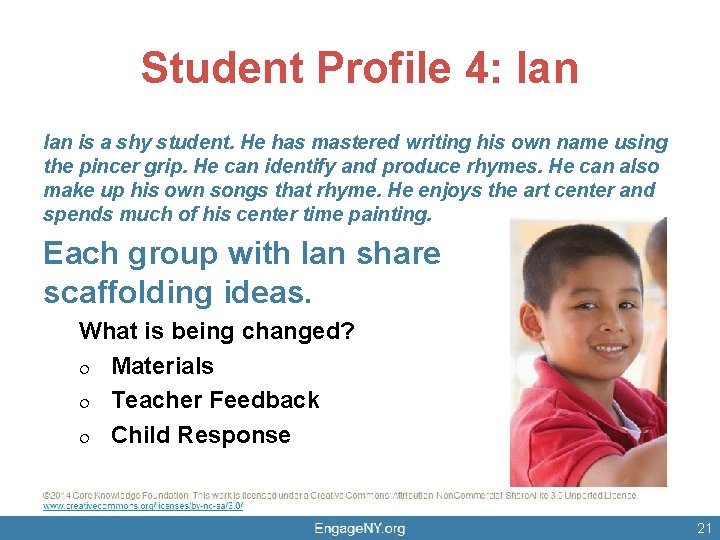
Student Profile 4: Ian is a shy student. He has mastered writing his own name using the pincer grip. He can identify and produce rhymes. He can also make up his own songs that rhyme. He enjoys the art center and spends much of his center time painting. Each group with Ian share scaffolding ideas. What is being changed? ¦ Materials ¦ Teacher Feedback ¦ Child Response © 2014 Core Knowledge Foundation. This work is licensed under a Creative Commons Attribution-Non. Commercial-Share. Alike 3. 0 Unported License. www. creativecommons. org/licenses/by-nc-sa/3. 0/ Engage. NY. org 21
Wrap Up and Reflection • The Planning Tool is flexible ¦ ¦ Levels of use (school, class, student) Application (skill developed over time or simple 10 minute activity) • How can this planning tool help you plan for diverse learners? © 2014 Core Knowledge Foundation. This work is licensed under a Creative Commons Attribution-Non. Commercial-Share. Alike 3. 0 Unported License. www. creativecommons. org/licenses/by-nc-sa/3. 0/ Engage. NY. org 22