Walk With Ease Training for Program Administrators May

- Slides: 28
Walk With Ease Training for Program Administrators May 31, 2017
Training Content Overview of Walk With Ease Program Syllabus (script) Managing the Program • Leader and Administrator Roles Teaching Tips • Providing support to Leaders Post-program Strategies Leader’s Knowledge Self-Test
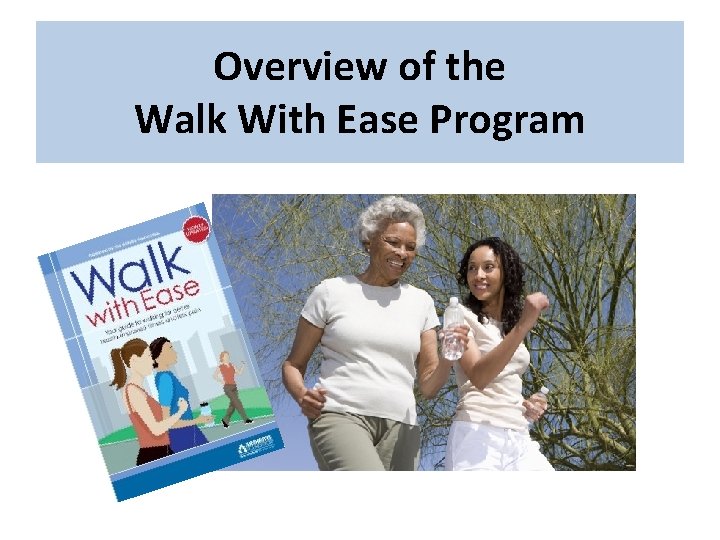
Overview of the Walk With Ease Program
Program Goals • Gain an understanding of the basics of arthritis, and the relationship between arthritis, exercise and pain • Learn how to exercise safely and comfortably • Use methods to make walking fun • Develop and implement a doable personal walking plan with realistic goals for improved fitness • Gather tips, strategies and resources that will help participants maintain a long term exercise routine • Learn about other programs and resources that help participants keep up their walking
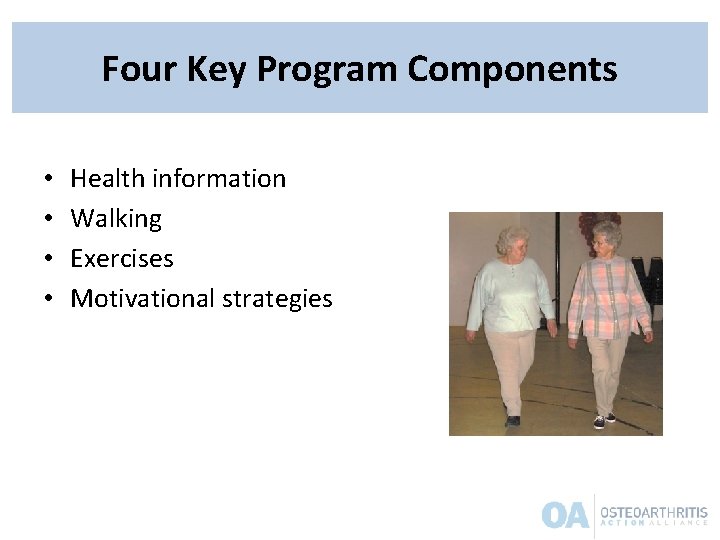
Four Key Program Components • • Health information Walking Exercises Motivational strategies
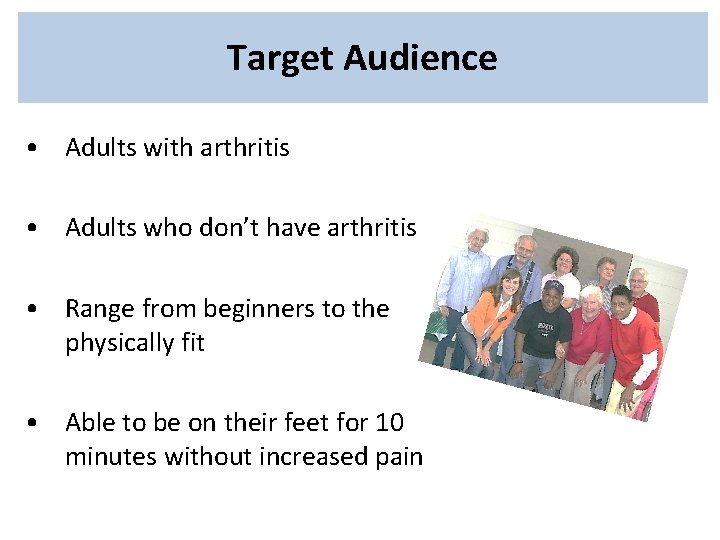
Target Audience • Adults with arthritis • Adults who don’t have arthritis • Range from beginners to the physically fit • Able to be on their feet for 10 minutes without increased pain
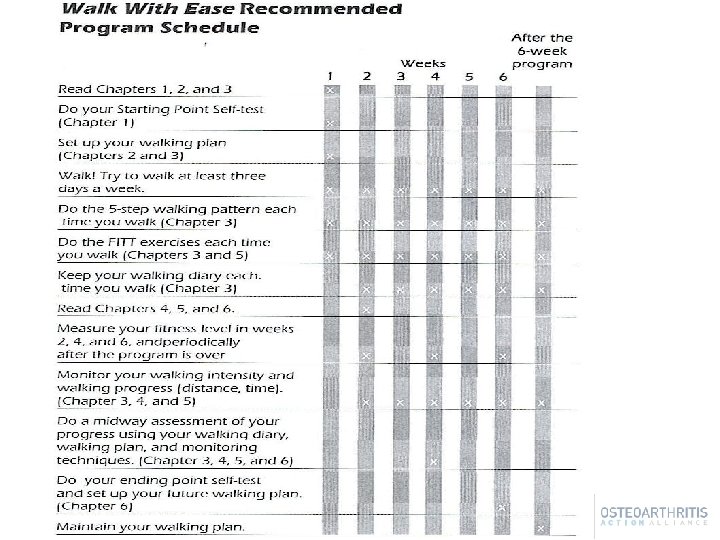
Program Structure • 6 week program that meets 3 times a week • Class sessions are about 1 hour • Leaders can instruct the classes independently or with another trained Walk With Ease Leader • Follow the script in Part 2 of the Leader’s Guide
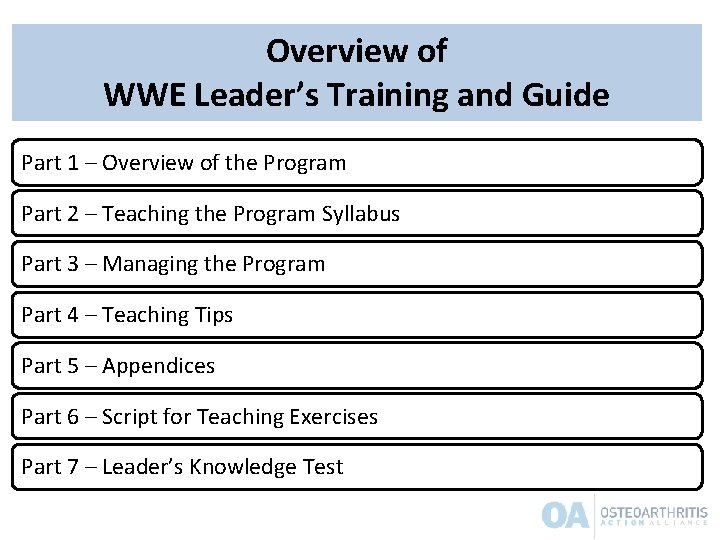
Overview of WWE Leader’s Training and Guide Part 1 – Overview of the Program Part 2 – Teaching the Program Syllabus Part 3 – Managing the Program Part 4 – Teaching Tips Part 5 – Appendices Part 6 – Script for Teaching Exercises Part 7 – Leader’s Knowledge Test
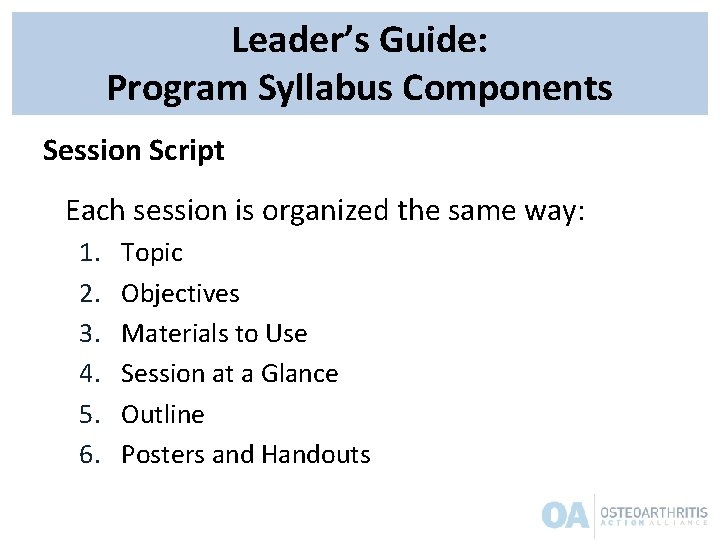
Leader’s Guide: Program Syllabus Components Session Script Each session is organized the same way: 1. 2. 3. 4. 5. 6. Topic Objectives Materials to Use Session at a Glance Outline Posters and Handouts
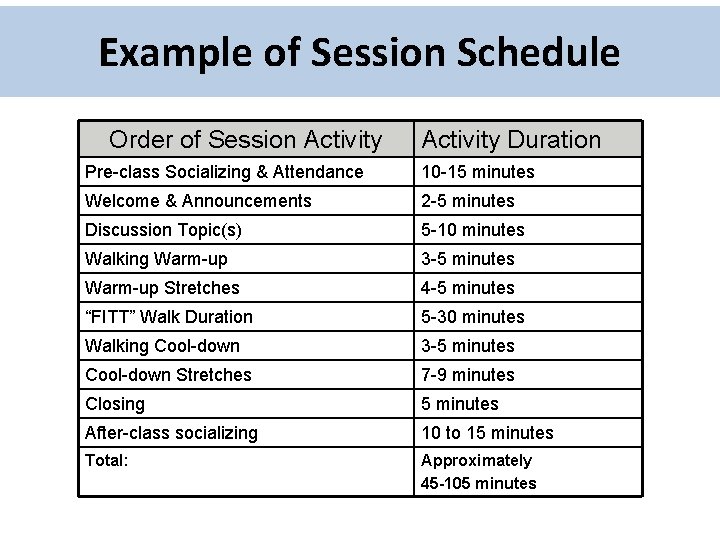
Example of Session Schedule Order of Session Activity Duration Pre-class Socializing & Attendance 10 -15 minutes Welcome & Announcements 2 -5 minutes Discussion Topic(s) 5 -10 minutes Walking Warm-up 3 -5 minutes Warm-up Stretches 4 -5 minutes “FITT” Walk Duration 5 -30 minutes Walking Cool-down 3 -5 minutes Cool-down Stretches 7 -9 minutes Closing 5 minutes After-class socializing 10 to 15 minutes Total: Approximately 45 -105 minutes
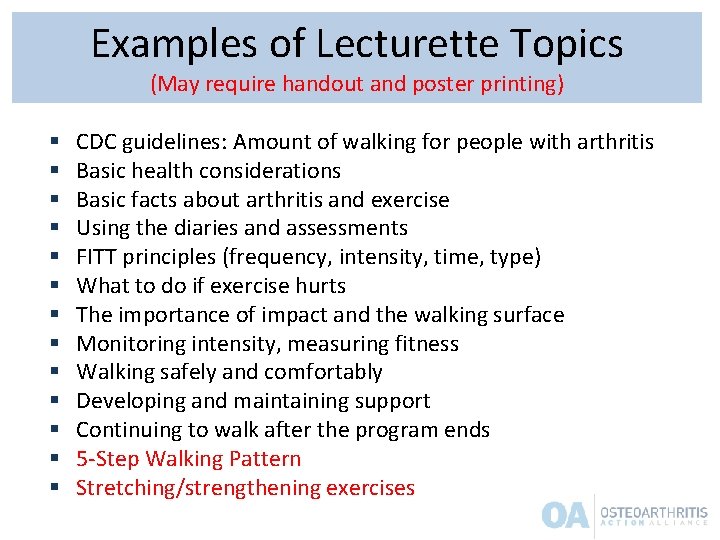
Examples of Lecturette Topics (May require handout and poster printing) § § § § CDC guidelines: Amount of walking for people with arthritis Basic health considerations Basic facts about arthritis and exercise Using the diaries and assessments FITT principles (frequency, intensity, time, type) What to do if exercise hurts The importance of impact and the walking surface Monitoring intensity, measuring fitness Walking safely and comfortably Developing and maintaining support Continuing to walk after the program ends 5 -Step Walking Pattern Stretching/strengthening exercises
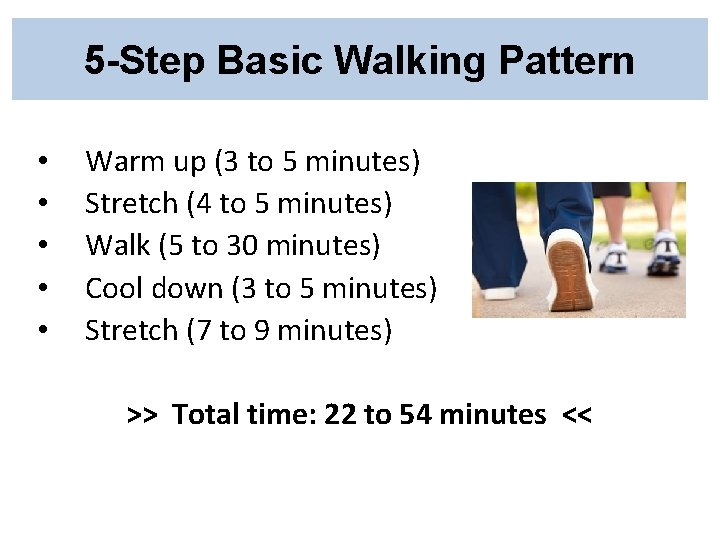
5 -Step Basic Walking Pattern • • • Warm up (3 to 5 minutes) Stretch (4 to 5 minutes) Walk (5 to 30 minutes) Cool down (3 to 5 minutes) Stretch (7 to 9 minutes) >> Total time: 22 to 54 minutes <<
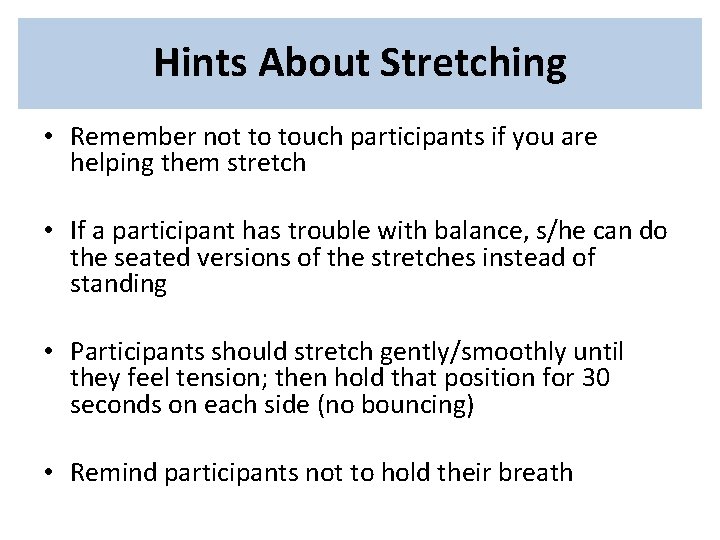
Hints About Stretching • Remember not to touch participants if you are helping them stretch • If a participant has trouble with balance, s/he can do the seated versions of the stretches instead of standing • Participants should stretch gently/smoothly until they feel tension; then hold that position for 30 seconds on each side (no bouncing) • Remind participants not to hold their breath
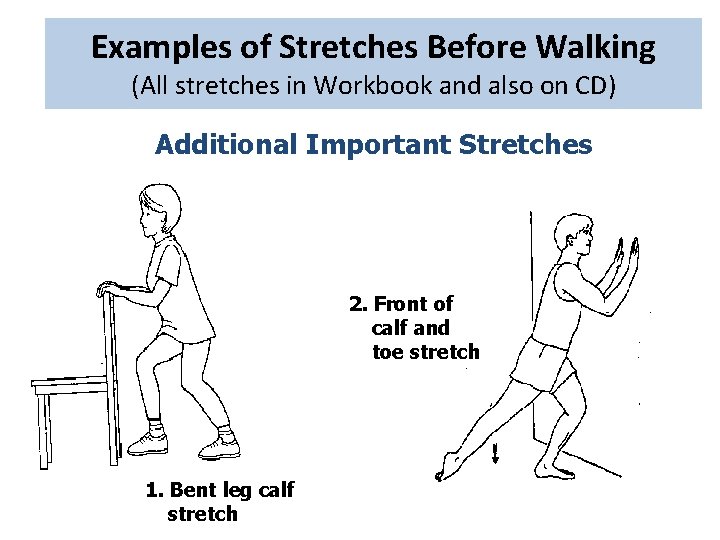
Examples of Stretches Before Walking (All stretches in Workbook and also on CD) Additional Important Stretches 2. Front of calf and toe stretch 1. Bent leg calf stretch
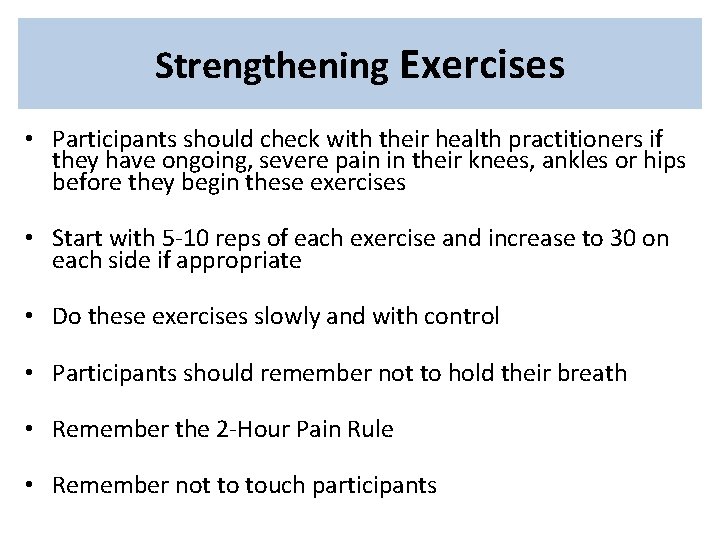
Strengthening Exercises • Participants should check with their health practitioners if they have ongoing, severe pain in their knees, ankles or hips before they begin these exercises • Start with 5 -10 reps of each exercise and increase to 30 on each side if appropriate • Do these exercises slowly and with control • Participants should remember not to hold their breath • Remember the 2 -Hour Pain Rule • Remember not to touch participants
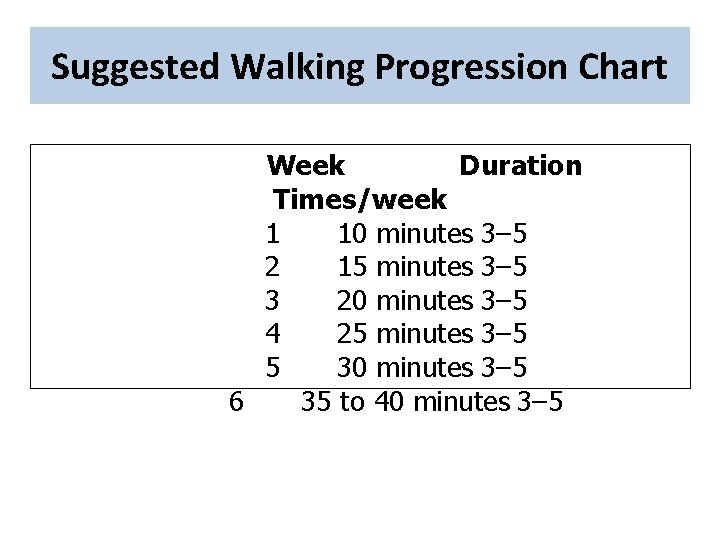
Suggested Walking Progression Chart Week Duration Times/week 1 10 minutes 3– 5 2 15 minutes 3– 5 3 20 minutes 3– 5 4 25 minutes 3– 5 5 30 minutes 3– 5 6 35 to 40 minutes 3– 5
Managing the WWE Program
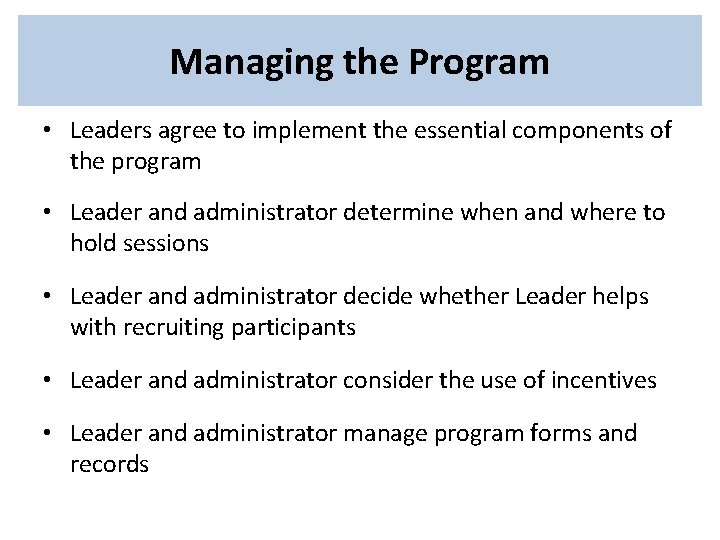
Managing the Program • Leaders agree to implement the essential components of the program • Leader and administrator determine when and where to hold sessions • Leader and administrator decide whether Leader helps with recruiting participants • Leader and administrator consider the use of incentives • Leader and administrator manage program forms and records
When & Where to Hold Sessions • Consider schedule appropriate for people with arthritis – Negotiate schedule, if feasible, at first class – May need to avoid mornings • Variety of locations – Malls, senior & community centers, neighborhoods, churches, parks, etc. • Classroom set-up – Ideally large table for people to sit around; room with door; chair with no cross bars under the seat • Other considerations – Noise, places to sit, accessibility, nearby bathrooms, insured areas – Route should be an easy walking surface
Consider Partnerships • Advertising/Recruiting – Identifying partners who can help with marketing • Sponsorship – Provide a variety of assistance (staffing, financing, space) • Incentives – Donated items
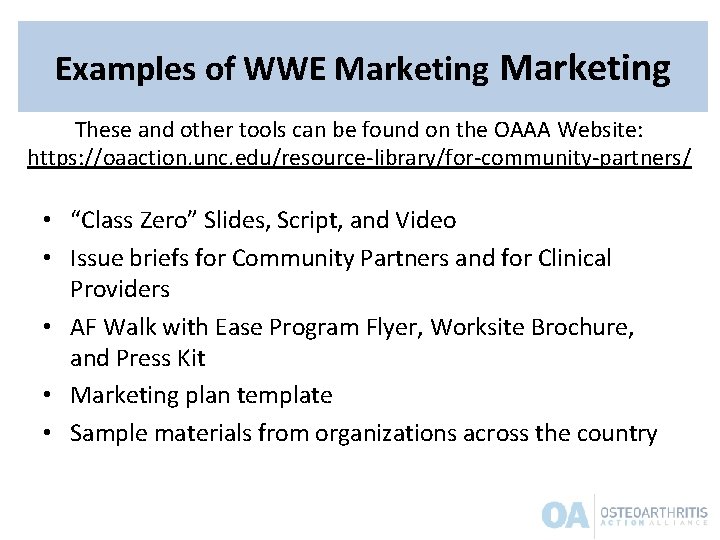
Examples of WWE Marketing These and other tools can be found on the OAAA Website: https: //oaaction. unc. edu/resource-library/for-community-partners/ • “Class Zero” Slides, Script, and Video • Issue briefs for Community Partners and for Clinical Providers • AF Walk with Ease Program Flyer, Worksite Brochure, and Press Kit • Marketing plan template • Sample materials from organizations across the country
Managing Program Forms and Records • Review with your Leaders the forms they need to be using – Participant Information Form (baseline) – Post-program Form – Fidelity Form – Local forms (e. g. , attendance log, site forms)
Teaching Tips • Review the teaching tips provided to Leaders to help them: – Promote a positive learning environment – Encourage and Support participants – Instill motivation – Conduct 3 -Step Problem Solving Strategy – Address common problems and how to solve them – Handling problem situations
Post Program Strategies • Leaders are provided a series of strategies for participants to take charge of, including: – Encouraging participants to use the walking contract as a tool to focus on their post-program goals and priorities – Encouraging the group to consider formally keeping in touch with each other – Suggesting that the group set up a walking distance theme and hold celebrations when the group achieves certain milestones in reaching that theme – Introducing participants to other programs that are designed for people with arthritis
Leader’s Self-Knowledge Test • For the Leader’s use only after reviewing the program materials • Covers program content • Two versions: with and without answers • A handy way for administrators to learn the scope of the training
Self-Directed Format of WWE • Self-directed participants receive the WWE Workbook • They can do the walking on their own or you might consider a “hybrid” where they walk with a group, but read workbook on their own • Could be an alternative for those who drop out of class or are unable to commit to the group version • Must complete the same baseline and post-program forms • Sample weekly emails to help keep self-directed participants engaged are on the OAAA website: – https: //oaaction. unc. edu/resource-library/for-community-partners/
Questions or Comments? OAAA Walk With Ease Expansion Staff Mary Altpeter mary_altpeter@unc. edu Serena Weisner s. weisner@outlook. com