VIEW OF SCOTLAND LOVE POEM Liz Lochhead HOGMANAY
- Slides: 21
‘VIEW OF SCOTLAND/ LOVE POEM’ Liz Lochhead
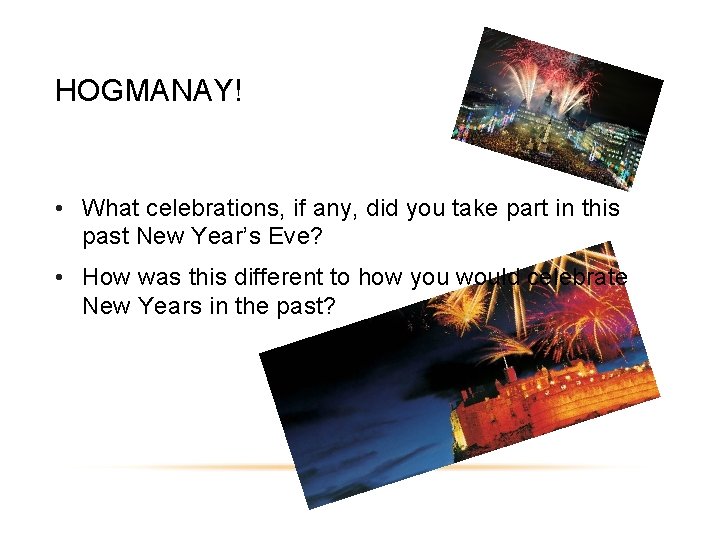
HOGMANAY! • What celebrations, if any, did you take part in this past New Year’s Eve? • How was this different to how you would celebrate New Years in the past?
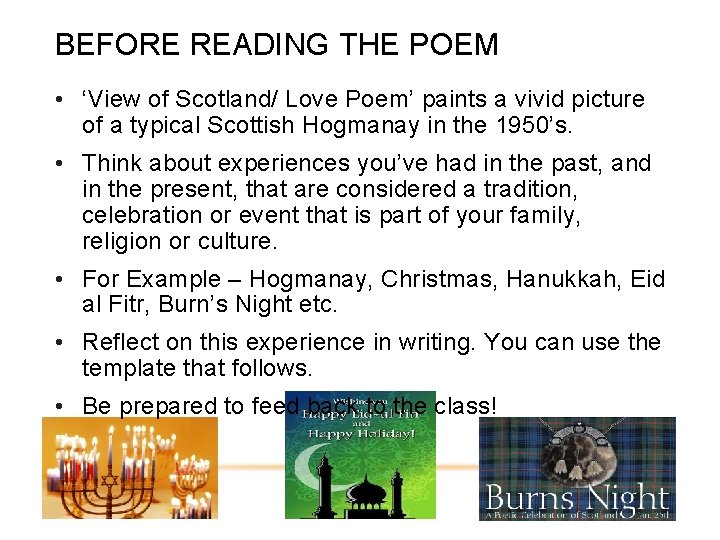
BEFORE READING THE POEM • ‘View of Scotland/ Love Poem’ paints a vivid picture of a typical Scottish Hogmanay in the 1950’s. • Think about experiences you’ve had in the past, and in the present, that are considered a tradition, celebration or event that is part of your family, religion or culture. • For Example – Hogmanay, Christmas, Hanukkah, Eid al Fitr, Burn’s Night etc. • Reflect on this experience in writing. You can use the template that follows. • Be prepared to feed back to the class!
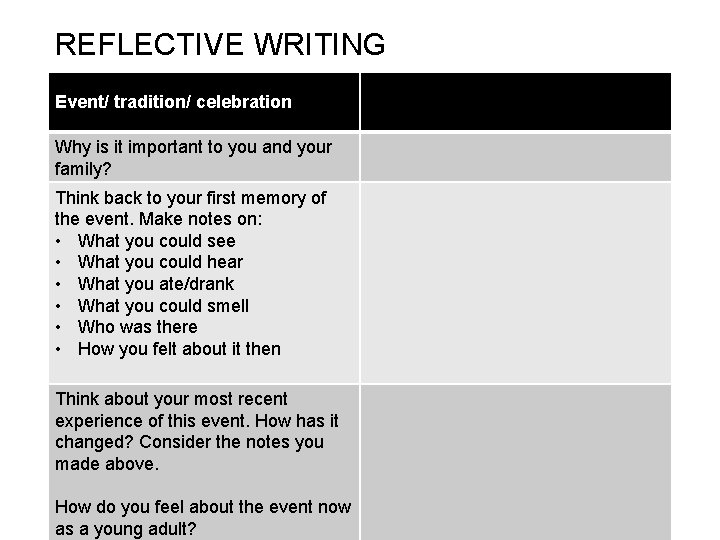
REFLECTIVE WRITING Event/ tradition/ celebration Why is it important to you and your family? Think back to your first memory of the event. Make notes on: • What you could see • What you could hear • What you ate/drank • What you could smell • Who was there • How you felt about it then Think about your most recent experience of this event. How has it changed? Consider the notes you made above. How do you feel about the event now as a young adult?
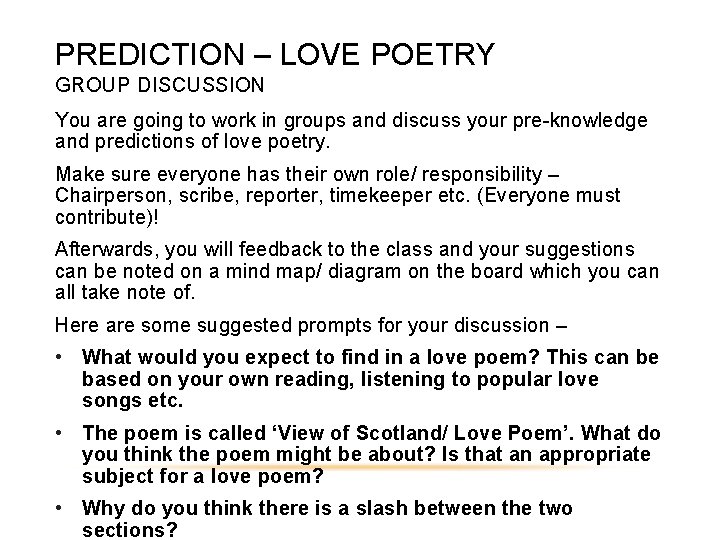
PREDICTION – LOVE POETRY GROUP DISCUSSION You are going to work in groups and discuss your pre-knowledge and predictions of love poetry. Make sure everyone has their own role/ responsibility – Chairperson, scribe, reporter, timekeeper etc. (Everyone must contribute)! Afterwards, you will feedback to the class and your suggestions can be noted on a mind map/ diagram on the board which you can all take note of. Here are some suggested prompts for your discussion – • What would you expect to find in a love poem? This can be based on your own reading, listening to popular love songs etc. • The poem is called ‘View of Scotland/ Love Poem’. What do you think the poem might be about? Is that an appropriate subject for a love poem? • Why do you think there is a slash between the two sections?
WANTED POSTER! • This activity can be approached in a number of ways, but the end result is the same: to identify poetic techniques required for annotation. • Here are some suggested ways to develop the list before study of this poem begins – 1. Class, group or individual textual analysis on a different poem 2. Modelled annotation of a different poem 3. Class or group discussion based on, and building on, any prior knowledge the class have on poetic techniques.
WANTED POSTER! • Once poetic techniques have been identified, you will create your own ‘Wanted’ poster for a particular technique. • The poster must include the technique, it’s definition, an example and effect. • You will then become the ‘Champion’ of your technique. • When the poem is first read, you will then highlight your technique, comment on it and share with the class your findings. • This can be done as a Search, Pair, Share task if the class is too big to have 1 Champion per technique. • These posters could be displayed on a learning wall for future use; learners can refer to the posters to ensure they are highlighting/ underlining the techniques, considering their purpose and evaluating their effectiveness.
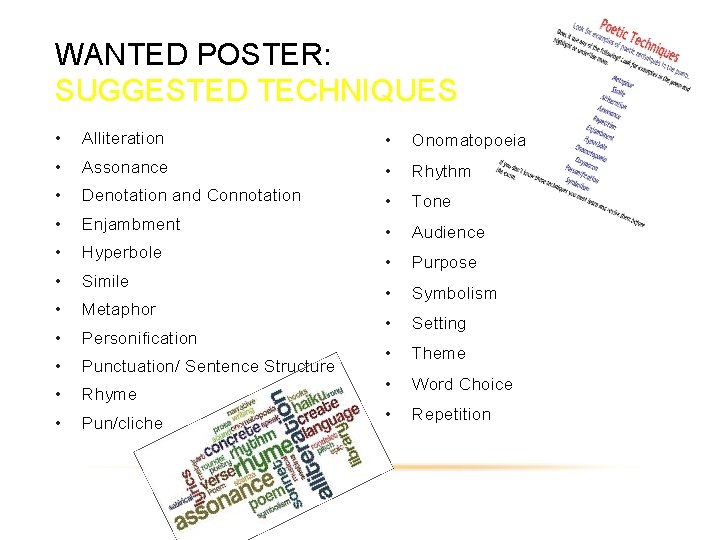
WANTED POSTER: SUGGESTED TECHNIQUES • Alliteration • Onomatopoeia • Assonance • Rhythm • Denotation and Connotation • Tone • Enjambment • Audience • Hyperbole • Simile • Purpose • Metaphor • Symbolism • Personification • Setting • Punctuation/ Sentence Structure • Theme • Rhyme • Word Choice • Pun/cliche • Repetition
DISCUSSION ACTIVITY: INITIAL THOUGHTS Now read through the poem. (Closely as a class or this could be done as a homework activity). In your notebooks, write down your first thoughts about what the poet is trying to say. (Individually or Think, Pair, Share). • These notes should be updated regularly based on what has been learned in class and should be kept for each of the poems.
PAIR READING • In pairs, read one stanza of the poem silently. • Discuss the stanza and what you understand it to be about. • Feedback to the class about your stanza. This could also be done as a – • Carousel Activity – one pupil visits every group to share their thoughts OR • One Stay, One Stray – One partner shares with another stayer from a pair from a different stanza, while one partner stays to hear from a strayer from a different stanza. • Two pairs dealing with the same stanza could also meet up and discuss their stanza before feeding back to the class.
CLASS DISCUSSION Suggested questions for class discussion – • Who is speaking? • Where and when is the poem set? • Do the time and place change? If so, where does this happen? What do they change to? Why do you think they change? • Does answering these questions change what you first thought about the poem? If so, without changing your original notes, make a note about what you think now.
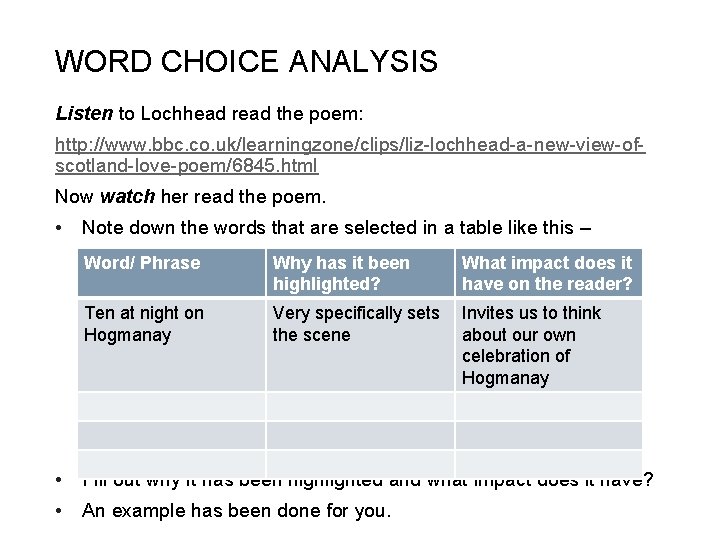
WORD CHOICE ANALYSIS Listen to Lochhead read the poem: http: //www. bbc. co. uk/learningzone/clips/liz-lochhead-a-new-view-ofscotland-love-poem/6845. html Now watch her read the poem. • Note down the words that are selected in a table like this – Word/ Phrase Why has it been highlighted? What impact does it have on the reader? Ten at night on Hogmanay Very specifically sets the scene Invites us to think about our own celebration of Hogmanay • Fill out why it has been highlighted and what impact does it have? • An example has been done for you.
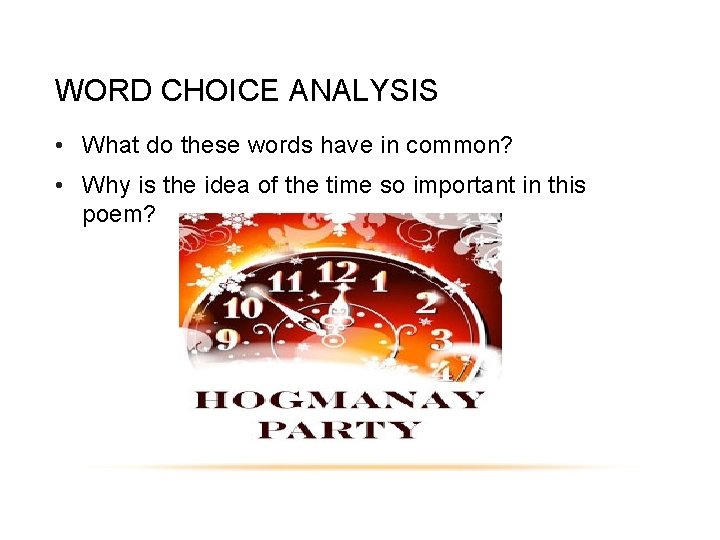
WORD CHOICE ANALYSIS • What do these words have in common? • Why is the idea of the time so important in this poem?
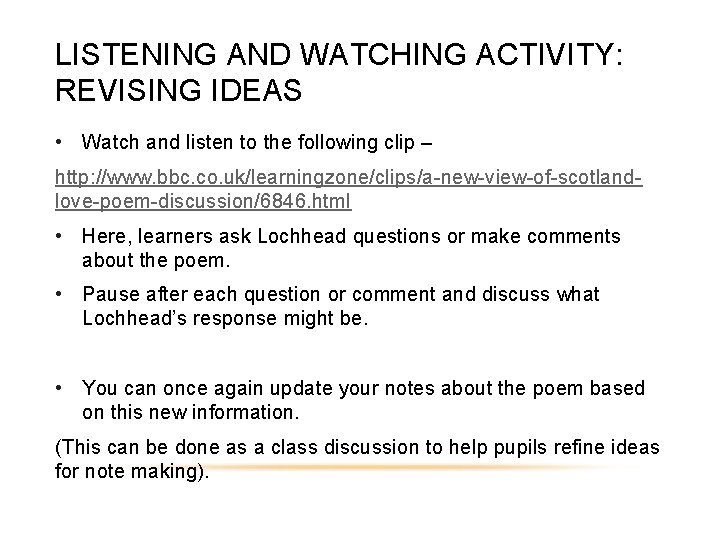
LISTENING AND WATCHING ACTIVITY: REVISING IDEAS • Watch and listen to the following clip – http: //www. bbc. co. uk/learningzone/clips/a-new-view-of-scotlandlove-poem-discussion/6846. html • Here, learners ask Lochhead questions or make comments about the poem. • Pause after each question or comment and discuss what Lochhead’s response might be. • You can once again update your notes about the poem based on this new information. (This can be done as a class discussion to help pupils refine ideas for note making).
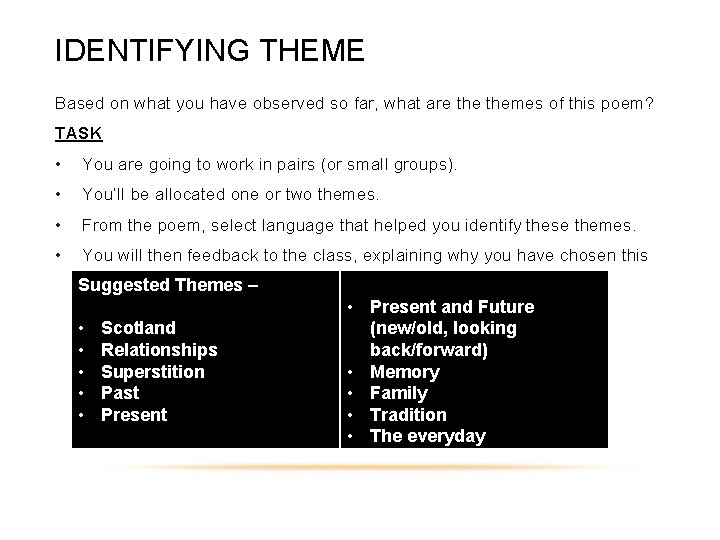
IDENTIFYING THEME Based on what you have observed so far, what are themes of this poem? TASK • You are going to work in pairs (or small groups). • You’ll be allocated one or two themes. • From the poem, select language that helped you identify these themes. • You will then feedback to the class, explaining why you have chosen this language. Suggested Themes – • • • Scotland Relationships Superstition Past Present • Present and Future (new/old, looking back/forward) • Memory • Family • Tradition • The everyday
IDENTIFYING THEME • Watch the following clip which may help you identify further themes: http: //www. bbc. co. uk/learningzone/clips/liz-lochhead-anew-view-of-scotland-love-poem-analysis/6847. html • Any themes not previously considered can be explored by finding language associated/ linked with that theme. • Notes on the poem can be updated.
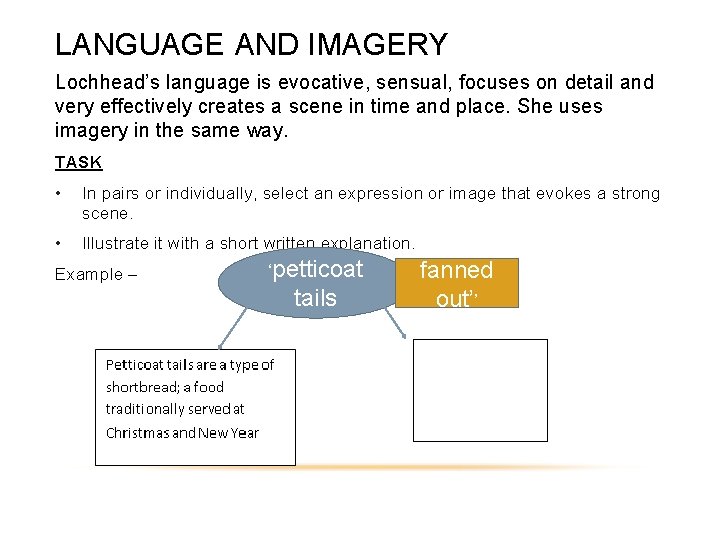
LANGUAGE AND IMAGERY Lochhead’s language is evocative, sensual, focuses on detail and very effectively creates a scene in time and place. She uses imagery in the same way. TASK • In pairs or individually, select an expression or image that evokes a strong scene. • Illustrate it with a short written explanation. Example – ‘petticoat tails fanned out’’ Petticoats are oldfashioned underwear.
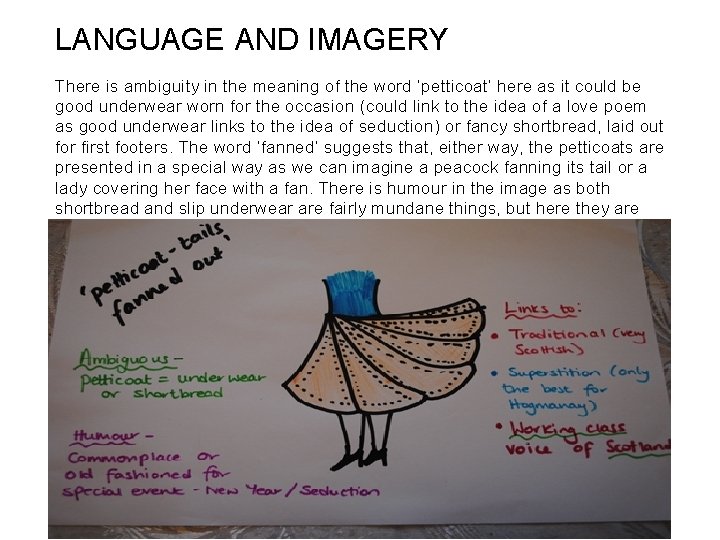
LANGUAGE AND IMAGERY There is ambiguity in the meaning of the word ‘petticoat’ here as it could be good underwear worn for the occasion (could link to the idea of a love poem as good underwear links to the idea of seduction) or fancy shortbread, laid out for first footers. The word ‘fanned’ suggests that, either way, the petticoats are presented in a special way as we can imagine a peacock fanning its tail or a lady covering her face with a fan. There is humour in the image as both shortbread and slip underwear are fairly mundane things, but here they are presented in a grand style
STRUCTURE Lochhead’s poetry often does not follow a formal structure. This is done to match closely the pattern of speech. The structure in this poem also allows for the change in time from 10 pm, to 10. 30 pm, to 30 years later, to the final stanza (particularly the final line), to right up to the present. TASK In groups, identify the changes in structure and discuss the impact and effectiveness of these. The following are suggested prompts and these revise some ideas from earlier: • Describe the structure of the poem – consider rhyme, metre, length of stanza (revisit ‘wanted’ posters, or any rhyme, metre and structure champions could lead the identification of features). What do you notice? Why has this been done? • Who is speaking in the poem? Does this stay the same throughout? When and why does it change? What is the significance of the change? • With close reference to the poem, identify the changes in time. Why does it do this and what is the impact? • With close reference to the poem, discuss the sentence structure and the effect it creates.
REVISITING FIRST IMPRESSIONS • Look back to the expectations you noted after the first group discussion. • Were they correct? • Take the opportunity to reassess your thoughts on the poem and fill in/ take any additional notes.
SELF-EVALUATION • You should now be able to see a clear progression from the notes made on initial discussions to much more refined ideas, with evidence, by the end of studying the poem. • You can now identify what you have learned and what you may still be unsure about. • Take this opportunity to ask any questions. ‘Three then Me’ approach. • Before you ask your teacher for help; you must ask at least 3 peers for help or any questions you may have first.