Utility refers to want satisfying power of a


- Slides: 18
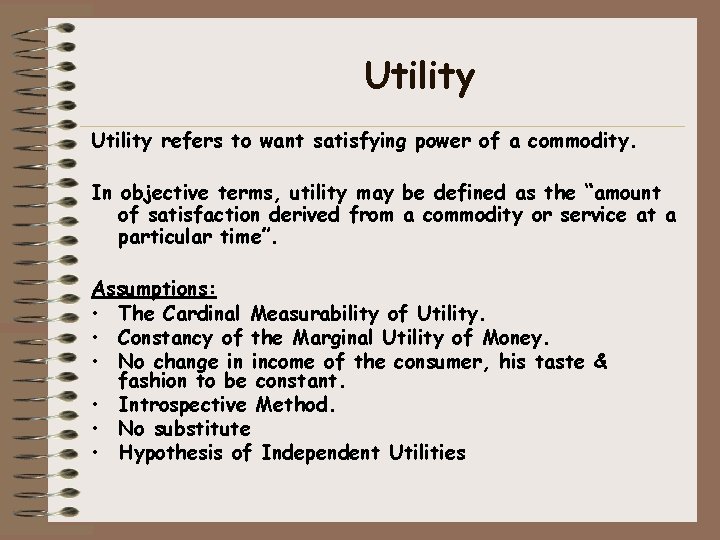
Utility refers to want satisfying power of a commodity. In objective terms, utility may be defined as the “amount of satisfaction derived from a commodity or service at a particular time”. Assumptions: • The Cardinal Measurability of Utility. • Constancy of the Marginal Utility of Money. • No change in income of the consumer, his taste & fashion to be constant. • Introspective Method. • No substitute • Hypothesis of Independent Utilities
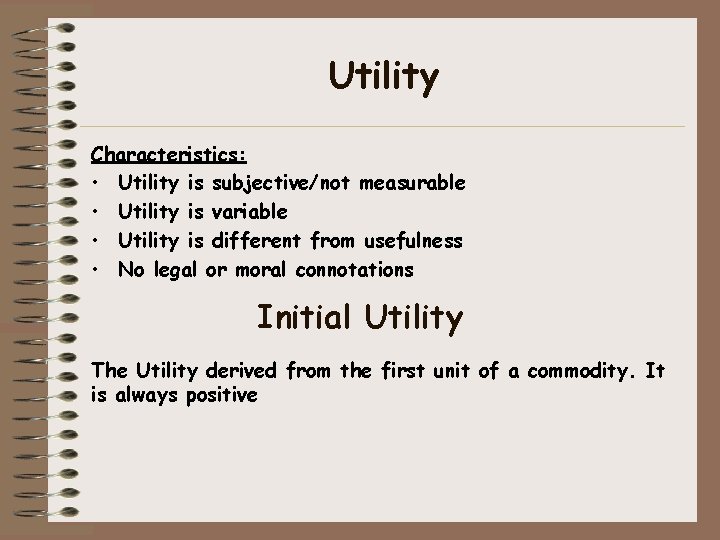
Utility Characteristics: • Utility is subjective/not measurable • Utility is variable • Utility is different from usefulness • No legal or moral connotations Initial Utility The Utility derived from the first unit of a commodity. It is always positive
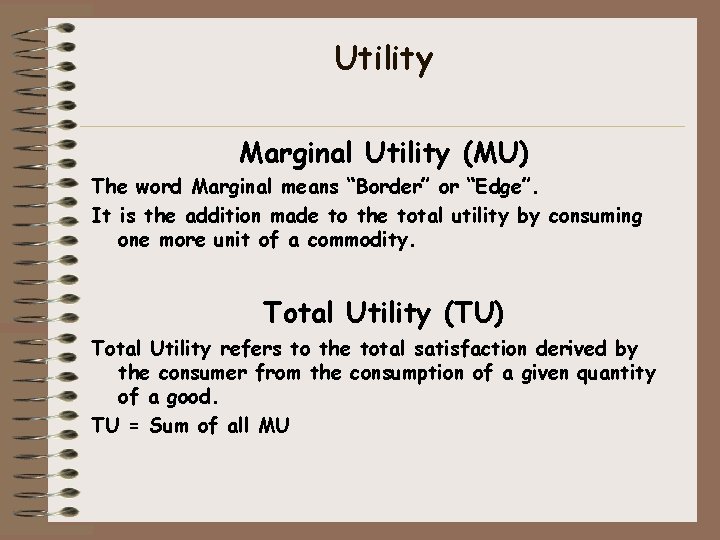
Utility Marginal Utility (MU) The word Marginal means “Border” or “Edge”. It is the addition made to the total utility by consuming one more unit of a commodity. Total Utility (TU) Total Utility refers to the total satisfaction derived by the consumer from the consumption of a given quantity of a good. TU = Sum of all MU
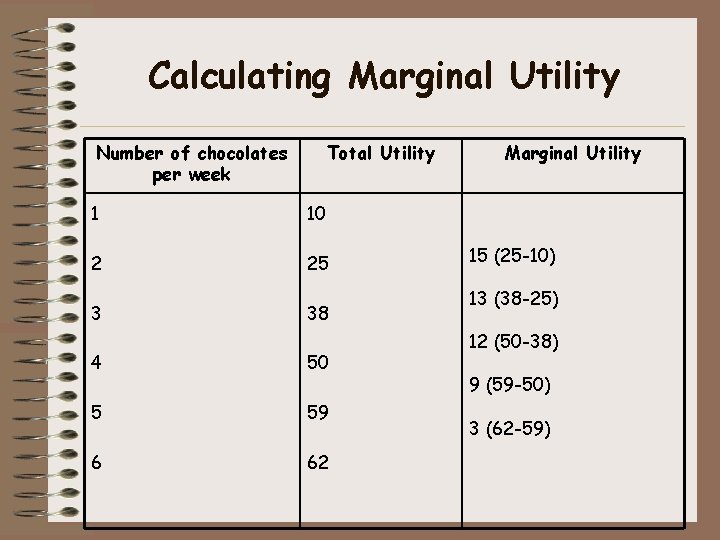
Calculating Marginal Utility Number of chocolates per week Total Utility 1 10 2 25 3 38 4 50 5 59 6 62 Marginal Utility 15 (25 -10) 13 (38 -25) 12 (50 -38) 9 (59 -50) 3 (62 -59)
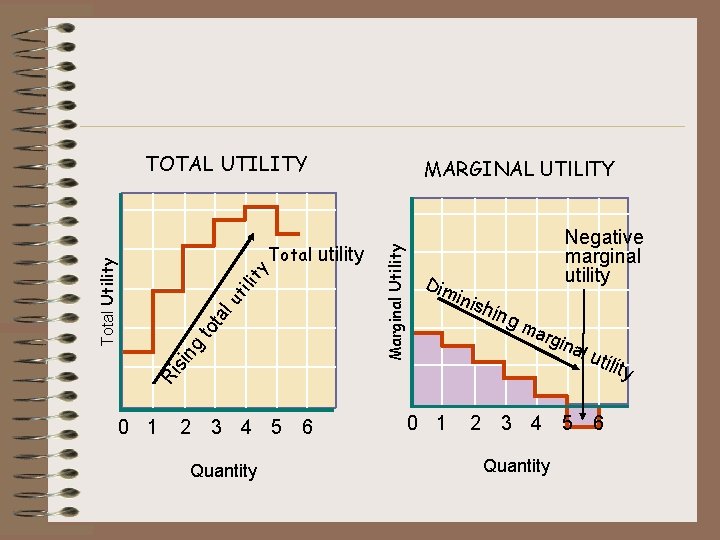
TOTAL UTILITY Marginal Utility Dim inis Negative marginal utility hin gm arg ina Ri sin g to ta lu til ity Total Utility Total utility MARGINAL UTILITY 0 1 2 3 4 5 6 Quantity 0 1 2 3 4 5 Quantity l ut ility 6
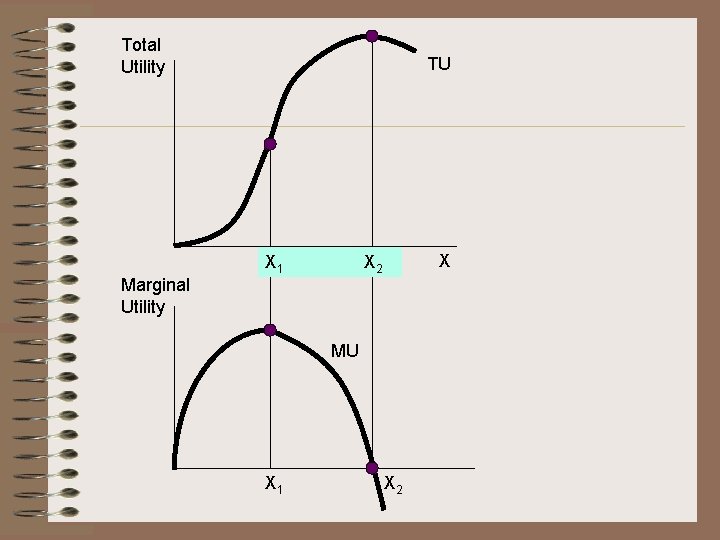
Total Utility Marginal Utility TU X 1 X X 2 MU X 1 X 2
• As long as marginal utility is positive, total utility will increase. • Total and marginal utility can be negative. • Total Utility follows marginal utility. • When marginal utility is zero, total utility is maximized. This graph demonstrated the Law of Diminishing Marginal Utility.
Law of Diminishing Marginal Utility Though wants of an individual are unlimited in number yet each individual want is satiable. Because of this, the more we have a commodity, the less we want to have more of it. This law state that as the amount consumed of a commodity increases, the utility derived by the consumer from the additional units, i. e marginal utility goes on decreasing. According to Marshall, “The additional benefit a person derives from a given increase of his stock of a thing diminishes with every increase in the stock that he already has”
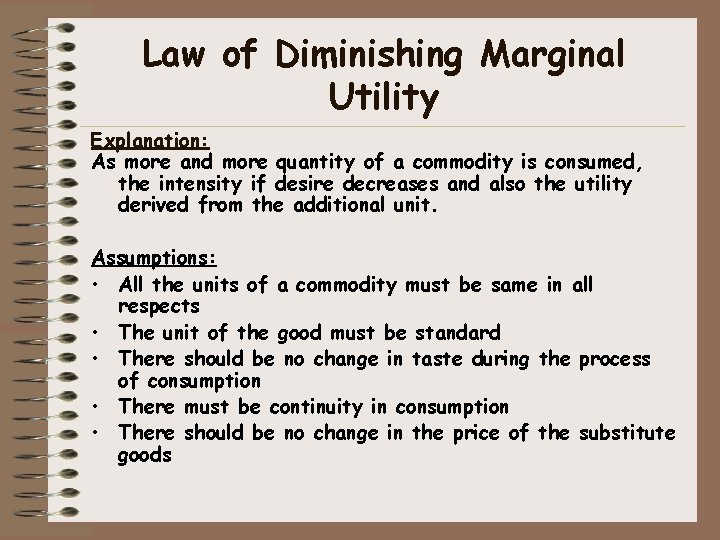
Law of Diminishing Marginal Utility Explanation: As more and more quantity of a commodity is consumed, the intensity if desire decreases and also the utility derived from the additional unit. Assumptions: • All the units of a commodity must be same in all respects • The unit of the good must be standard • There should be no change in taste during the process of consumption • There must be continuity in consumption • There should be no change in the price of the substitute goods
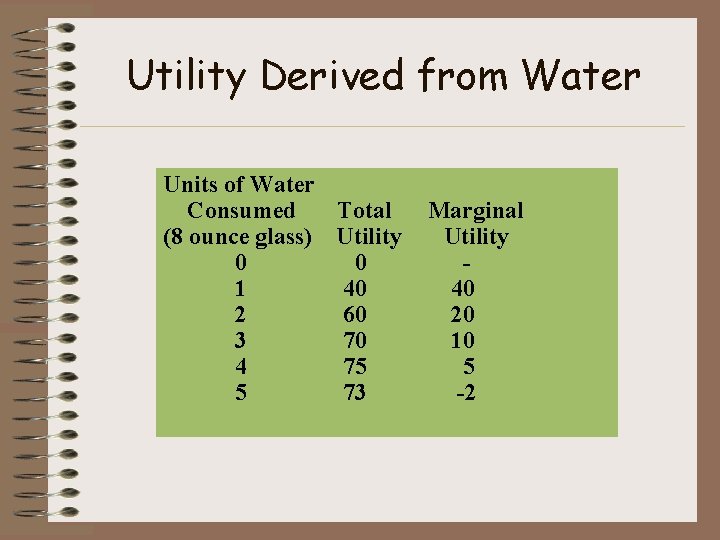
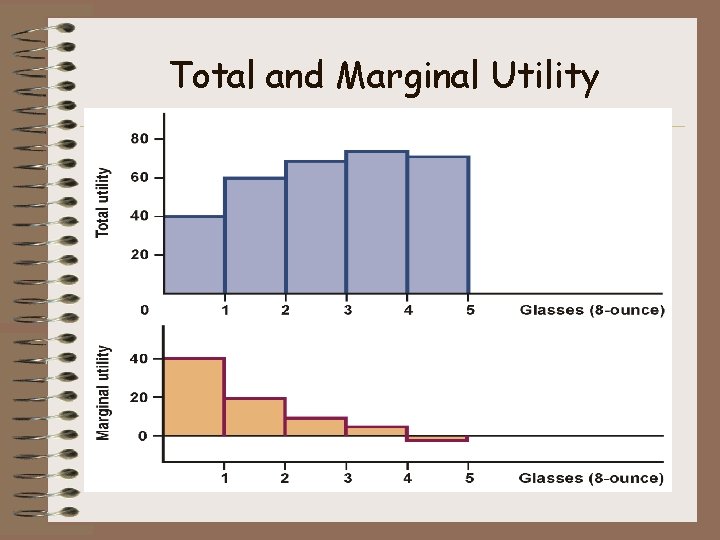
Utility Derived from Water Units of Water Consumed Total (8 ounce glass) Utility 0 0 1 40 2 60 3 70 4 75 5 73 Marginal Utility 40 20 10 5 -2
Total and Marginal Utility
Law of Diminishing Marginal Utility Exceptions: # Money # Hobbies and Rare Things # Liquor and Music # Things of Display Importance: ¬Basis of Law of Demand ¬Basis of ‘Why Demand Curve slopes downward’
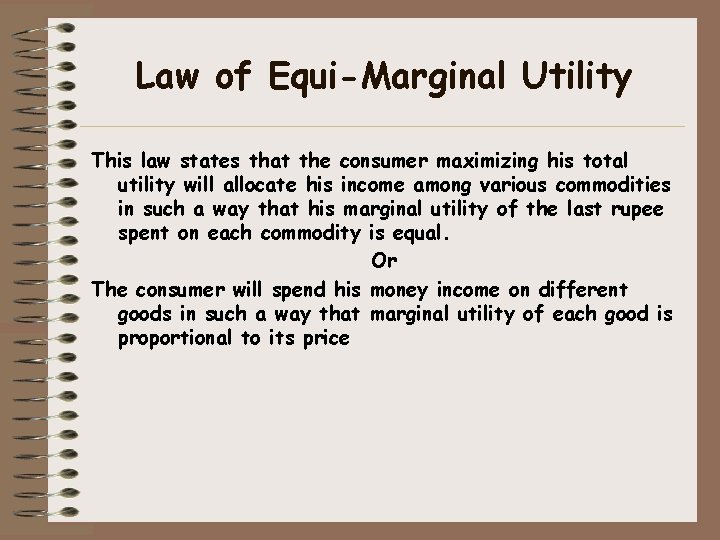
Law of Equi-Marginal Utility This law states that the consumer maximizing his total utility will allocate his income among various commodities in such a way that his marginal utility of the last rupee spent on each commodity is equal. Or The consumer will spend his money income on different goods in such a way that marginal utility of each good is proportional to its price
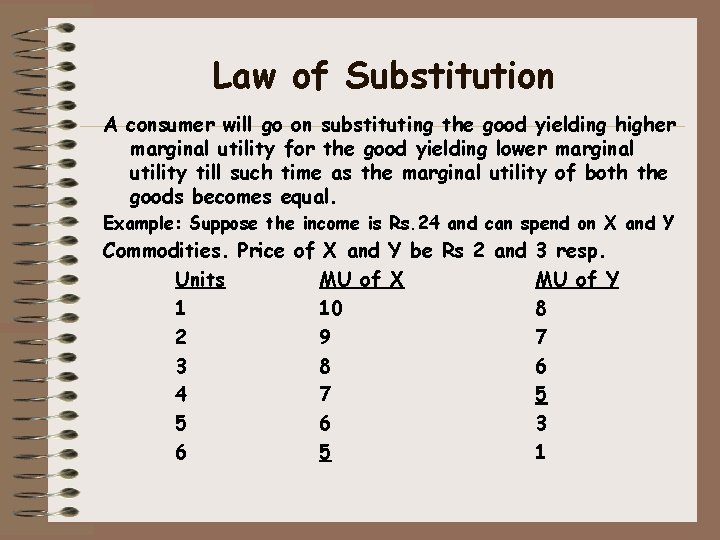
Law of Substitution A consumer will go on substituting the good yielding higher marginal utility for the good yielding lower marginal utility till such time as the marginal utility of both the goods becomes equal. Example: Suppose the income is Rs. 24 and can spend on X and Y Commodities. Price of X and Y be Rs 2 and 3 resp. Units MU of X MU of Y 1 10 8 2 9 7 3 8 6 4 7 5 5 6 3 6 5 1
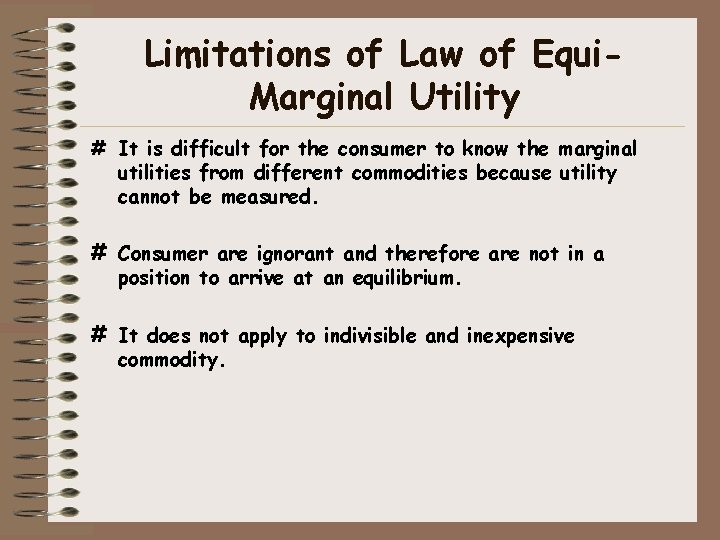
Limitations of Law of Equi. Marginal Utility # It is difficult for the consumer to know the marginal utilities from different commodities because utility cannot be measured. # Consumer are ignorant and therefore are not in a position to arrive at an equilibrium. # It does not apply to indivisible and inexpensive commodity.
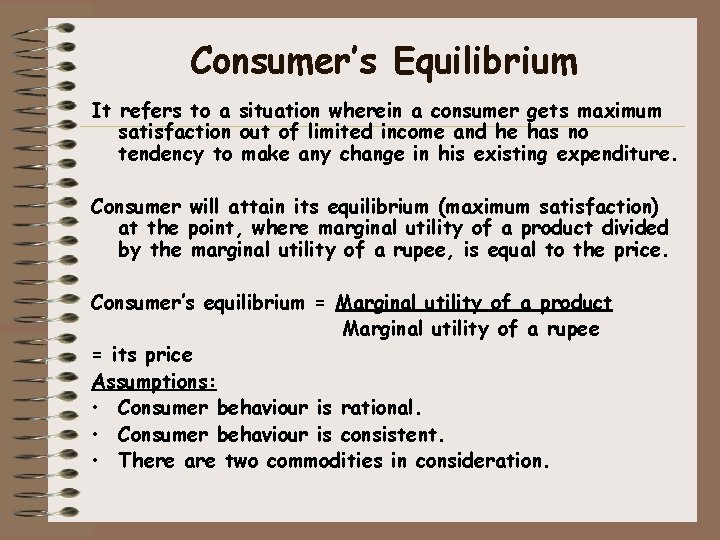
Consumer’s Equilibrium It refers to a situation wherein a consumer gets maximum satisfaction out of limited income and he has no tendency to make any change in his existing expenditure. Consumer will attain its equilibrium (maximum satisfaction) at the point, where marginal utility of a product divided by the marginal utility of a rupee, is equal to the price. Consumer’s equilibrium = Marginal utility of a product Marginal utility of a rupee = its price Assumptions: • Consumer behaviour is rational. • Consumer behaviour is consistent. • There are two commodities in consideration.
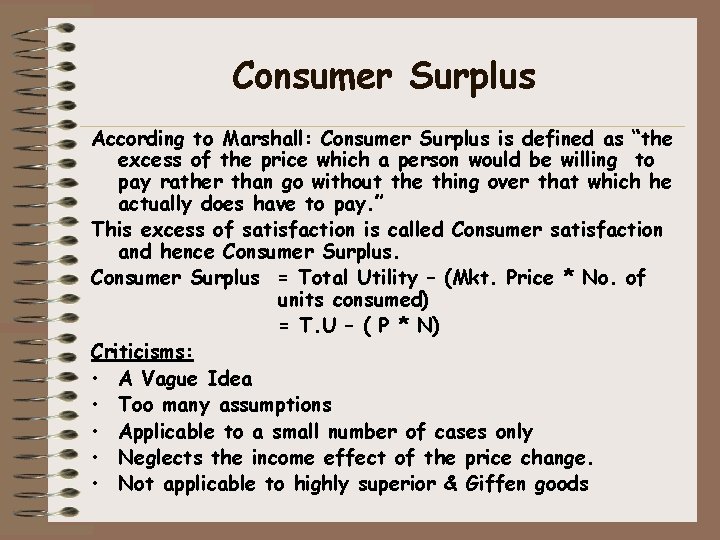
Consumer Surplus According to Marshall: Consumer Surplus is defined as “the excess of the price which a person would be willing to pay rather than go without the thing over that which he actually does have to pay. ” This excess of satisfaction is called Consumer satisfaction and hence Consumer Surplus = Total Utility – (Mkt. Price * No. of units consumed) = T. U – ( P * N) Criticisms: • A Vague Idea • Too many assumptions • Applicable to a small number of cases only • Neglects the income effect of the price change. • Not applicable to highly superior & Giffen goods
Submitted for – www. mycollegebag. in