Use of Psychotropic Medications in Patients Undergoing Primary




- Slides: 13
Use of Psychotropic Medications in Patients Undergoing Primary LASIK, LASIK Retreatment, and Contact Lens Fitting Thomas J Dingle, MD, Jay S Pepose, MD, Ph. D, Susan K Feigenbaum, Ph. D, Mujtaba A Qazi, MD * None of the investigators have any financial interests related to this presentation
Purpose • The percentage of US adults with a diagnosable mental disorder may be as high as 20%. 1 • The prevalence of psychotropic drug use in the general, noninstitutionalized United States population is between 8. 1% and 11. 1%. 2, 3 • Depression and mood disorders have been associated with a poor psychosocial outcome for various surgical procedures, 4 -7 including refractive surgery. 8 • On April 25, 2008 the FDA Ophthalmic Devices Advisory Panel meeting heard both expert opinion and family and patient testimony on post-LASIK depression and suicide. • The are over 700, 000 refractive surgery procedures performed each year in the USA, and this population includes patients with psychiatric disorders.
Purpose • To assess the prevalence of psychotropic medication use in various patient populations at one institution (Pepose Vision Institute) • To compare the prevalence of psychotropic medication use in the prerefractive surgery population compared to: a) the general US population over age 18 b) the contact lens population over age 18 c) the LASIK retreatment population • To compare the prevalence of psychotropic medication use prior to primary refractive surgery and prior to retreatment • To assess the odds ratio of psychotropic medication use associated with age and gender in the refractive surgery and contact lens groups, and to compare these odds ratios to the general population
Methods Retrospective chart review of patients in one high volume, refractive practice (Pepose Vision Institute) The charts were selected randomly from previous office visits from 2002 to 2008. The data collected was analyzed using Linear Prob, Probit, Logit qualitative choice estimation models
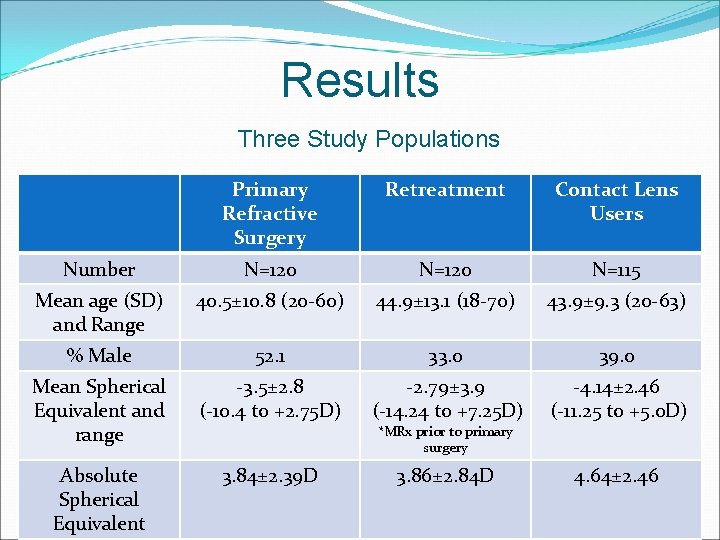
Results Three Study Populations Primary Refractive Surgery Retreatment Contact Lens Users Number N=120 N=115 Mean age (SD) and Range 40. 5± 10. 8 (20 -60) 44. 9± 13. 1 (18 -70) 43. 9± 9. 3 (20 -63) % Male 52. 1 33. 0 39. 0 Mean Spherical Equivalent and range -3. 5± 2. 8 (-10. 4 to +2. 75 D) -2. 79± 3. 9 (-14. 24 to +7. 25 D) -4. 14± 2. 46 (-11. 25 to +5. 0 D) Absolute Spherical Equivalent 3. 84± 2. 39 D 3. 86± 2. 84 D 4. 64± 2. 46 *MRx prior to primary surgery
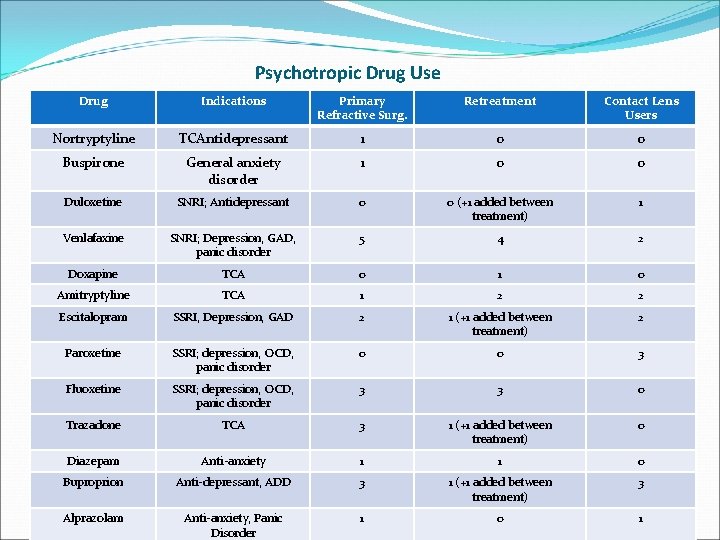
Psychotropic Drug Use Drug Indications Primary Refractive Surg. Retreatment Contact Lens Users Nortryptyline TCAntidepressant 1 0 0 Buspirone General anxiety disorder 1 0 0 Duloxetine SNRI; Antidepressant 0 0 (+1 added between treatment) 1 Venlafaxine SNRI; Depression, GAD, panic disorder 5 4 2 Doxapine TCA 0 1 0 Amitryptyline TCA 1 2 2 Escitalopram SSRI, Depression, GAD 2 1 (+1 added between treatment) 2 Paroxetine SSRI; depression, OCD, panic disorder 0 0 3 Fluoxetine SSRI; depression, OCD, panic disorder 3 3 0 Trazadone TCA 3 1 (+1 added between treatment) 0 Diazepam Anti-anxiety 1 1 0 Buproprion Anti-depressant, ADD 3 1 (+1 added between treatment) 3 Alprazolam Anti-anxiety, Panic Disorder 1 0 1
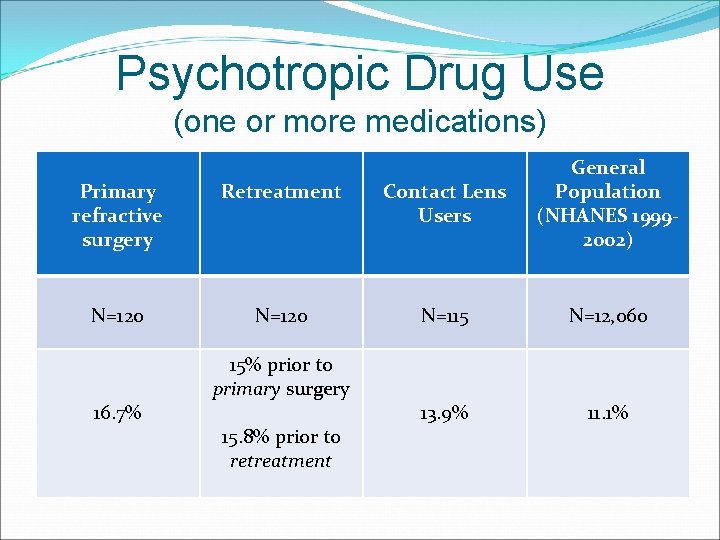
Psychotropic Drug Use (one or more medications) Primary refractive surgery Retreatment Contact Lens Users General Population (NHANES 19992002) N=120 N=115 N=12, 060 13. 9% 11. 1% 16. 7% 15% prior to primary surgery 15. 8% prior to retreatment
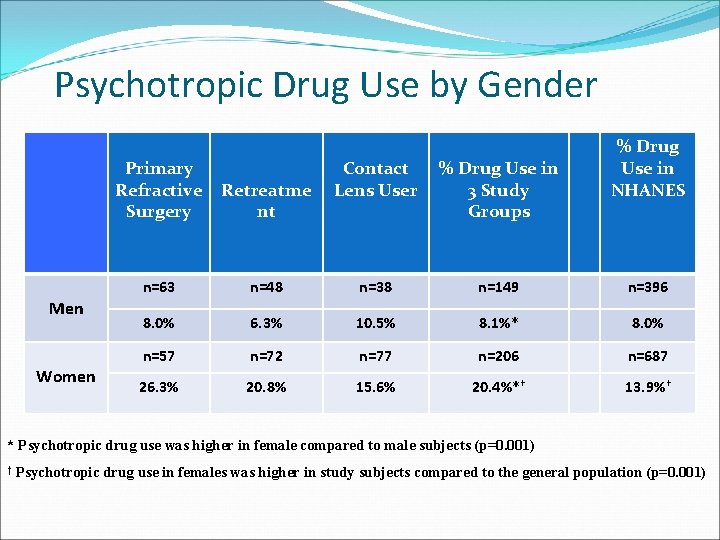
Psychotropic Drug Use by Gender Men Women Primary Refractive Surgery Retreatme nt n=63 % Drug Use in NHANES Contact Lens User % Drug Use in 3 Study Groups n=48 n=38 n=149 n=396 8. 0% 6. 3% 10. 5% 8. 1%* 8. 0% n=57 n=72 n=77 n=206 n=687 26. 3% 20. 8% 15. 6% 20. 4%*† 13. 9%† * Psychotropic drug use was higher in female compared to male subjects (p=0. 001) † Psychotropic drug use in females was higher in study subjects compared to the general population (p=0. 001)
Results Variables affecting CTL fitting versus refractive surgery Psychotropic drug use and age (with and without gender as an independent variable) were not significant predictors of the probability of refractive surgery versus contact lens use. Male gender was a significant predictor of the probability of refractive surgery (p=0. 02). Higher spherical equivalent was a significant predictor of the probability of contact lens fitting (p=0. 02)
Results Variables affecting the probability of retreatment Psychotropic drug use did not increase the probability of retreatment Adding a psychotropic medication after primary treatment did not increase the probability of retreatment Older age (p=0. 003) increased the probability of retreatment Men were 14% less likely than women, on average, to have retreatment surgery (p=0. 04) Higher pre-LASIK spherical equivalents increased the likelihood of retreatment; p=0. 06 (Logit p=0. 05) The probability of adding a psychotropic medication after initial refractive surgery and prior to retreatment was not correlated with the pre-retreament spherical equivalent or the time from initial surgery to retreatment
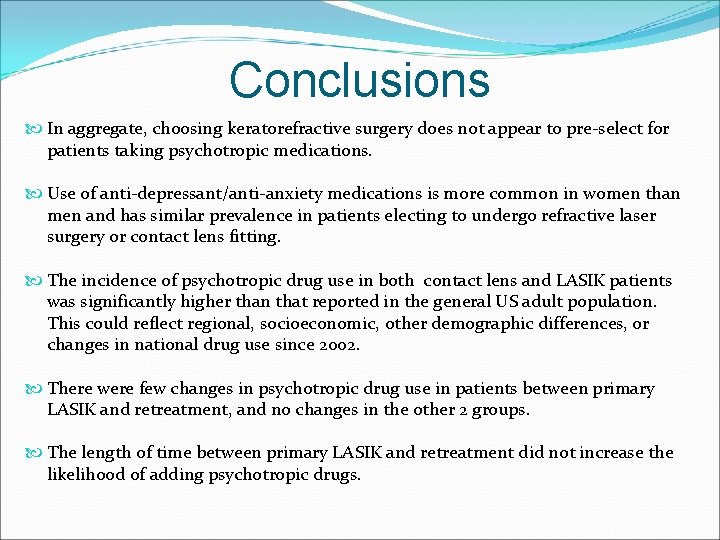
Conclusions In aggregate, choosing keratorefractive surgery does not appear to pre-select for patients taking psychotropic medications. Use of anti-depressant/anti-anxiety medications is more common in women than men and has similar prevalence in patients electing to undergo refractive laser surgery or contact lens fitting. The incidence of psychotropic drug use in both contact lens and LASIK patients was significantly higher than that reported in the general US adult population. This could reflect regional, socioeconomic, other demographic differences, or changes in national drug use since 2002. There were few changes in psychotropic drug use in patients between primary LASIK and retreatment, and no changes in the other 2 groups. The length of time between primary LASIK and retreatment did not increase the likelihood of adding psychotropic drugs.
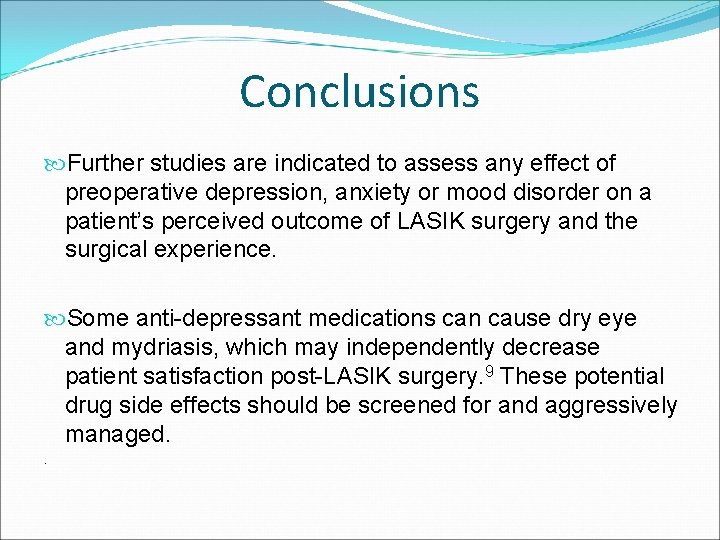
Conclusions Further studies are indicated to assess any effect of preoperative depression, anxiety or mood disorder on a patient’s perceived outcome of LASIK surgery and the surgical experience. Some anti-depressant medications can cause dry eye and mydriasis, which may independently decrease patient satisfaction post-LASIK surgery. 9 These potential drug side effects should be screened for and aggressively managed. .
References 1 U. S. , Department of Health and Human Services. Mental Health: A Report of the Surgeon General. Rockville, MD: U. S. Department of Health and Human Services, Substance Abuse and Mental Health Services Administration, Center for Mental Health Services, National Institutes of Health, National Institutes of Mental Health. 1999. 2 Paulose-Ram R, Safran MA, Jonas BS, Gu Q, Orwig D. Trends in psychotropic medication use among US adults. Pharmacoepidemiol Drug Saf. 2007; 16(5): 560 -70. 3 Zuvekas SH. Prescription drugs and the changing patterns of treatment for mental disorders, 1996– 2001. Health Affairs. 2005; 24(1): 195– 205. 4 Honigman RJ, Phillips KA, Castle DJ. A review of psychosocial outcomes for patients seeking cosmetic surgery. Plast Reconstr Surg. , 2004; 113: 1229– 12. 5 Sinikallio S, Aalto T, Airaksinen O, Herno A, Kröger H, Savolainen S, Turunen V, and Viinamäki H. Lumbar spinal stenosis patients are satisfied with short-term results of surgery - younger age, symptom severity, disability and depression decrease satisfaction. Disability & Rehabilitation, 2007; 29: 537 -544. 6 Trief PM, Grant W, Fredrickson B. A Prospective Study of Psychological Predictors of Lumbar Surgery Outcome. Spine, 2000; 25: 2616 -2621. 7 Bradbury ET, Simons W, Sanders R. Psychological and social factors in reconstructive surgery for hemi-facial palsy. J Plast. Reconst Aesthet Surg. , 2006; 59: 272 -8. 8 Morse JS, Schallhorn SC, Hettinger K, Tanzer D. Role of depressive symptoms in patient satisfaction with visual quality after lasik in situ keratomileusis. J Cataract Refract Surg. 2009 Feb; 35(2): 341 -6. 9 Celik L, Kaynak T, Ozerdem A, Kocak N, Kaynak S. Disappointment of patients on antidepressants therapy after excimer laser treatment. J Cataract Refract Surg 2006; 32: 1775 -6.