UNIVERSITY OF JYVSKYL Multicast Admission Control in Diff

- Slides: 22
UNIVERSITY OF JYVÄSKYLÄ Multicast Admission Control in Diff. Serv Networks Department of Mathematical Information Technology University of Jyväskylä Finland 2005
UNIVERSITY OF JYVÄSKYLÄ Introduction g g IPTV, video conferences, etc. are more and more transferred in the IP networks nowadays than earlier Video services demand strict Qo. S limits in terms of delay, jitter and packet loss Multicast is a relevant transmission mechanism for these services Differentiated Services is likely to be the most used Qo. S architecture in future 2005
UNIVERSITY OF JYVÄSKYLÄ The Methods g g There are three different admission control methods; Measurement based 1&2 and Parameter based The methods are distributed to the edge nodes Based on filtering the join requests from customers The admission control methods are divided into three distinct phases 2005
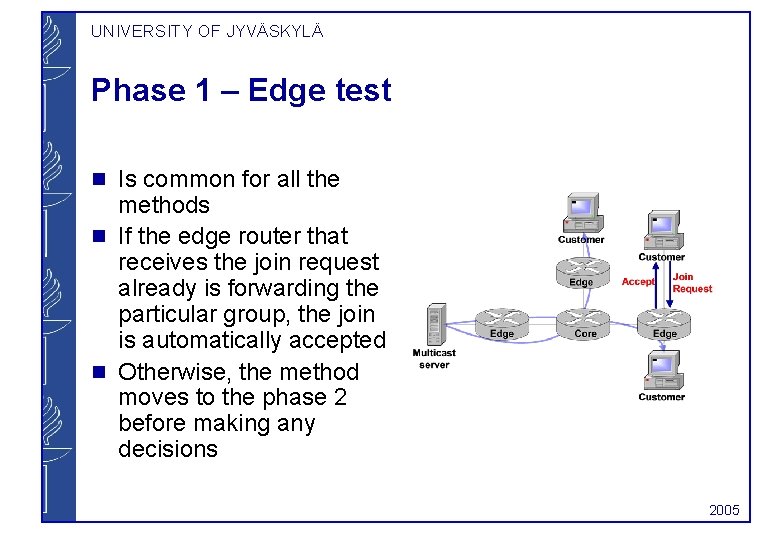
UNIVERSITY OF JYVÄSKYLÄ Phase 1 – Edge test g g g Is common for all the methods If the edge router that receives the join request already is forwarding the particular group, the join is automatically accepted Otherwise, the method moves to the phase 2 before making any decisions 2005
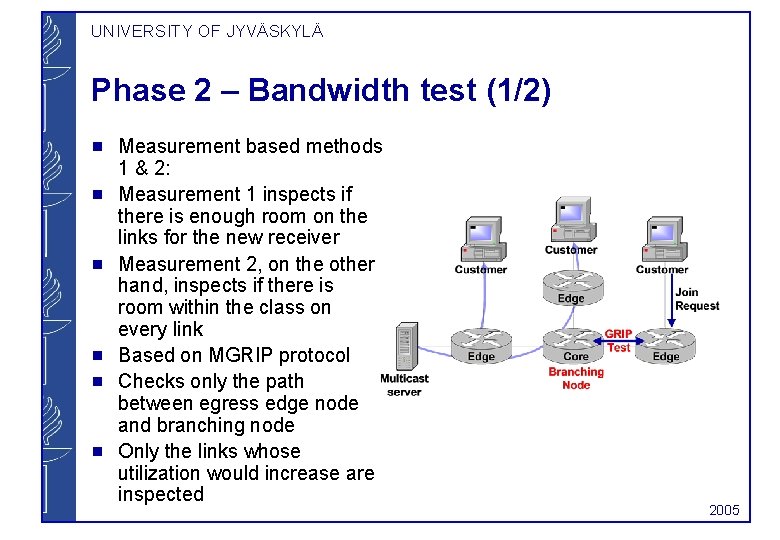
UNIVERSITY OF JYVÄSKYLÄ Phase 2 – Bandwidth test (1/2) g g g Measurement based methods 1 & 2: Measurement 1 inspects if there is enough room on the links for the new receiver Measurement 2, on the other hand, inspects if there is room within the class on every link Based on MGRIP protocol Checks only the path between egress edge node and branching node Only the links whose utilization would increase are inspected 2005
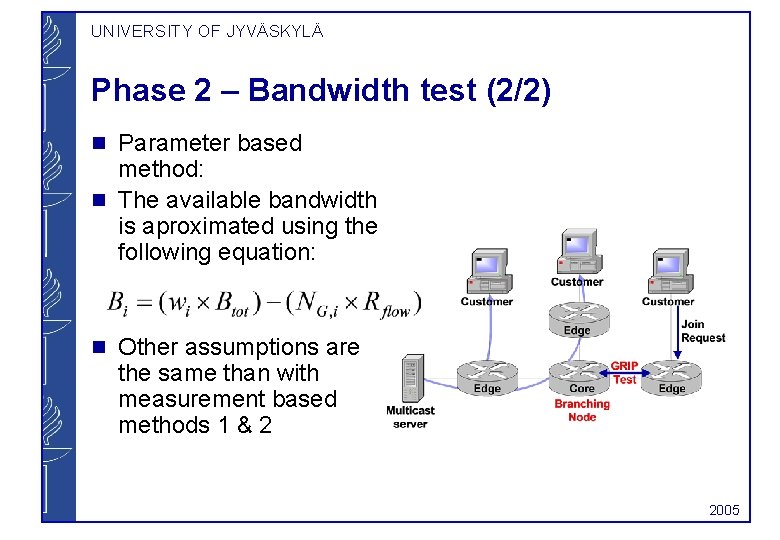
UNIVERSITY OF JYVÄSKYLÄ Phase 2 – Bandwidth test (2/2) g g g Parameter based method: The available bandwidth is aproximated using the following equation: Other assumptions are the same than with measurement based methods 1 & 2 2005
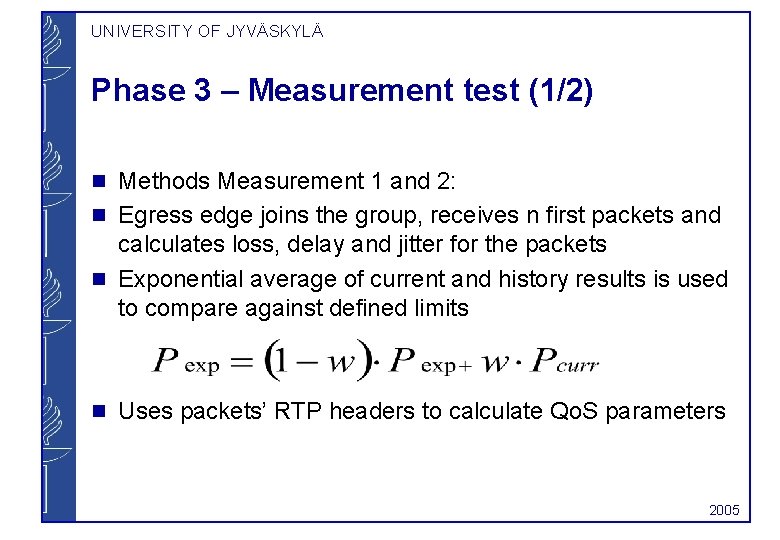
UNIVERSITY OF JYVÄSKYLÄ Phase 3 – Measurement test (1/2) g g Methods Measurement 1 and 2: Egress edge joins the group, receives n first packets and calculates loss, delay and jitter for the packets Exponential average of current and history results is used to compare against defined limits Uses packets’ RTP headers to calculate Qo. S parameters 2005
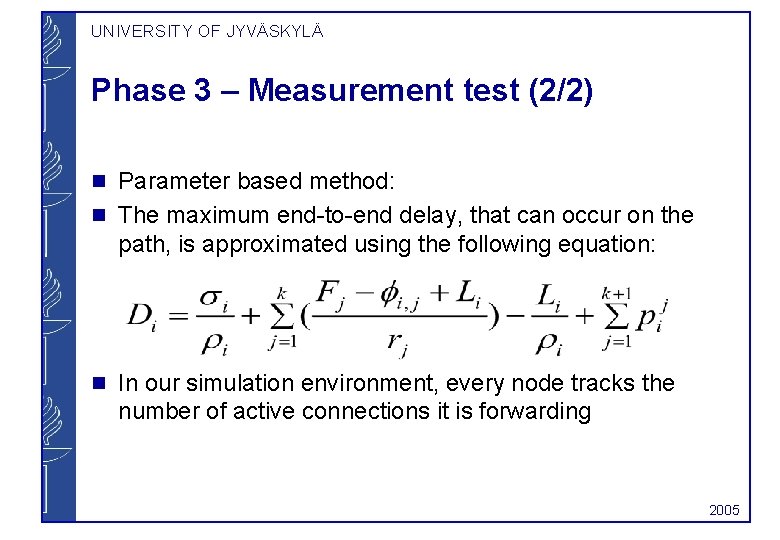
UNIVERSITY OF JYVÄSKYLÄ Phase 3 – Measurement test (2/2) g g g Parameter based method: The maximum end-to-end delay, that can occur on the path, is approximated using the following equation: In our simulation environment, every node tracks the number of active connections it is forwarding 2005
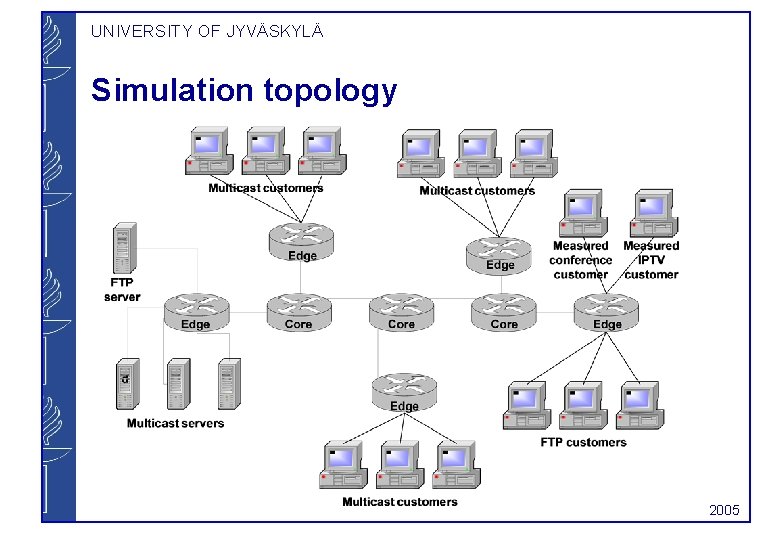
UNIVERSITY OF JYVÄSKYLÄ Simulations g g Simulations were done with ”Network Simulator 2” Traffic of two customers was measured and other customers produced the background traffic FTP, IPTV and video conference were used as the applications Video traffic was produced from real captured video stream 2005
UNIVERSITY OF JYVÄSKYLÄ Simulation topology 2005
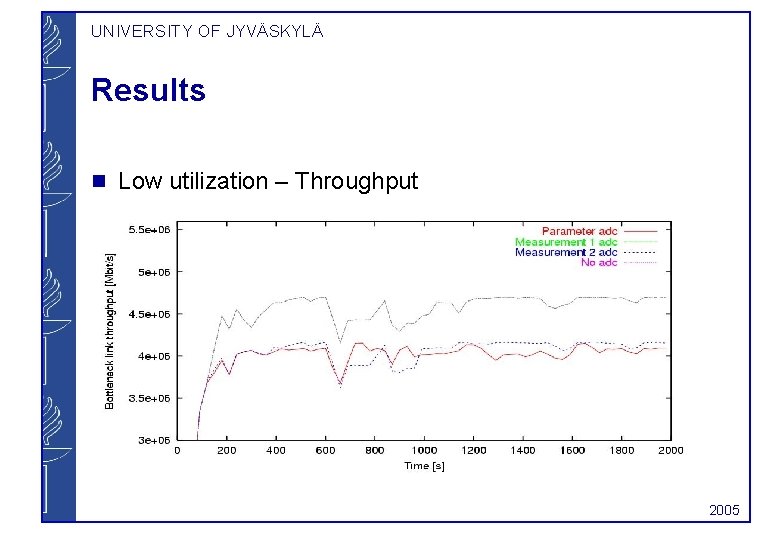
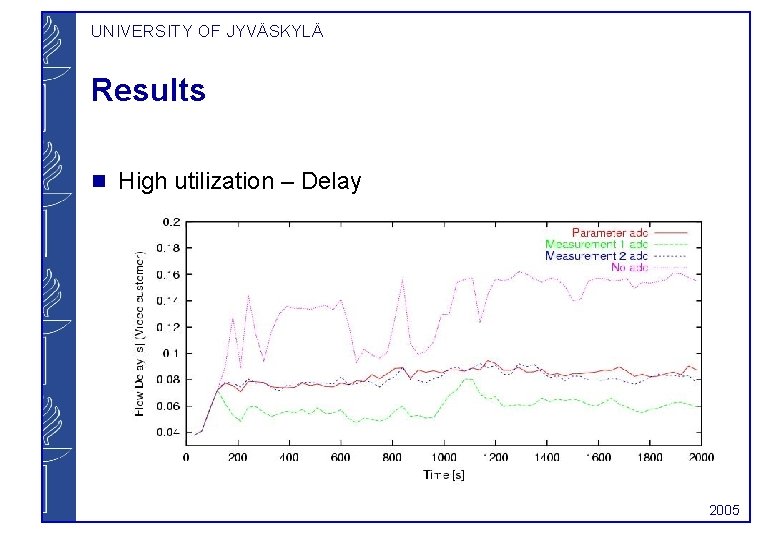
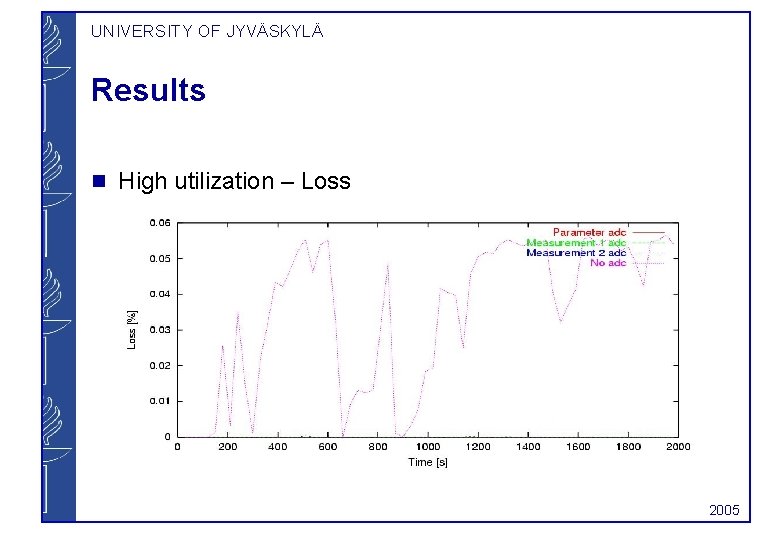
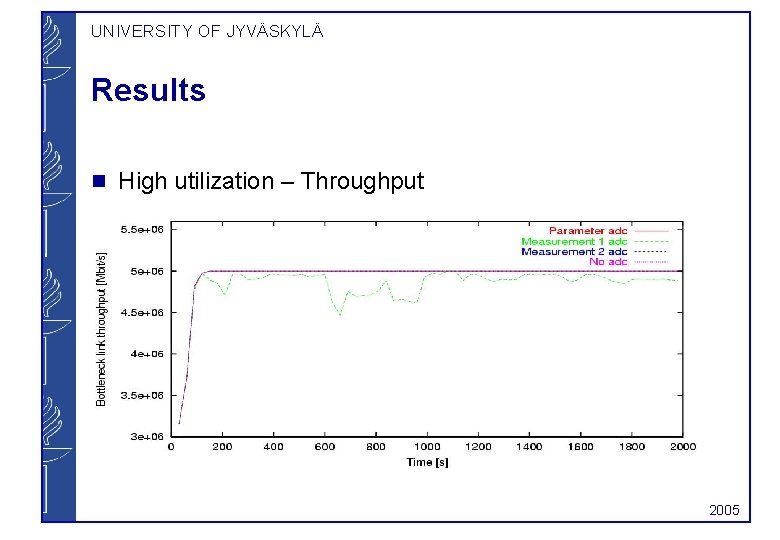
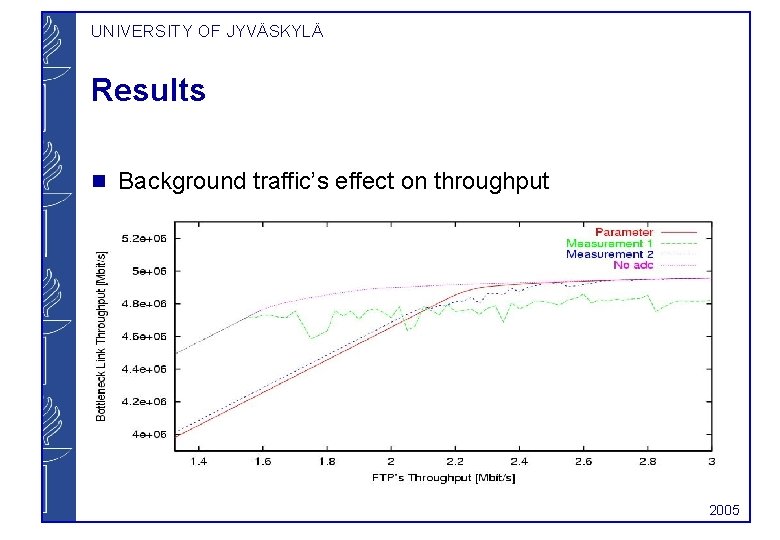
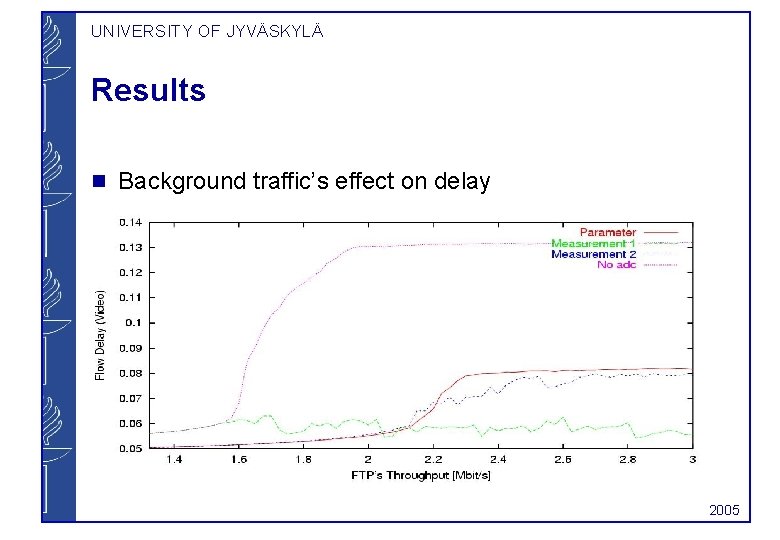
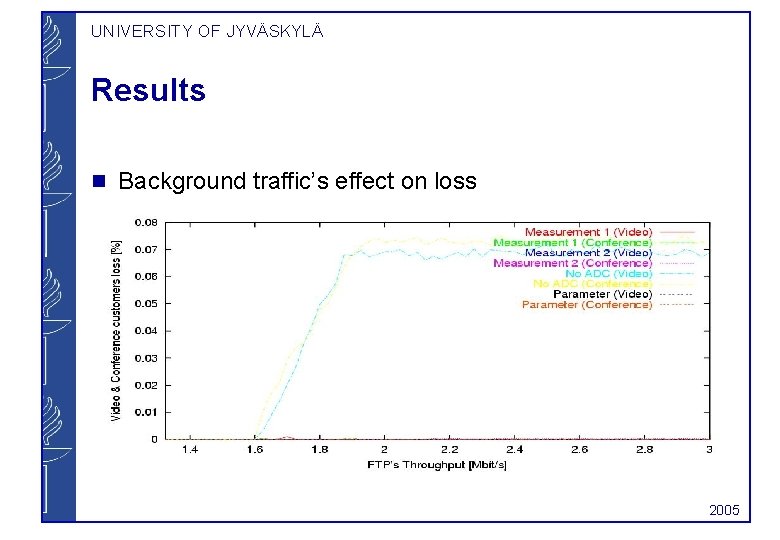
UNIVERSITY OF JYVÄSKYLÄ Results g g Tens of identical simulations with different background traffic loads were ran First case shows a situation in a slightly loaded network Second case shows a situation with more loaded network The last case presents the influence of backgroud traffic 2005
UNIVERSITY OF JYVÄSKYLÄ Results g Low utilization – Throughput 2005
UNIVERSITY OF JYVÄSKYLÄ Results g High utilization – Delay 2005
UNIVERSITY OF JYVÄSKYLÄ Results g High utilization – Loss 2005
UNIVERSITY OF JYVÄSKYLÄ Results g High utilization – Throughput 2005
UNIVERSITY OF JYVÄSKYLÄ Results g Background traffic’s effect on throughput 2005
UNIVERSITY OF JYVÄSKYLÄ Results g Background traffic’s effect on delay 2005
UNIVERSITY OF JYVÄSKYLÄ Results g Background traffic’s effect on loss 2005
UNIVERSITY OF JYVÄSKYLÄ Conclusions based on simulations g g g The need for admission control can be seen clearly Our simple admission control method gives better quality for the customers being served Decreased throughput and rejection of some of the requests is the cost of the method 2005
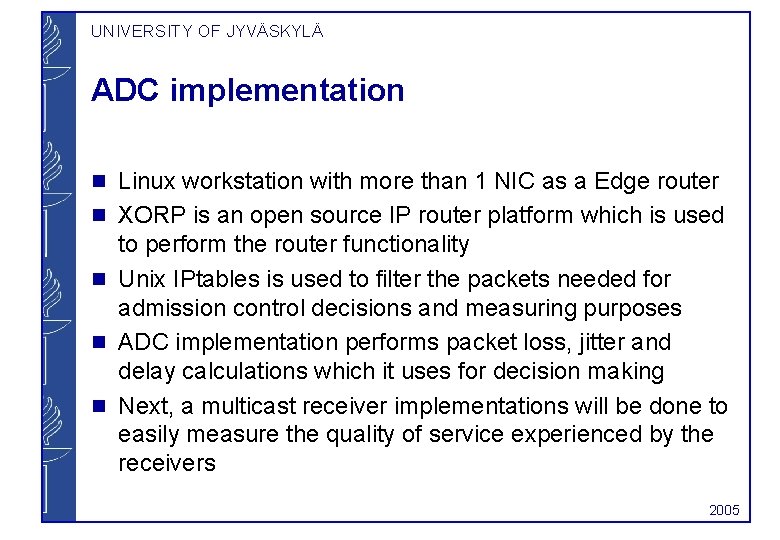
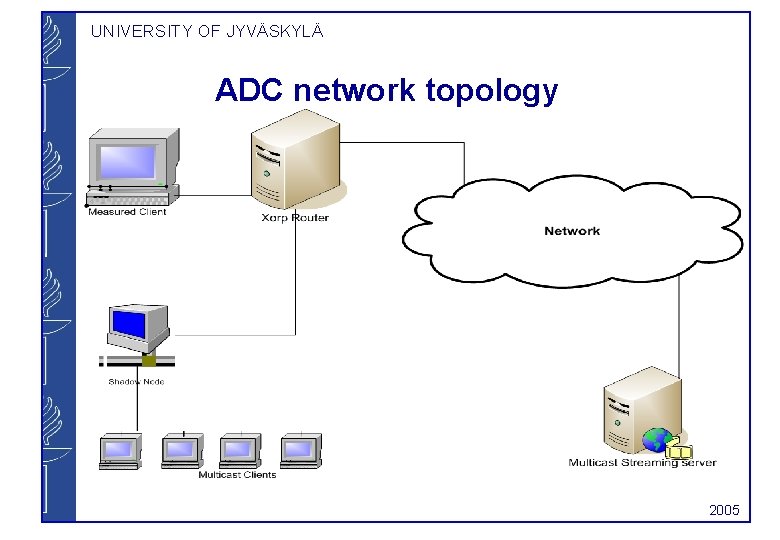
UNIVERSITY OF JYVÄSKYLÄ ADC implementation g g g Linux workstation with more than 1 NIC as a Edge router XORP is an open source IP router platform which is used to perform the router functionality Unix IPtables is used to filter the packets needed for admission control decisions and measuring purposes ADC implementation performs packet loss, jitter and delay calculations which it uses for decision making Next, a multicast receiver implementations will be done to easily measure the quality of service experienced by the receivers 2005
UNIVERSITY OF JYVÄSKYLÄ ADC network topology 2005
UNIVERSITY OF JYVÄSKYLÄ The end 2005