Universal Gravitation 1 Newton hypothesized that the moon
- Slides: 18
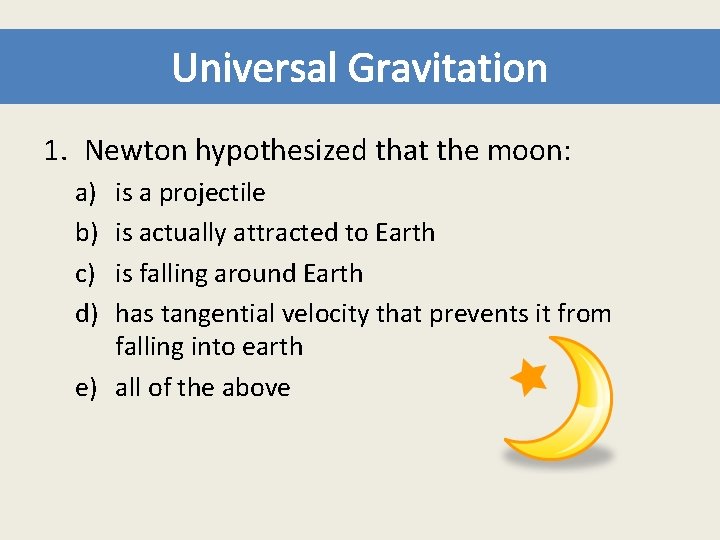
Universal Gravitation 1. Newton hypothesized that the moon: a) b) c) d) is a projectile is actually attracted to Earth is falling around Earth has tangential velocity that prevents it from falling into earth e) all of the above
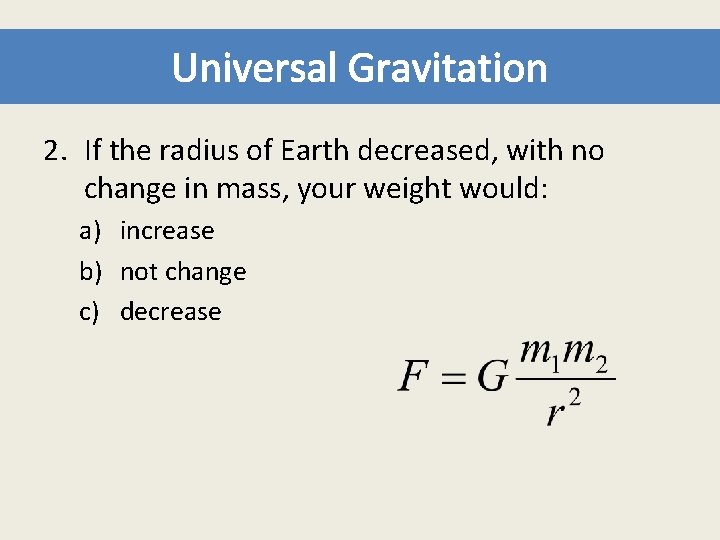
Universal Gravitation 2. If the radius of Earth decreased, with no change in mass, your weight would: a) increase b) not change c) decrease
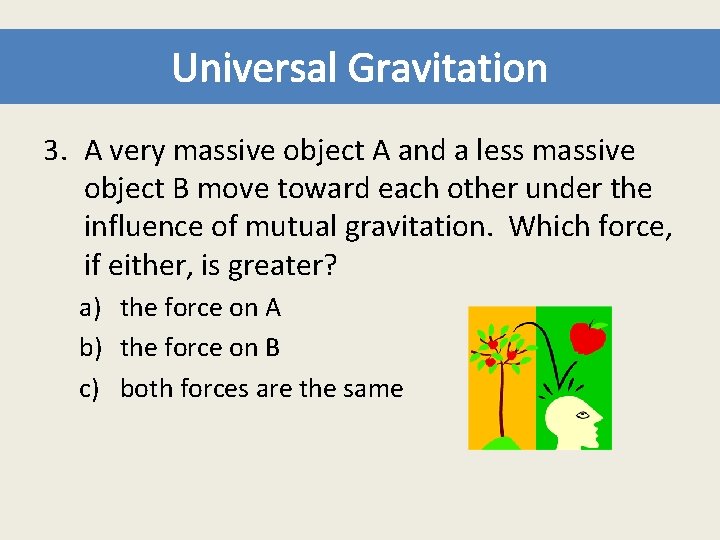
Universal Gravitation 3. A very massive object A and a less massive object B move toward each other under the influence of mutual gravitation. Which force, if either, is greater? a) the force on A b) the force on B c) both forces are the same
Universal Gravitation 4. A very massive object A and a less massive object B move toward each other under the influence of mutual gravitation. Which object will accelerate more? a) object A b) object B c) both objects accelerate the same
Universal Gravitation 5. The force of gravity on you is greatest when you are standing: a) above the earth’s surface b) at the center of the earth c) on the earth’s surface
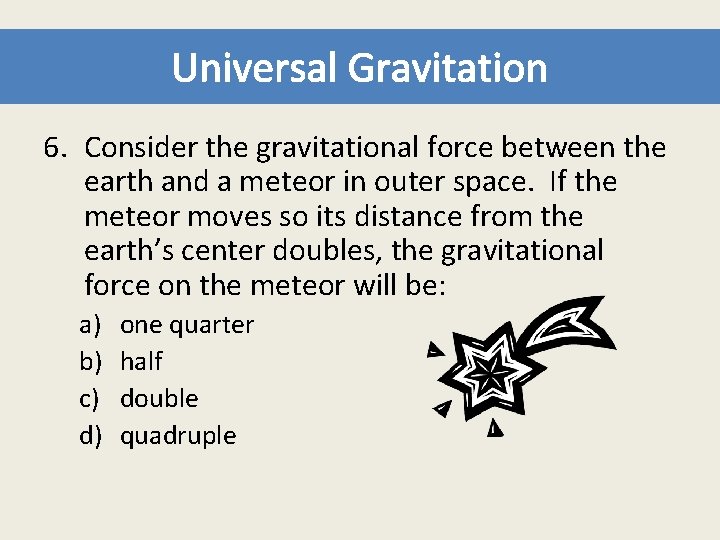
Universal Gravitation 6. Consider the gravitational force between the earth and a meteor in outer space. If the meteor moves so its distance from the earth’s center doubles, the gravitational force on the meteor will be: a) b) c) d) one quarter half double quadruple
Universal Gravitation 7. Why did Newton think there was a force acting on the moon? a) because the moon always keeps one side toward Earth b) because the moon moves in a curved path c) because there is no air on the moon d) because the moon is moving e) all of the above
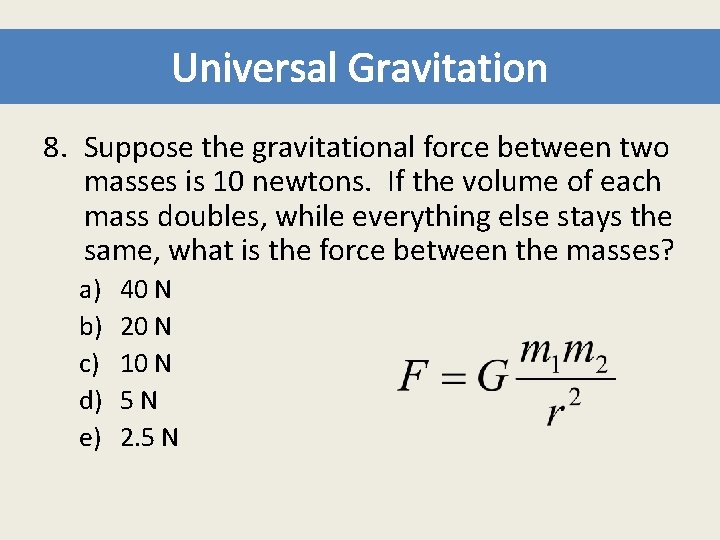
Universal Gravitation 8. Suppose the gravitational force between two masses is 10 newtons. If the volume of each mass doubles, while everything else stays the same, what is the force between the masses? a) b) c) d) e) 40 N 20 N 10 N 5 N 2. 5 N
Universal Gravitation 9. The force of attraction between two masses depends inversely on the square of the distance between them. Any law that follows this relationship is called an inverse square law. a) true b) false
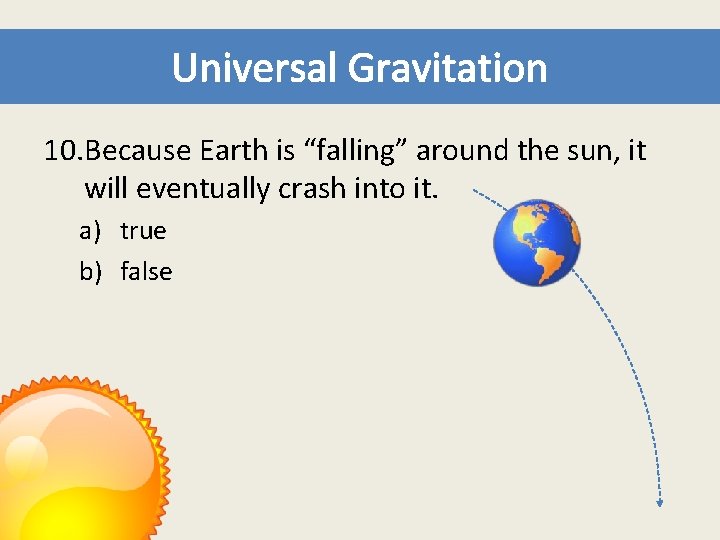
Universal Gravitation 10. Because Earth is “falling” around the sun, it will eventually crash into it. a) true b) false
Gravitational Interactions 11. The value of the acceleration due to gravity: a) b) c) d) e) depends on the radius of Earth depends on the mass of Earth depends on the universal gravitational constant is different on different planets all of the above
Gravitational Interactions 12. Gravitational field lines show the: a) b) c) d) e) direction a mass would be accelerated direction of the field direction of the force on any mass strength of the field all of the above
Gravitational Interactions 13. The acceleration due to gravity at the center of the earth is: a) b) c) d) large the same as on the surface slightly less than on the surface zero
Gravitational Interactions 14. If you were to weigh yourself in an elevator that is accelerating upward, compared to your ordinary weight you would weigh: a) b) c) d) more the same less, but more than zero
Gravitational Interactions 15. The affect of the sun’s pull on the earth’s oceans is much less visible that of the moon’s pull because: a) b) c) d) e) Earth is orbiting so fast Earth is rotating so fast the sun is so far away the sun is radiating a lot of energy none of the above
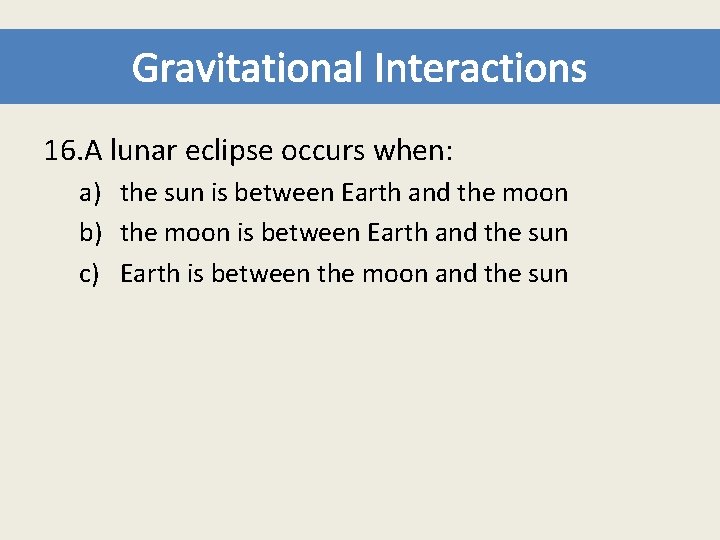
Gravitational Interactions 16. A lunar eclipse occurs when: a) the sun is between Earth and the moon b) the moon is between Earth and the sun c) Earth is between the moon and the sun
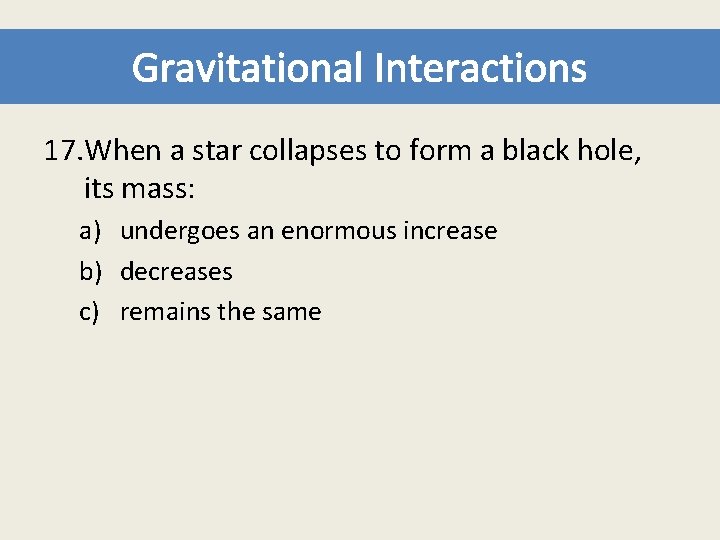
Gravitational Interactions 17. When a star collapses to form a black hole, its mass: a) undergoes an enormous increase b) decreases c) remains the same
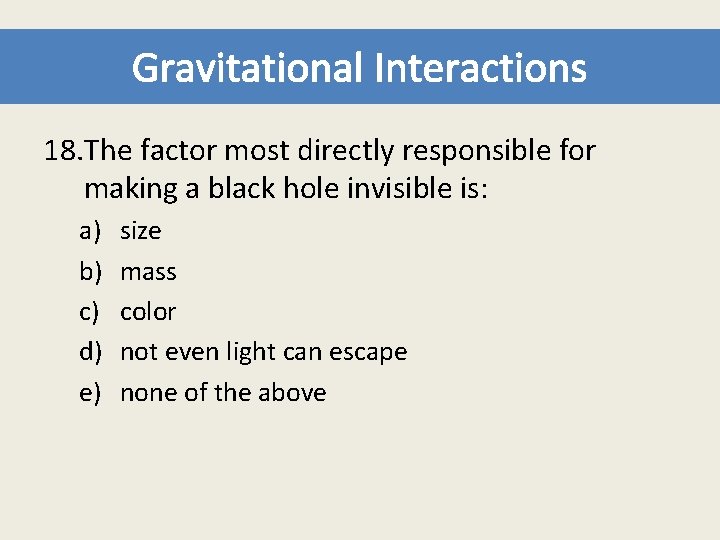
Gravitational Interactions 18. The factor most directly responsible for making a black hole invisible is: a) b) c) d) e) size mass color not even light can escape none of the above