Unit 32 Networked Systems Security https www tes



- Slides: 13
Unit 32 – Networked Systems Security https: //www. tes. com/lessons/k-4 i 3 Dlopqk. OYA/review-week-unit-32 -networked-systems-security
Find different network attacks Learning Objective 2
A group of interconnected (via cable and/or wireless) computers and peripherals that is capable of sharing software and hardware resources between many users. The Internet is a global network of networks. What is a Network?
Network security is the process by which digital information are protected What is Network Security?
• The term ‘computer virus' was formally defined by Fred Cohen in 1983, while he performed academic experiments on a Digital Equipment Corporation VAX system. • Viruses are classified as being one of two types: research or ‘in the wild. ' A little history
• The first computer viruses were developed in the early 1980 s. • The first viruses found in the wild were Apple II viruses, such as Elk Cloner, which was reported in 1981 A little history
Create an a-z of network attacks poster (pairs). See if you can find 26 different attacks! Organise the attacks into highest to lowest impact the attack has on a network Task
Define network attacks Learning Objective 3
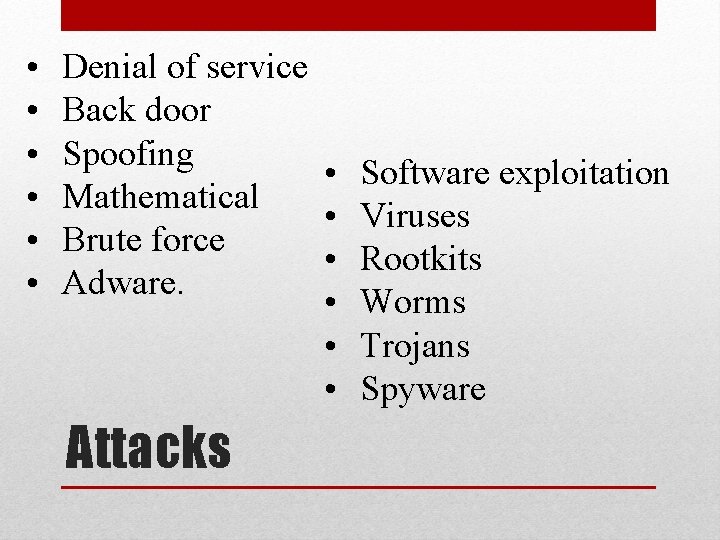
• • • Denial of service Back door Spoofing • Software exploitation Mathematical • Viruses Brute force • Rootkits Adware. • Worms • Trojans • Spyware Attacks
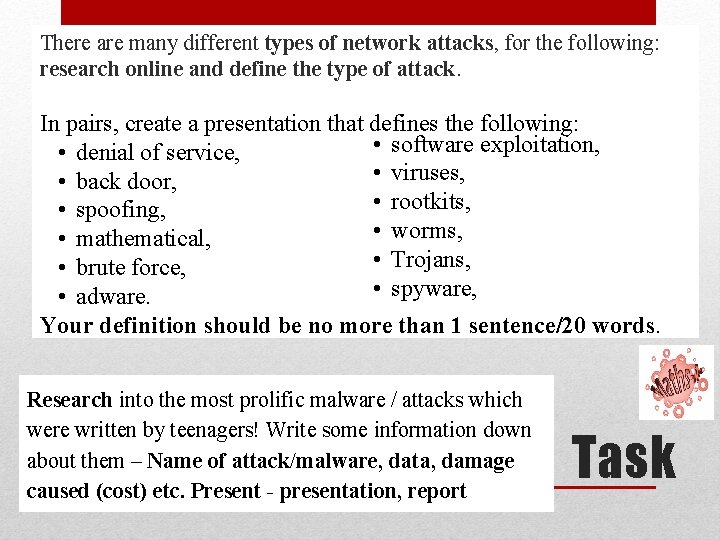
There are many different types of network attacks, for the following: research online and define the type of attack. In pairs, create a presentation that defines the following: • software exploitation, • denial of service, • viruses, • back door, • rootkits, • spoofing, • worms, • mathematical, • Trojans, • brute force, • spyware, • adware. Your definition should be no more than 1 sentence/20 words. Research into the most prolific malware / attacks which were written by teenagers! Write some information down about them – Name of attack/malware, data, damage caused (cost) etc. Present - presentation, report Task
Summarise a network attack Learning Objective 4
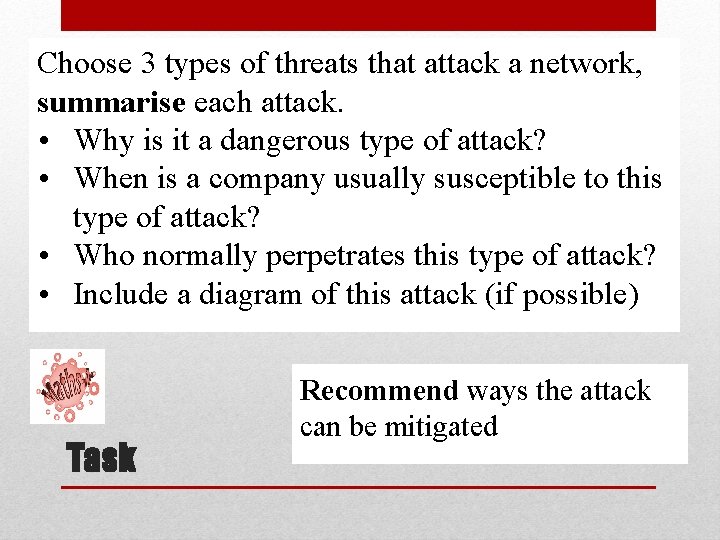
Choose 3 types of threats that attack a network, summarise each attack. • Why is it a dangerous type of attack? • When is a company usually susceptible to this type of attack? • Who normally perpetrates this type of attack? • Include a diagram of this attack (if possible) Task Recommend ways the attack can be mitigated
Read this http: //www. securityweek. com /virus-threats is there anything interesting? Homework