Uniform Anatomical Gift Act 2006 Improving the Donation
- Slides: 14
Uniform Anatomical Gift Act (2006) Improving the Donation Process National Conference of Commissioners On Uniform State Laws
History of the UAGA • Original UAGA promulgated in 1968, created the power to donate organs, eyes and tissue. • 1968 UAGA was uniformly adopted in all jurisdictions. • First revision to UAGA promulgated in 1987, intended to update Act to reflect changes in circumstance and practice. • 1987 UAGA adopted in only 26 states.
Why Revise the UAGA? • Uneven adoption of 1987 UAGA and numerous amendments over the years in each state have eliminated uniformity. • State and Federal law are no longer in sync. • The practice of organ donation has changed significantly, including a rise in the importance of organ procurement organizations.
What’s New in 2006 Act? • New and expanded definitions. • Increased focus on personal autonomy in the donation process. • Clearer rules on the role of family, friends, and caregivers. • Tools to facilitate the work of organ procurement organizations. • Various changes that modernize the Act.
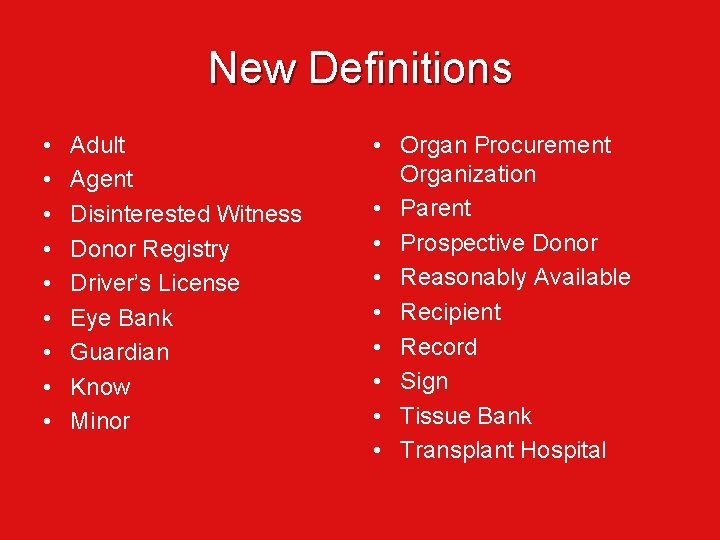
New Definitions • • • Adult Agent Disinterested Witness Donor Registry Driver’s License Eye Bank Guardian Know Minor • Organ Procurement Organization • Parent • Prospective Donor • Reasonably Available • Recipient • Record • Sign • Tissue Bank • Transplant Hospital
Individual’s Right to Donate • Simplifies the document of gift and recognizes driver’s license donation forms. • Strengthens individual’s right not to donate by permitting signed refusals.
Individual’s Right to Donate (cont. ) • Permits minors to make a gift, with some limitations. • Better prevents others from overriding an individual’s decision to make or refuse to make an anatomical gift.
Donations by Others • Allows agents under a health-care power of attorney make a gift during an incapacitated individual’s lifetime. • Widens the class of individuals authorized to make a gift after the donor’s death. • Provides clearer rules and procedures for the post-death donation decision making process.
Organ Procurement Organizations • Authorizes and provides protocols for states to create donor registries. • Allows OPOs to access donor registries, medical records, and motor vehicle records to locate documents of gift. • Reduces the need for OPOs to seek consent from the family except when donor is a minor.
Other Additions • As a default rule for use of a gift, transplantation and therapy are given priority over research or education. • Intentional falsification of a document of gift or refusal is a felony. • Individual’s acting in good faith in accordance with the Act or the applicable laws of another state are not liable for their actions in civil, criminal, or administrative proceedings.
Other Additions • If there any refusals in a given class, the majority of that class determine whether a gift is made. • Definition of “reasonably available” addresses the time-sensitive nature of the organ donation process. • Health-care directives requesting withdrawal of life-support are no longer construed as a refusal to donate.
Legislative Note • The UAGA legislative notes recommend states to keep existing donor registries, donor awareness programs and other licensing matters in statutes when enacting UAGA.
Why is Uniformity Important? • Transplantation occurs across state boundaries and requires speed and efficiency if the organ is to be successfully transplanted into the recipient. • There is simply no time for researching and conforming to variations of the laws among the states. • Need to harmonize state and federal law and policy to fully respect autonomy interest of donors. • Uniformity is highly desirable.
More Information • www. anatomicalgiftact. org • Nicole Julal nicole. julal@nccusl. org 111 N. Wabash Ave. Suite 1010 Chicago, IL 60602 Phone: (312) 450 -6600 Fax: (312) 450 -6601