UNDERSTANDING PROGRESSIVE REALISATION AND IWRM WITHIN THE SOUTH
- Slides: 20
UNDERSTANDING PROGRESSIVE REALISATION AND IWRM WITHIN THE SOUTH AFRICAN CONTEXT By Derick du Toit, Ramin Pejan, Sharon Pollard, and Hubert Thompson The Association for Water and Rural Development
Sponsored by South African Water Research Commission WRC
Key objectives of this study for the Water Research Commission (WRC) • The importance of water reforms in ensuring a sustainable resource, redressing past inequities and optimal use of resource • Definition of lag • Criteria that can govern policy implementation lag assessments • Recommendations
Reform or transform? • We take reform characteristics to be congruent with: restructure, rearrange, carry forward differently, reformulate and change direction, where transformation occurs when there is systemic change, new policy and principles, removal and replacement, redesign, adopt new procedures and practices, and reorientation.
SA Water Transformation South Africa is unique in that it has undergone deep systemic changes, not only for environmental and sustainability reasons, but also to “engage in reallocation of resources in order to rectify an extremely skewed distribution resulting from a historical legacy of colonialism, apartheid and discrimination. ”
Changes in water management • Integrated Water Resource Management (IWRM) NEW water management paradigm introducing: • tradable formal or administrative entitlements, known variously as permits, licences, concessions or grants. • shift from water rights regimes, such as the riparian principle, to ones where authority to issue or use water is vested in the State. • Management at catchment level, new institution • Sustainability and equity feature as principles
LAGS • when there is a significant transformation always a “lag” from policy formulation to implementation (Pollard & du Toit 2008). • Implementation Lag: Economic defn etc
Dilemma • The best designed and intentioned policies are meaningless, if 1) the time it takes to implement them is “too long” or 2) their implementation is of an “unacceptable quality or standard”. The key, therefore, is to understand when a lag is unreasonable with respect to these two categories.
Why use progressive realisation as a guide for evaluating IWRM Lags? S. 24 Constitution. Environment. -Everyone has the right(a) to an environment that is not harmful to their health or well-being; and (b) to have the environment protected, for the benefit of present and future generations, through reasonable legislative and other measures that-(i) prevent pollution and ecological degradation; (ii) promote conservation; and(iii) secure ecologically sustainable development and use of natural resources while promoting justifiable economic and social development
Clarification of PR in South Africa • measures must be comprehensive and co-ordinated, clearly allocating responsibilities and tasks; • capable of promoting realisation of the right; • be reasonable in conception and realisation; • be balanced and flexible, providing for needs of different degrees of urgency, and refraining from excluding significant elements of society; • and include a component that responds to the most urgent needs and the management of crises (Glazewksi 2004). KEY is to apply this test to IWRM’s major management actions
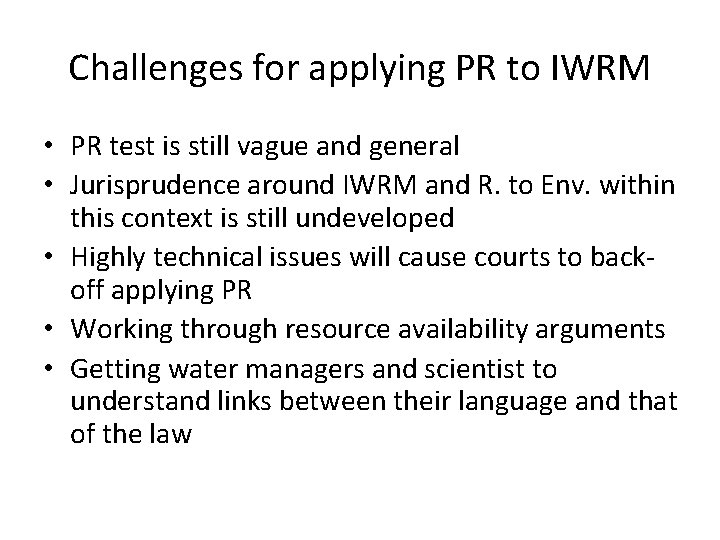
Challenges for applying PR to IWRM • PR test is still vague and general • Jurisprudence around IWRM and R. to Env. within this context is still undeveloped • Highly technical issues will cause courts to backoff applying PR • Working through resource availability arguments • Getting water managers and scientist to understand links between their language and that of the law
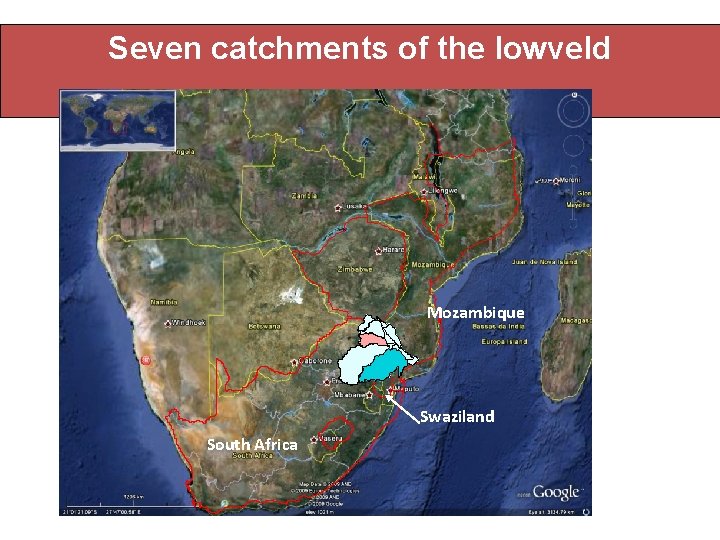
Seven catchments of the lowveld Mozambique Swaziland South Africa
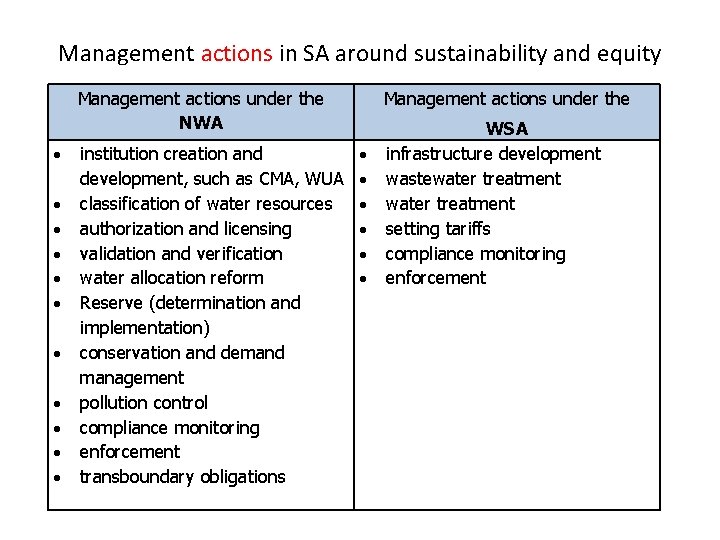
Management actions in SA around sustainability and equity Management actions under the NWA institution creation and development, such as CMA, WUA classification of water resources authorization and licensing validation and verification water allocation reform Reserve (determination and implementation) conservation and demand management pollution control compliance monitoring enforcement transboundary obligations Management actions under the WSA infrastructure development wastewater treatment setting tariffs compliance monitoring enforcement
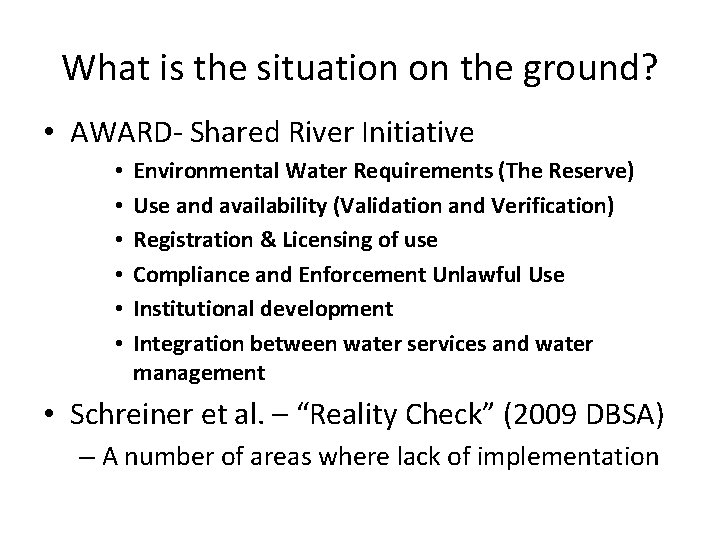
What is the situation on the ground? • AWARD- Shared River Initiative • • • Environmental Water Requirements (The Reserve) Use and availability (Validation and Verification) Registration & Licensing of use Compliance and Enforcement Unlawful Use Institutional development Integration between water services and water management • Schreiner et al. – “Reality Check” (2009 DBSA) – A number of areas where lack of implementation
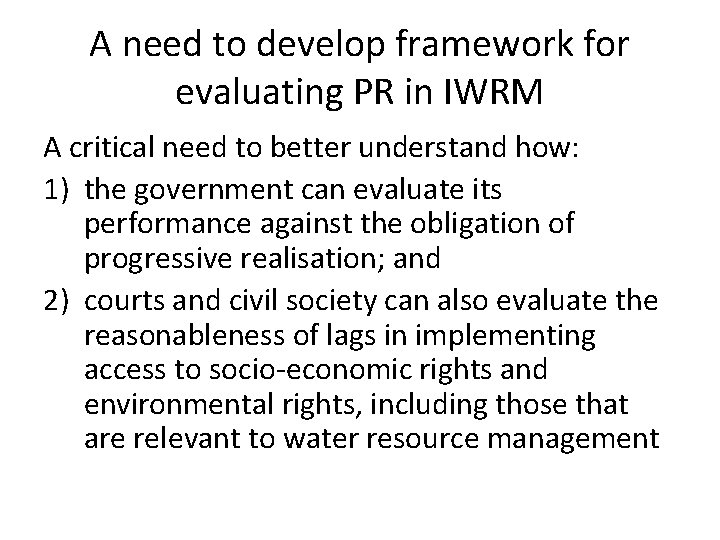
A need to develop framework for evaluating PR in IWRM A critical need to better understand how: 1) the government can evaluate its performance against the obligation of progressive realisation; and 2) courts and civil society can also evaluate the reasonableness of lags in implementing access to socio-economic rights and environmental rights, including those that are relevant to water resource management
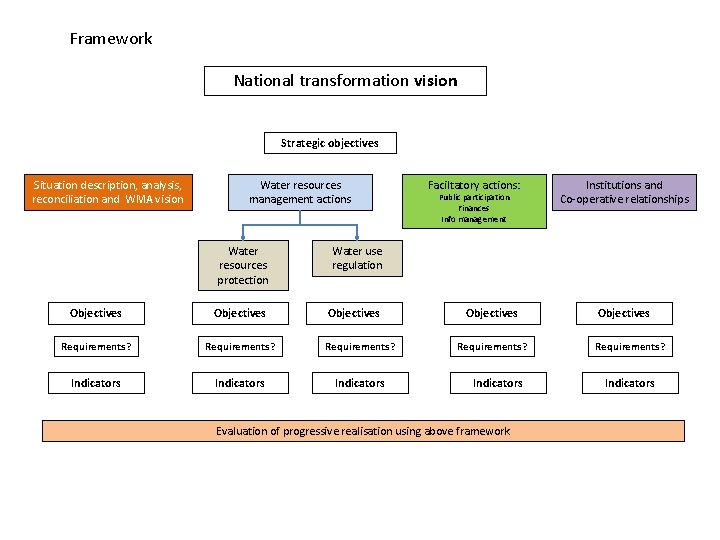
Framework National transformation vision Strategic objectives Situation description, analysis, reconciliation and WMA vision Water resources management actions Water resources protection Water use regulation Objectives Requirements? Indicators Faciltatory actions: Public participation Finances Info management Objectives Requirements? Indicators Evaluation of progressive realisation using above framework Institutions and Co-operative relationships Objectives Requirements? Indicators
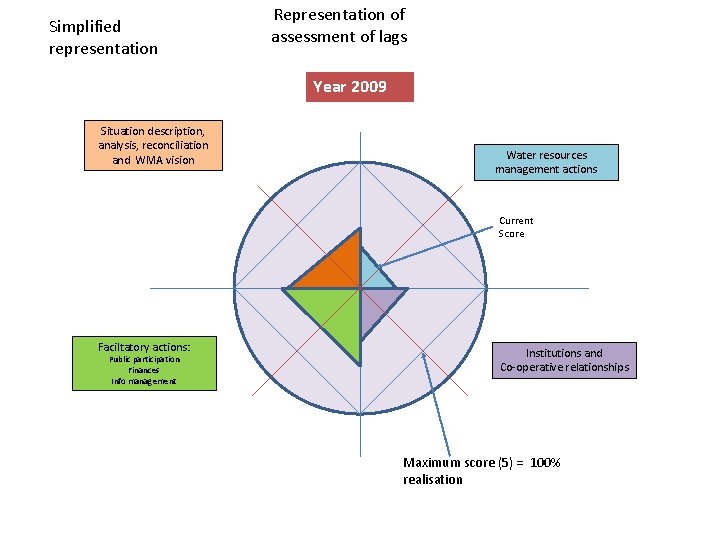
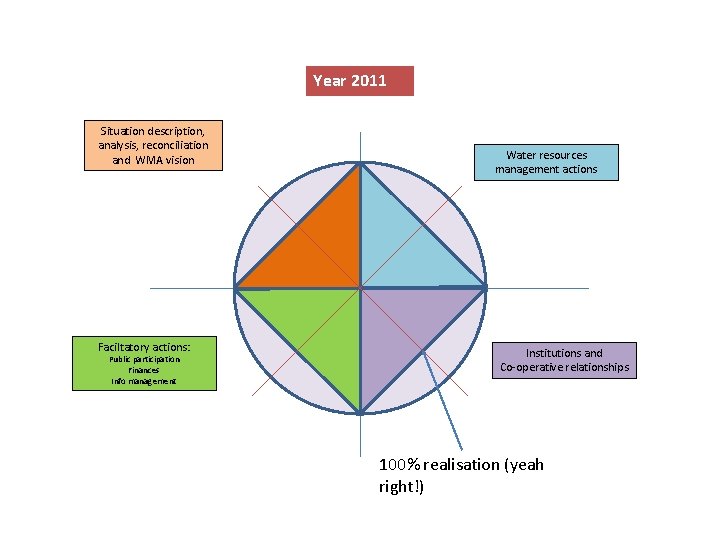
Simplified representation Representation of assessment of lags Year 2009 Situation description, analysis, reconciliation and WMA vision Water resources management actions Current Score Faciltatory actions: Public participation Finances Info management Institutions and Co-operative relationships Maximum score (5) = 100% realisation
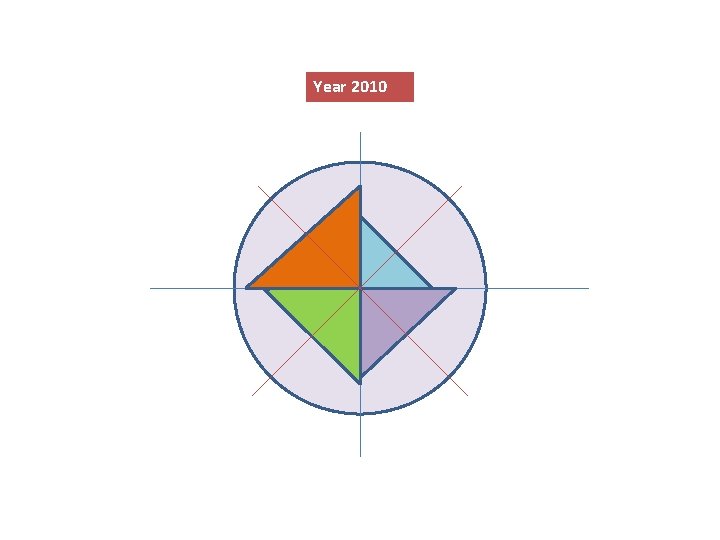
Year 2010
Year 2011 Situation description, analysis, reconciliation and WMA vision Faciltatory actions: Public participation Finances Info management Water resources management actions Institutions and Co-operative relationships 100% realisation (yeah right!)
Important to build on existing mechanisms in South Africa: NWRS and CMS. • NWRS: – set out the strategies, objectives, plans, guidelines and procedures relating to the protection, use, development, conservation, management and control of water resources – 5 years – Phased and progressive manner • CMS: – Medium to long term strategy – Established in a phased and progressive manner – Reviewed at intervals not more than 5 years – Not be in conflict with NWRS – Based on SAM – protection, use, development, conservation, management and control of water resources