U S HISTORY Chapter 10 Jacksonian Democracy 1820



- Slides: 19
U. S. HISTORY Chapter 10 Jacksonian Democracy, 1820– 1840 Power. Point Image Slideshow
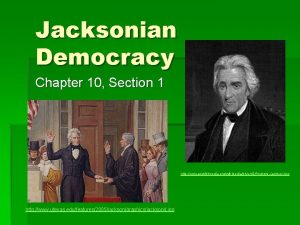
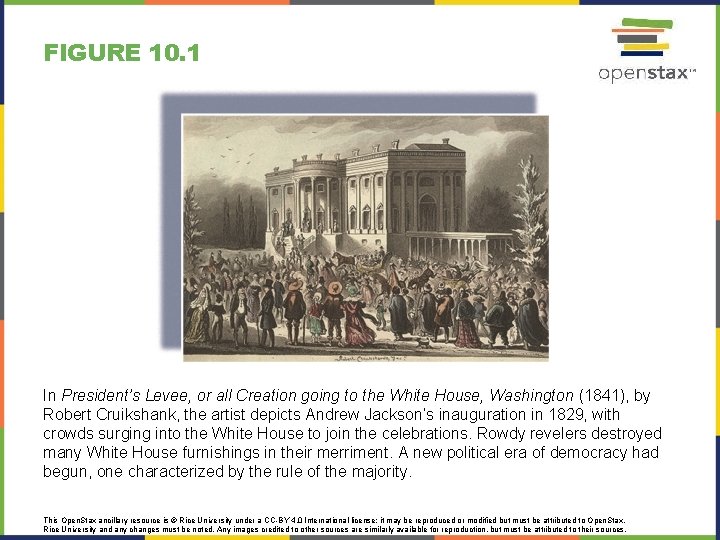
FIGURE 10. 1 In President’s Levee, or all Creation going to the White House, Washington (1841), by Robert Cruikshank, the artist depicts Andrew Jackson’s inauguration in 1829, with crowds surging into the White House to join the celebrations. Rowdy revelers destroyed many White House furnishings in their merriment. A new political era of democracy had begun, one characterized by the rule of the majority. This Open. Stax ancillary resource is © Rice University under a CC-BY 4. 0 International license; it may be reproduced or modified but must be attributed to Open. Stax, Rice University and any changes must be noted. Any images credited to other sources are similarly available for reproduction, but must be attributed to their sources.
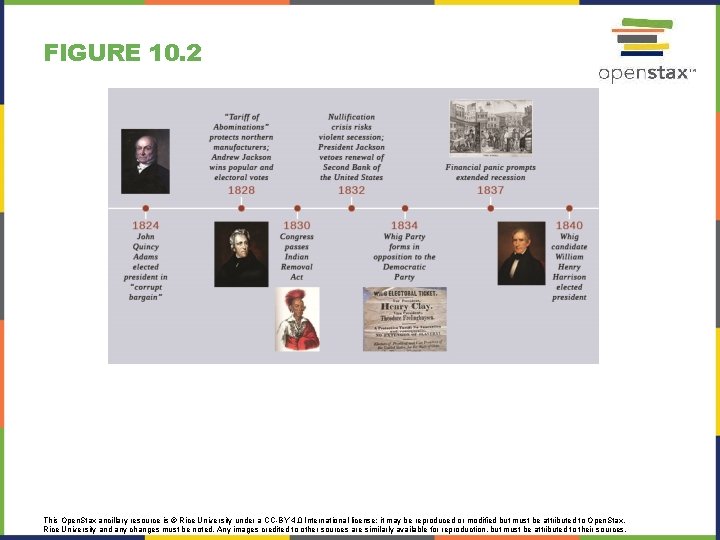
FIGURE 10. 2 This Open. Stax ancillary resource is © Rice University under a CC-BY 4. 0 International license; it may be reproduced or modified but must be attributed to Open. Stax, Rice University and any changes must be noted. Any images credited to other sources are similarly available for reproduction, but must be attributed to their sources.
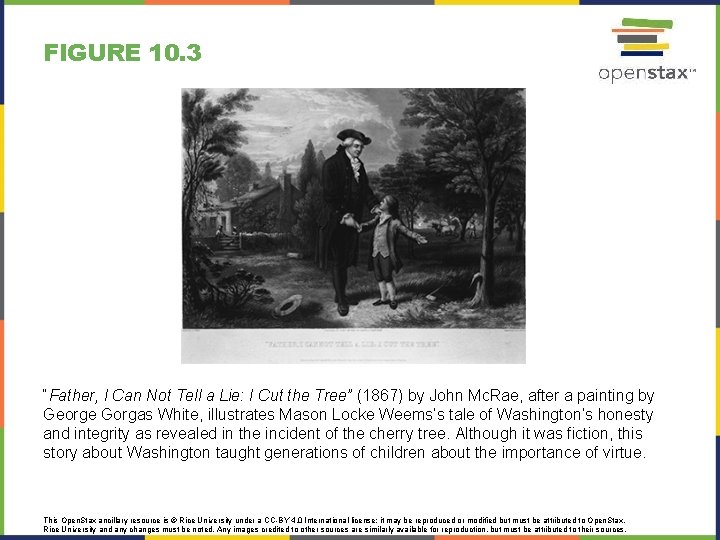
FIGURE 10. 3 “Father, I Can Not Tell a Lie: I Cut the Tree” (1867) by John Mc. Rae, after a painting by George Gorgas White, illustrates Mason Locke Weems’s tale of Washington’s honesty and integrity as revealed in the incident of the cherry tree. Although it was fiction, this story about Washington taught generations of children about the importance of virtue. This Open. Stax ancillary resource is © Rice University under a CC-BY 4. 0 International license; it may be reproduced or modified but must be attributed to Open. Stax, Rice University and any changes must be noted. Any images credited to other sources are similarly available for reproduction, but must be attributed to their sources.
FIGURE 10. 4 The two most popular presidential candidates in the election of 1824 were Andrew Jackson (a), who won the popular vote but failed to secure the requisite number of votes in the Electoral College, and John Quincy Adams (b), who emerged victorious after a contentious vote in the U. S. House of Representatives. This Open. Stax ancillary resource is © Rice University under a CC-BY 4. 0 International license; it may be reproduced or modified but must be attributed to Open. Stax, Rice University and any changes must be noted. Any images credited to other sources are similarly available for reproduction, but must be attributed to their sources.
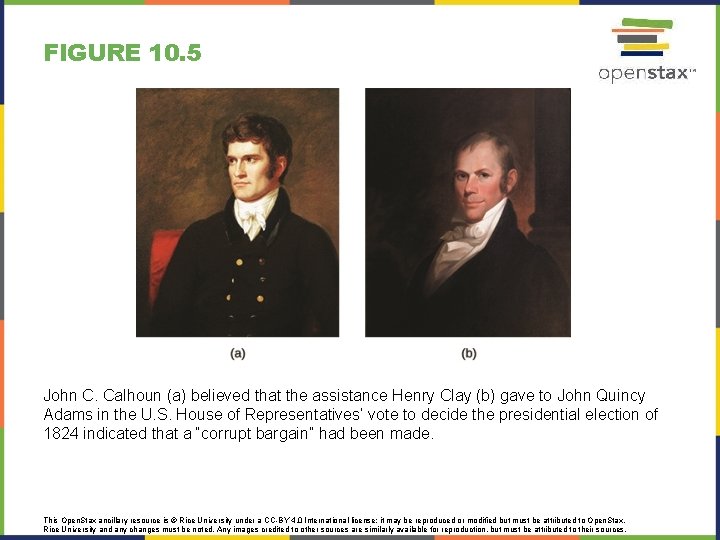
FIGURE 10. 5 John C. Calhoun (a) believed that the assistance Henry Clay (b) gave to John Quincy Adams in the U. S. House of Representatives’ vote to decide the presidential election of 1824 indicated that a “corrupt bargain” had been made. This Open. Stax ancillary resource is © Rice University under a CC-BY 4. 0 International license; it may be reproduced or modified but must be attributed to Open. Stax, Rice University and any changes must be noted. Any images credited to other sources are similarly available for reproduction, but must be attributed to their sources.
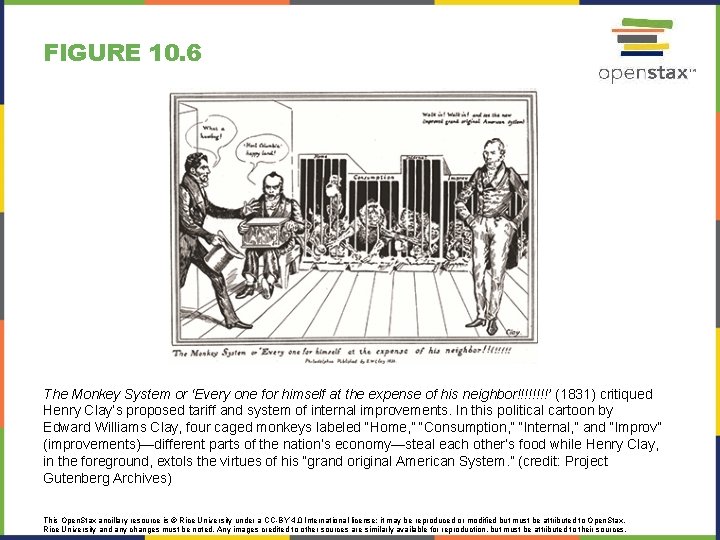
FIGURE 10. 6 The Monkey System or ‘Every one for himself at the expense of his neighbor!!!!’ (1831) critiqued Henry Clay’s proposed tariff and system of internal improvements. In this political cartoon by Edward Williams Clay, four caged monkeys labeled “Home, ” “Consumption, ” “Internal, ” and “Improv” (improvements)—different parts of the nation’s economy—steal each other’s food while Henry Clay, in the foreground, extols the virtues of his “grand original American System. ” (credit: Project Gutenberg Archives) This Open. Stax ancillary resource is © Rice University under a CC-BY 4. 0 International license; it may be reproduced or modified but must be attributed to Open. Stax, Rice University and any changes must be noted. Any images credited to other sources are similarly available for reproduction, but must be attributed to their sources.
FIGURE 10. 7 The bitter rivalry between Andrew Jackson and Henry Clay was exacerbated by the “corrupt bargain” of 1824, which Jackson made much of during his successful presidential campaign in 1828. This drawing, published in the 1830 s during the debates over the future of the Second Bank of the United States, shows Clay sewing up Jackson’s mouth while the “cure for calumny [slander]” protrudes from his pocket. This Open. Stax ancillary resource is © Rice University under a CC-BY 4. 0 International license; it may be reproduced or modified but must be attributed to Open. Stax, Rice University and any changes must be noted. Any images credited to other sources are similarly available for reproduction, but must be attributed to their sources.
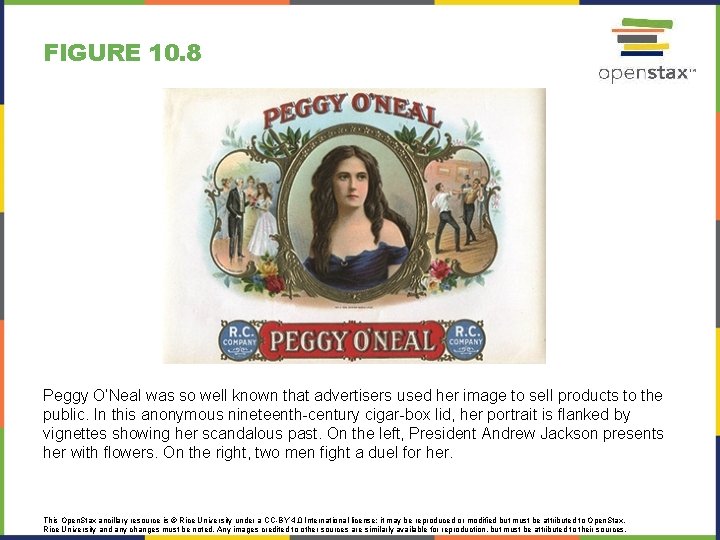
FIGURE 10. 8 Peggy O’Neal was so well known that advertisers used her image to sell products to the public. In this anonymous nineteenth-century cigar-box lid, her portrait is flanked by vignettes showing her scandalous past. On the left, President Andrew Jackson presents her with flowers. On the right, two men fight a duel for her. This Open. Stax ancillary resource is © Rice University under a CC-BY 4. 0 International license; it may be reproduced or modified but must be attributed to Open. Stax, Rice University and any changes must be noted. Any images credited to other sources are similarly available for reproduction, but must be attributed to their sources.
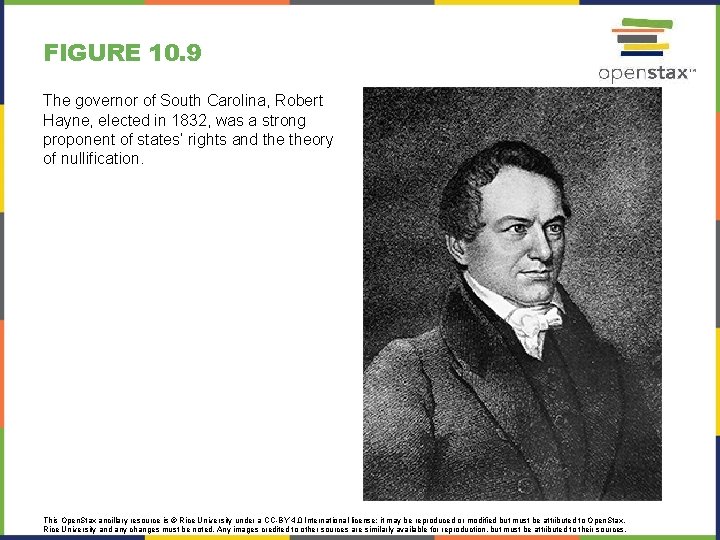
FIGURE 10. 9 The governor of South Carolina, Robert Hayne, elected in 1832, was a strong proponent of states’ rights and theory of nullification. This Open. Stax ancillary resource is © Rice University under a CC-BY 4. 0 International license; it may be reproduced or modified but must be attributed to Open. Stax, Rice University and any changes must be noted. Any images credited to other sources are similarly available for reproduction, but must be attributed to their sources.
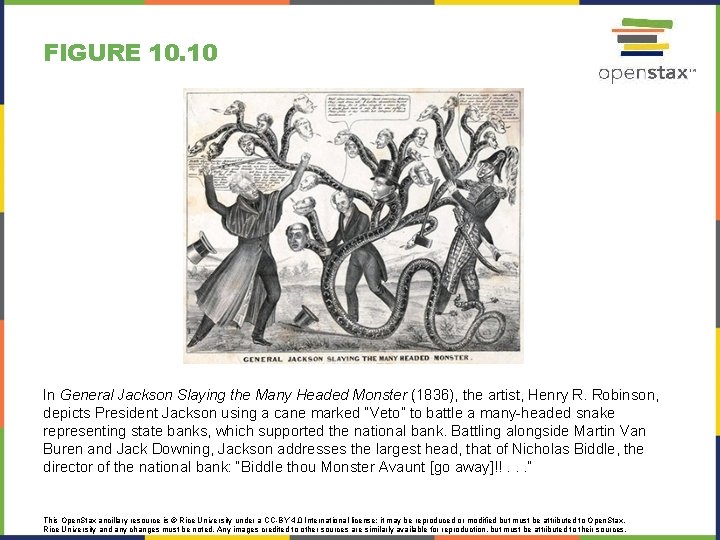
FIGURE 10. 10 In General Jackson Slaying the Many Headed Monster (1836), the artist, Henry R. Robinson, depicts President Jackson using a cane marked “Veto” to battle a many-headed snake representing state banks, which supported the national bank. Battling alongside Martin Van Buren and Jack Downing, Jackson addresses the largest head, that of Nicholas Biddle, the director of the national bank: “Biddle thou Monster Avaunt [go away]!!. . . ” This Open. Stax ancillary resource is © Rice University under a CC-BY 4. 0 International license; it may be reproduced or modified but must be attributed to Open. Stax, Rice University and any changes must be noted. Any images credited to other sources are similarly available for reproduction, but must be attributed to their sources.
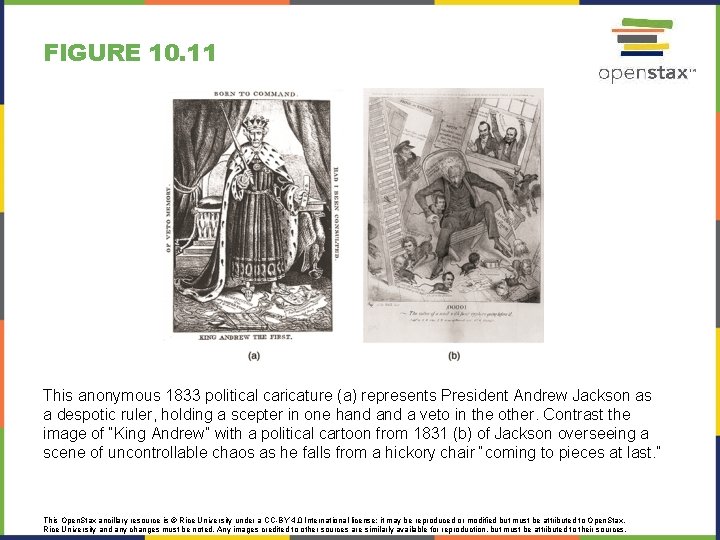
FIGURE 10. 11 This anonymous 1833 political caricature (a) represents President Andrew Jackson as a despotic ruler, holding a scepter in one hand a veto in the other. Contrast the image of “King Andrew” with a political cartoon from 1831 (b) of Jackson overseeing a scene of uncontrollable chaos as he falls from a hickory chair “coming to pieces at last. ” This Open. Stax ancillary resource is © Rice University under a CC-BY 4. 0 International license; it may be reproduced or modified but must be attributed to Open. Stax, Rice University and any changes must be noted. Any images credited to other sources are similarly available for reproduction, but must be attributed to their sources.
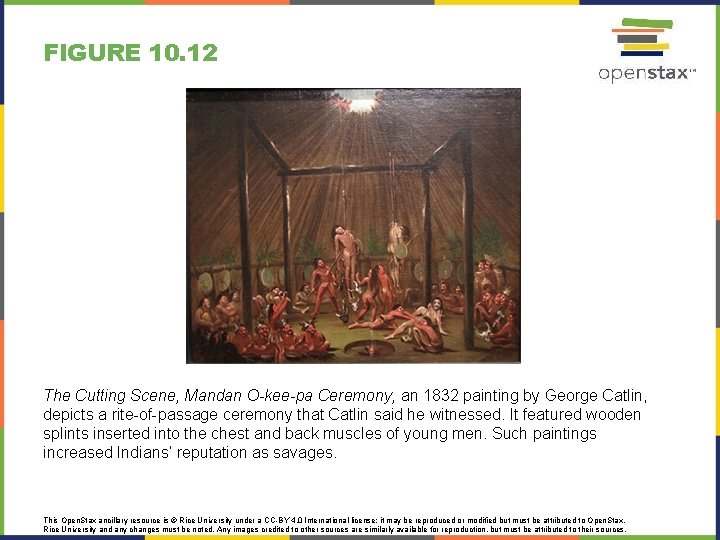
FIGURE 10. 12 The Cutting Scene, Mandan O-kee-pa Ceremony, an 1832 painting by George Catlin, depicts a rite-of-passage ceremony that Catlin said he witnessed. It featured wooden splints inserted into the chest and back muscles of young men. Such paintings increased Indians’ reputation as savages. This Open. Stax ancillary resource is © Rice University under a CC-BY 4. 0 International license; it may be reproduced or modified but must be attributed to Open. Stax, Rice University and any changes must be noted. Any images credited to other sources are similarly available for reproduction, but must be attributed to their sources.
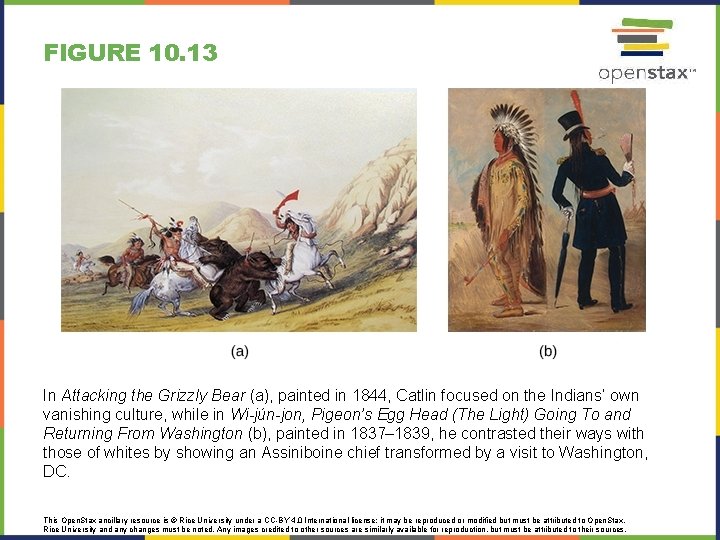
FIGURE 10. 13 In Attacking the Grizzly Bear (a), painted in 1844, Catlin focused on the Indians’ own vanishing culture, while in Wi-jún-jon, Pigeon’s Egg Head (The Light) Going To and Returning From Washington (b), painted in 1837– 1839, he contrasted their ways with those of whites by showing an Assiniboine chief transformed by a visit to Washington, DC. This Open. Stax ancillary resource is © Rice University under a CC-BY 4. 0 International license; it may be reproduced or modified but must be attributed to Open. Stax, Rice University and any changes must be noted. Any images credited to other sources are similarly available for reproduction, but must be attributed to their sources.
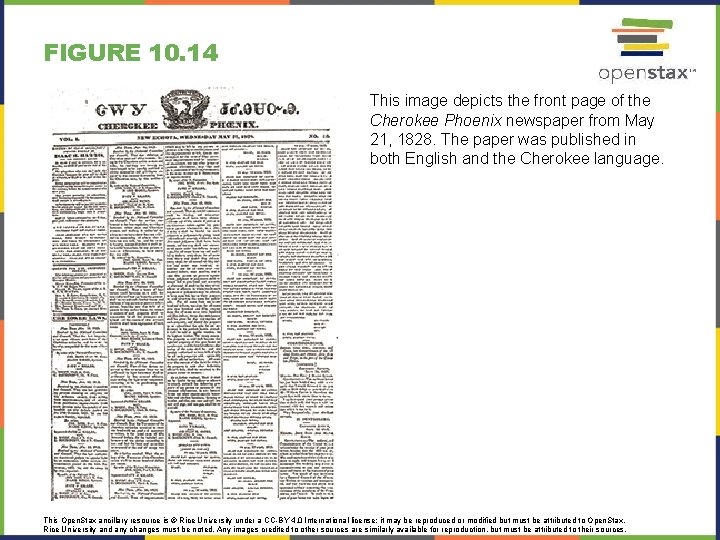
FIGURE 10. 14 This image depicts the front page of the Cherokee Phoenix newspaper from May 21, 1828. The paper was published in both English and the Cherokee language. This Open. Stax ancillary resource is © Rice University under a CC-BY 4. 0 International license; it may be reproduced or modified but must be attributed to Open. Stax, Rice University and any changes must be noted. Any images credited to other sources are similarly available for reproduction, but must be attributed to their sources.
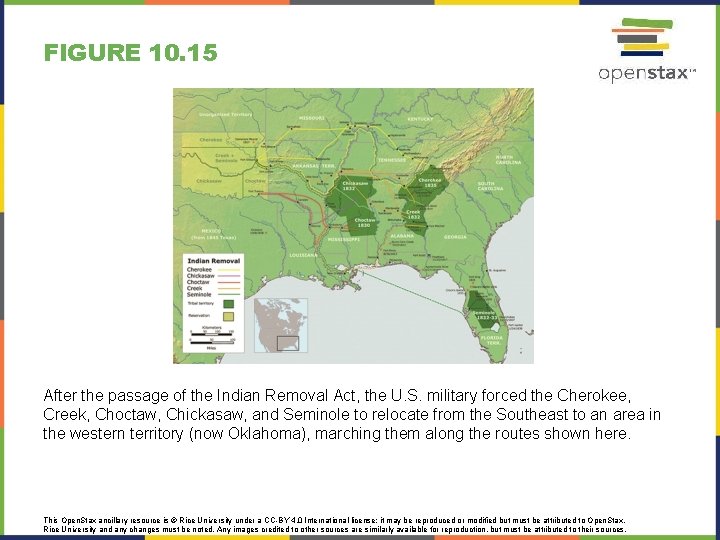
FIGURE 10. 15 After the passage of the Indian Removal Act, the U. S. military forced the Cherokee, Creek, Choctaw, Chickasaw, and Seminole to relocate from the Southeast to an area in the western territory (now Oklahoma), marching them along the routes shown here. This Open. Stax ancillary resource is © Rice University under a CC-BY 4. 0 International license; it may be reproduced or modified but must be attributed to Open. Stax, Rice University and any changes must be noted. Any images credited to other sources are similarly available for reproduction, but must be attributed to their sources.
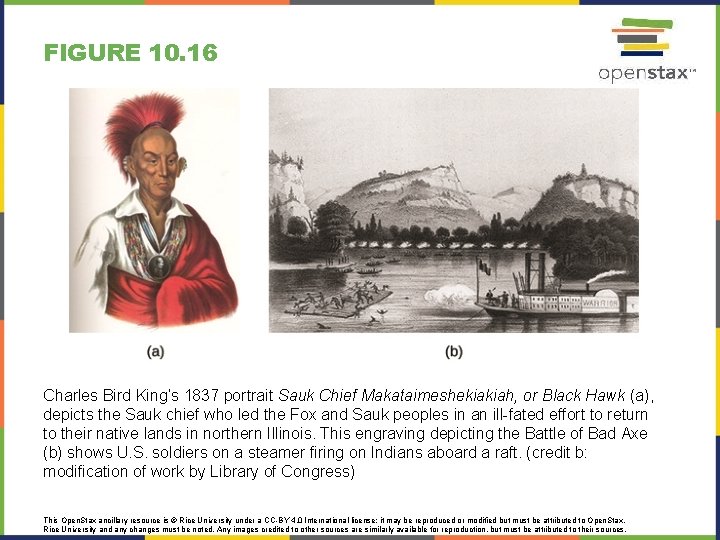
FIGURE 10. 16 Charles Bird King’s 1837 portrait Sauk Chief Makataimeshekiakiah, or Black Hawk (a), depicts the Sauk chief who led the Fox and Sauk peoples in an ill-fated effort to return to their native lands in northern Illinois. This engraving depicting the Battle of Bad Axe (b) shows U. S. soldiers on a steamer firing on Indians aboard a raft. (credit b: modification of work by Library of Congress) This Open. Stax ancillary resource is © Rice University under a CC-BY 4. 0 International license; it may be reproduced or modified but must be attributed to Open. Stax, Rice University and any changes must be noted. Any images credited to other sources are similarly available for reproduction, but must be attributed to their sources.
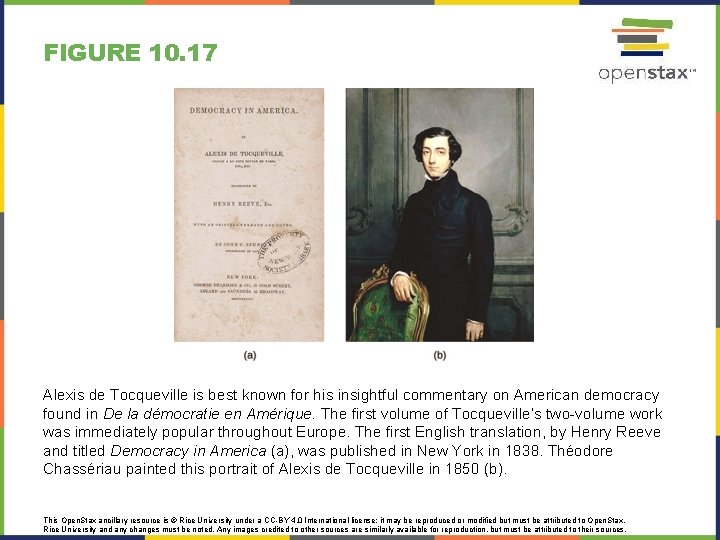
FIGURE 10. 17 Alexis de Tocqueville is best known for his insightful commentary on American democracy found in De la démocratie en Amérique. The first volume of Tocqueville’s two-volume work was immediately popular throughout Europe. The first English translation, by Henry Reeve and titled Democracy in America (a), was published in New York in 1838. Théodore Chassériau painted this portrait of Alexis de Tocqueville in 1850 (b). This Open. Stax ancillary resource is © Rice University under a CC-BY 4. 0 International license; it may be reproduced or modified but must be attributed to Open. Stax, Rice University and any changes must be noted. Any images credited to other sources are similarly available for reproduction, but must be attributed to their sources.
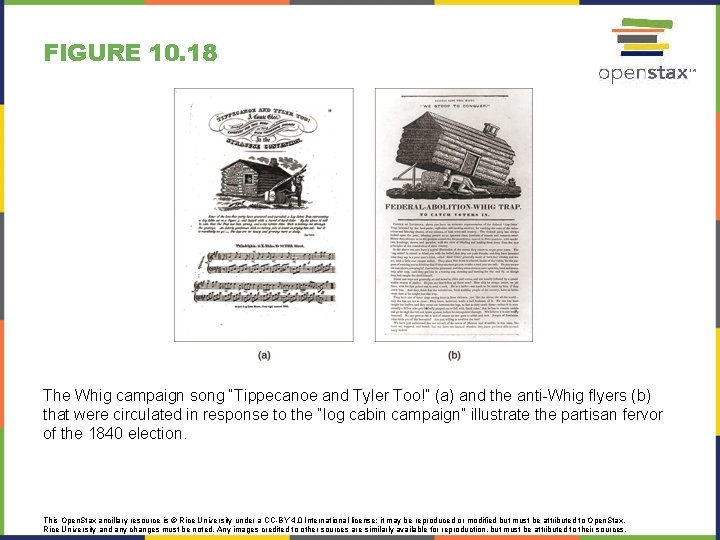
FIGURE 10. 18 The Whig campaign song “Tippecanoe and Tyler Too!” (a) and the anti-Whig flyers (b) that were circulated in response to the “log cabin campaign” illustrate the partisan fervor of the 1840 election. This Open. Stax ancillary resource is © Rice University under a CC-BY 4. 0 International license; it may be reproduced or modified but must be attributed to Open. Stax, Rice University and any changes must be noted. Any images credited to other sources are similarly available for reproduction, but must be attributed to their sources.