U S Department of Energy Office of Science

- Slides: 23
U. S. Department of Energy Office of Science DOE Office of Science High Energy Physics Biological and Environmental Research Advisory Committee April 20, 2005 Dr. Robin Staffin, Associate Director Office of High Energy Physics Office of Science
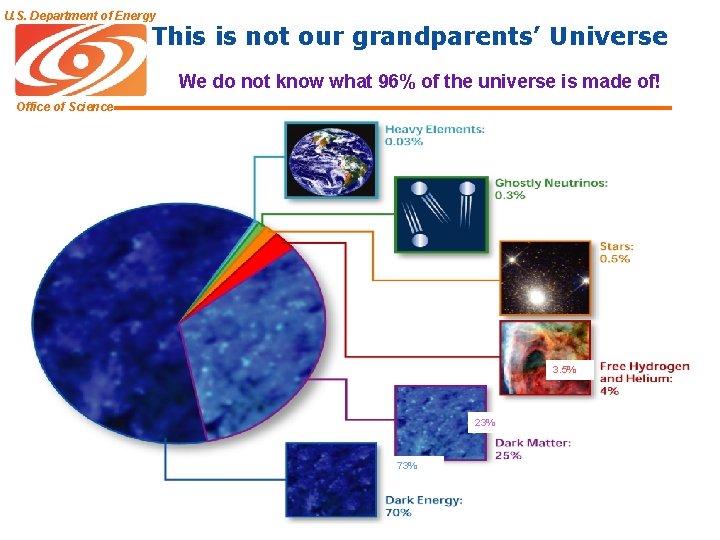
U. S. Department of Energy This is not our grandparents’ Universe We do not know what 96% of the universe is made of! Office of Science 3. 5% 23% 73%
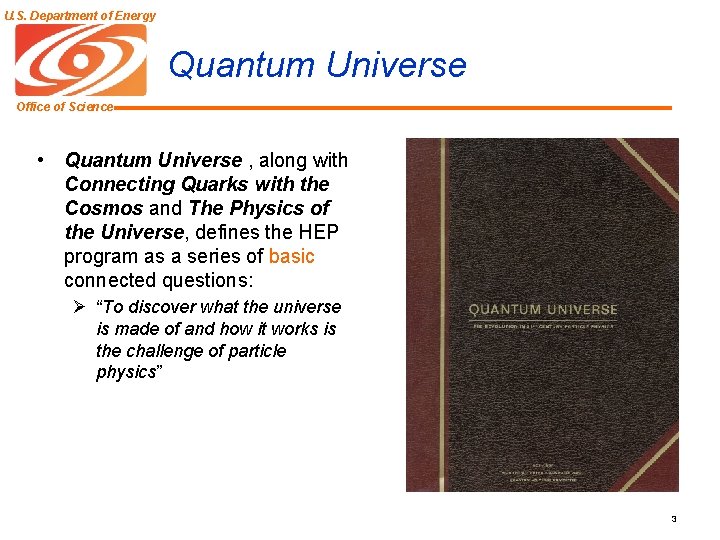
U. S. Department of Energy Quantum Universe Office of Science • Quantum Universe , along with Connecting Quarks with the Cosmos and The Physics of the Universe, defines the HEP program as a series of basic connected questions: Ø “To discover what the universe is made of and how it works is the challenge of particle physics” 3
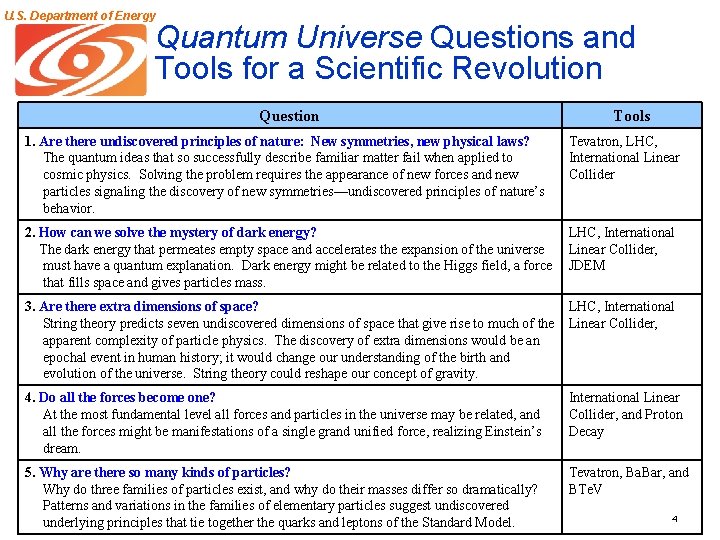
U. S. Department of Energy Quantum Universe Questions and Tools for a Scientific Revolution Office of Science Question Tools 1. Are there undiscovered principles of nature: New symmetries, new physical laws? The quantum ideas that so successfully describe familiar matter fail when applied to cosmic physics. Solving the problem requires the appearance of new forces and new particles signaling the discovery of new symmetries—undiscovered principles of nature’s behavior. Tevatron, LHC, International Linear Collider 2. How can we solve the mystery of dark energy? The dark energy that permeates empty space and accelerates the expansion of the universe must have a quantum explanation. Dark energy might be related to the Higgs field, a force that fills space and gives particles mass. LHC, International Linear Collider, JDEM 3. Are there extra dimensions of space? LHC, International String theory predicts seven undiscovered dimensions of space that give rise to much of the Linear Collider, apparent complexity of particle physics. The discovery of extra dimensions would be an epochal event in human history; it would change our understanding of the birth and evolution of the universe. String theory could reshape our concept of gravity. 4. Do all the forces become one? At the most fundamental level all forces and particles in the universe may be related, and all the forces might be manifestations of a single grand unified force, realizing Einstein’s dream. International Linear Collider, and Proton Decay 5. Why are there so many kinds of particles? Why do three families of particles exist, and why do their masses differ so dramatically? Patterns and variations in the families of elementary particles suggest undiscovered underlying principles that tie together the quarks and leptons of the Standard Model. Tevatron, Ba. Bar, and BTe. V 4
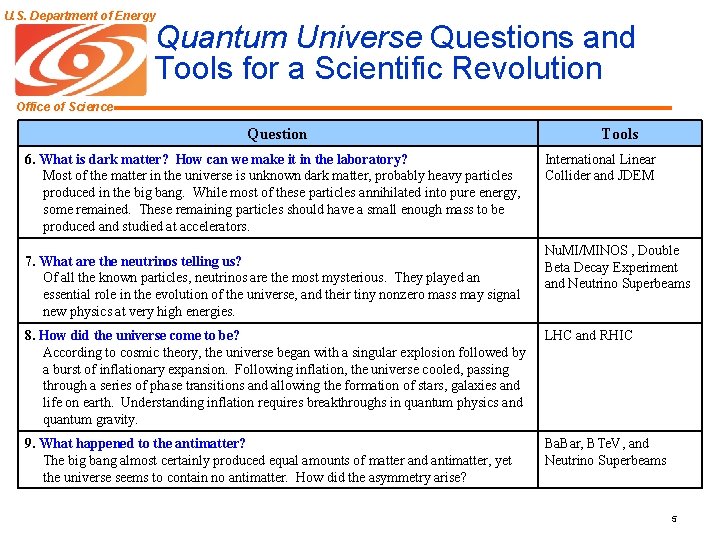
U. S. Department of Energy Quantum Universe Questions and Tools for a Scientific Revolution Office of Science Question 6. What is dark matter? How can we make it in the laboratory? Most of the matter in the universe is unknown dark matter, probably heavy particles produced in the big bang. While most of these particles annihilated into pure energy, some remained. These remaining particles should have a small enough mass to be produced and studied at accelerators. 7. What are the neutrinos telling us? Of all the known particles, neutrinos are the most mysterious. They played an essential role in the evolution of the universe, and their tiny nonzero mass may signal new physics at very high energies. Tools International Linear Collider and JDEM Nu. MI/MINOS , Double Beta Decay Experiment and Neutrino Superbeams 8. How did the universe come to be? According to cosmic theory, the universe began with a singular explosion followed by a burst of inflationary expansion. Following inflation, the universe cooled, passing through a series of phase transitions and allowing the formation of stars, galaxies and life on earth. Understanding inflation requires breakthroughs in quantum physics and quantum gravity. LHC and RHIC 9. What happened to the antimatter? The big bang almost certainly produced equal amounts of matter and antimatter, yet the universe seems to contain no antimatter. How did the asymmetry arise? Ba. Bar, BTe. V, and Neutrino Superbeams 5
U. S. Department of Energy Quantum Universe - Major U. S. Facilities Office of Science 6
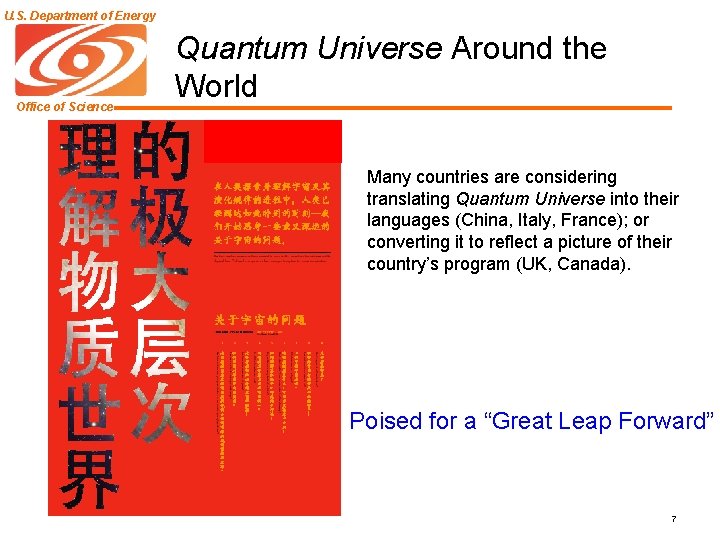
U. S. Department of Energy Office of Science Quantum Universe Around the World Many countries are considering translating Quantum Universe into their languages (China, Italy, France); or converting it to reflect a picture of their country’s program (UK, Canada). Poised for a “Great Leap Forward” 7
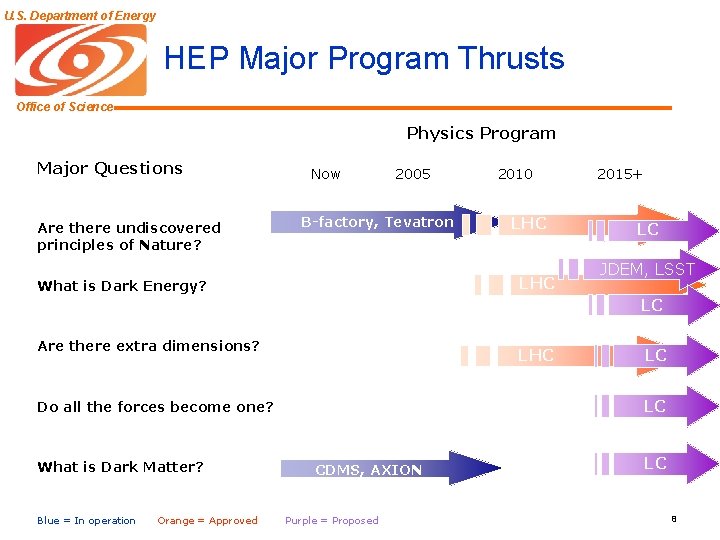
U. S. Department of Energy HEP Major Program Thrusts Office of Science Physics Program Major Questions Are there undiscovered principles of Nature? Now 2005 B-factory, Tevatron 2010 LHC What is Dark Energy? 2015+ LC JDEM, LSST LC Are there extra dimensions? LHC LC Do all the forces become one? What is Dark Matter? LC CDMS, AXION Blue = In operation Orange = Approved Purple = Proposed LC 8
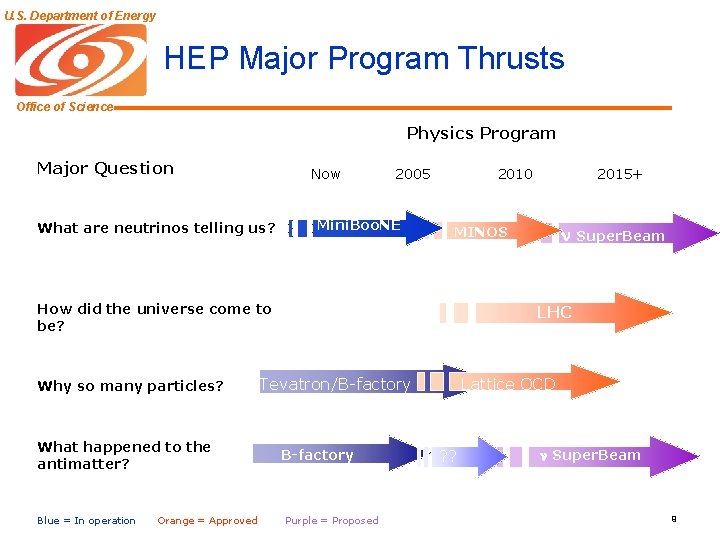
U. S. Department of Energy HEP Major Program Thrusts Office of Science Physics Program Major Question Now What are neutrinos telling us? 2005 Mini. Boo. NE 2010 n Super. Beam MINOS How did the universe come to be? Why so many particles? 2015+ LHC Tevatron/B-factory Lattice QCD BTe. V What happened to the antimatter? B-factory Blue = In operation Orange = Approved Purple = Proposed ? ? n Super. Beam 9
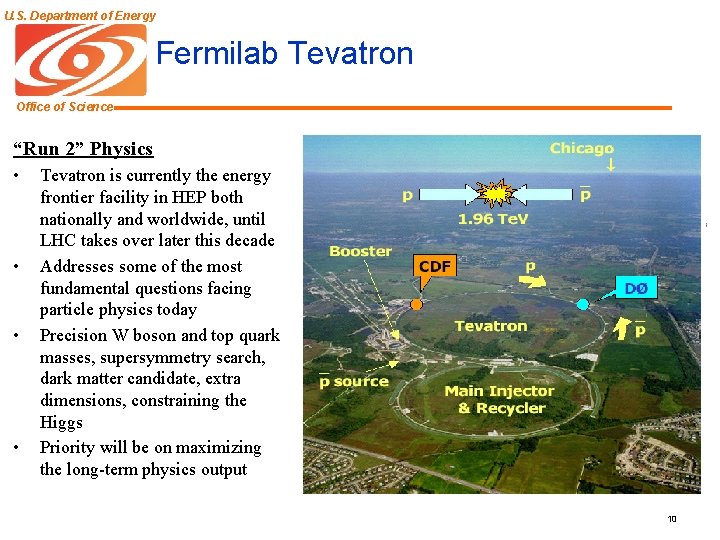
U. S. Department of Energy Fermilab Tevatron Office of Science “Run 2” Physics • • Tevatron is currently the energy frontier facility in HEP both nationally and worldwide, until LHC takes over later this decade Addresses some of the most fundamental questions facing particle physics today Precision W boson and top quark masses, supersymmetry search, dark matter candidate, extra dimensions, constraining the Higgs Priority will be on maximizing the long-term physics output 10
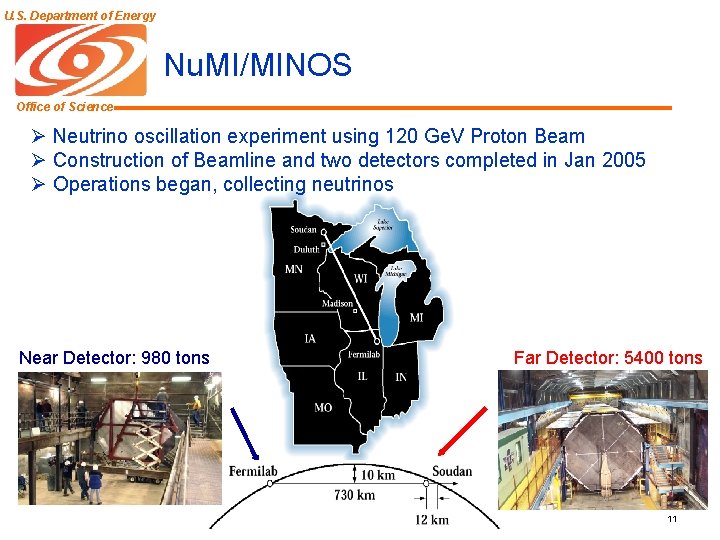
U. S. Department of Energy Nu. MI/MINOS Office of Science Ø Neutrino oscillation experiment using 120 Ge. V Proton Beam Ø Construction of Beamline and two detectors completed in Jan 2005 Ø Operations began, collecting neutrinos Near Detector: 980 tons Far Detector: 5400 tons 11
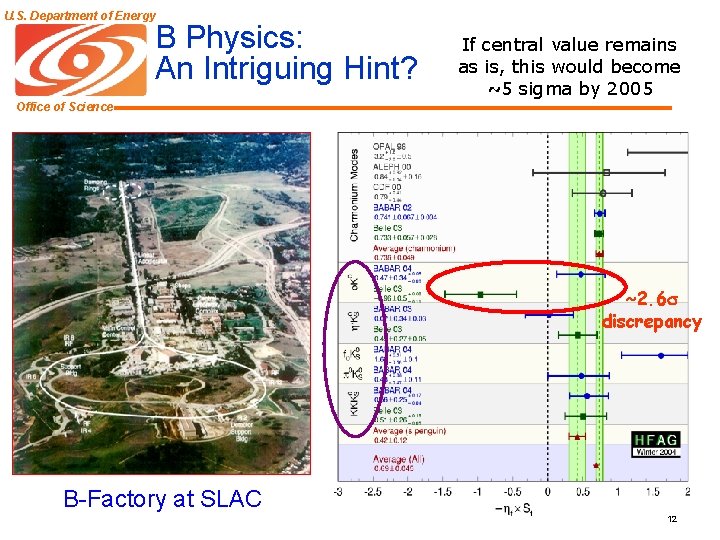
U. S. Department of Energy B Physics: An Intriguing Hint? If central value remains as is, this would become ~5 sigma by 2005 Office of Science ~2. 6 s discrepancy B-Factory at SLAC 12
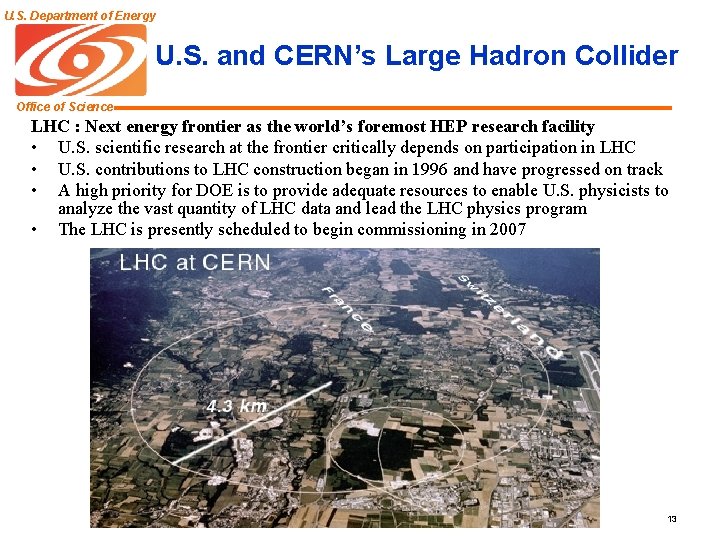
U. S. Department of Energy U. S. and CERN’s Large Hadron Collider Office of Science LHC : Next energy frontier as the world’s foremost HEP research facility • U. S. scientific research at the frontier critically depends on participation in LHC • U. S. contributions to LHC construction began in 1996 and have progressed on track • A high priority for DOE is to provide adequate resources to enable U. S. physicists to analyze the vast quantity of LHC data and lead the LHC physics program • The LHC is presently scheduled to begin commissioning in 2007 13
U. S. Department of Energy The Next Step: International Linear Collider (ILC) Office of Science § Electron Positron Collider at 0. 5 -1 Te. V § ILC together with LHC § Can establish “Higgs” mechanism generates all masses § Can establish Supersymmetry as a new principle of nature § Can figure out what Dark Matter really is § Can study Extra Dimensions & measure their number, shape, geometry § Can test Unification of Quantum Mechanics and Gravity § Super high tech: nanometer beams § Superconducting cavities for main accelerator § Technology extremely challenging, yet basically at hand § Need to complete the design § World-wide organization and machine design in development 14
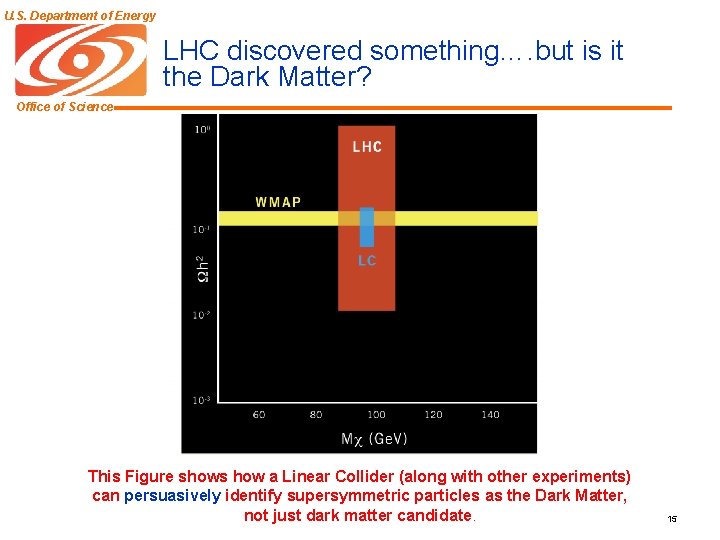
U. S. Department of Energy LHC discovered something…. but is it the Dark Matter? Office of Science This Figure shows how a Linear Collider (along with other experiments) can persuasively identify supersymmetric particles as the Dark Matter, not just dark matter candidate. 15
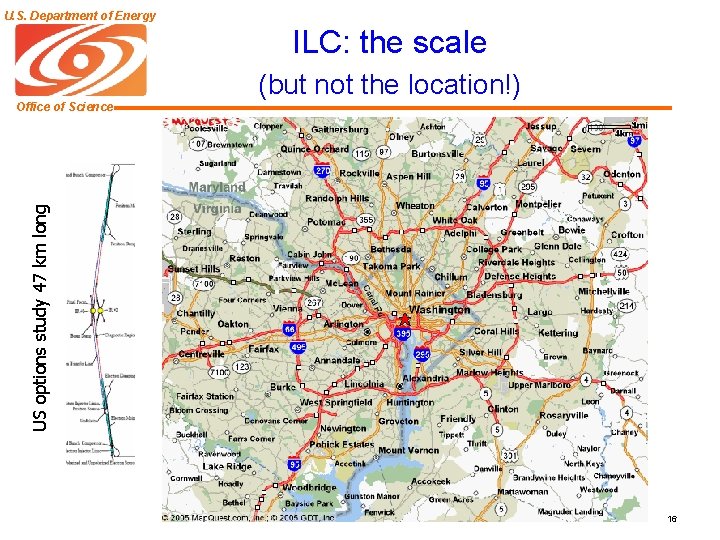
U. S. Department of Energy ILC: the scale (but not the location!) US options study 47 km long Office of Science 16
U. S. Department of Energy Planning for the Future Office of Science § Current U. S. accelerator-based program is world-leading, but finite in lifetime § B-factory and the Tevatron will ramp down toward the end of the decade; and a number of neutrino programs also § Linear Collider is HEP’s highest priority for a future major facility, § but timescale is uncertain and it cannot be done without either an increase in resources or a reduction in cost § LHC participation will be a central piece of the program Hence We are planning for a portfolio of medium scale, medium term experiments to start construction in the period 2007 -10 § Scientific opportunities are compelling § neutrino physics (APS study); dark matter, dark energy… § Resources will become available, through redirection 17
U. S. Department of Energy Summary Office of Science § We appear to be on the verge of the next revolution in particle physics § Te. V scale: Unification, origin of mass, supersymmetry and dark matter § Neutrinos: Determine the detailed properities of the three (? ) “flavor” of neutrinos § CP Violation: Is the Standard Model all there is? § Where’s all the anti-matter? § Dark Matter and Energy: Can we understand the other 90% of the universe? § By the end of the decade, we hope to have some of the answers…and undoubtedly new questions 18
U. S. Department of Energy Office of Science BACKUP SLIDES 19
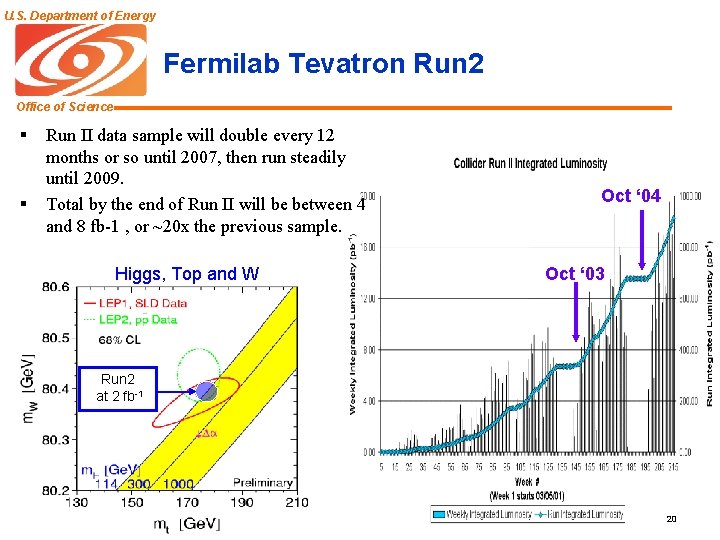
U. S. Department of Energy Fermilab Tevatron Run 2 Office of Science § § Run II data sample will double every 12 months or so until 2007, then run steadily until 2009. Total by the end of Run II will be between 4 and 8 fb-1 , or ~20 x the previous sample. Higgs, Top and W Oct ‘ 04 Oct ‘ 03 Run 2 at 2 fb-1 20
U. S. Department of Energy International Linear Collider (ILC) and U. S. Involvement Office of Science § In August 2004 International Committee for the Future of Accelerators (ICFA) announced their technology recommendation for an ILC: § The recommended technology choice is superconducting radio frequency acceleration in the main linacs § World-wide collaborators are consolidating efforts toward cold technologybased world-wide R&D program. § The Director of the world-wide Global Design Effort has been appointed: Barry Barish (U. S) by ICFA. § The technology selection has led to a realignment of the U. S. linear collider R&D effort: § A management realignment into the “American Directorate” as part of a Global Design Effort. § World government meetings on how to organize international R&D. UK, US, Canada, Germany, Italy, France, CERN, Japan, South Korea, India. 21
U. S. Department of Energy Office of Science High Energy Physics FY 2006 Budget ($M) 22
U. S. Department of Energy New Initiatives Office of Science § Some medium-scale experiments that might be considered (not an exhaustive list) • A reactor-based neutrino experiment to measure 13 • An off-axis accelerator-based neutrino experiment for 13 and to resolve the neutrino mass hierarchy • A high intensity neutrino beam for neutrino CP-violation experiments • A neutrinoless double-beta decay experiment to probe the Majorana nature of neutrinos • An underground experiment to search for direct evidence of dark matter • A ground-based dark energy experiment • … Note: JDEM, ILC are considered to be above “medium-scale. ” 23