TwoDimensional Motion and Vectors Uniform vs NonUniform Motion
- Slides: 14
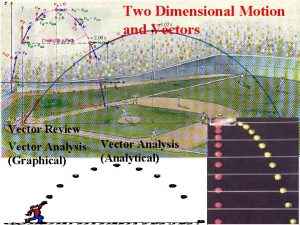
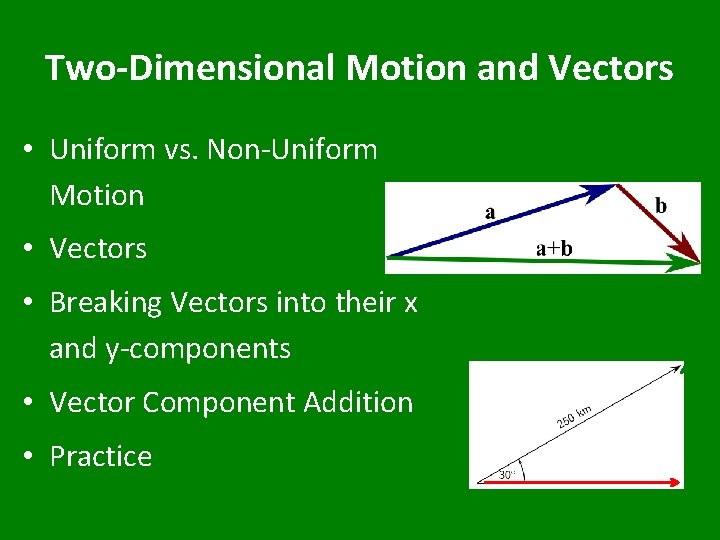
Two-Dimensional Motion and Vectors • Uniform vs. Non-Uniform Motion • Vectors • Breaking Vectors into their x and y-components • Vector Component Addition • Practice
Uniform vs. Nonuniform Motion Recall: • Uniform motion is a movement at a constant speed in a straight line. • Nonuniform motion means movement which changes in speed or direction or both.
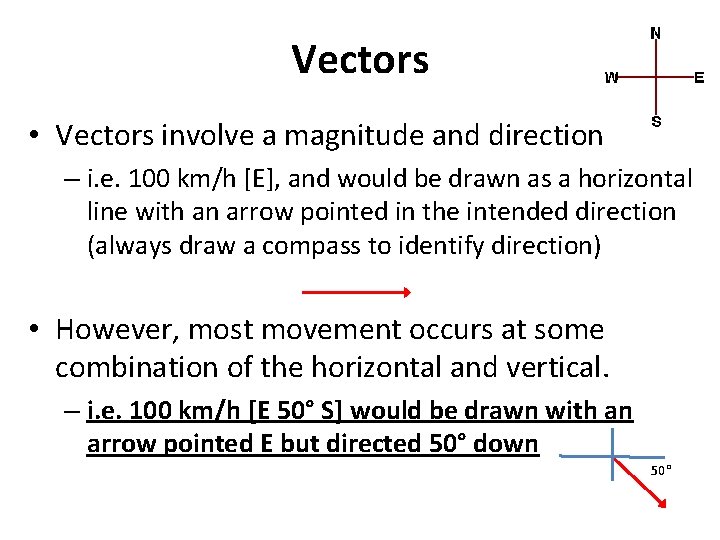
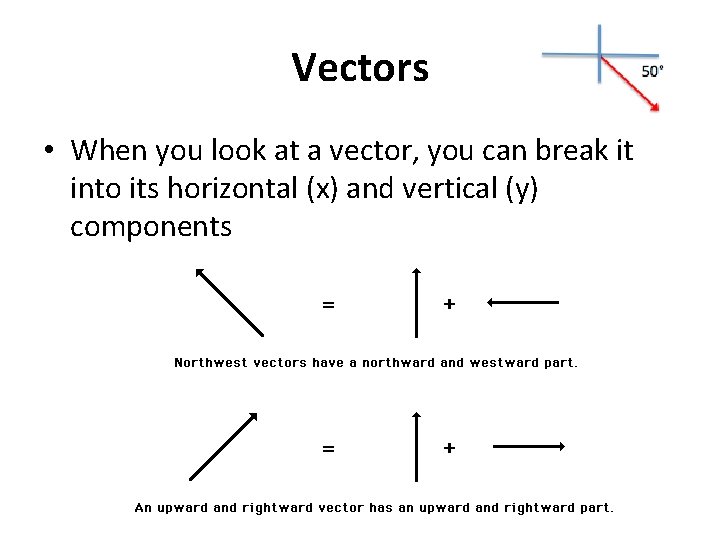
Vectors • Vectors involve a magnitude and direction – i. e. 100 km/h [E], and would be drawn as a horizontal line with an arrow pointed in the intended direction (always draw a compass to identify direction) • However, most movement occurs at some combination of the horizontal and vertical. – i. e. 100 km/h [E 50° S] would be drawn with an arrow pointed E but directed 50° down 50°
Vectors • When you look at a vector, you can break it into its horizontal (x) and vertical (y) components
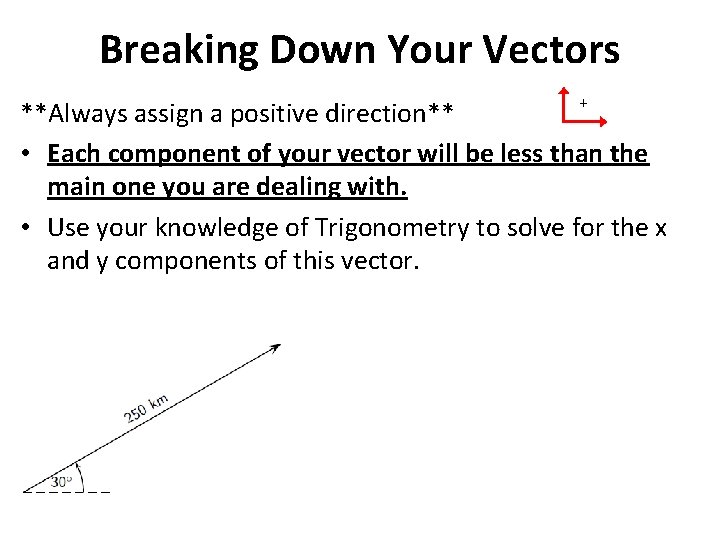
Breaking Down Your Vectors + **Always assign a positive direction** • Each component of your vector will be less than the main one you are dealing with. • Use your knowledge of Trigonometry to solve for the x and y components of this vector.
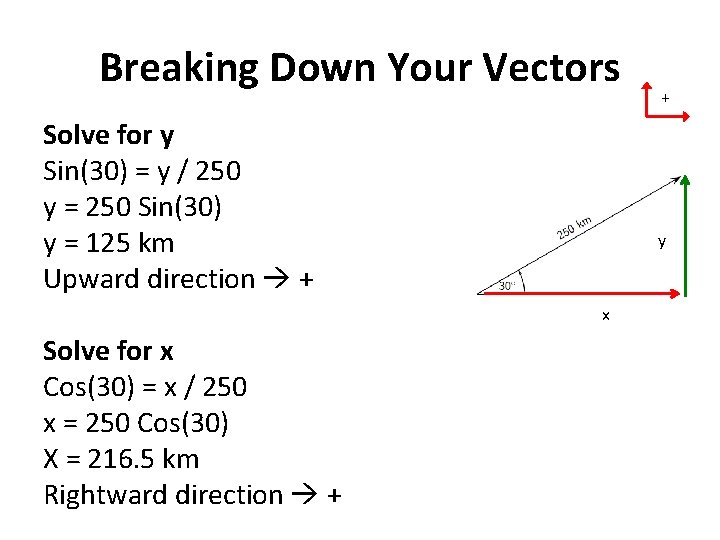
Breaking Down Your Vectors Solve for y Sin(30) = y / 250 y = 250 Sin(30) y = 125 km Upward direction + y x Solve for x Cos(30) = x / 250 x = 250 Cos(30) X = 216. 5 km Rightward direction + +
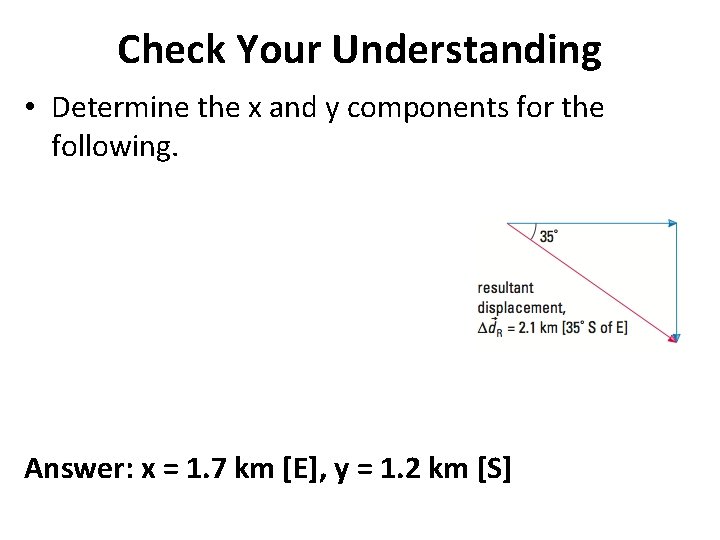
Check Your Understanding • Determine the x and y components for the following. Answer: x = 1. 7 km [E], y = 1. 2 km [S]
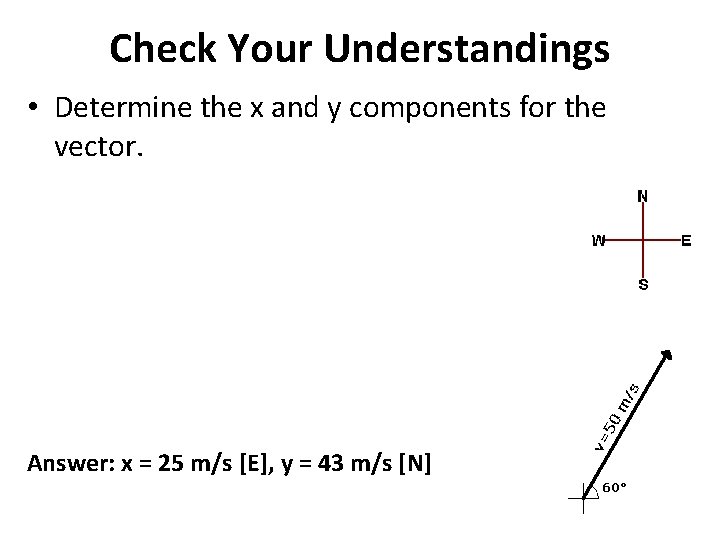
Check Your Understandings • Determine the x and y components for the vector. Answer: x = 25 m/s [E], y = 43 m/s [N]
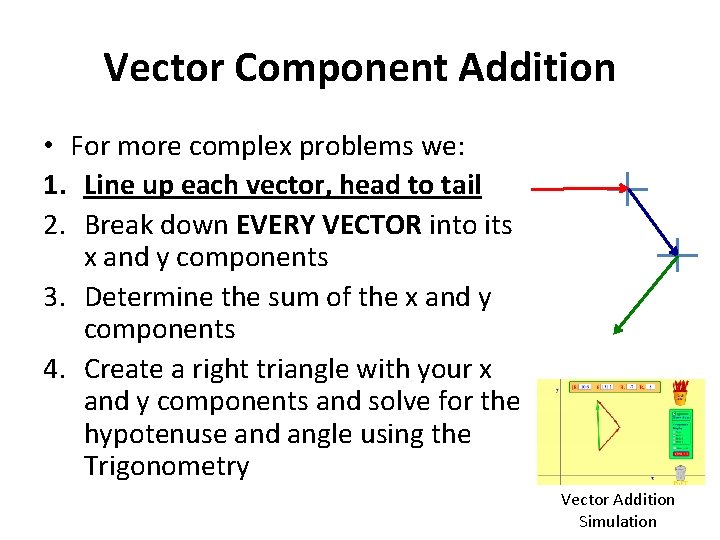
Vector Component Addition • For more complex problems we: 1. Line up each vector, head to tail 2. Break down EVERY VECTOR into its x and y components 3. Determine the sum of the x and y components 4. Create a right triangle with your x and y components and solve for the hypotenuse and angle using the Trigonometry Vector Addition Simulation
Check Your Understanding • An outdoor enthusiast aims a kayak northward and paddles 26 m [N] across a swift river that carries the kayak 36 m [E] downstream. Determine the displacement of the kayaker. Answer: 44 m [E 36° N]
Check Your Understanding • After leaving the huddle, a receiver on a football team runs 8. 5 m [E] waiting for the ball to be snapped, then he turns abruptly and runs 12. 0 m [S], suddenly changes directions, catches a pass, and runs 13. 5 m [W] before being tackled. If the entire motion takes 7. 0 s, determine the receiver’s a) average speed. b) average velocity. Answer: a) 4. 9 m/s b) 1. 9 m/s [23° W of S]
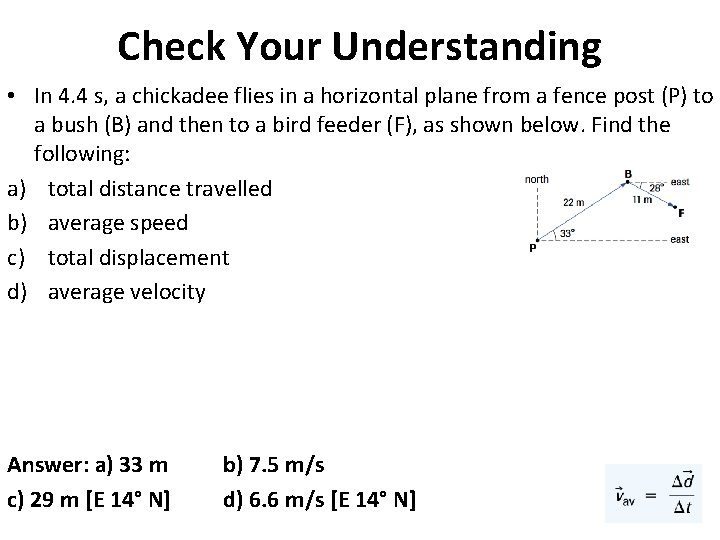
Check Your Understanding • In 4. 4 s, a chickadee flies in a horizontal plane from a fence post (P) to a bush (B) and then to a bird feeder (F), as shown below. Find the following: a) total distance travelled b) average speed c) total displacement d) average velocity Answer: a) 33 m c) 29 m [E 14° N] b) 7. 5 m/s d) 6. 6 m/s [E 14° N]
Check Your Understanding • Determine the vector sum of the displacements Δd 1 = 2. 4 m [32° S of W]; Δd 2 = 1. 6 m [S]; and Δd 3 = 4. 9 m [E 27° S]. Answer: 5. 6 m [24° E of S]
Check Your Understanding • A skater on Ottawa’s Rideau Canal travels in a straight line 8. 5 x 10² m [25° N of E] and then 5. 6 x 10² m in a straight line [21° E of N]. The entire motion takes 4. 2 min. a) What is the skater’s displacement? b) What are the skater’s average speed and average velocity? Answer: a) 1. 3 x 10³ m [42° N of E], b) 5. 6 m/s; 5. 2 m/s [42° N of E]