Training and Supporting Facilitators of Intergroup Dialogue A



- Slides: 24
Training and Supporting Facilitators of Intergroup Dialogue A New Frontier in Diversity, Learning, and Leadership for Undergraduate Students The Program on Intergroup Relations University of Michigan
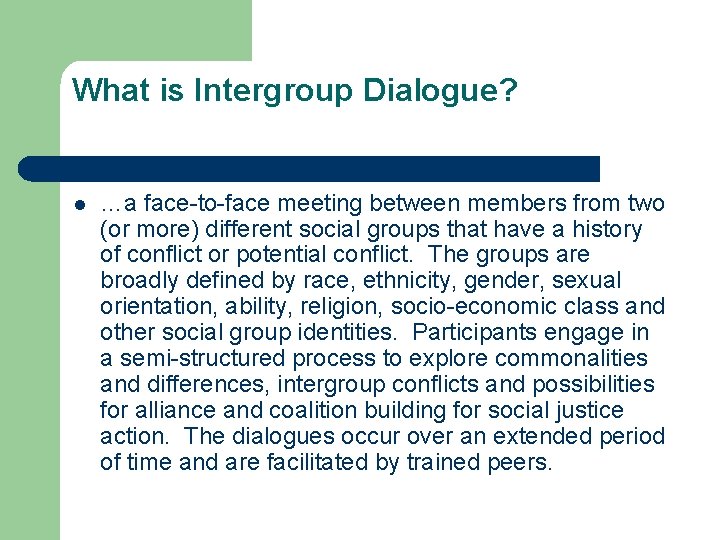
What is Intergroup Dialogue? l …a face-to-face meeting between members from two (or more) different social groups that have a history of conflict or potential conflict. The groups are broadly defined by race, ethnicity, gender, sexual orientation, ability, religion, socio-economic class and other social group identities. Participants engage in a semi-structured process to explore commonalities and differences, intergroup conflicts and possibilities for alliance and coalition building for social justice action. The dialogues occur over an extended period of time and are facilitated by trained peers.
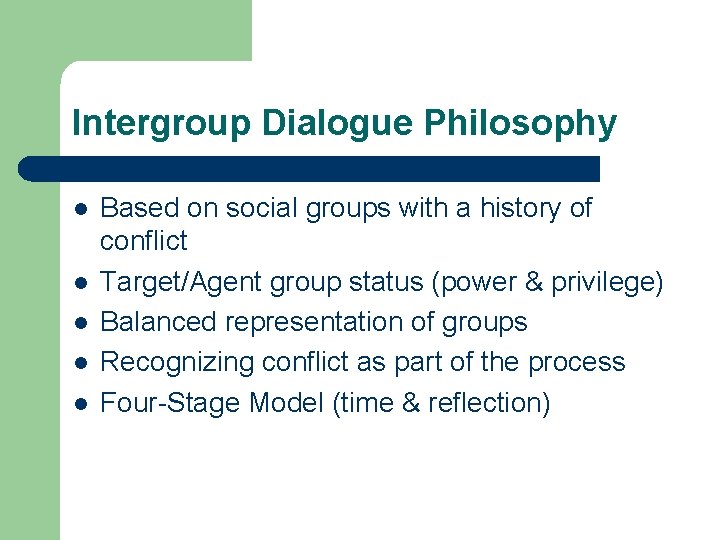
Intergroup Dialogue Philosophy l l l Based on social groups with a history of conflict Target/Agent group status (power & privilege) Balanced representation of groups Recognizing conflict as part of the process Four-Stage Model (time & reflection)
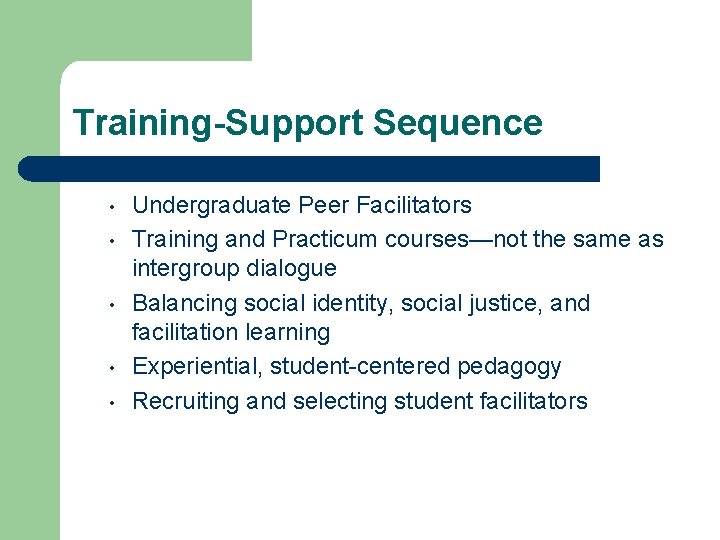
Training-Support Sequence • • • Undergraduate Peer Facilitators Training and Practicum courses—not the same as intergroup dialogue Balancing social identity, social justice, and facilitation learning Experiential, student-centered pedagogy Recruiting and selecting student facilitators
Training Facilitators The Training Course: The goals of this course are to develop students’ knowledge and skills as potential facilitators of intergroup dialogues. As such, the course builds upon, but does not replicate, the principles and content of intergroup dialogues themselves.
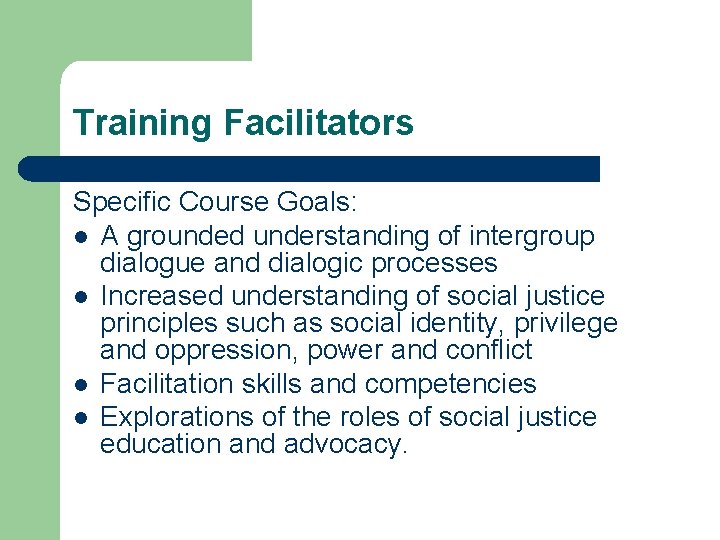
Training Facilitators Specific Course Goals: l A grounded understanding of intergroup dialogue and dialogic processes l Increased understanding of social justice principles such as social identity, privilege and oppression, power and conflict l Facilitation skills and competencies l Explorations of the roles of social justice education and advocacy.
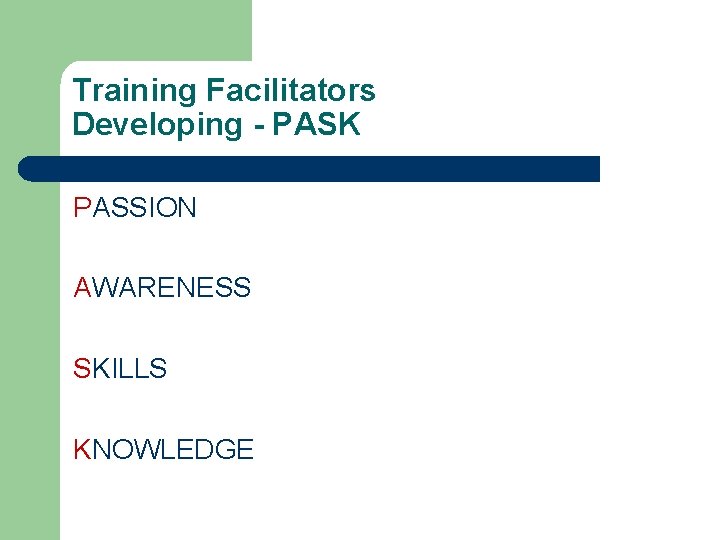
Training Facilitators Developing - PASK PASSION AWARENESS SKILLS KNOWLEDGE
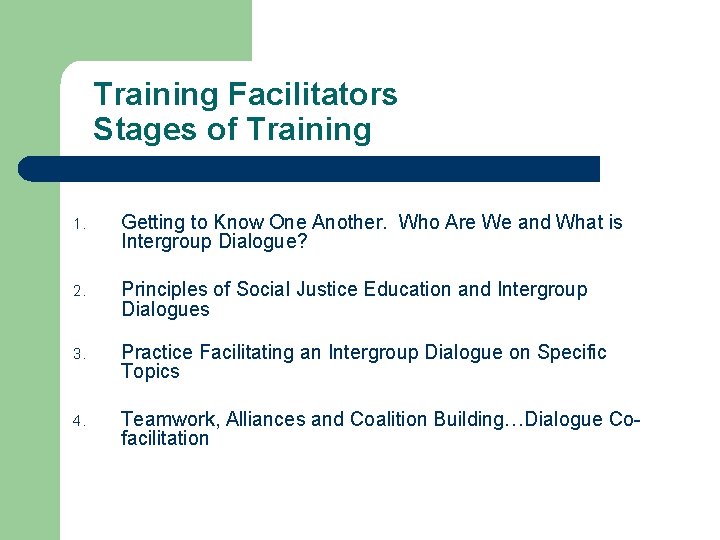
Training Facilitators Stages of Training 1. Getting to Know One Another. Who Are We and What is Intergroup Dialogue? 2. Principles of Social Justice Education and Intergroup Dialogues 3. Practice Facilitating an Intergroup Dialogue on Specific Topics 4. Teamwork, Alliances and Coalition Building…Dialogue Cofacilitation
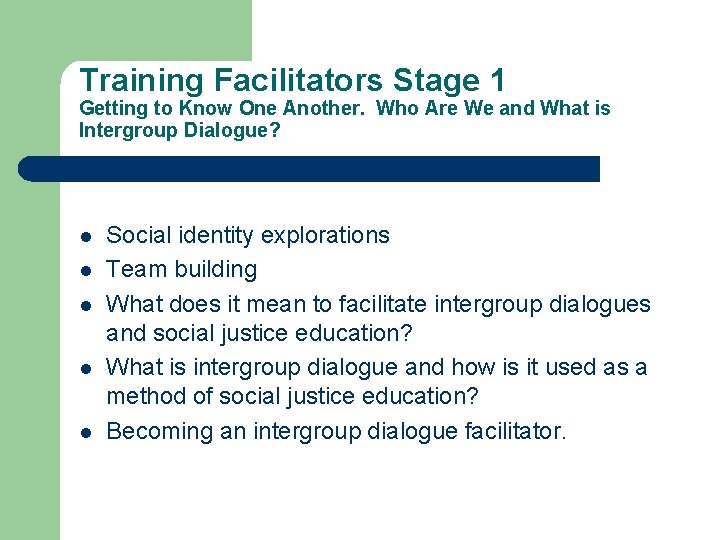
Training Facilitators Stage 1 Getting to Know One Another. Who Are We and What is Intergroup Dialogue? l l l Social identity explorations Team building What does it mean to facilitate intergroup dialogues and social justice education? What is intergroup dialogue and how is it used as a method of social justice education? Becoming an intergroup dialogue facilitator.
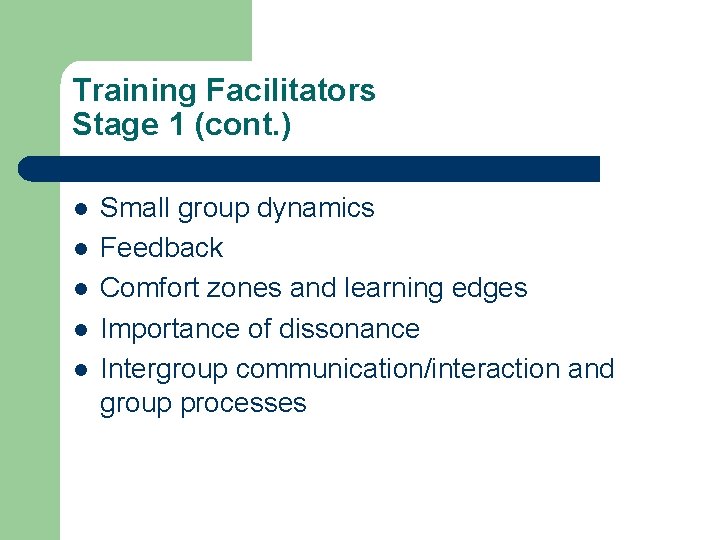
Training Facilitators Stage 1 (cont. ) l l l Small group dynamics Feedback Comfort zones and learning edges Importance of dissonance Intergroup communication/interaction and group processes
Training Facilitators Stage 2 Principles of Social Justice Education and Intergroup Dialogues l l l l Forms of Justice Power & Oppression and privilege Modern forms of prejudice, discrimination, and -isms Internalized -isms Facilitating dialogue The uses and management of conflict Co-facilitating intergroup dialogues
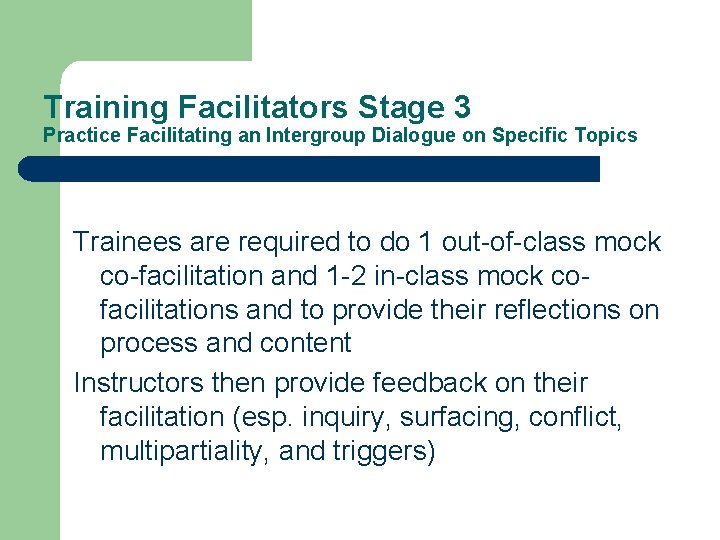
Training Facilitators Stage 3 Practice Facilitating an Intergroup Dialogue on Specific Topics Trainees are required to do 1 out-of-class mock co-facilitation and 1 -2 in-class mock cofacilitations and to provide their reflections on process and content Instructors then provide feedback on their facilitation (esp. inquiry, surfacing, conflict, multipartiality, and triggers)
Training Facilitators Stage 4 Teamwork, Alliances and Coalition Building…. Dialogue Cofacilitation l l Being an ally Teamwork, alliances and coalition-building
Training Facilitators Assessing Facilitator Competency & Readiness Trainees are evaluated by instructors on their readiness as it relates to PASK -We use a Personal Resource Assessment Chart for this purpose
Facilitator Support The Practicum Course: l A 3 -credit course for trained peer facilitators to help develop and improve their skills as dialogue facilitators l Taken during the semester that they facilitate an intergroup dialogue
Facilitator Support Course Goals: l To discuss and prepare facilitators for their role in the dialogue groups l To strengthen students’ own understanding of intergroup relations l To further develop the co-facilitation relationship and experience
Facilitator Support l l To discuss theory and practice of group observation, conflict intervention, intergroup communication and community building To continue their own personal growth and development in the areas of social justice education
Facilitator Support l Beginning Retreat – – – Co-facilitation exercises and development Experiential exercises about the meaning of intergroup dialogue Experiential exercises or lecturette about how conflict can be a necessary and useful step in building social justice “Workshop” exercises Logistical information about running a dialogue
Facilitator Support l Coaching groups – – – Small groups consisting of one coach (instructor) and 4 -8 student facilitators Review weekly dialogue session Continue facilitation skill-building Continue social justice skill-building Prepare for upcoming dialogue session
Facilitator Support l Observations – l Consultations – l Coaches observe dialogues for content and process issues Meet with co-facilitator pairs for continued support and development “Closing the Loop”-Meeting with the current training class to share experiences
Facilitator Support Practicum Assignments: l Weekly attendance at practicum sessions and intergroup dialogues l Weekly planning and preparation l Weekly dialogue feedback l Occasional journals l Final report about the facilitation experience
The Program on Intergroup Relations University of Michigan Monita C. Thompson, Co-Director Kelly E. Maxwell, Ph. D. , Associate Director Contacting us: monitact@umich. edu kmax@umich. edu www. igr. umich. edu