TRA VINH UNIVERSITY TEACHING AND LEARNING CENTER 1
- Slides: 22
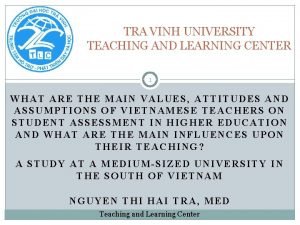
TRA VINH UNIVERSITY TEACHING AND LEARNING CENTER 1 WHAT ARE THE MAIN VALUES, ATTITUDES AND ASSUMPTIONS OF VIETNAMESE TEACHERS ON STUDENT ASSESSMENT IN HIGHER EDUCATION AND WHAT ARE THE MAIN INFLUENCES UPON THEIR TEACHING? A STUDY AT A MEDIUM-SIZED UNIVERSITY IN THE SOUTH OF VIETNAM NGUYEN THI HAI TRA, MED Teaching and Learning Center
CONTENTS 2 1. Purposes of the study 2. Purposes of student assessment in higher education 3. Types of assessment 4. Issues of formative assessment implementation 5. Student assessment in Vietnam 6. Methods of the study 7. Findings and discussion 8. Conclusion and suggestions Teaching and Learning Center
PURPOSES OF THE STUDY 3 To focus on developing insights into the values, attitudes, and assumptions about student assessment that are held by teachers and academic administrators at the site university, To explore how these values, attitudes, and assumptions impact on teaching practice. Teaching and Learning Center
PURPOSES OF ASSESSMENT IN HIGHER EDUCATION 4 To support the learning process, To maintain disciplinary or professional standards, To judge student achievement of essential knowledge and skills. Teaching and Learning Center
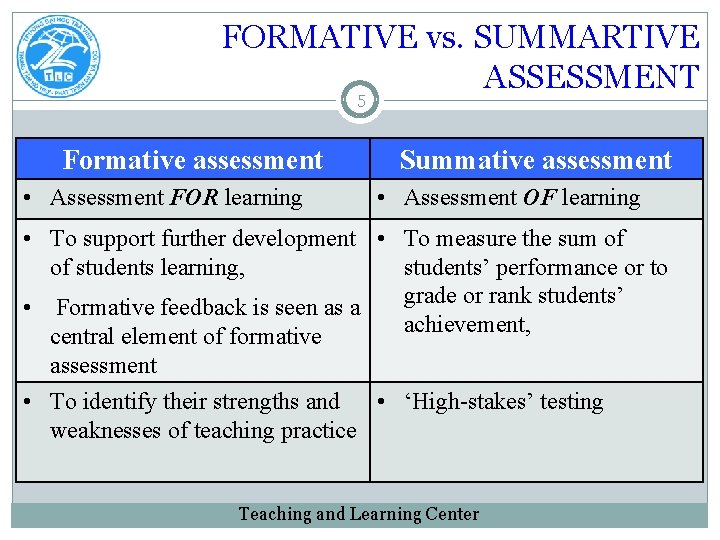
FORMATIVE vs. SUMMARTIVE ASSESSMENT 5 Formative assessment • Assessment FOR learning Summative assessment • Assessment OF learning • To support further development • To measure the sum of of students learning, students’ performance or to grade or rank students’ • Formative feedback is seen as a achievement, central element of formative assessment • To identify their strengths and • ‘High-stakes’ testing weaknesses of teaching practice Teaching and Learning Center
ISSUES OF FORMATIVE ASSESSMENT IMPLEMENTATION 6 The size of large classes, The extensive and excessive curriculum requirements in educational systems, Teachers’ expertise, professional knowledge and skills, Having a cultural context. Teaching and Learning Center
STUDENT ASSESSMETN OF LEARNING IN VIETNAM 7 MOET’s Regulation 25 and Regulation 43, Require greater memorization in the final exams, Do not emphasize formative assessment, Students ‘cram’ for the exams, Teaching and Learning Center
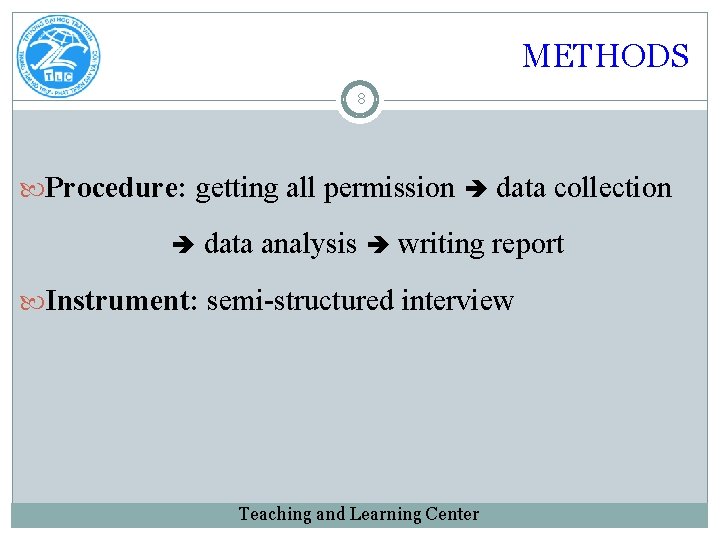
METHODS 8 Procedure: getting all permission data collection data analysis writing report Instrument: semi-structured interview Teaching and Learning Center
FINDINGS AND DICUSSION 9 Traditional student assessment: Summative assessment Teachers did not have the responsibility for implementing the whole process of student assessment Students adopt their learning style to 'surface approach to learning’ => did not help to improve students' learning Teaching and Learning Center
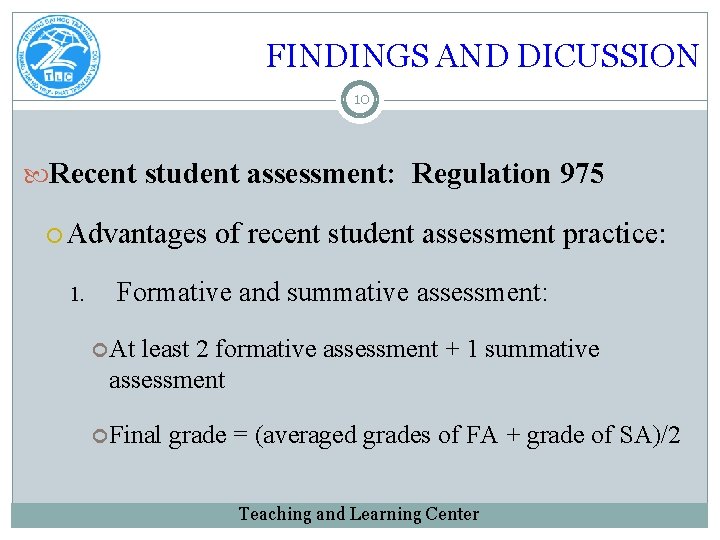
FINDINGS AND DICUSSION 10 Recent student assessment: Regulation 975 Advantages 1. of recent student assessment practice: Formative and summative assessment: At least 2 formative assessment + 1 summative assessment Final grade = (averaged grades of FA + grade of SA)/2 Teaching and Learning Center
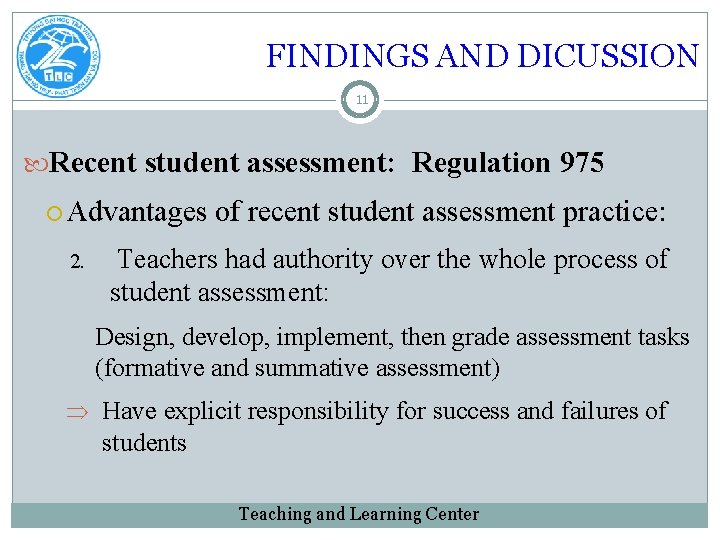
FINDINGS AND DICUSSION 11 Recent student assessment: Regulation 975 Advantages 2. of recent student assessment practice: Teachers had authority over the whole process of student assessment: Design, develop, implement, then grade assessment tasks (formative and summative assessment) Have explicit responsibility for success and failures of students Teaching and Learning Center
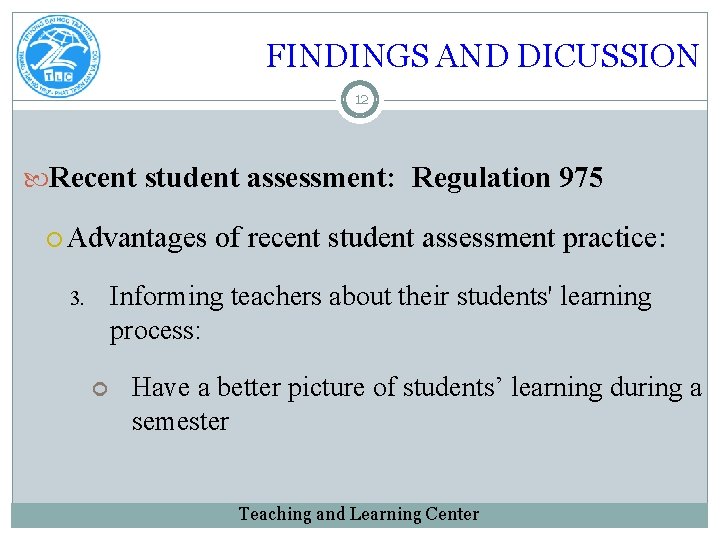
FINDINGS AND DICUSSION 12 Recent student assessment: Regulation 975 Advantages of recent student assessment practice: Informing teachers about their students' learning process: 3. Have a better picture of students’ learning during a semester Teaching and Learning Center
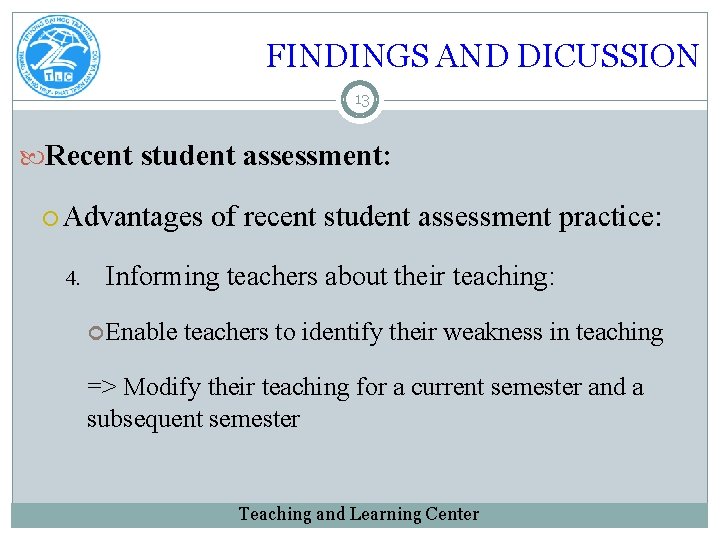
FINDINGS AND DICUSSION 13 Recent student assessment: Advantages 4. of recent student assessment practice: Informing teachers about their teaching: Enable teachers to identify their weakness in teaching => Modify their teaching for a current semester and a subsequent semester Teaching and Learning Center
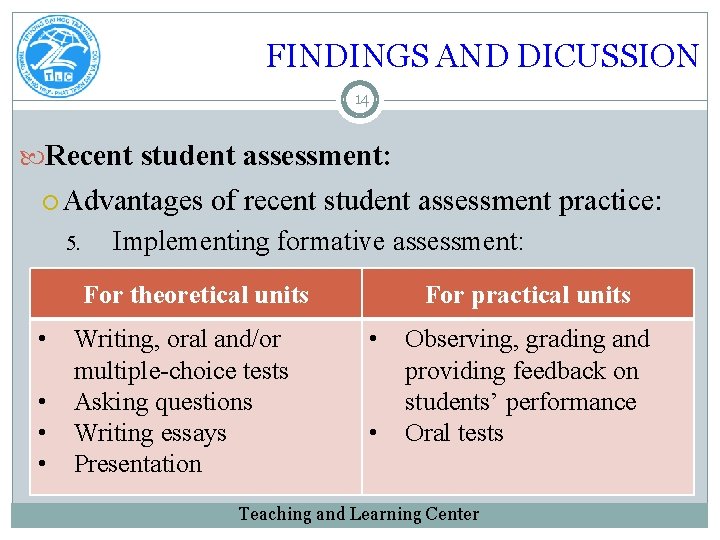
FINDINGS AND DICUSSION 14 Recent student assessment: Advantages 5. of recent student assessment practice: Implementing formative assessment: For theoretical units • • Writing, oral and/or multiple-choice tests Asking questions Writing essays Presentation For practical units • • Observing, grading and providing feedback on students’ performance Oral tests Teaching and Learning Center
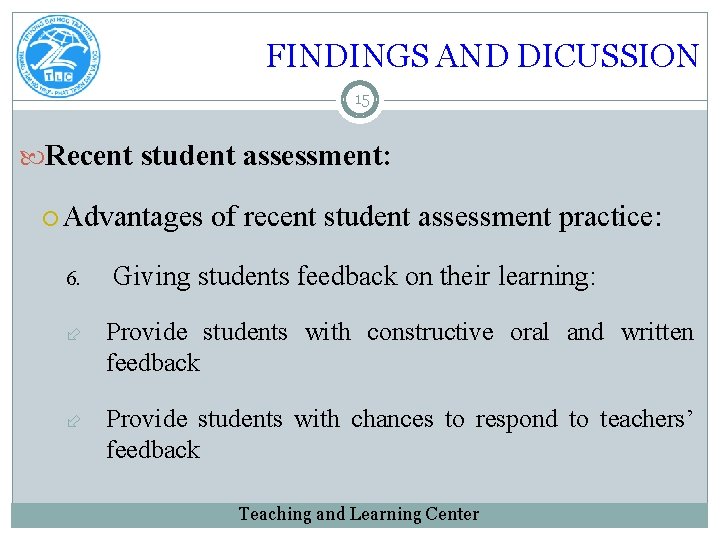
FINDINGS AND DICUSSION 15 Recent student assessment: Advantages 6. of recent student assessment practice: Giving students feedback on their learning: Provide students with constructive oral and written feedback Provide students with chances to respond to teachers’ feedback Teaching and Learning Center
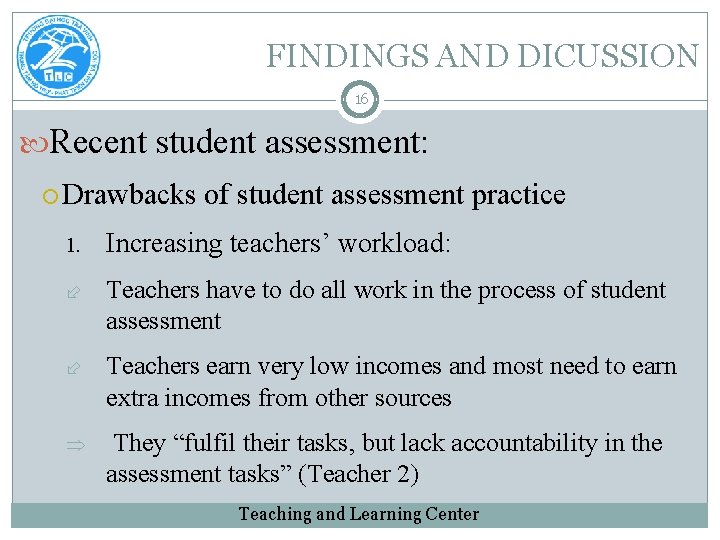
FINDINGS AND DICUSSION 16 Recent student assessment: Drawbacks of student assessment practice 1. Increasing teachers’ workload: Teachers have to do all work in the process of student assessment Teachers earn very low incomes and most need to earn extra incomes from other sources They “fulfil their tasks, but lack accountability in the assessment tasks” (Teacher 2) Teaching and Learning Center
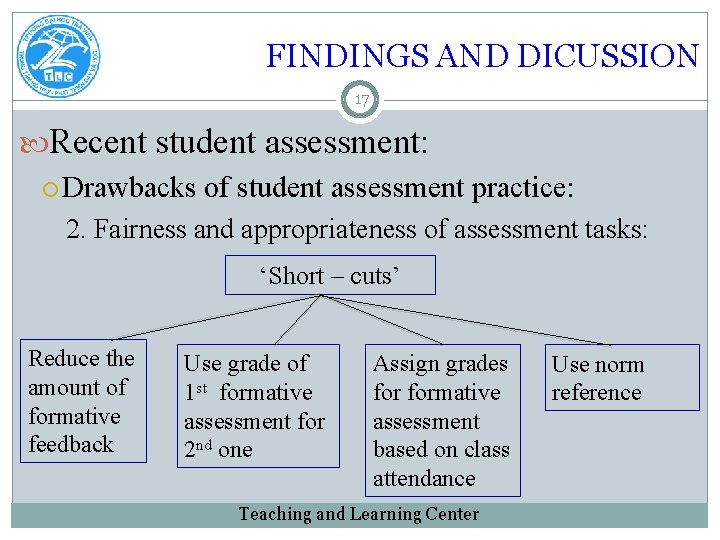
FINDINGS AND DICUSSION 17 Recent student assessment: Drawbacks of student assessment practice: 2. Fairness and appropriateness of assessment tasks: ‘Short – cuts’ Reduce the amount of formative feedback Use grade of 1 st formative assessment for 2 nd one Assign grades formative assessment based on class attendance Teaching and Learning Center Use norm reference
CONCLUSION AND SUGGESTION 18 Have been changed for the better, A powerful tool in directly or indirectly supporting student learning, The teachers recognized the important responsibility, The broader conception of student assessment helped them monitor their student learning progress, Teaching and Learning Center
CONCLUSION AND SUGGESTION 19 Teachers’ workloads increased Fairness in assessment became an issue. => Explore students’ experiences and perceptions of fairness in assessment, Teaching and Learning Center
REFERRENCES 20 Berry, R. A. W. (2008). Novice teachers' conceptions of fairness in inclusion classrooms. Teaching and Teacher Education, 24, 1149 -1159. Black, P. , & Wiliam, D. (1998). Assessment and classroom learning. Assessment in Education, 5(1), 7 -75. Chun, L. O. Y. (2006). Practice and challenges of school-based formative assessment. Paper presented at the 32 nd Annual Coference of International Association for Educational Assessment: Assessment in an Era of Rapid Change: Innovations and Best Practices, Singapore. Flick, U. (2009). An introduction to qualitative research (4 th ed. ). London: SAGE Publications. Flint, N. R. , & Johnson, B. (2011). Towards fairner university assessment: Recognising the concerns of students. London & New York: Routledge. Joughin, G. (2009). Assessment, learning and judgement in higher education: Springer. Kennedy, K. J. , & Lee, J. (2008). Changing schools in Asia: Schools for the knowledge society. London: Routledge. Looney, J. W. (2011). Integrating formative and summative assessment: Progress toward a seamless system? OECD Education Working Papers, 58. Marsh, C. J. (2007). A critical analysis of the use of formative assessment in schools. Education Research Policy Practice, 6, 25 -29. Marton, F. , Hounsell, D. , & Entwistle, N. (1997). The experience of learning: Implications for teaching and studying in higher education (2 nd ed. ). Edinburgh: Scottish Academiac Press. Mc. Donald, A. (2001). The prevalence and effects of test anxiety in school children. Educational Psychology, 21(1), 89 -101. Morgan, C. , Dunn, L. , Parry, S. , & O'Reilly, M. (2004). The student assessment handbook: New directions in traditional and online assessment. London & New York: Routledge. Falmer. Nightingale, P. , Wiata, I. T. , Toohey, S. , Ryan, G. , Hughes, C. , & Magin, D. (1996). Assessing learning in university. Sydney, Australia: University of New South Wales Press. Teaching and Learning Center
REFERRENCES 21 OECD. (2005). Formative assessment: Improving learning in secondary classroom. Paris: OECD. Osborn, M. , Mc. Ness, E. , Broadfoot, P. , Pollard, A. , & Triggs, P. (2000). What teachers do: changing policy and practice in primary education. (London, Continuum). Patton, M. Q. (2002). Qualitative research and evaluation methods (3 rd ed. ). Thousand Oaks: SAGE Publications. Ramsden, P. (2003). Learning to teach in higher education (2 nd ed. ). London & New York: Routledge. Rowntree, D. (1987). Assessing students: How shall we know them? London: Kogan Page. Rushton, A. (2005). Formative assessment: a key to deep learning? Medical Teacher, 27(6), 509 -513. Sadler, D. R. (1989). Formative assessment and the design of instructional systems. Instructional Science, 18(1), 1 -25. Sadler, D. R. (1998 a). Formative assessment: revisiting the territory. Assessment in Education, 5(1), 77 -84. Sadler, D. R. (1998 b). Letting students into the secret: Further steps in making criteria and standards work to improve learning. Paper presented at the Queensland Studies Authority Annual Conference for State Review panels and District panel chairs, Brisbane, Australia. Spradley, J. P. (1979). The ethnographic interview. New York: Holt, Rinehart and Winston. Stefani, L. A. J. (1994). Peer, self and tutor assessment: relative reliabilities. Studies in higher education, 19(1), 69 -75. Taras, M. (2002). Using assessment for learning and learning from assessment. Assessment and Evaluation in Higher Education, 27(6), 501 -510. Timperley, H. (2008). Teacher Professional Learning and Development: Educational Practices Series - 18. Belgium & Switzerland: the International Academy of Education (IAE) & the International Bureau of Education (IBE). http: //www. ibe. unesco. org/fileadmin/user_upload/Publications/Educational_Practices/Ed. Practices_18. pdf. Weaver, M. R. (2006). Do students value feedback? Student perceptions of tutor's written responses. Assessment & Evaluation in Higher Education, 31(3), 379 -394. Welch, A. B. (2000). Responding to student concerns about fairness. Teaching Exceptional Children, 33(22), 36 -40. Teaching and Learning Center
TEACHING AND LEARNING CENTER 22 THANK YOU FOR YOUR ATTENTION Comments and suggestion haitranguyen 2412@gmail. com Teaching and Learning Center