Topic 3 4 INHERITANCE Topic Outline AUDIO Mendelian






- Slides: 34
Topic 3. 4 INHERITANCE
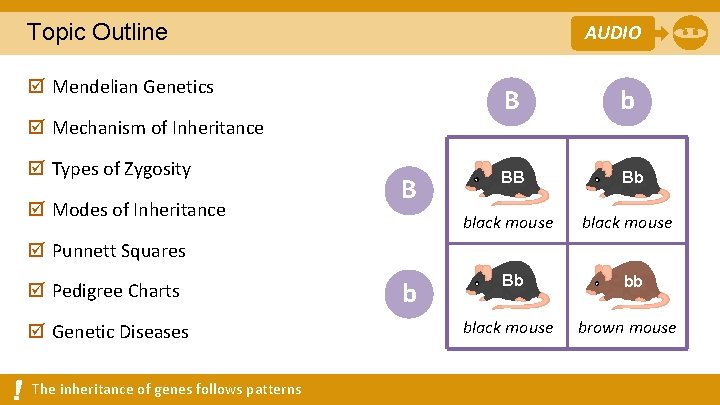
Topic Outline AUDIO þ Mendelian Genetics þ Mechanism of Inheritance þ Types of Zygosity þ Modes of Inheritance B B b BB Bb black mouse þ Punnett Squares þ Pedigree Charts þ Genetic Diseases The inheritance of genes follows patterns b Bb black mouse bb brown mouse
Part 1: PRINCIPLES OF INHERITANCE
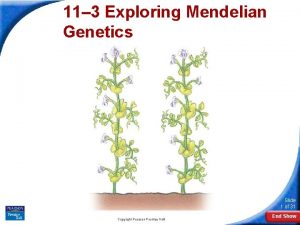
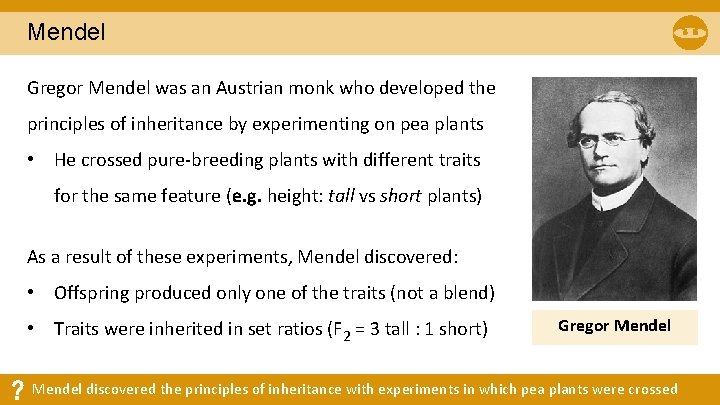
Mendel Gregor Mendel was an Austrian monk who developed the principles of inheritance by experimenting on pea plants • He crossed pure-breeding plants with different traits for the same feature (e. g. height: tall vs short plants) As a result of these experiments, Mendel discovered: • Offspring produced only one of the traits (not a blend) • Traits were inherited in set ratios (F 2 = 3 tall : 1 short) Gregor Mendel discovered the principles of inheritance with experiments in which pea plants were crossed
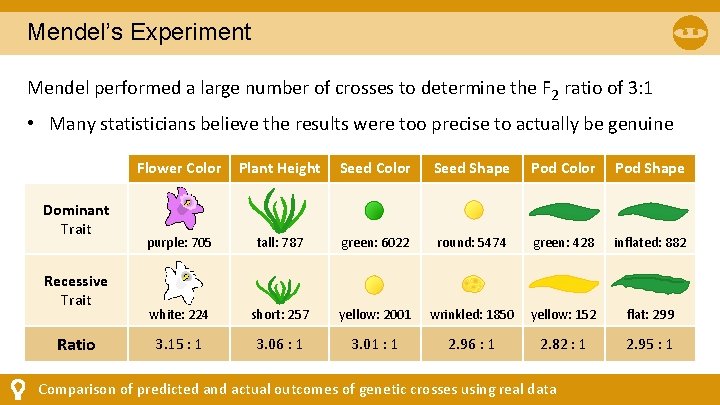
Mendel’s Experiment Mendel performed a large number of crosses to determine the F 2 ratio of 3: 1 • Many statisticians believe the results were too precise to actually be genuine Dominant Trait Recessive Trait Ratio Flower Color Plant Height Seed Color Seed Shape Pod Color Pod Shape purple: 705 tall: 787 green: 6022 round: 5474 green: 428 inflated: 882 white: 224 short: 257 yellow: 2001 wrinkled: 1850 yellow: 152 flat: 299 3. 15 : 1 3. 06 : 1 3. 01 : 1 2. 96 : 1 2. 82 : 1 2. 95 : 1 DNA is replicated before meiosis so that all chromosomes tworeal sister chromatids Comparison of predicted and actual outcomes of genetic consist crosses of using data
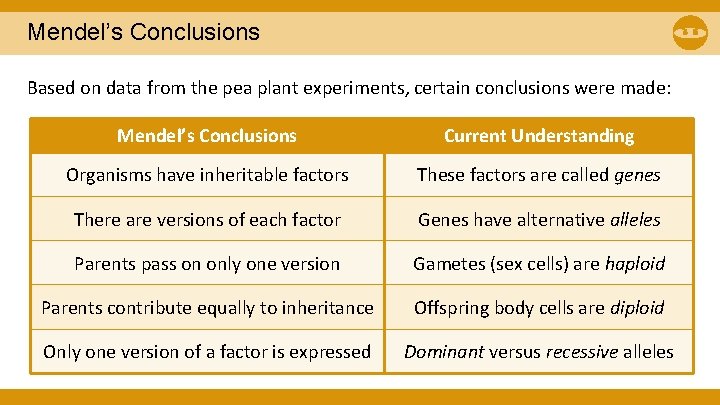
Mendel’s Conclusions Based on data from the pea plant experiments, certain conclusions were made: Mendel’s Conclusions Current Understanding Organisms have inheritable factors These factors are called genes There are versions of each factor Genes have alternative alleles Parents pass on only one version Gametes (sex cells) are haploid Parents contribute equally to inheritance Offspring body cells are diploid Only one version of a factor is expressed Dominant versus recessive alleles
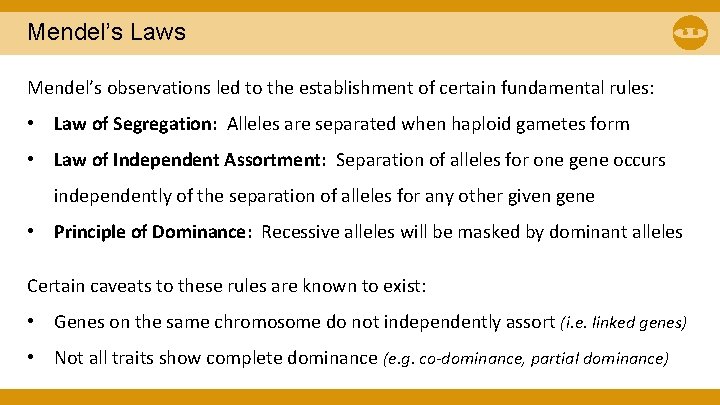
Mendel’s Laws Mendel’s observations led to the establishment of certain fundamental rules: • Law of Segregation: Alleles are separated when haploid gametes form • Law of Independent Assortment: Separation of alleles for one gene occurs independently of the separation of alleles for any other given gene • Principle of Dominance: Recessive alleles will be masked by dominant alleles Certain caveats to these rules are known to exist: • Genes on the same chromosome do not independently assort (i. e. linked genes) • Not all traits show complete dominance (e. g. co-dominance, partial dominance)
Part 2: MECHANISM OF INHERITANCE
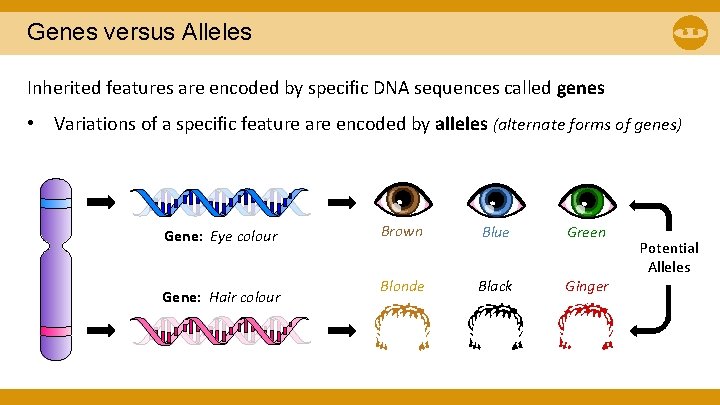
Genes versus Alleles Inherited features are encoded by specific DNA sequences called genes • Variations of a specific feature are encoded by alleles (alternate forms of genes) Gene: Eye colour Gene: Hair colour Brown Blue Green Blonde Black Ginger Potential Alleles
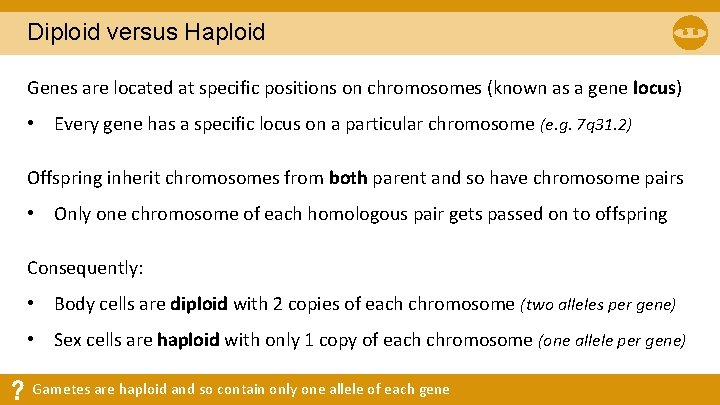
Diploid versus Haploid Genes are located at specific positions on chromosomes (known as a gene locus) • Every gene has a specific locus on a particular chromosome (e. g. 7 q 31. 2) Offspring inherit chromosomes from both parent and so have chromosome pairs • Only one chromosome of each homologous pair gets passed on to offspring Consequently: • Body cells are diploid with 2 copies of each chromosome (two alleles per gene) • Sex cells are haploid with only 1 copy of each chromosome (one allele per gene) Gametes are haploid and so contain only one allele of each gene
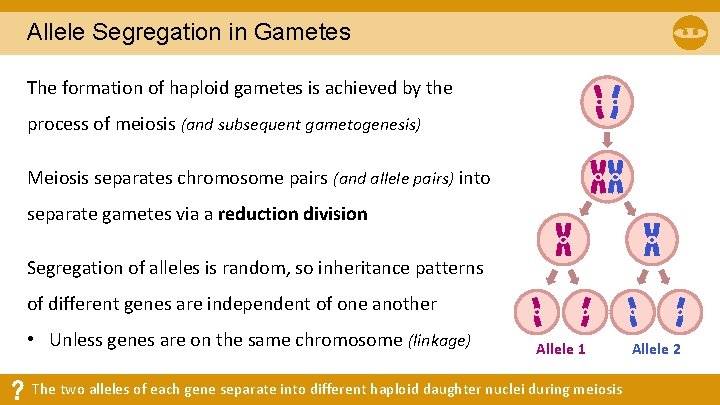
Allele Segregation in Gametes The formation of haploid gametes is achieved by the process of meiosis (and subsequent gametogenesis) Meiosis separates chromosome pairs (and allele pairs) into separate gametes via a reduction division Segregation of alleles is random, so inheritance patterns of different genes are independent of one another • Unless genes are on the same chromosome (linkage) Allele 1 The two alleles of each gene separate into different haploid daughter nuclei during meiosis Allele 2
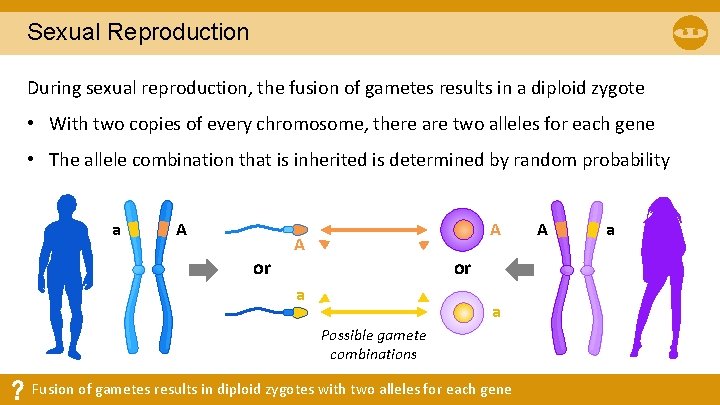
Sexual Reproduction During sexual reproduction, the fusion of gametes results in a diploid zygote • With two copies of every chromosome, there are two alleles for each gene • The allele combination that is inherited is determined by random probability a A A A or or a a Possible gamete combinations Fusion of gametes results in diploid zygotes with two alleles for each gene A a
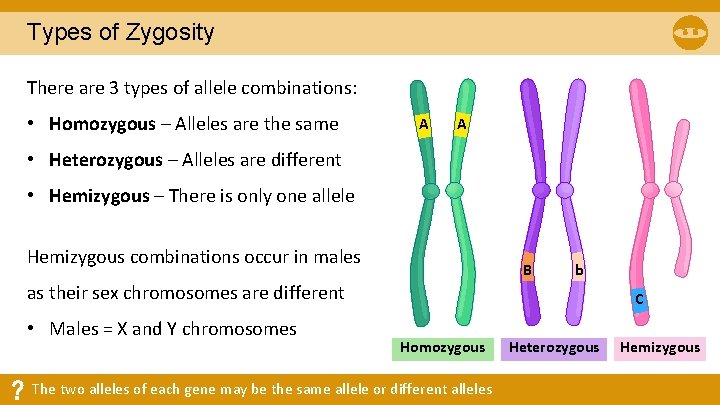
Types of Zygosity There are 3 types of allele combinations: • Homozygous – Alleles are the same A A • Heterozygous – Alleles are different • Hemizygous – There is only one allele Hemizygous combinations occur in males B b as their sex chromosomes are different • Males = X and Y chromosomes C Homozygous The two alleles of each gene may be the same allele or different alleles Heterozygous Hemizygous
Genotype versus Phenotype The allele combination for any given characteristic is called the genotype • Genotypes may be homozygous, heterozygous or hemizygous The physical expression of a given characteristic is called the phenotype • Phenotypes are influenced by the genotype and the environment b b Genotype: bb (homozygous) Phenotype: Blond hair + environment
Part 3: PATTERNS OF INHERITANCE
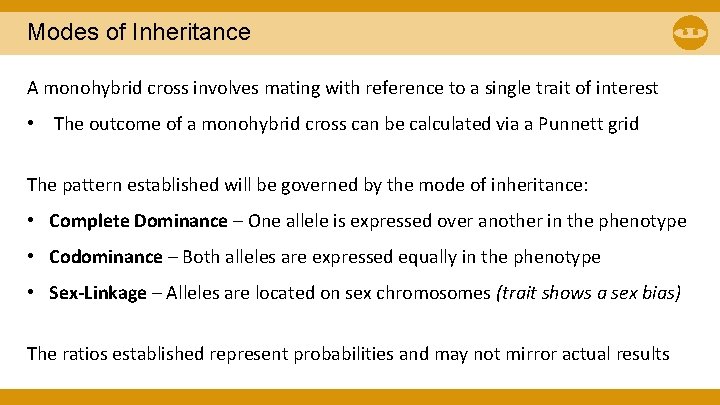
Modes of Inheritance A monohybrid cross involves mating with reference to a single trait of interest • The outcome of a monohybrid cross can be calculated via a Punnett grid The pattern established will be governed by the mode of inheritance: • Complete Dominance – One allele is expressed over another in the phenotype • Codominance – Both alleles are expressed equally in the phenotype • Sex-Linkage – Alleles are located on sex chromosomes (trait shows a sex bias) The ratios established represent probabilities and may not mirror actual results
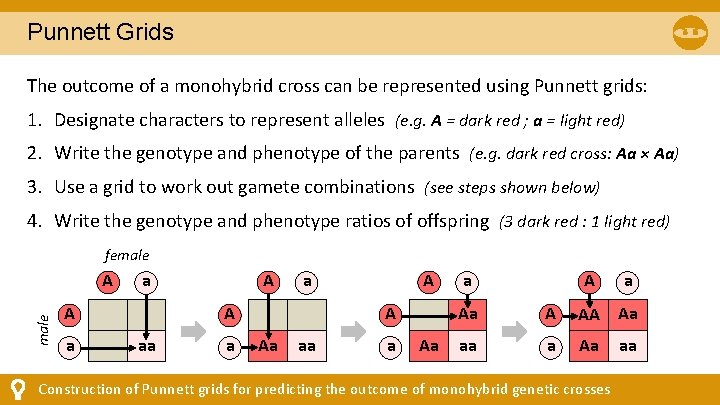
Punnett Grids The outcome of a monohybrid cross can be represented using Punnett grids: 1. Designate characters to represent alleles (e. g. A = dark red ; a = light red) 2. Write the genotype and phenotype of the parents (e. g. dark red cross: Aa × Aa) 3. Use a grid to work out gamete combinations (see steps shown below) 4. Write the genotype and phenotype ratios of offspring (3 dark red : 1 light red) female A a A A aa a Aa A a aa a A AA Aa aa a Aa DNA is replicated before meiosis that all chromosomes of two sister chromatids Construction of Punnett grids forsopredicting the outcome consist of monohybrid genetic crosses aa
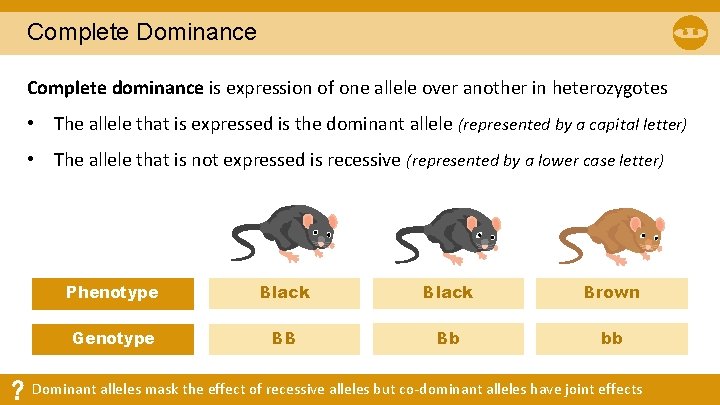
Complete Dominance Complete dominance is expression of one allele over another in heterozygotes • The allele that is expressed is the dominant allele (represented by a capital letter) • The allele that is not expressed is recessive (represented by a lower case letter) Phenotype Black Brown Genotype BB Bb bb Dominant alleles mask the effect of recessive alleles but co-dominant alleles have joint effects
Codominance is when both alleles are expressed equally in heterozygotes • Superscript annotations are used to represent the different codominant alleles Phenotype Black Speckled White Genotype CB CB CB CW CWCW Dominant alleles mask the effect of recessive alleles but co-dominant alleles have joint effects
Codominance: ABO Blood Groups The ABO gene has multiple alleles (three) and demonstrates co-dominance • IA and IB are both co-dominant alleles, while i is a recessive allele Blood Type A B AB O Genotype IA IA or IA i IB IB or IB i IA IB ii Phenotype A B AB O Inheritance of ABO blood groups
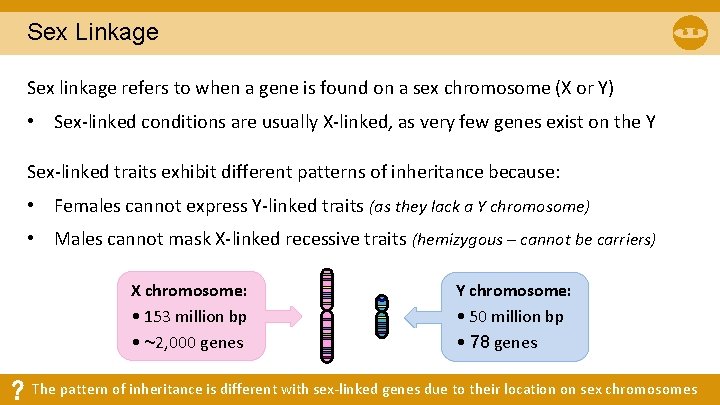
Sex Linkage Sex linkage refers to when a gene is found on a sex chromosome (X or Y) • Sex-linked conditions are usually X-linked, as very few genes exist on the Y Sex-linked traits exhibit different patterns of inheritance because: • Females cannot express Y-linked traits (as they lack a Y chromosome) • Males cannot mask X-linked recessive traits (hemizygous – cannot be carriers) X chromosome: • 153 million bp • ~2, 000 genes Y chromosome: • 50 million bp • 78 genes The pattern of inheritance is different with sex-linked genes due to their location on sex chromosomes
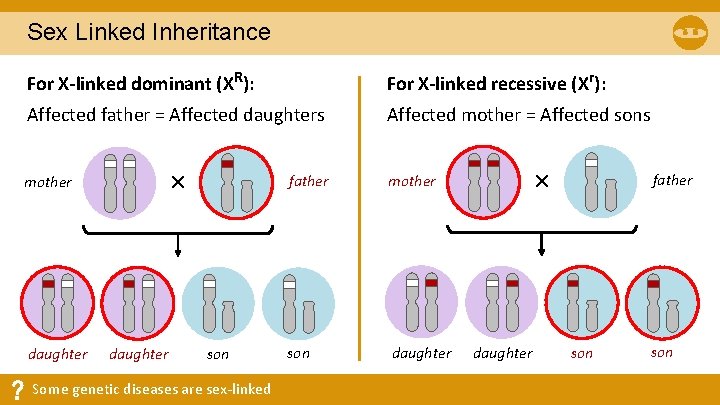
Sex Linked Inheritance For X-linked dominant (XR): For X-linked recessive (Xr): Affected father = Affected daughters Affected mother = Affected sons × mother daughter son Some genetic diseases are sex-linked father mother son daughter × daughter father son
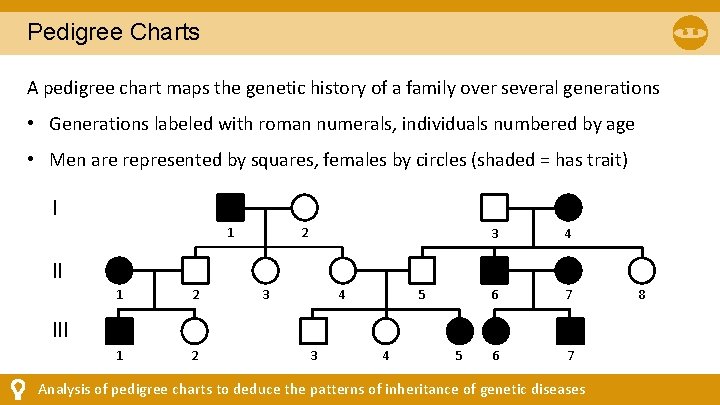
Pedigree Charts A pedigree chart maps the genetic history of a family over several generations • Generations labeled with roman numerals, individuals numbered by age • Men are represented by squares, females by circles (shaded = has trait) I 1 2 3 4 6 7 II 1 2 3 4 5 III 3 4 5 DNA is replicated before meiosis so thatthe allpatterns chromosomes consist of sister chromatids Analysis of pedigree charts to deduce of inheritance oftwo genetic diseases 8
Pedigree Charts: Dominant vs Recessive For Autosomal Dominant Traits: For Autosomal Recessive Traits: If both parents are affected any If neither parent is affected any offspring isn’t, trait is dominant offspring is, trait is recessive * * Could not occur if trait was dominant
Part 4: GENETIC DISEASES
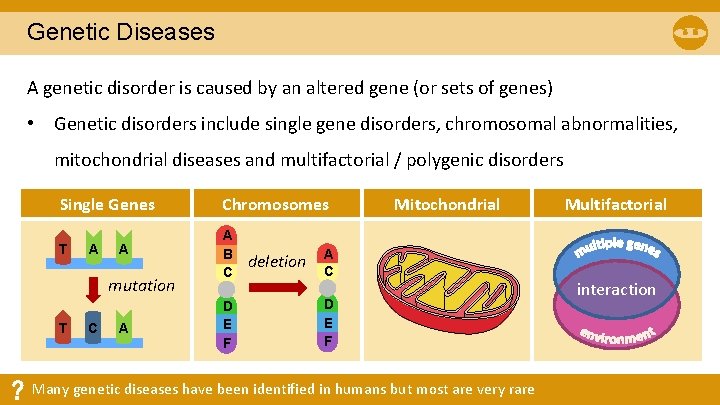
Genetic Diseases A genetic disorder is caused by an altered gene (or sets of genes) • Genetic disorders include single gene disorders, chromosomal abnormalities, mitochondrial diseases and multifactorial / polygenic disorders Single Genes Chromosomes T A B C A A mutation T C A D E F deletion Mitochondrial A C D E F Many genetic diseases have been identified in humans but most are very rare Multifactorial interaction
Single Gene Disorders Single gene disorders occur when a mutation to a single gene alters or abrogates protein function, leading to the development of a disease phenotype Examples of single gene disorders include: • Autosomal Dominant: Huntington’s Disease • Autosomal Recessive: Cystic Fibrosis • Autosomal Co-Dominant: Sickle Cell Anemia • X-Linked Recessive: Hemophilia & Red-Green Color Blindness Many diseases are due to autosomal recessive alleles, some are due to dominant or co-dominant alleles
Genetic Diseases: Huntington’s Disease Huntington’s disease is an autosomal dominant disorder • Caused by a mutation to the HTT gene (chromosome 4) The HTT gene contains a repeating sequence (CAG) • Normally, there a low number of repeats (<25) Normal Brain • More repeats (>40) cause the protein to misfold A misfolded protein will cause neurodegeneration • This often occurs in late adulthood (leads to dementia) Inheritance of cystic fibrosis and Huntington’s disease Huntington’s Brain
Genetic Diseases: Cystic Fibrosis Cystic fibrosis is an autosomal recessive disorder • Caused by a mutation to the CFTR gene (chromosome 7) Individuals with this disorder produce a thick mucus • This mucus clogs the airways and digestive tract and Normal Airway leads to respiratory failure and pancreatic cysts Heterozygous carriers do not display disease symptoms • Presence of normal protein prevents excess mucus Inheritance of cystic fibrosis and Huntington’s disease Cystic Fibrosis
Genetic Diseases: Red-Green Color Blindness Red-green color blindness is an X-linked recessive condition • Therefore it is more commonly found in males (hemizygous – cannot be carriers) • The condition is caused by a mutation in the red-green photoreceptors (on X) Ishihara Test: Click on image to cycle between what normal and colour blind people see Red-green colour blindness and haemophilia as examples of sex-linked inheritance
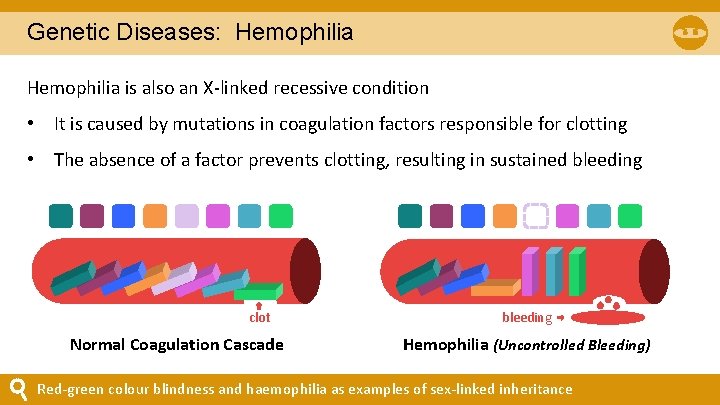
Genetic Diseases: Hemophilia is also an X-linked recessive condition • It is caused by mutations in coagulation factors responsible for clotting • The absence of a factor prevents clotting, resulting in sustained bleeding clot Normal Coagulation Cascade bleeding Hemophilia (Uncontrolled Bleeding) Red-green colour blindness and haemophilia as examples of sex-linked inheritance
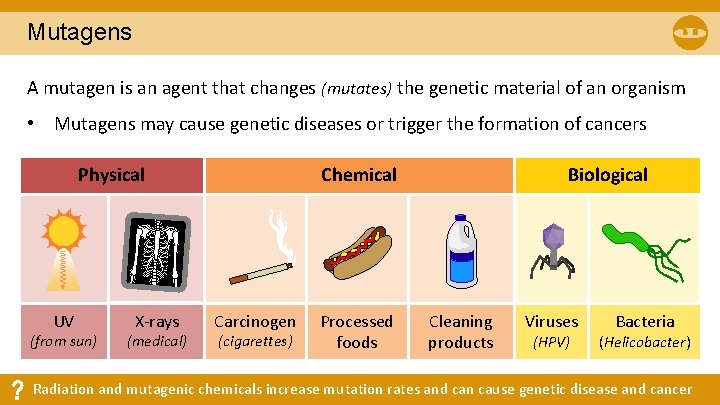
Mutagens A mutagen is an agent that changes (mutates) the genetic material of an organism • Mutagens may cause genetic diseases or trigger the formation of cancers Physical UV (from sun) X-rays (medical) Chemical Carcinogen (cigarettes) Processed foods Biological Cleaning products Viruses (HPV) Bacteria (Helicobacter) Radiation and mutagenic chemicals increase mutation rates and can cause genetic disease and cancer
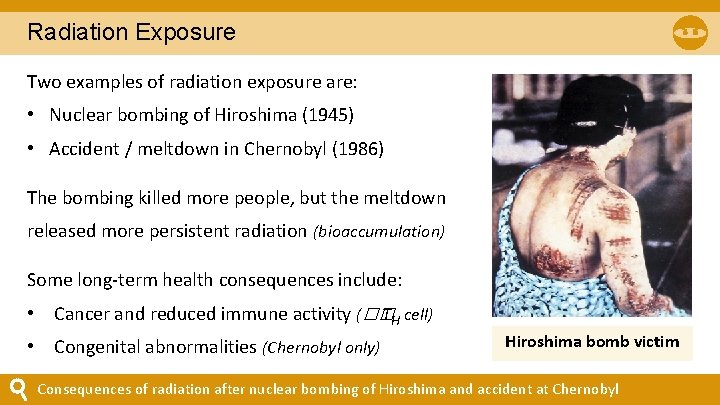
Radiation Exposure Two examples of radiation exposure are: • Nuclear bombing of Hiroshima (1945) • Accident / meltdown in Chernobyl (1986) The bombing killed more people, but the meltdown released more persistent radiation (bioaccumulation) Some long-term health consequences include: • Cancer and reduced immune activity (�� TH cell) • Congenital abnormalities (Chernobyl only) Hiroshima bomb victim Consequences of radiation after nuclear bombing of Hiroshima and accident at Chernobyl
Topic Review Can you do the following? • Define genotype and phenotype • Compare types of zygosity • List different modes of inheritance • Construct Punnett grids • Analyse pedigree charts • Identify types of genetic disease • Describe the role of mutagens in disease