TOLERANCE CULTURE IN JAPANESE SPEECH ACT ANALYSIS OF
- Slides: 8
TOLERANCE CULTURE IN JAPANESE SPEECH ACT ANALYSIS OF ANNOYED EXPRESSION Name: Radhia Elita Affiliation: Prodi Sastra Jepang FIB Universitas Andalas Abstract Code: ABS-ICOLLITE-20244
RESEARCH PURPOSES Describe and explain the cultural characteristics of tolerance Knowing whether in the speech acts of young Japanese, the characteristics of tolerance are still alive or not What kind of tolerance lives in the speech activities of these young people
Ungkapan Tenggang rasa ( hairyo hyougen) oleh : * Yamaoka Masaki : 2010 Culture in Japanese language cannot be separated from the ability to tolerance which is known in Japanese as hairyo in which the expression is named as hairyo hyougen. * Ponfei (2004) can be concluded: The expression of tolerance is: * Give a good impression to the other person: * makes the other person feel good in the mood * keep the other person from misunderstanding * trying well brings joy, comfort to the partner - You can use this PPT background or another background according to your preference (using this PPT background is optional).
METHOD OF THE RESEARCH • This research is a qualitative research by applying descriptive method • Nida (1963: 1) stated that The descriptive analyst must be guided by certain very fixed principles if he is to be objective in describing accurately any language or part of any language.
• • • • Data 1. Nene : おかえり. ( Okaeri ) Junko : ただいま. ( Tadaima ) Junko : ねえ. . 声 外まで 聞こえてるよ. ( Nee. . koe soto made kikoeteru yo ) Mitsuru : あっ. ごめん. ( Aa. Gomen ) (Episode 1, 00: 10: 05 – 00: 11) • This conversation takes place between Junko, Mitsuru (Junko's father) and Nene (his sister), while Junko is heading to his house in an apartment. Junko complained to his family's laughing voice that sounded out. Junko worried that the laughter would disturb his neighbors. Because it also complains with marked sentences: ね え. . 声 外 ま で 聞 こ え て る よ. (Nee. . koe soto made kikoeteru yo hey, the sound of your laughter reached all of you know). The form of hairyo hyougen was found • ねえ ( nee )and 声外まで聞こえてるよ ( koe soto made kikoeru yo)
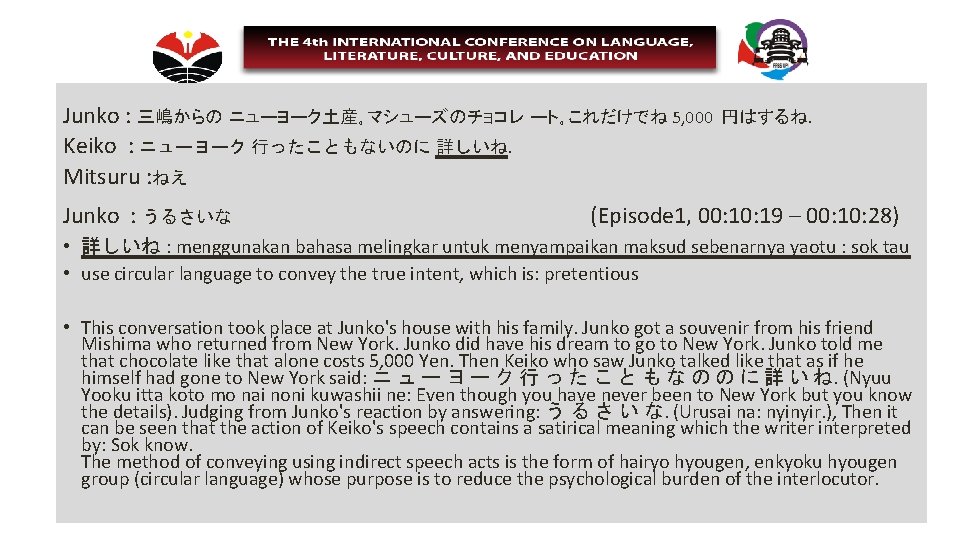
Junko : 三嶋からの ニューヨーク土産。マシューズのチョコレ ート。これだけでね 5, 000 円はするね. Keiko : ニューヨーク 行ったこともないのに 詳しいね. Mitsuru : ねえ Junko : うるさいな (Episode 1, 00: 19 – 00: 10: 28) • 詳しいね : menggunakan bahasa melingkar untuk menyampaikan maksud sebenarnya yaotu : sok tau • use circular language to convey the true intent, which is: pretentious • This conversation took place at Junko's house with his family. Junko got a souvenir from his friend Mishima who returned from New York. Junko did have his dream to go to New York. Junko told me that chocolate like that alone costs 5, 000 Yen. Then Keiko who saw Junko talked like that as if he himself had gone to New York said: ニ ュ ー ヨ ー ク 行 っ た こ と も な の の に 詳 い ね. (Nyuu Yooku itta koto mo nai noni kuwashii ne: Even though you have never been to New York but you know the details). Judging from Junko's reaction by answering: う る さ い な. (Urusai na: nyinyir. ), Then it can be seen that the action of Keiko's speech contains a satirical meaning which the writer interpreted by: Sok know. The method of conveying using indirect speech acts is the form of hairyo hyougen, enkyoku hyougen group (circular language) whose purpose is to reduce the psychological burden of the interlocutor.
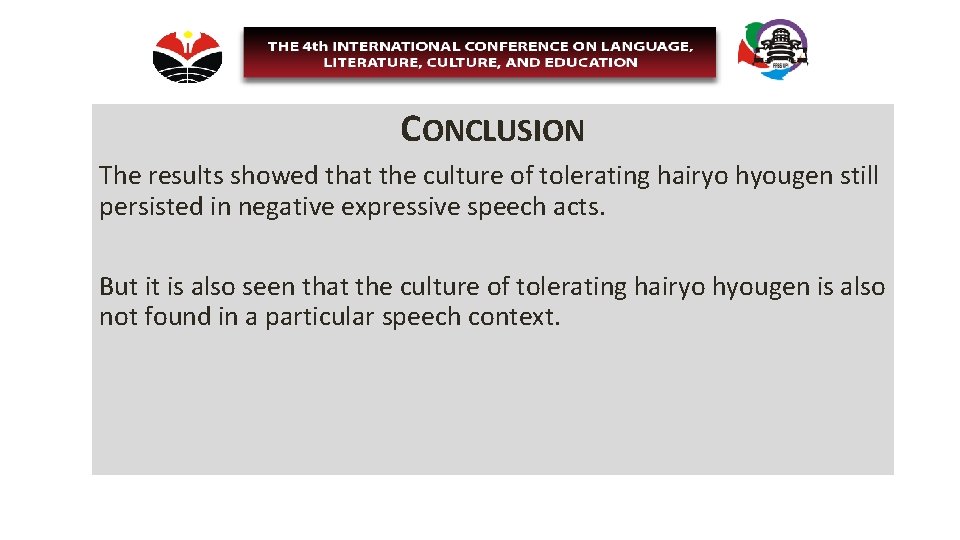
CONCLUSION The results showed that the culture of tolerating hairyo hyougen still persisted in negative expressive speech acts. But it is also seen that the culture of tolerating hairyo hyougen is also not found in a particular speech context.
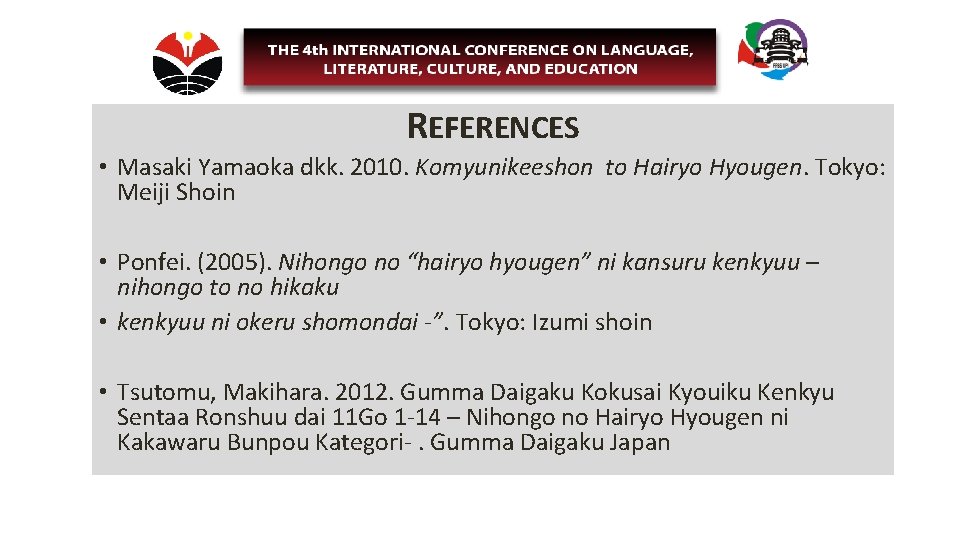
REFERENCES • Masaki Yamaoka dkk. 2010. Komyunikeeshon to Hairyo Hyougen. Tokyo: Meiji Shoin • Ponfei. (2005). Nihongo no “hairyo hyougen” ni kansuru kenkyuu – nihongo to no hikaku • kenkyuu ni okeru shomondai -”. Tokyo: Izumi shoin • Tsutomu, Makihara. 2012. Gumma Daigaku Kokusai Kyouiku Kenkyu Sentaa Ronshuu dai 11 Go 1 -14 – Nihongo no Hairyo Hyougen ni Kakawaru Bunpou Kategori-. Gumma Daigaku Japan