
Objective Explain how the ideas from the Enlightenment

Objective: Explain how the ideas from the Enlightenment impacted social, political, and economic systems and institutions. (Explain how the ideas from the Enlightenment changed government systems-Absolute Monarchy to Democracy) Political Thinkers
» The works of Locke and Hobbes set the stage for later development. » During the 1700 s in France, Voltaire, Rousseau, Montesquieu, Diderot, Beccaria, and Wollstonecraft carried the ideas of new government structures further. » Although these men shared a desire to reform society, they differed in their views of what needed to be done. » In France, Enlightenment thinkers were called philosophes, or philosophers. French Thinkers

Part 1 Voltaire
» Published essays, plays, and works of fiction that reflected Enlightenment ideals » Believed in religious toleration and deism » Deism is the belief that God made the universe and left it to be ruled by natural law » Seeking social and political reform, Voltaire often used humor to attack the laws and customs of France Voltaire
» His targets were the Roman Catholic Church, the powerful aristocracy, and the monarchy. » Often, Voltaire disguised his criticism in works of fiction. » Not surprisingly, his writings got him in trouble with the government. » During the course of his career, Voltaire was imprisoned in the Bastille and exiled from his native France for many years. Voltaire
» » » Tolerance Reason Freedom of religious belief Freedom of speech “I do not agree with a word you say but will defend to the death your right to say it” Voltaire
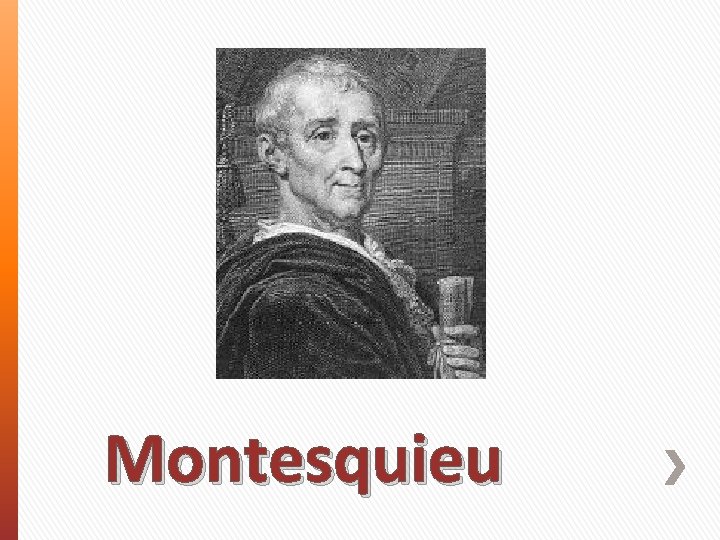
Montesquieu
» Studied governments of ancient Rome and closely examined the contemporary governments of France and England » Concluded England had the best government because it balanced the powers of competing groups in society » The English government divided power among three branches: legislative, executive, and judicial. » Separation of Powers Montesquieu
» Each branch had control the others through a system of checks and balances. » Asserted a government with divided powers was a government of limited powers. » A government of limited powers was less likely to violate the natural rights of its citizens. » Later became basis for United States Constitution Montesquieu
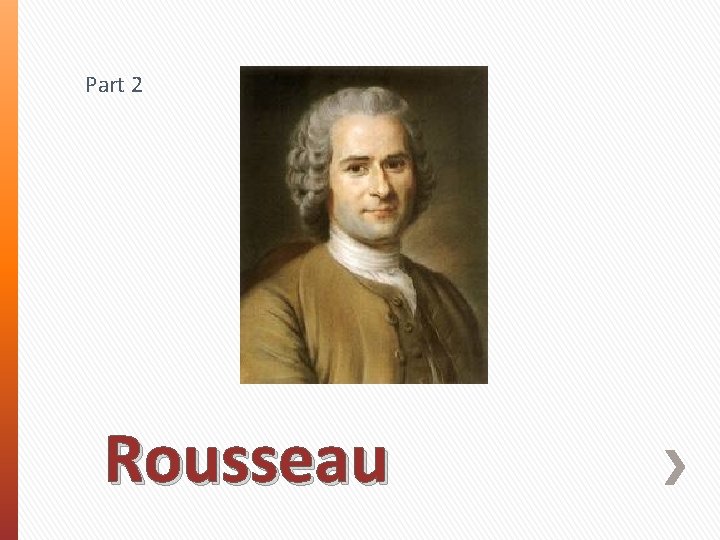
Part 2 Rousseau
» Individual Freedom » Civilization corrupted peoples’ natural goodness » “Man is born free, and everywhere he is in chains. ” » Only good government was one freely formed by the people and guided by the ‘general will’ of society—a direct democracy » Under such a government, people agree to give up some of their freedom in favor of the common good Rousseau

» Social Contract: it was an agreement among free individuals to create a society and a government » Legitimate government came from the consent of the governed (Like Locke) » Inspired many leaders of the French Revolution Rousseau
Diderot

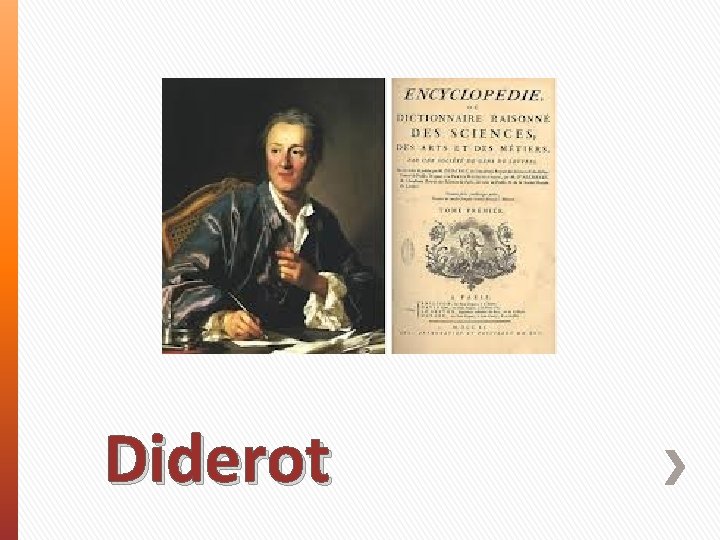
» Helped spread Enlightenment ideas throughout Europe and the American colonies with his multivolume Encyclopedia » The Encyclopedia included articles written by scholars, philosophers, and scientists. » Hoped this huge work would summarize all theoretical and actual knowledge Diderot

» Goal in editing the Encyclopedia was to change the way people thought » Many articles criticized the Roman Catholic Church and supported religious toleration (freedom) » Other articles advanced the Enlightenment idea of social reform Diderot

» The Roman Catholic Church and the French government condemned the Encyclopedia and tried to censor it » The church did not like challenges to its authority » The monarchy did not like radical new ideas about government and the rights of the governed (people or citizens) » Even so, approximately 20, 000 copies of the Encyclopedia (a very large number for that time) were printed and distributed Diderot
Beccaria
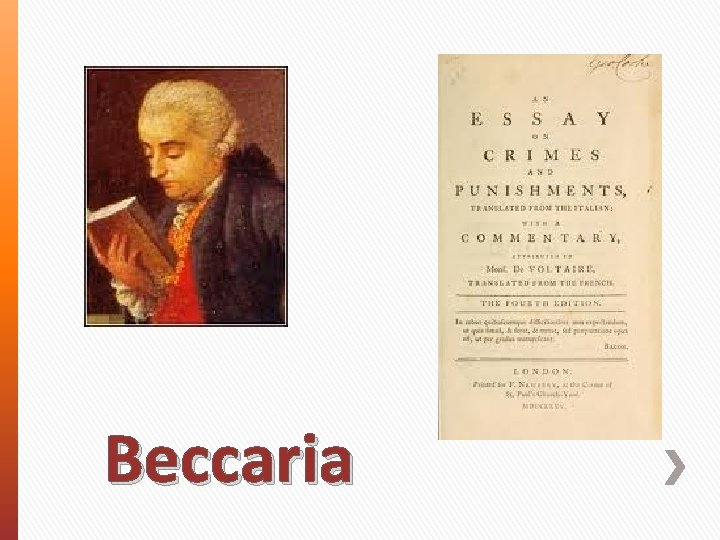
» Promotes criminal justice » Italian » Believed laws existed to preserve social order, not to avenge crimes » Regularly criticized common abuses of justice » Including: torturing witnesses and suspects, irregular proceedings in trials, and punishments that were arbitrary or cruel Beccaria
» Argued that a person accused of a crime should receive a speedy trial, and that torture should never be used » The degree of punishment should be based on the seriousness of the crime » Believed capital punishment should be abolished Beccaria

» Beccaria based his ideas about justice on the principle that governments should seek the greatest good for the greatest number of people » His ideas influenced criminal law reformers in Europe and North America » 8 th Amendment-outlaws unusual and cruel punishment Beccaria
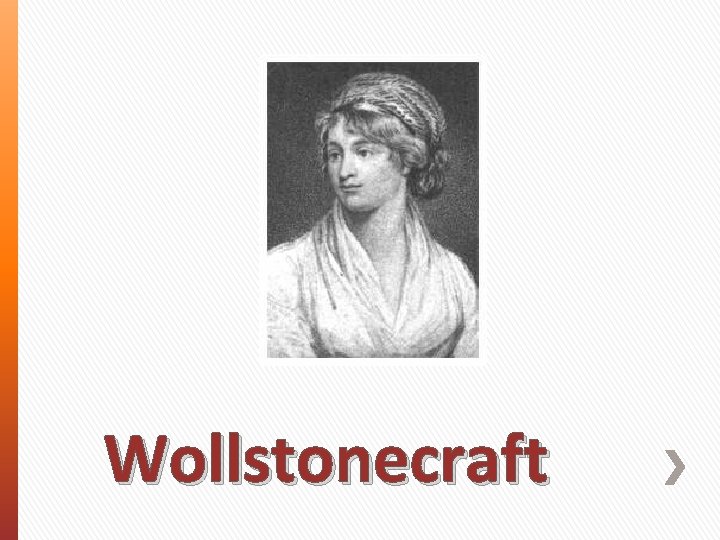
Wollstonecraft
» Philosophes or philosophers (Enlightenment thinkers) often took traditional view of women » Rousseau, for example, developed many progressive ideas about education » However, he believed that a girl’s education should mainly teach her how to be a helpful wife and mother » Other male social critics scolded women for reading novels because they thought it encourage idleness and wickedness » Still, some male writers argued for more education for women and for women’s equality in marriage Wollstonecraft
» Disagreed with Rousseau that women’s education should be secondary to men’s » Need education to become virtuous (moral) and useful » Urged women to enter the male-dominated fields of medicine and politics Wollstonecraft

» Other women made important contributions to the Enlightenment in other ways: In Paris and other European cities, wealthy women helped spread Enlightenment ideas through social gatherings called salons Wollstonecraft
» Belief in Progress-new discoveries in science, human reason could solve social problems, reformers urged an end to slavery and argued for greater social equality, as well as a more democratic style of government Legacy of the Enlightenment
» A more secular outlook-non-religious » People began to question openly their religious beliefs and the teachings of the church Legacy of the Enlightenment
» Importance of the Individual-the rise of individualism » Looked to themselves for guidance » Use your own ability to reason in order to judge what was right or wrong » Emphasized the importance of the individual in society » Government, they argued, was formed by individuals to promote their welfare Legacy of the Enlightenment
- Slides: 27